How to File Your Income Tax Return in Pakistan
File your income tax return on FBR IRIS by 30 September. See who must file, the due dates, the late penalty and the Rs 25,000 ATL surcharge.
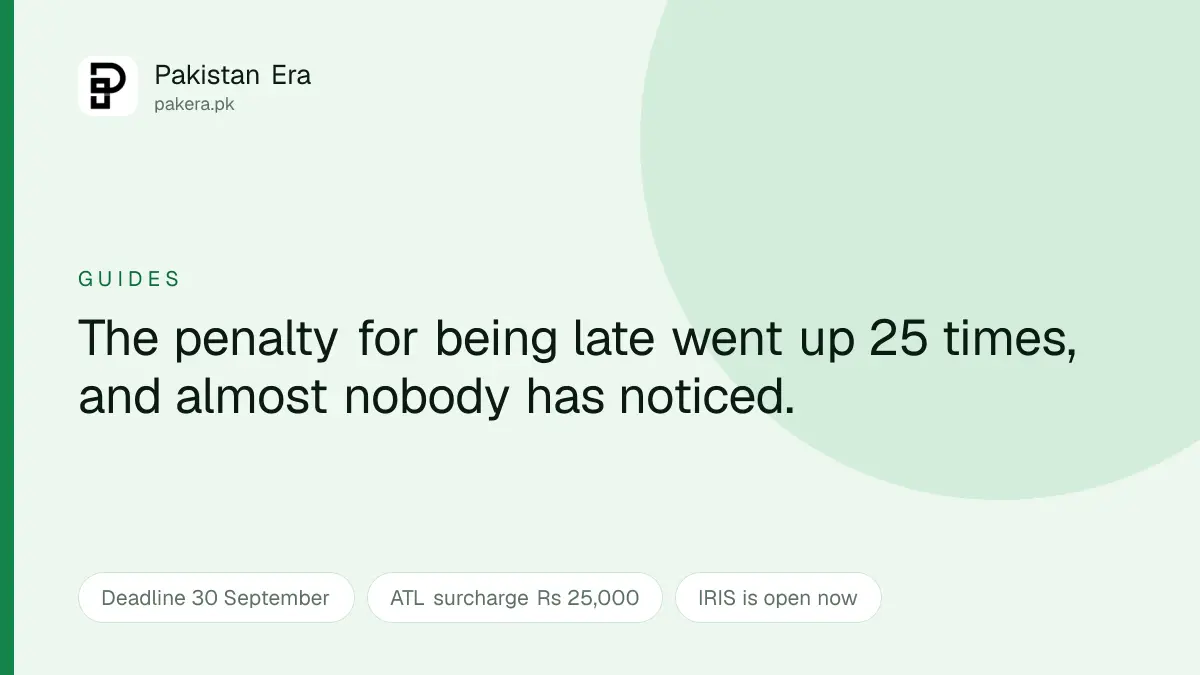
Short answer: File your income tax return online on FBR's IRIS portal at iris.fbr.gov.pk, or in the Tax Asaan app, with your CNIC as your NTN. Individuals and associations of persons must file by 30 September after the tax year ends on 30 June. If you miss it, you stay off the Active Taxpayers List (ATL) until you file and pay a surcharge of Rs 25,000 as an individual.
We read the filing rules in the Income Tax Ordinance, 2001, as amended up to 30 June 2026, on FBR's website on 8 November 2026. The steps, the dates and the late filing costs below come from that text. This is a plain reading of the law, not tax advice.
Who must file a return
Section 114 sets the tests. Meeting any one of them means you must file, even if your employer already deducted all your tax. Deduction is payment. Only filing puts your name on the ATL.
| Test in section 114 | What it means |
|---|---|
| Taxable income above the tax-free amount | For an individual, taxable income above Rs 600,000 in the year |
| Every company and every non-profit organisation | Must file every year, whatever the income, even with a tax exemption such as an STZA zone licence |
| Charged to tax in either of the two previous tax years | Must file again this year |
| Holds an NTN | Must file every year from then on |
| Owns a motor vehicle | Engine above 1000cc |
| Owns property in a rating area | Land of 500 square yards or more, or a flat of 2,000 square feet or more |
| Commercial or industrial electricity | Annual bill above Rs 500,000 |
| Member of a chamber, trade body or professional council | Such as the Pakistan Bar Council, PMDC, PEC or ICAP, if resident |
| Must file a foreign income and assets statement | A resident individual with foreign income or assets |
The NTN test catches many people. If you registered years ago for a job or a property deal, the duty to file did not stop. Our guide to who must file an income tax return takes each test in more detail, and you can check your filer status by SMS in a minute.
The due dates in section 118
The tax year runs from 1 July to 30 June. Tax Year 2026, for example, covers income from 1 July 2025 to 30 June 2026. The return for it is due after the year ends, not during it.
| Who files | Due date in the law |
|---|---|
| Salaried individual | 30 September after the tax year |
| Other individuals and associations of persons | 30 September after the tax year |
| Company with a year ending between 1 January and 30 June | 31 December after the tax year |
| Any other company | 30 September after the tax year |
FBR can extend the date for everyone under section 214A, and a Commissioner can extend it for one person under section 119. Do not plan around an extension. If one is given, it appears as an FBR announcement, and the extended date then counts as the due date.
How to file on IRIS, step by step
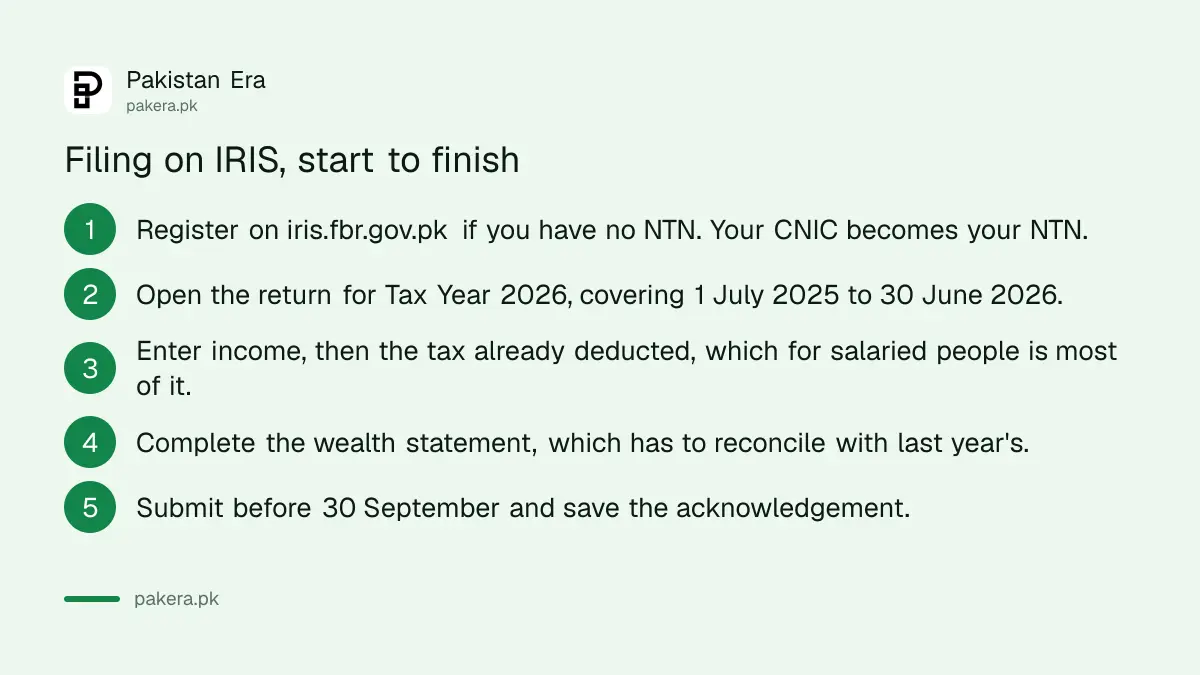
Section 118 says a salaried individual files electronically. Most people file on IRIS. Salaried people with simple income can also use the FBR Tax Asaan app.
- Register if you have no NTN. For an individual, the 13 digit CNIC is the NTN. A firm or company gets its own 7 digit NTN, as set out in getting an NTN for a partnership or company.
- Open the return for the right tax year. Check the year at the top of the form before you type anything.
- Enter your income, then the tax already deducted. Your salary certificate and bank tax certificates have the figures. Claim only tax that was actually deposited, because an excess claim now carries a penalty, as we explain in claiming only the withholding tax FBR can see.
- Complete the wealth statement. Assets at the start of the year, plus income, minus spending, should equal assets at the end. Explain any gap.
- Submit and save the acknowledgement. Then confirm it went through, as shown in checking your return was filed on IRIS.
If you earn from YouTube or other foreign platforms, you declare that income here too. The US form Google asks for is a separate step, covered in submitting US tax info for YouTube. If you find a mistake after filing, you can revise the return under section 114(6).
What filing late costs you
Two separate costs apply. The first is the late filing penalty in entry 1 of the section 182 table. The second is the section 182A surcharge you pay to get back on the ATL.
| Cost | What the Ordinance says |
|---|---|
| Late filing penalty | The higher of 0.1% of tax payable for each day of default, or Rs 1,000 a day |
| Minimum penalty | Rs 10,000 for an individual with 75% or more income from salary, Rs 50,000 for others |
| Maximum penalty | 200% of the tax payable for the year |
| Reduction for filing soon | 75%, 50% or 25% off if filed within one, two or three months of the due date |
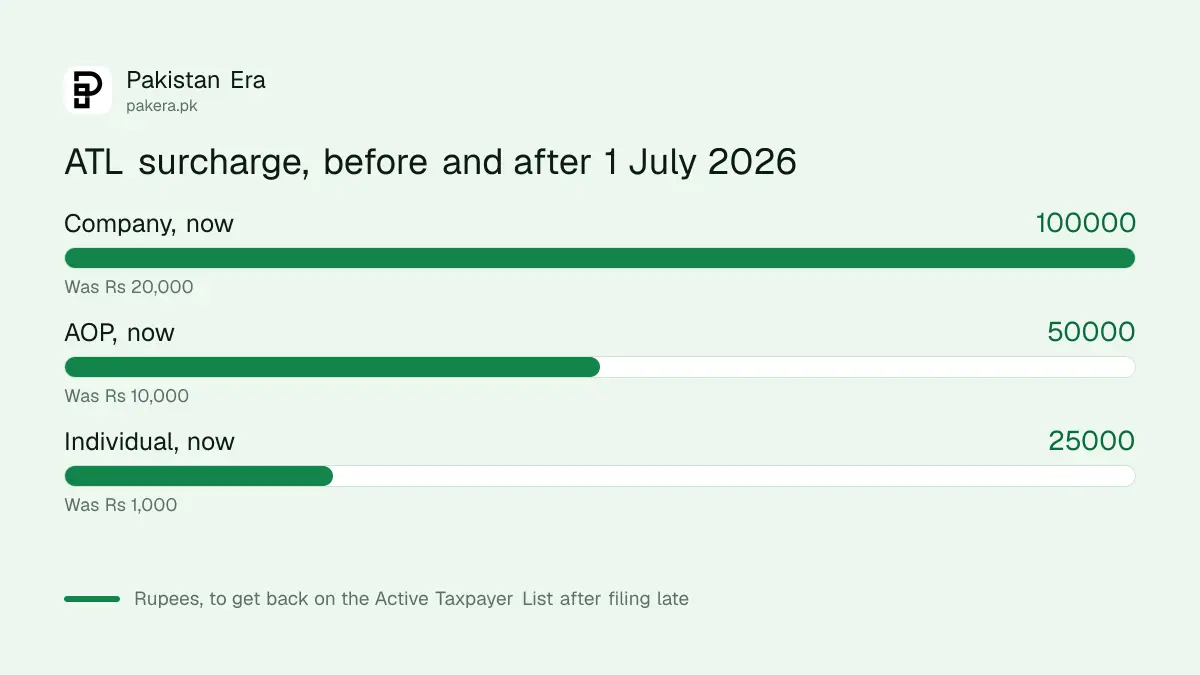
| ATL surcharge, individual | Rs 25,000, up from Rs 1,000 by the Finance Act 2026 |
| ATL surcharge, association of persons | Rs 50,000, up from Rs 10,000 |
| ATL surcharge, company | Rs 100,000, up from Rs 20,000 |
Section 182(2) says no penalty is payable unless an officer passes a written order after giving you a chance to be heard. The surcharge works differently. You file the late return and pay it, and only then are you put back on the list.
Being off the list has more effects. Under section 182A you cannot carry forward a business loss for that year, you get no refund while you are off the list, and that time does not count towards extra payment for a delayed refund. Our page on filing after the deadline covers the late steps.
An individual can skip the surcharge with an undertaking
Section 182A(3) gives individuals another way back. The surcharge does not apply to an individual who gives the Commissioner an undertaking not to buy or acquire any property, or any interest in property, for six months from the date of the undertaking.
The undertaking must be in the form FBR prescribes. FBR published a draft of that form, which we cover in Form ATL-U for late filers. The late filing penalty still applies, so this only removes the surcharge.
What being on the ATL is worth
Filers pay lower withholding tax than non-filers on many everyday deals. These include bank cash withdrawals, buying and selling property, registering a car and buying at an FBR auction, where section 236A advance tax applies, as noted in checking an FBR e-auction notice. On one property or car deal, the difference can be larger than the tax in your whole return.
The filer and non-filer rates for 2026-27 lists each extra charge. Our salary tax calculator shows what your employer should have deducted, which helps you spot a mistake before you file.
Common questions
What is the last date to file an income tax return in Pakistan?
30 September after the tax year ends, for individuals and associations of persons. A company whose year ends between 1 January and 30 June has until 31 December. FBR can extend the date.
How much is the ATL surcharge?
Rs 25,000 for an individual, Rs 50,000 for an association of persons and Rs 100,000 for a company, under section 182A as amended by the Finance Act 2026.
Does paying the surcharge alone put me back on the list?
No. You must file the late return as well. The surcharge is paid with a return filed after the due date.
What is the penalty for filing late?
The higher of 0.1% of tax payable a day or Rs 1,000 a day, with a minimum of Rs 10,000 for mostly salaried individuals and Rs 50,000 for others. It is cut by 75%, 50% or 25% if you file within one, two or three months.
Do I have to file if my employer deducted my tax?
Yes, if you meet any test in section 114, such as taxable income above Rs 600,000 or holding an NTN. Deduction at source does not put you on the ATL.
Can I avoid the Rs 25,000 surcharge?
An individual can, by giving an undertaking not to buy property for six months, under section 182A(3). The penalty for late filing still applies.
How we verified this
What we checked, where we read it, and what we could not confirm.
Last checked 8 November 2026. We read sections 114, 118, 182 (entry 1 and sub-section 2) and 182A of the Income Tax Ordinance, 2001, as amended up to 30 June 2026, listed on FBR's Income Tax Ordinance page. Filing is done at iris.fbr.gov.pk. We did not file a return for this guide, and we did not read any FBR extension notice.
About the author

Senior Writer, Public Services and Technology
Shahid joined us in 2024 as an author. He is a senior contributor to Pakistan's leading technology websites. He writes detailed articles, mostly covering his expertise in the latest tech, mobiles, apps, gadgets, and step-by-step guides. His ideology is to help people understand the latest trends and explain complex methods through very easy-to-understand guides.