Get a Workers Welfare Scholarship for Your Child in Punjab
PWWF pays fees and a stipend for a Punjab worker's child at college or university. See the 2026 rates, private fee caps, who qualifies and how to apply online.

The Punjab Workers Welfare Fund (PWWF) pays the college or university fees of a registered worker's child, plus a stipend of Rs 3,500 a month at intermediate level and Rs 5,000 a month after that. Apply on mis.pwwf.punjab.gov.pk within one year of admission.
Many factory workers in Punjab pay full fees for a child at university without knowing this exists. PWWF calls it the Talent Scholarship. At a public college or university, it pays the fees as charged. At a private one, it pays up to a cap that runs from Rs 100,000 a year for intermediate to Rs 200,000 a semester for engineering.
We read the scholarship rules in force from 1 February 2026, the fee cap notification of 29 August 2025 and its February 2026 change, and the PWWF portal guide on 2 October 2026.
What the PWWF scholarship pays in Punjab
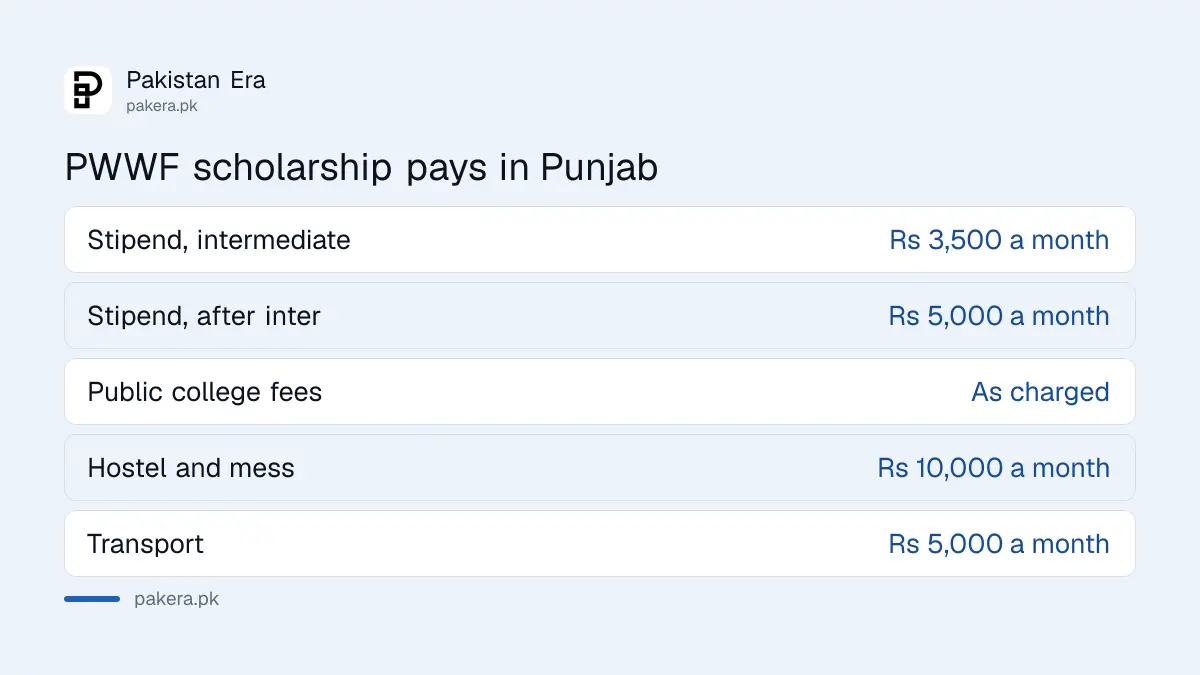
PWWF pays tuition, admission, exam, registration, library, lab and computer fees, plus a monthly stipend. Students away from home can get Rs 10,000 a month for hostel and mess, and day scholars Rs 5,000 a month for transport.
| Item | Amount | Condition |
|---|---|---|
| Stipend, intermediate | Rs 3,500 a month | Children of workers only |
| Stipend, after intermediate | Rs 5,000 a month | Graduation and post-graduation |
| Fees, public institution | As charged | Paid vouchers needed |
| Fees, private institution | Up to the cap below | Admissions after 1 September 2025 |
| Hostel and mess | Rs 10,000 a month | Institution outside the home district |
| Transport | Rs 5,000 a month | Day scholars only |
You get hostel money or transport money, not both. Hostel money is not paid for intermediate students at private colleges. Neither is paid for MS, MPhil or PhD, or for weekend and distance learning courses.
Transport changed in February 2026. It is now paid when the institution is in the student's home district, the district where the factory is, or a district next to either.
Private university fee caps under the PWWF scholarship
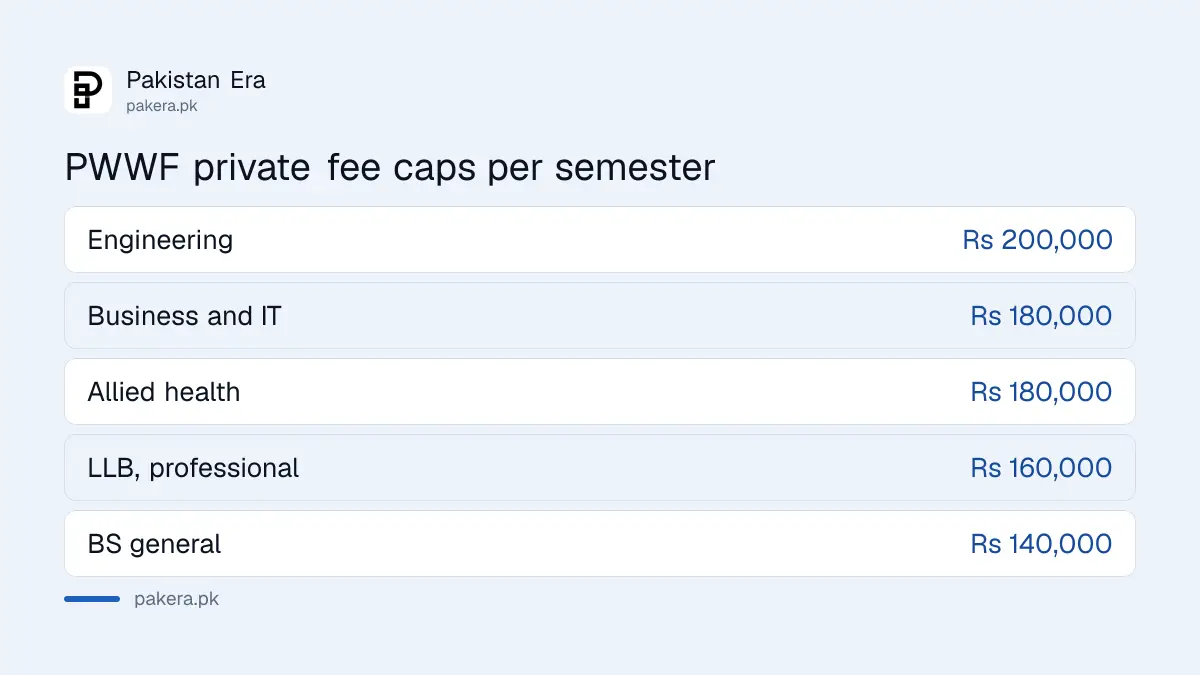
For admissions after 1 September 2025, PWWF pays private fees as charged or up to a cap, whichever is lower. The cap is Rs 200,000 a semester for engineering and Rs 180,000 for business, IT and allied health degrees.
| Programme | Most PWWF pays |
|---|---|
| Intermediate, A-level and equivalent | Rs 100,000 a year |
| Associate degree and 14-year education | Rs 120,000 a year |
| Engineering (PEC accredited), architecture | Rs 200,000 a semester |
| Business, IT, pharmacy, DPT, nursing and allied health | Rs 180,000 a semester |
| LLB and other professional degrees | Rs 160,000 a semester |
| BS maths, physics, chemistry, English and similar | Rs 140,000 a semester |
| MS, MPhil, MBA, LLM | Rs 180,000 a semester |
The cap notice leaves out five top institutions by name: LUMS, FAST-NUCES, GIKI, LSE and IBA Karachi. It does not say what PWWF pays for them, so ask the fund before you commit. MBBS and BDS fees are paid as charged. A course that runs by year gets double the semester cap.
Who can get a workers welfare scholarship
The parent must be a worker in a registered factory or mine in Punjab, on EOBI or PESSI with nine of the last twelve months paid. One year of service is enough up to intermediate. After intermediate, three years are needed.
- The parent is a "workman" under the Punjab Industrial Relations Act 2010.
- The factory is working and listed in the Directorate General of Labour Welfare database, or the mine pays its PWWF contribution.
- The parent has at least nine months of EOBI or PESSI contributions in the last twelve.
- The student has a registration number from the board or university. It is compulsory.
- There is no age limit for the child.
The rules also cover children of a worker who died in service, once the family has claimed the Rs 1 million workers death grant. Children of retired workers are covered in the worker's lifetime, and so are children of workers laid off after a certified disability.
A worker can also study on the scheme. The course must relate to the job, the employer must give a no objection certificate, and the age limit for admission is 40. Workers do not get the stipend.
If the worker has no PESSI record, fix that first. Getting a PESSI social security card is also what lets the portal recognise the CNIC.
How to apply for the PWWF scholarship
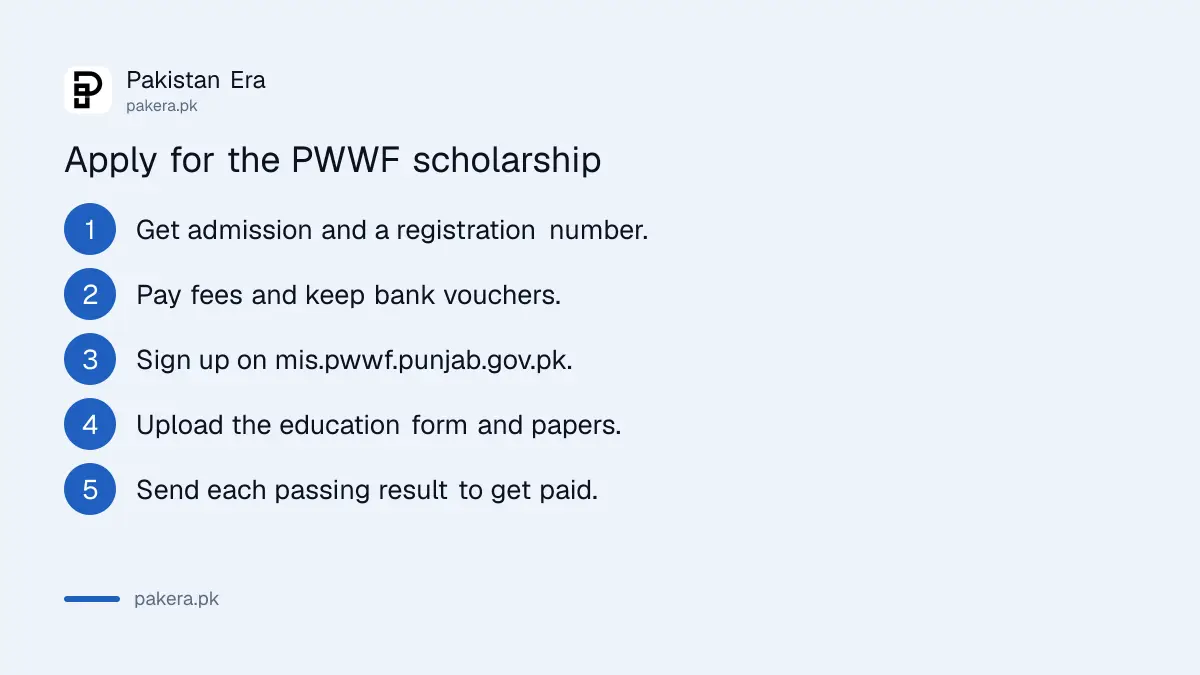
Sign up on the PWWF portal with the worker's CNIC, then fill the education form and upload the papers. The claim must be made within one year of the student's registration, and money is released after each passing result.
- Get admission and a registration number. The board or university issues it. No number, no scholarship.
- Pay the fee and keep the bank vouchers. PWWF repays against paid vouchers or online payment receipts. For admissions after 9 January 2025, it no longer pays fees direct to the institution.
- Sign up at mis.pwwf.punjab.gov.pk. The worker's CNIC is checked against PESSI records. Confirm the codes sent to the mobile and email.
- Fill the education form and upload papers. See the list below.
- Send each new result. The stipend and fees for a year or semester are paid after the passing result for it, attested by a gazetted officer.
The papers are the CNICs of the worker and the student (or the student's B-Form), the NADRA family registration certificate, the worker's PESSI or EOBI card, an employment certificate and an admission form on the PWWF specimen, the paid vouchers, the registration number, a cheque leaf with an IBAN, and an affidavit on a Rs 100 e-stamp.
Deadlines and rules that stop payment
Apply within one year of registration. The PWWF Secretary can accept up to six months more with a written reason. No claim is accepted after the course ends, and PWWF will not fund a second degree at the same level.
Failing one subject in a year does not stop that year's claim, except in the final year or semester. The withheld money can be claimed once the student passes the next exam. A student who drops out and starts again at another institution at the same level loses the funding.
For school, PWWF runs its own Workers Welfare Schools, 65 of them working in 20 districts, with free books, uniform and transport. Children of workers should try those first. Families who do not qualify can look at the PEEF scholarship in Punjab.
In Islamabad, the federal Workers Welfare Fund runs a similar scheme for children of workers at Islamabad-based industries. Its page lists stipends of Rs 3,500, Rs 4,500 and Rs 5,500 a month for intermediate, graduation and post-graduation.
Common questions
How much is the PWWF scholarship stipend?
Rs 3,500 a month at intermediate level and Rs 5,000 a month after intermediate, on top of fees.
Does PWWF pay fees at private universities?
Yes, up to a cap that depends on the degree, from Rs 140,000 to Rs 200,000 a semester for most bachelor's programmes.
How many years must the parent have worked?
One year for education up to intermediate, and three years for anything after intermediate.
Can we apply after the first year of a degree?
Only within one year of the student's registration, or up to six months later if the Secretary accepts your reason.
Is there an age limit for the student?
No, not for a worker's child. A worker who studies on the scheme must be 40 or under at admission.
How we verified this
What we checked, where we read it, and what we could not confirm.
Last checked 2 October 2026. We read the welfare grant rules of 3 February 2026, the fee cap notification of 29 August 2025, its amendment of 4 February 2026, the rule changes of 29 August 2025 and the scholarship notice of 2 May 2025, all on the PWWF public notices page. We read the school figures on the PWWF education page and the federal fund's scholarship pages on wwf.gov.pk. The PWWF welfare page says no service limit applies at intermediate level, while the 2026 rules ask for one year. We follow the newer rules. Parts of the 2026 rules are scanned, and we quote only lines we could read clearly.
About the author

Senior Writer, Public Services and Technology
Shahid joined us in 2024 as an author. He is a senior contributor to Pakistan's leading technology websites. He writes detailed articles, mostly covering his expertise in the latest tech, mobiles, apps, gadgets, and step-by-step guides. His ideology is to help people understand the latest trends and explain complex methods through very easy-to-understand guides.