Get Your SNGPL Gas Bill by Email or SMS and Estimate It Before It Arrives
Stop missing SNGPL gas bills. How to sign up for the paperless bill and SMS alerts, what the form asks for, and how the bill estimator works. Set it up today.
SNGPL lets you switch to a paperless gas bill by email and get billing information by SMS, free, through a form on sngpl.com.pk. You need your consumer number, CNIC, the CNIC issue date, a mobile number and an email address. A separate bill estimator lets you work out a bill from your meter readings.
Winter is when gas bills jump and paper bills go missing. We opened both SNGPL pages on 8 October 2026 and read what they ask for. We did not submit either form.
The sign up form is on the Consumer Services menu
On sngpl.com.pk, open Customer Services, then Consumer Services, then "Register - Email Bill / SMS Alert". The page is titled "Subscription for Delivery of Gas Bill through Email / SMS". It is for SNGPL customers only, not for SSGC.
The form first asks whether you are the owner of the premises. Choose yes or no. If you choose no, you then pick tenant or other, and the form asks for the owner's details too.
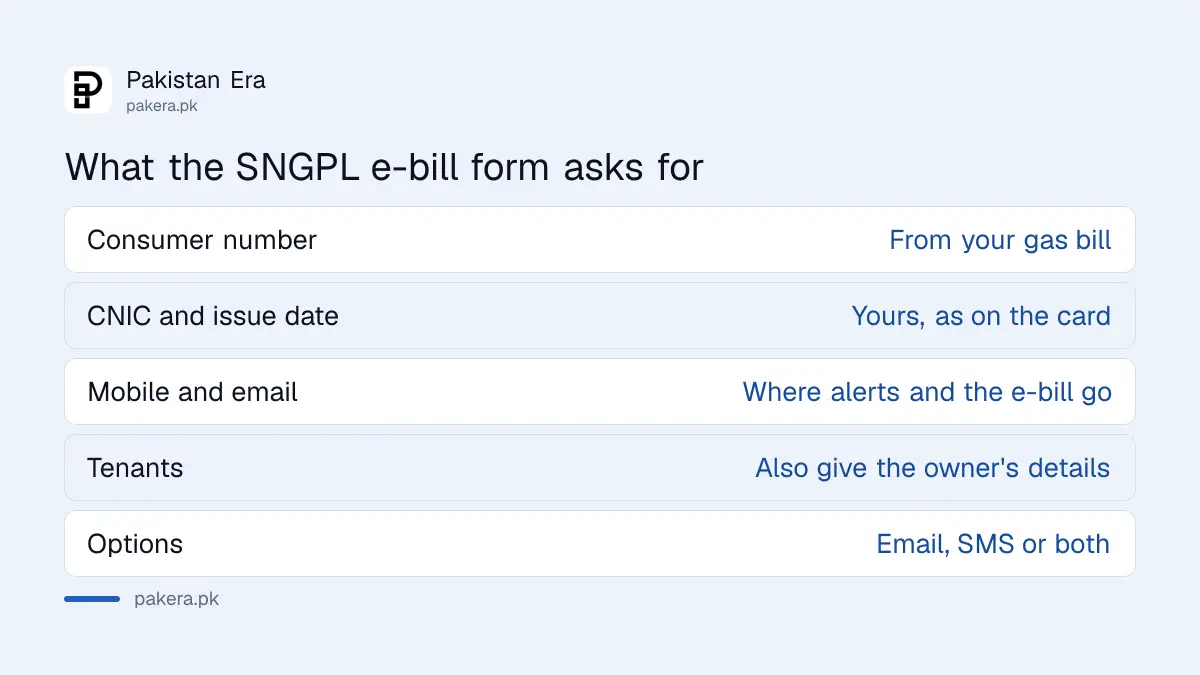
| Field on the form | What to enter |
|---|---|
| Consumer No. | The consumer number from your gas bill |
| CNIC and CNIC issue date | Your own CNIC and its issue date |
| Mobile No. and Email | The number and address where you want bills and alerts |
| Owner details | Only if you are a tenant or other: owner name, CNIC, issue date, mobile, email |
| Delivery options | Tick Email (paperless bill), SMS, or both |
The consumer number is on the bill itself. If you cannot find it, see how to get a free duplicate gas or electricity bill, and use that copy to read the number.
Choose email, SMS or both on the form
The form lets you tick Email (paperless bill) and SMS separately. Email replaces the printed bill. SMS sends billing information. If you choose email only, the paper bill stops, so make sure the address works before you submit.
The terms on the page are short. SNGPL says it will send the e-bill to your email address instead of a hard copy. It suggests adding noreply@sngpl.com.pk to your safe sender list. You also agree to check your email or SMS every month to view the bill.
That last point is worth taking seriously. A bill you never open is still a bill. Late payment charges do not wait for you to find the email. The guide to paying a gas or electricity bill in instalments covers what to do if a large winter bill arrives and you cannot pay it at once.
The bill estimator works from your meter readings
SNGPL's Domestic Bill Estimator asks for your consumer number, category, status, calorific value, pressure, and your previous and current readings with dates. It says its calculations assume a meter that reads in cubic metres.
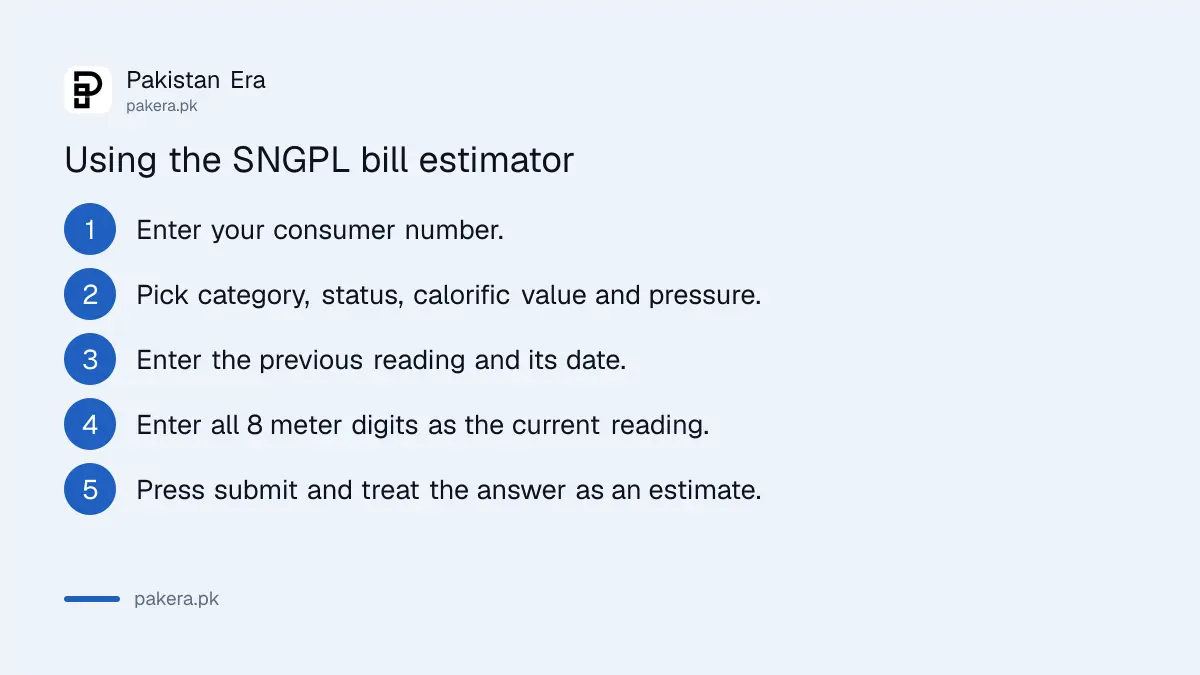
One instruction on the page matters most. It says the full 8 digits on the meter counter should be entered in the reading column. The system then arranges the conversion to HM3 by itself, so you do not convert anything. Enter the digits exactly as the meter shows them.
We did not run a reading through the estimator, so we cannot say how close its answer is to a real bill. Treat it as a planning tool. For the slab rates that make a winter bill jump, see how Sui gas slab rates shape your winter bill.
Update your CNIC and phone number first if the form fails
SNGPL also lists "Update CNIC and Phone Number" in the same menu. If the sign up form does not accept your CNIC or your mobile number is old, fix those details first. A wrong number on file means alerts go to the wrong person.
The page does not state what happens to a form with details that do not match. We have not tested that. Call 1199 or write to customerservices@sngpl.com.pk, both of which SNGPL lists, if the form keeps failing.
- Keep your last gas bill in front of you and note the consumer number.
- Open sngpl.com.pk and go to Customer Services, then Consumer Services.
- Choose "Register - Email Bill / SMS Alert".
- Fill in the consumer number, CNIC, issue date, mobile number and email. Add the owner's details if you are a tenant.
- Tick email, SMS or both, accept the terms and submit.
- Add noreply@sngpl.com.pk to your safe senders and check your inbox next month.
A wrong or missing bill still needs a complaint
An e-bill does not change what you owe. If the amount looks wrong, the usual routes apply. Ask for a meter check, and if SNGPL does not answer, take the complaint to the regulator.
Our guides on getting a gas meter checked or changed and on filing a gas complaint on 1199 cover those steps. Keep screenshots of every e-bill. They are your record if the paper copy stops arriving.
Common questions
Is the email and SMS bill service free?
SNGPL's page lists no fee for it. We saw no charge on the form or in its terms.
Do I still get a paper bill if I choose email?
SNGPL says it will deliver the e-bill to your email address instead of a hard copy.
What do I need to sign up?
Your consumer number, CNIC, CNIC issue date, mobile number and email. Tenants also give the owner's details.
Does the estimator give my exact bill?
We cannot say. We did not run a reading through it, so treat it as an estimate, not a bill.
Does this work for SSGC customers?
No. These pages belong to SNGPL. SSGC runs its own services and we did not review them.
Which email address should I add to safe senders?
SNGPL suggests adding noreply@sngpl.com.pk so the e-bill does not land in spam.
How we verified this
What we checked, where we read it, and what we could not confirm.
Last checked 8 October 2026. We opened the Register - Email Bill / SMS Alert page and the Domestic Bill Estimator page on sngpl.com.pk and read the form fields, instructions and terms. We did not submit the registration or run a reading through the estimator, and we did not check whether SNGPL charges anything beyond what the pages show. Pages and forms can change, so confirm on sngpl.com.pk or on 1199 before you rely on this.
About the author

Public Services and Education Journalist
Fajr Riaz is a journalist and content writer at Pakistan Era, based in Lahore. She covers the questions people meet in everyday life in Pakistan: how a public service works, what a change in the rules means, and where to find a reliable answer.