Sui Gas Slab Rates in Pakistan 2026: Work Out Your Winter Bill
Sui gas slab rates for SNGPL and SSGC homes in Pakistan: protected and non-protected prices, fixed charges and worked winter bills at 1, 2 and 3 hm3 of gas.
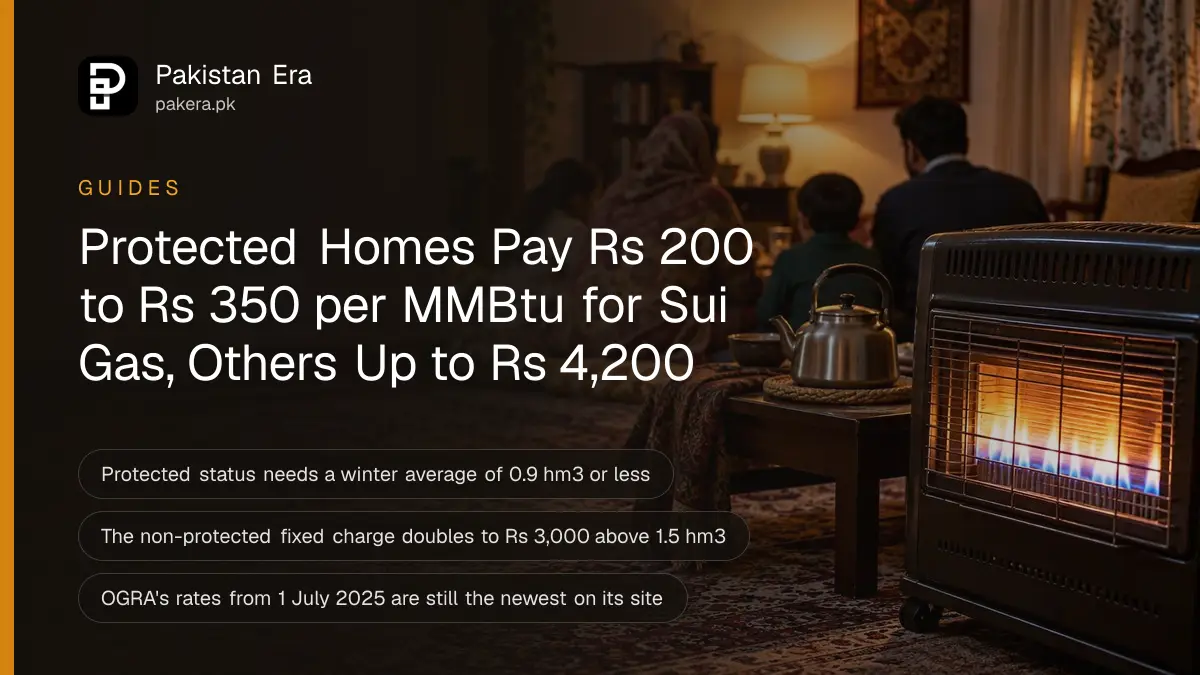
Sui gas slab rates in Pakistan are Rs 200 to Rs 350 per MMBtu for protected homes and Rs 500 to Rs 4,200 for everyone else. Protected homes also pay a Rs 600 fixed charge. Non-protected homes pay Rs 1,500, or Rs 3,000 once they use more than 1.5 hm3 in a month.
These are the rates OGRA, the Oil and Gas Regulatory Authority, notified on 29 June 2025 for both SNGPL and SSGC customers, with effect from 1 July 2025. We read the notice on OGRA's site on 7 October 2026, and it is still the newest domestic sale price notice listed there. SSGC's own domestic rates page shows the same figures. In winter, a heater and a geyser together can push a home two or three slabs higher.
Protected homes pay Rs 200 to Rs 350 per MMBtu
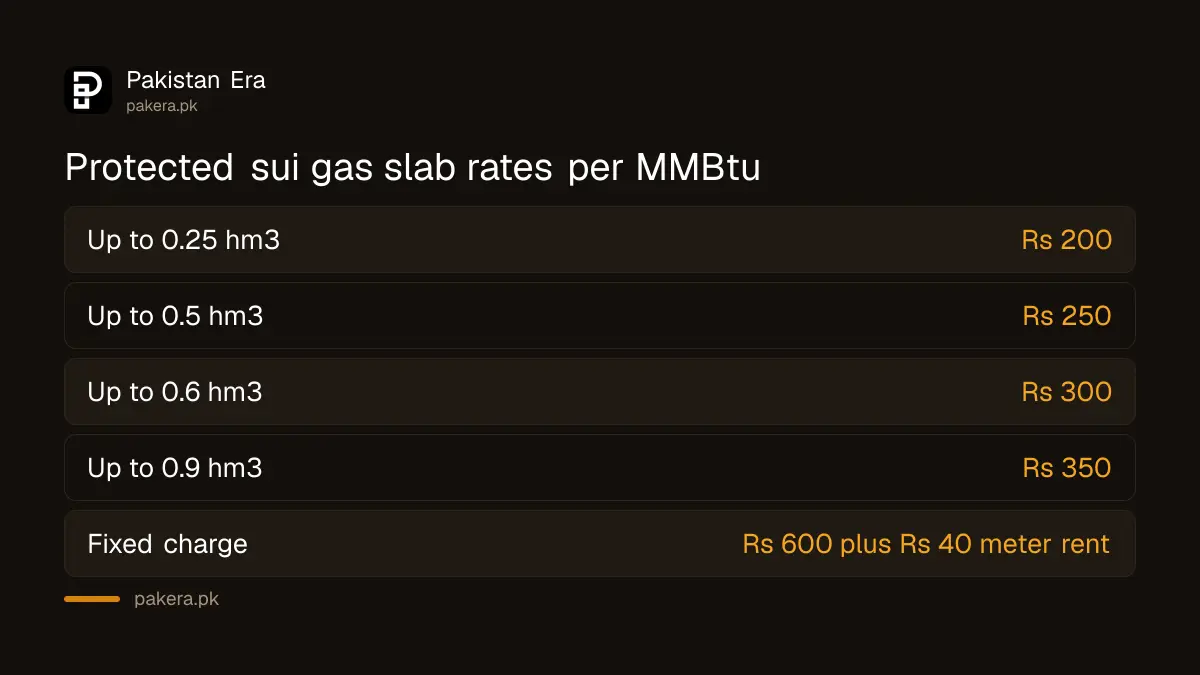
A protected home is billed in four cheap slabs, from Rs 200 to Rs 350 per MMBtu, plus a Rs 600 fixed charge and Rs 40 meter rent. You count as protected only if your average use from November to February last winter was 0.9 hm3 or less.
The unit on your meter is hm3, which means one hundred cubic metres. The price is per MMBtu, a unit of heat. Your bill converts one into the other using the gas heating value, called GCV, that is printed on it. SSGC's own explanation works out its rates at a GCV of 990, and at that value one hm3 is about 3.5 MMBtu. We use 3.5 for every example below.
Non-protected homes climb eight slabs to Rs 4,200
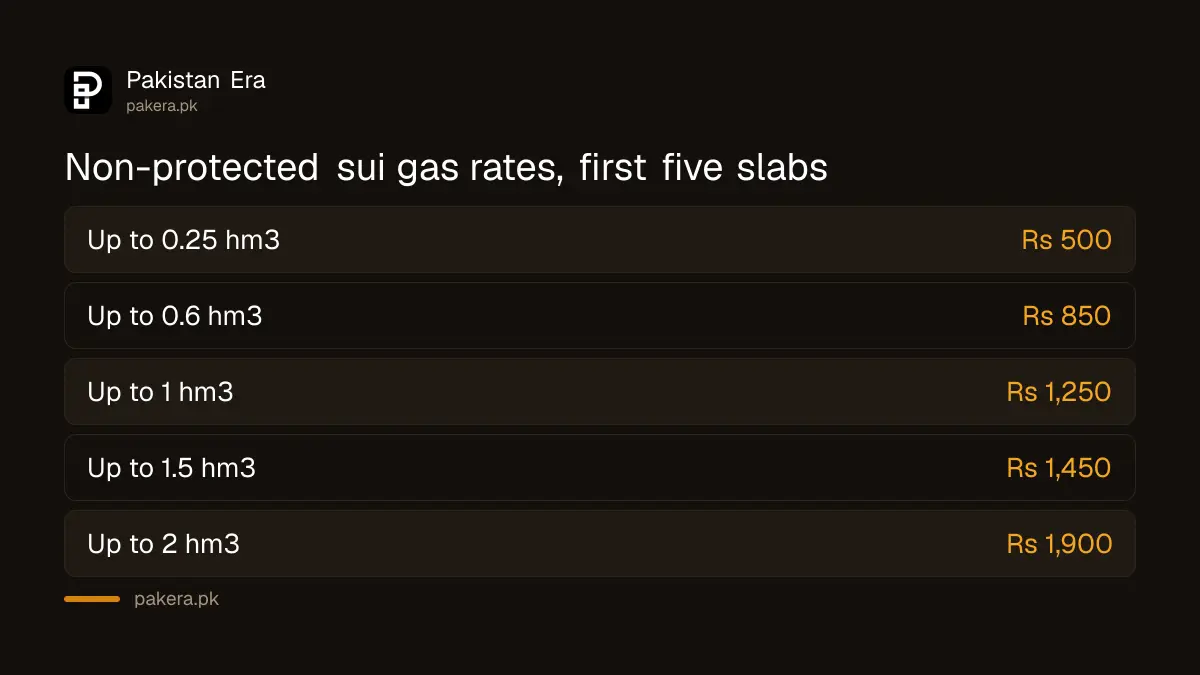
Every home that is not protected pays the non-protected rates. They start at Rs 500 per MMBtu up to 0.25 hm3 and reach Rs 4,200 above 4 hm3. The fixed charge is Rs 1,500 a month, rising to Rs 3,000 above 1.5 hm3.
| Monthly use | Protected, Rs per MMBtu | Non-protected, Rs per MMBtu |
|---|---|---|
| Up to 0.25 hm3 | 200 | 500 |
| Up to 0.5 hm3 | 250 | No slab |
| Up to 0.6 hm3 | 300 | 850 |
| Up to 0.9 hm3 | 350 | No slab |
| Up to 1 hm3 | No slab | 1,250 |
| Up to 1.5 hm3 | No slab | 1,450 |
| Up to 2 hm3 | No slab | 1,900 |
| Up to 3 hm3 | No slab | 3,300 |
| Up to 4 hm3 | No slab | 3,800 |
| Above 4 hm3 | No slab | 4,200 |
| Fixed charge a month | Rs 600 | Rs 1,500 up to 1.5 hm3, Rs 3,000 above |
| Meter rent a month | Rs 40 | Rs 40 |
Reports in July 2026 said the federal government kept these sale prices unchanged for 2026 to 2027. We could not find that decision on OGRA's site, but we also found no newer notice there. If OGRA issues one, the slab table above is what will change.
Your winter bill is worked out in five steps
The utility reads your meter, converts hm3 to MMBtu, applies your slab rate with the one preceding slab benefit, then adds the fixed charge and meter rent. Sales tax and any other items printed on your bill come on top.
- Take your units used this month in hm3, printed as the difference between the two meter readings.
- Multiply by the GCV factor on the bill. At a GCV of 990, 1 hm3 is about 3.5 MMBtu.
- Find your slab from the table. Protected or non-protected status is also printed on the bill.
- Apply the one preceding slab benefit. Gas up to the top of the previous slab is charged at that slab's rate, and only the rest at your own slab's rate.
- Add the fixed charge, Rs 40 meter rent and the taxes shown on the bill.
OGRA's notice states "one preceding slab benefit" but does not set out the method. Step 4 is how the benefit is commonly explained, and it matches SSGC's note that customers "get benefit of preceding one slab only". Check the gas charges breakup on your own bill against it. Above 4 hm3 there is no benefit at all, so every unit is billed at Rs 4,200. You can see that breakup when you check your Sui gas bill online.
A 2 hm3 winter month costs about Rs 13,978 before tax
At 3.5 MMBtu per hm3, a non-protected home using 1 hm3 pays about Rs 5,075 before tax. At 2 hm3 that rises to about Rs 13,978, and at 3 hm3 to about Rs 27,890. A protected home at 0.9 hm3 pays about Rs 1,638.
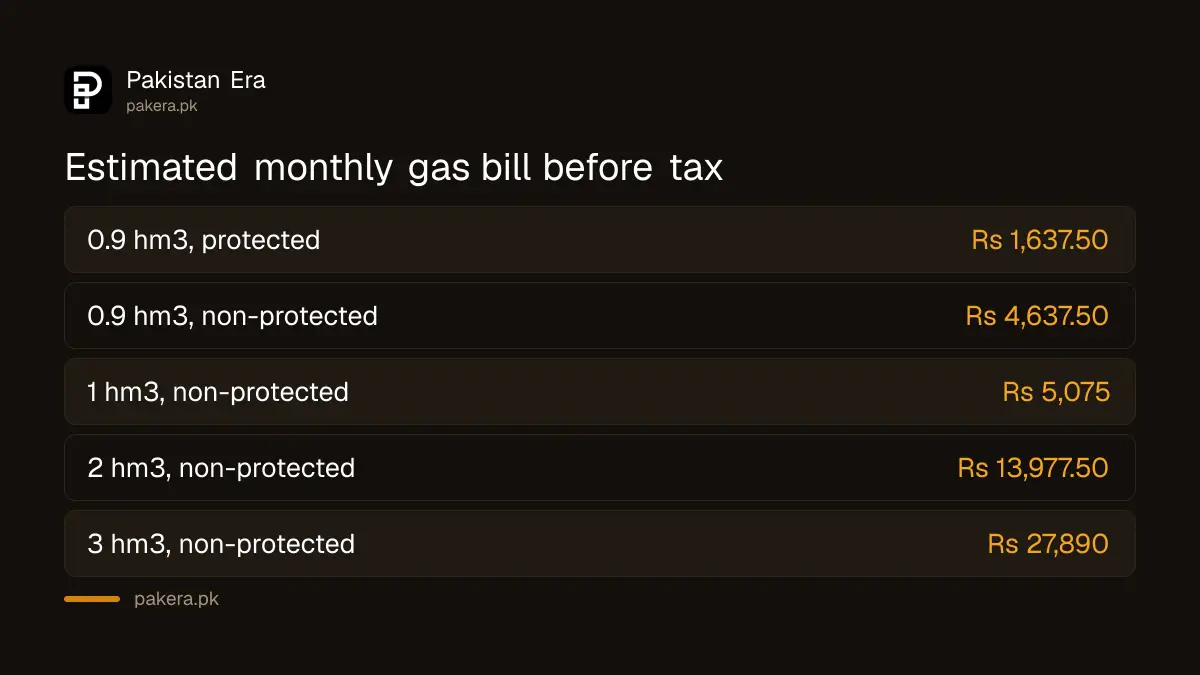
| Use and status | Gas charge | Fixed charge and meter rent | Total before tax |
|---|---|---|---|
| 0.9 hm3, protected | Rs 997.50 | Rs 640 | Rs 1,637.50 |
| 0.9 hm3, non-protected | Rs 3,097.50 | Rs 1,540 | Rs 4,637.50 |
| 1 hm3, non-protected | Rs 3,535 | Rs 1,540 | Rs 5,075 |
| 2 hm3, non-protected | Rs 10,937.50 | Rs 3,040 | Rs 13,977.50 |
| 3 hm3, non-protected | Rs 24,850 | Rs 3,040 | Rs 27,890 |
Here is the 2 hm3 bill in full. The first 1.5 hm3 is the previous slab, so 5.25 MMBtu at Rs 1,450 is Rs 7,612.50. The last 0.5 hm3 is 1.75 MMBtu at Rs 1,900, which is Rs 3,325. Add the Rs 3,000 fixed charge and Rs 40 meter rent.
These are our own estimates. Your GCV, the meter reading date and the taxes will move the real figure. Neither SNGPL nor SSGC publishes a scheme for paying a gas bill in instalments. You can ask at a customer centre, but the company can refuse.
Staying under 1.5 hm3 can save Rs 2,865 a month
The steepest step is at 1.5 hm3. Going from 1.5 to 1.6 hm3 lifts a non-protected bill from about Rs 8,453 to about Rs 11,318, because the fixed charge doubles and the slab rate jumps. The biggest saving of all is keeping protected status.
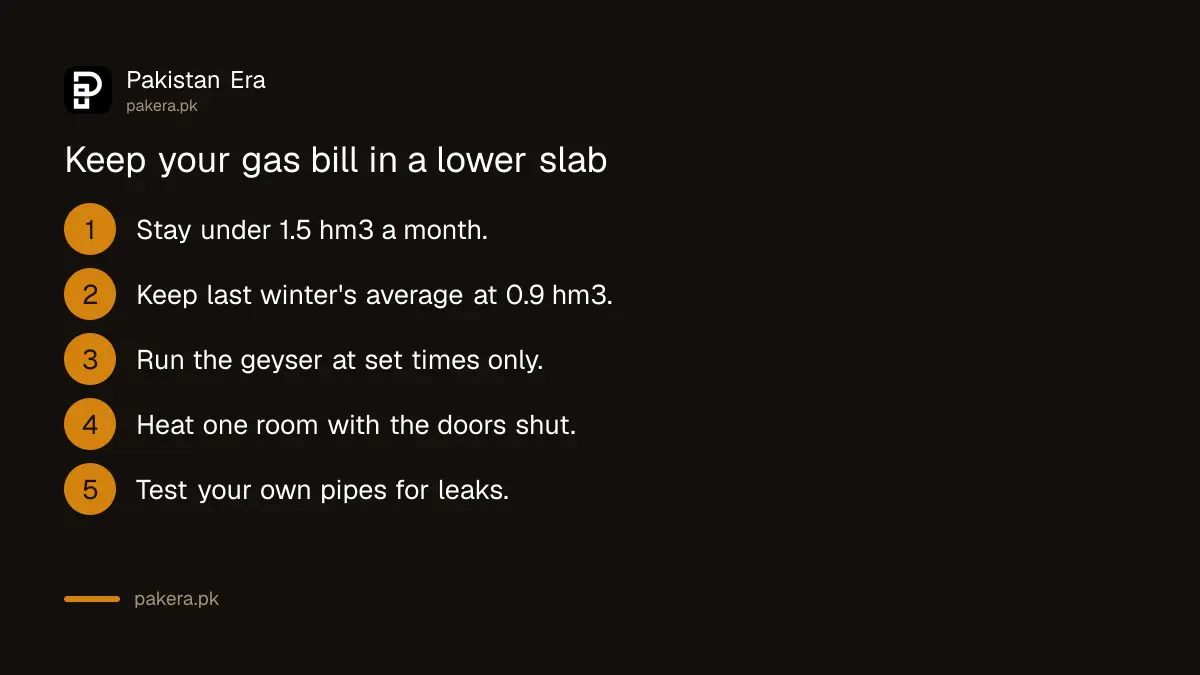
- Watch the 1.5 hm3 line. Ten extra cubic metres across it cost about Rs 2,865.
- Guard your protected status. It depends on last winter's November to February average. At 0.9 hm3, a protected home pays about Rs 1,638 and a non-protected one about Rs 4,638. That is a Rs 3,000 a month gap from status alone.
- Run the geyser for a set time. A geyser on pilot flame all day burns gas for nothing. Heat water once in the morning and once at night.
- Heat one room, not the house. Close doors and use one heater. Follow the rules for using a gas heater or geyser safely, including switching it off before sleep.
- Test your own pipes for leaks. Close every appliance, including the geyser pilot, and watch the meter for 15 minutes. If it still moves, gas is leaking after the meter, and SSGC says that gas is billed to you.
Low pressure does not lower your slab on its own. Gas is billed on what passes the meter. During gas supply cuts and low pressure hours, many homes leave valves open and burn more when supply returns.
A wrong reading or slab can be challenged
If your bill shows units you did not use, or the wrong protected status, complain to SNGPL or SSGC first on helpline 1199. If the company does not fix it, you can take it to OGRA.
Photograph your meter on the day you complain. A meter that runs fast can be tested at your request, and the steps for getting a gas meter checked or changed list the forms. A provisional bill, issued when nobody read your meter, is adjusted against the next real reading.
Common questions
What are the sui gas slab rates in Pakistan now?
Protected homes pay Rs 200 to Rs 350 per MMBtu and non-protected homes Rs 500 to Rs 4,200, under OGRA's notice effective 1 July 2025. The rates are the same for SNGPL and SSGC.
Who counts as a protected gas consumer?
A domestic consumer whose average use from November to February last winter was 0.9 hm3 or less. Everyone else is non-protected.
What is the fixed charge on a gas bill?
Rs 600 for protected homes. Rs 1,500 for non-protected homes up to 1.5 hm3, and Rs 3,000 above that. Meter rent of Rs 40 is extra.
How many MMBtu are in 1 hm3?
About 3.5 MMBtu at a GCV of 990, the value SSGC uses in its own explanation. Your bill prints the exact GCV used.
Did gas prices change for winter 2026?
We found no new domestic sale price notice on OGRA's site as of 7 October 2026. The 1 July 2025 rates still apply.
How we verified this
What we checked, where we read it, and what we could not confirm.
Last checked 7 October 2026. We read OGRA's notification of 29 June 2025 on natural gas sale prices, listed as the newest domestic notice on OGRA's consumer gas prices page. We matched its figures against SSGC's domestic rates page. The GCV of 990, the preceding slab note and the provisional billing rule are from SSGC's frequently asked questions. The bill examples, the 3.5 MMBtu factor and the savings figures are our own arithmetic, before sales tax.
About the author

Tax, Bills and Technology Writer
Ali Akhtar is a young and curious voice here at Pakistan Era. He is currently pursuing his A-Levels and has a growing interest in Pakistan’s changing industrial landscape and educational trends. Ali likes to write in a way that helps him explain and explore the world around him. His writing reflects the perspective of the new generation navigating the evolving trends of Pakistan where technology, youth innovation, and shifting opportunities are reshaping the country’s future.