What YouTube Actually Pays in Pakistan
The 18 dollar figure is a US number. Reported Pakistani RPM, why viewer location sets the rate, and the trade off nobody mentions.
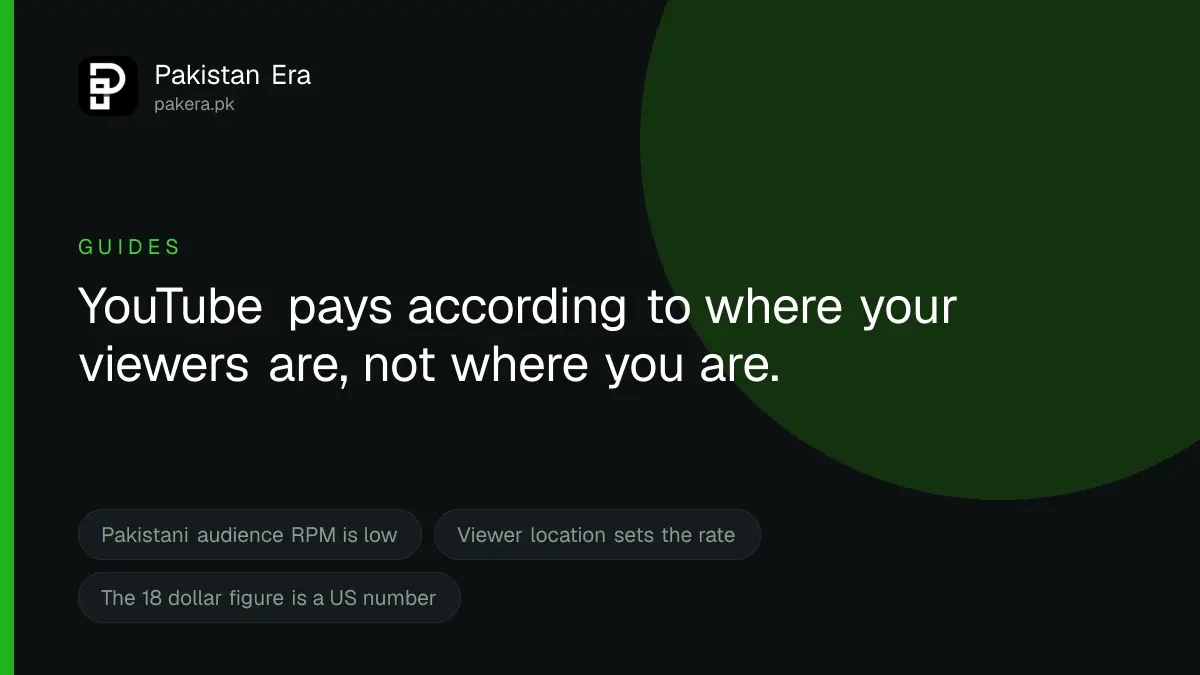
YouTube pays according to where your viewers are, not where you are. That single sentence explains most of the confusion about YouTube earnings in Pakistan, and it is the one lever a Pakistani creator can actually pull.
Update, 11 October 2026: YouTube's Partner Program rules change from 1 February 2027. See the new thresholds.
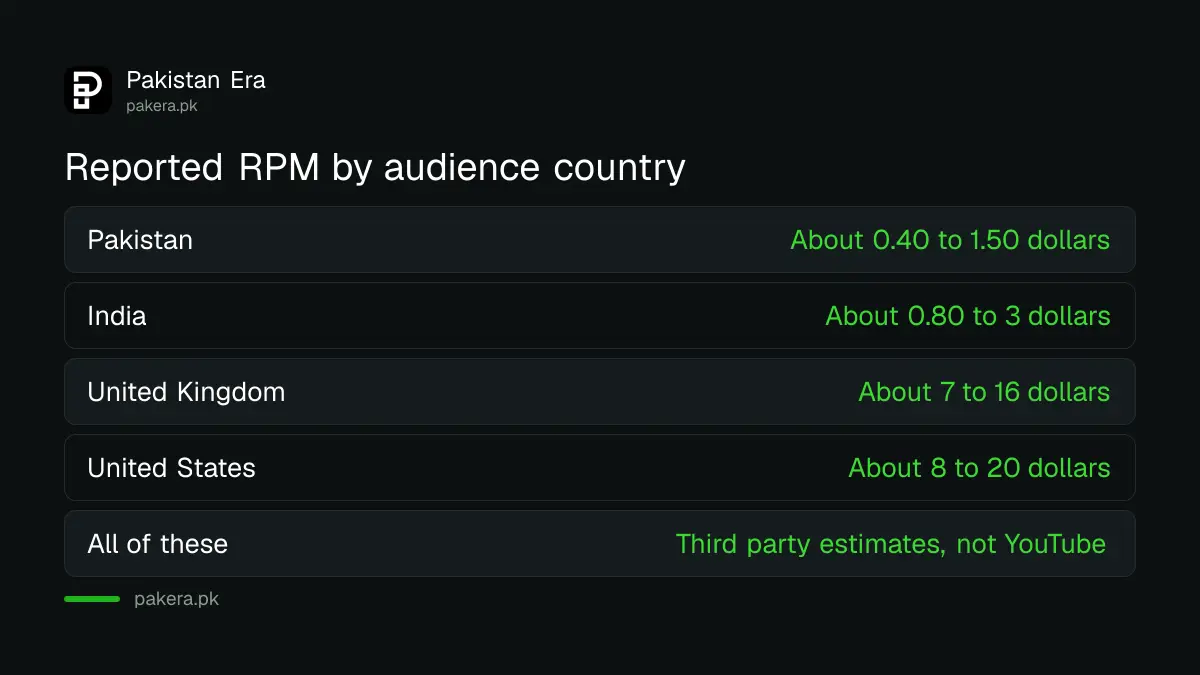
The figure people quote, around 18 dollars per thousand views, is a United States number. Reported ranges for a Pakistani audience sit far lower, commonly given as roughly 0.40 to 1.50 dollars per thousand views, with some sources putting the top of the range a little higher. Those are estimates from third party calculators rather than figures published by YouTube, and we mark them reported for that reason.
Why the same video earns different amounts
Advertising rates are set by what advertisers will pay to reach a particular market. An advertiser bidding for attention in the United States is competing for a customer with far more disposable income than one in Pakistan, so the rate per thousand views differs by a large multiple.
| Audience | Reported RPM range |
|---|---|
| Pakistan | About 0.40 to 1.50 dollars |
| India | About 0.80 to 3 dollars |
| United Kingdom | About 7 to 16 dollars |
| United States | About 8 to 20 dollars |
None of these are official YouTube figures and none are promises. They are the ranges reported by services that aggregate creator data, and your own channel can sit outside them in either direction depending on your subject, your video length and the season.
The lever that actually moves your income
Because the rate follows the viewer, two Pakistani creators with identical view counts can earn very differently. Reporting describes a Pakistani creator whose audience was mostly in the United States and United Kingdom earning many times the RPM of one whose audience was almost entirely local, on the same number of views.
We would treat any specific pair of numbers as illustration rather than a rule, because a single comparison is not a study. The mechanism behind it is not in doubt, though, and it points at a real decision: who you are making the video for.
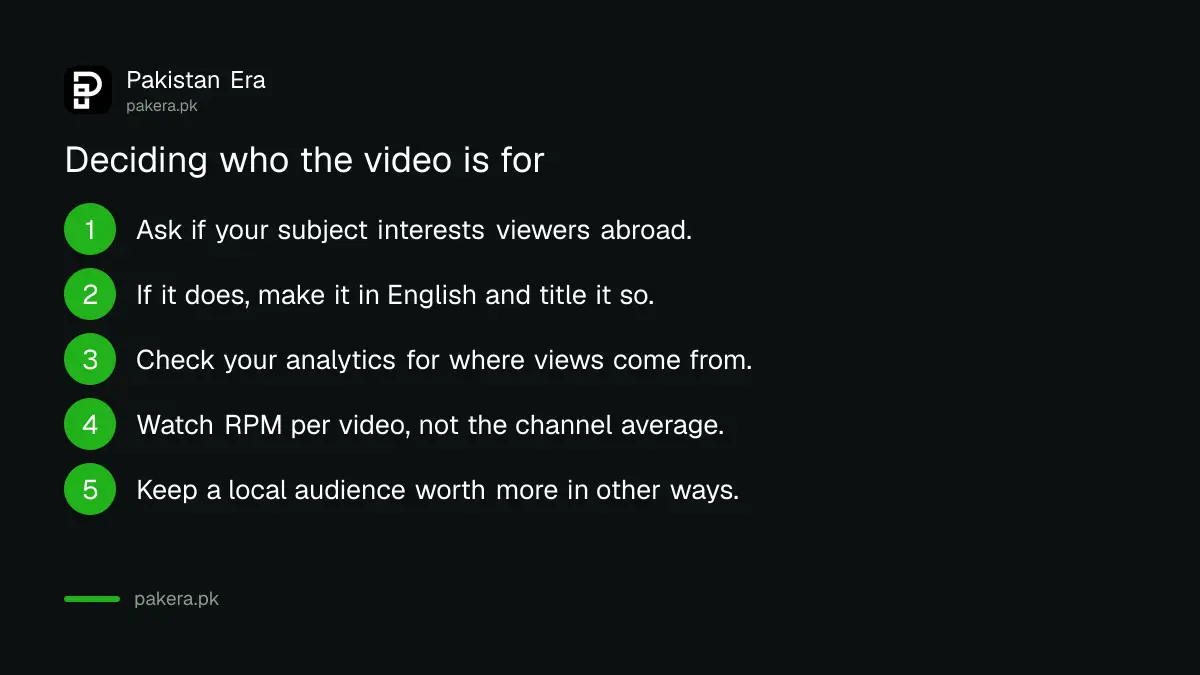
- Decide whether your subject can interest viewers outside Pakistan.
- If it can, make it in English and title it the way that audience searches.
- Check your own analytics for where views actually come from.
- Watch RPM by video rather than the channel average, since one video can carry it.
- Do not abandon a local audience that is worth more to you in other ways.
The honest trade off
Chasing a foreign audience is not free advice, and anyone giving it without the caveat is not being straight with you. A creator making Urdu content for a Pakistani audience may build something more loyal, more useful for brand deals, and more defensible than a channel competing globally in English.
Brand money often beats advertising money at the same size. A local brand paying you directly to reach a Pakistani audience does not care about your RPM. So the right answer depends on what you are actually building, and switching language to chase a rate can cost you the audience that was going to pay you properly.
Views are not the whole equation
Several things move the rate besides geography. Subject matters, because finance, technology and business attract higher bids than general entertainment. Length matters, because longer videos can carry more ad placements. Season matters, since advertising budgets rise towards the end of the year and fall in January.
Format matters most of the obvious ones. Short form video is monetised differently from long form and generally returns far less per view, which is why a creator with enormous short form numbers can earn less than one with modest long form watch time.
Getting the money out
Earning it and receiving it are separate problems, and the second one catches Pakistani creators out. Payment runs through AdSense, which has its own address verification and payment threshold before anything reaches your bank.
Set that up early rather than at the moment you first qualify. If you also take payments from clients or brands directly, our guide to freelancer payments in Pakistan covers those routes, and withdrawing from Payoneer covers one of them in detail.
Treat every quoted rate with suspicion
The 18 dollar figure circulating in Pakistan is a United States market number applied to a Pakistani audience, which is how a creator ends up planning around income that was never going to arrive.
Apply the same test we used on another platform. Ask where the number came from and whether it can be traced to the company that would have to pay it. We did that with a rate circulating for Bilibili and found it traced to a single post that had actually said something else, which we set out in earning from Bilibili in Pakistan.
Common questions about YouTube earnings in Pakistan
How much does YouTube pay per 1,000 views in Pakistan?
Reported ranges for a Pakistani audience are roughly 0.40 to 1.50 dollars per thousand views. These are third party estimates, not YouTube figures, and your channel can sit outside them.
Is the 18 dollar figure wrong?
It is a United States figure. Applied to a Pakistani audience it is badly misleading, which is the main reason people are disappointed by their first payment.
Does living in Pakistan reduce my earnings?
Your own location is not what sets the rate. Where your viewers are is what sets it.
Should I switch to English?
Only if your subject genuinely suits an international audience. A loyal Pakistani audience can be worth more through brand deals than a larger foreign one is through advertising.
Do Shorts pay the same as long videos?
No. Short form is monetised differently and generally returns much less per view than long form.
How we verified this
What we checked, where we read it, and what we could not confirm.
Last checked 27 August 2026. Every rate in this article is reported rather than read on a YouTube page. The RPM ranges by country come from third party services that aggregate creator data, and they disagree with each other, which is why they are given as ranges and described as estimates. The comparison between a Pakistani creator with a mostly foreign audience and one with a mostly local audience is reported and we treat it as illustration rather than evidence, because a single pair of channels is not a study. What is not in dispute is the mechanism: advertising rates follow the viewer's market. We run no monetised YouTube channel and have no earnings data of our own, so nothing here describes results we obtained.
About the author

Senior Writer, Public Services and Technology
Shahid joined us in 2024 as an author. He is a senior contributor to Pakistan's leading technology websites. He writes detailed articles, mostly covering his expertise in the latest tech, mobiles, apps, gadgets, and step-by-step guides. His ideology is to help people understand the latest trends and explain complex methods through very easy-to-understand guides.