FBR Sets Rs 195 per 1,000 YouTube Views as Minimum Income for Creators
FBR's SRO 1641 and 1642 of 2026 count every 1,000 views as Rs 195 of creator income, less costs up to 30%. We read the rules and worked out the tax you owe.
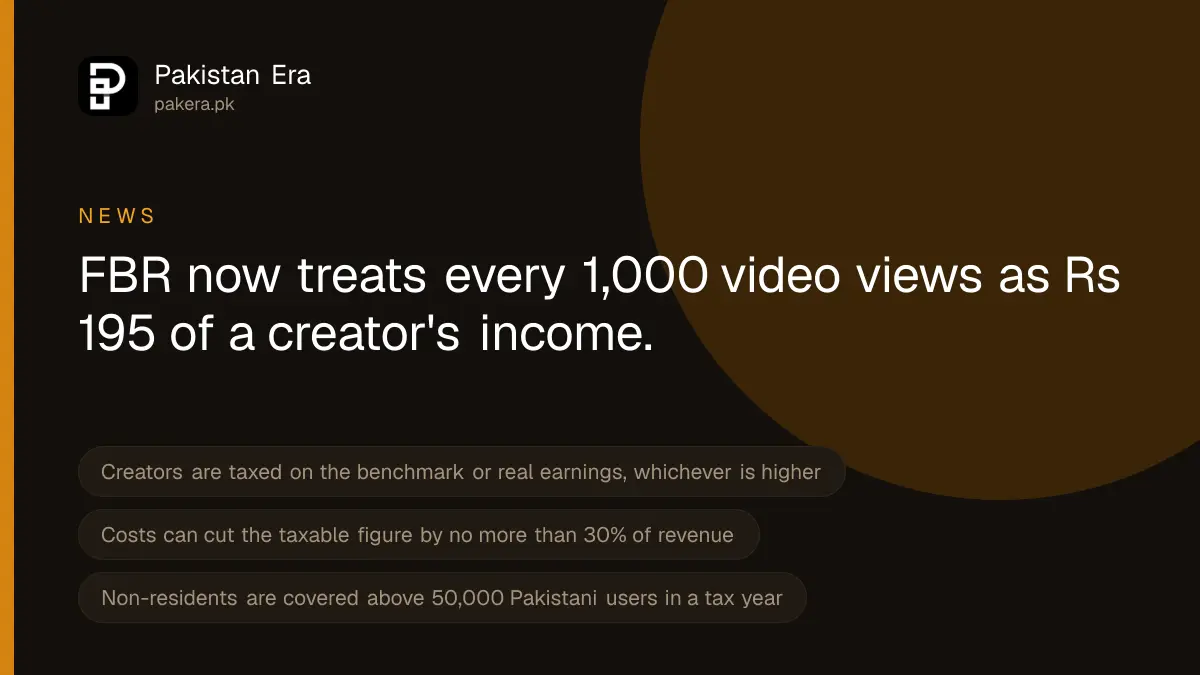
FBR has fixed Rs 195 per 1,000 video views as the starting point for taxing creators. Under SRO 1641(I)/2026 and SRO 1642(I)/2026, both dated 23 September 2026, your taxable income from social media is the higher of your views multiplied by that rate or what you actually earned, less costs of up to 30%.
Update, 11 October 2026: A reported FBR draft would apply the Rs 195 benchmark to all social media platforms. Read the report.
We downloaded all three notifications from FBR's own SRO list on 25 September 2026 and read them line by line. The rules apply to resident creators, and to non-residents who reach more than 50,000 users in Pakistan in a tax year. They do not set a new tax rate. They set a floor under your income, and your normal tax rate then applies to it.
That difference matters. A floor on income is not the same as a flat tax on views, and for small channels the tax can still be zero.
Three SROs dated 23 September 2026 create the social media tax rules
SRO 1640 names social media creators as a sector under section 99C of the Income Tax Ordinance 2001. SRO 1641 adds rules for residents, as Chapter IIA of the Income Tax Rules 2002. SRO 1642 adds matching rules for non-residents, as Chapter VA.
Section 99C lets FBR set a special procedure for a named sector, covering how tax is worked out, paid, recorded and filed. Other sectors under it include small businesses and medical practitioners. Before September, creators were not on that list.
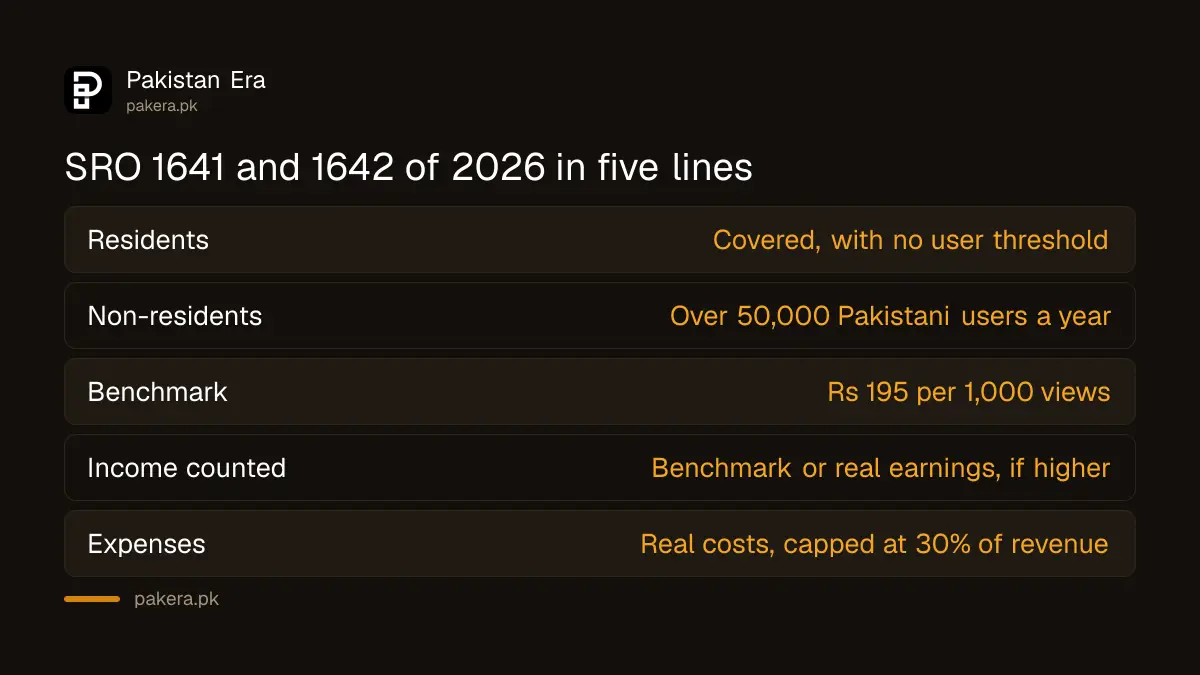
| Point | Residents, SRO 1641 | Non-residents, SRO 1642 |
|---|---|---|
| Who is covered | Every resident person earning from interaction with users in Pakistan through social media | Non-residents whose income from users in Pakistan counts as Pakistan-source income |
| User threshold | None | More than 50,000 users in a tax year, or 12,250 in a quarter |
| Benchmark | Rs 195 per 1,000 views | Rs 195 per 1,000 views |
| Income counted | Higher of benchmark or actual earnings, cash or kind | Same |
| Expenses allowed | Up to 30% of total revenue | Up to 30% of total revenue |
| Advance tax | Quarterly, under section 147 | Quarterly, under section 147 |
| Where declared | A special part of the annual return | A special part of the annual return |
Neither SRO names a start date or a tax year. Both are dated 23 September 2026, which falls inside tax year 2027, running from 1 July 2026 to 30 June 2027. FBR has not said whether it will apply the formula to returns for tax year 2026, the ones due on 30 September 2026.
Your taxable income is the higher of Rs 195 per 1,000 views or real earnings
Rule 13ZL, and rule 19N for non-residents, sets total remuneration as the higher of two numbers: views divided by 1,000 and multiplied by Rs 195, or the money and goods you actually received. You then subtract expenses, capped at 30%.
The rules call this the minimum income. So the formula is a floor. If a brand pays you more than the benchmark, the real figure wins. If your real earnings are lower, FBR starts from the benchmark.
The Rs 195 comes from the definition of "revenue per mille", which means revenue per 1,000 views. The SROs define it as the revenue per 1,000 views "on the video shared on Youtube" and say it is "subject to revision from time to time". At the State Bank's rate of Rs 277.16 to the dollar on 25 September 2026, Rs 195 is about 70 US cents.
Here is the part the rules leave open. The formula uses "total number of views", while the rate is defined only for YouTube. The SROs do not say whether views on TikTok, Facebook, Instagram or X are counted the same way. They also do not separate Shorts from long videos, or monetised views from unpaid ones. Until FBR clarifies, treat every platform's views as possibly in scope, and keep records for each one.
The final rules changed three things from the April 2026 draft
FBR published draft versions as SRO 545(I) and SRO 546(I) on 1 April 2026. The final rules keep Rs 195 and the 30% cap. They change how views are counted, add a way to prove lower earnings, and tie the formula to a tax year.
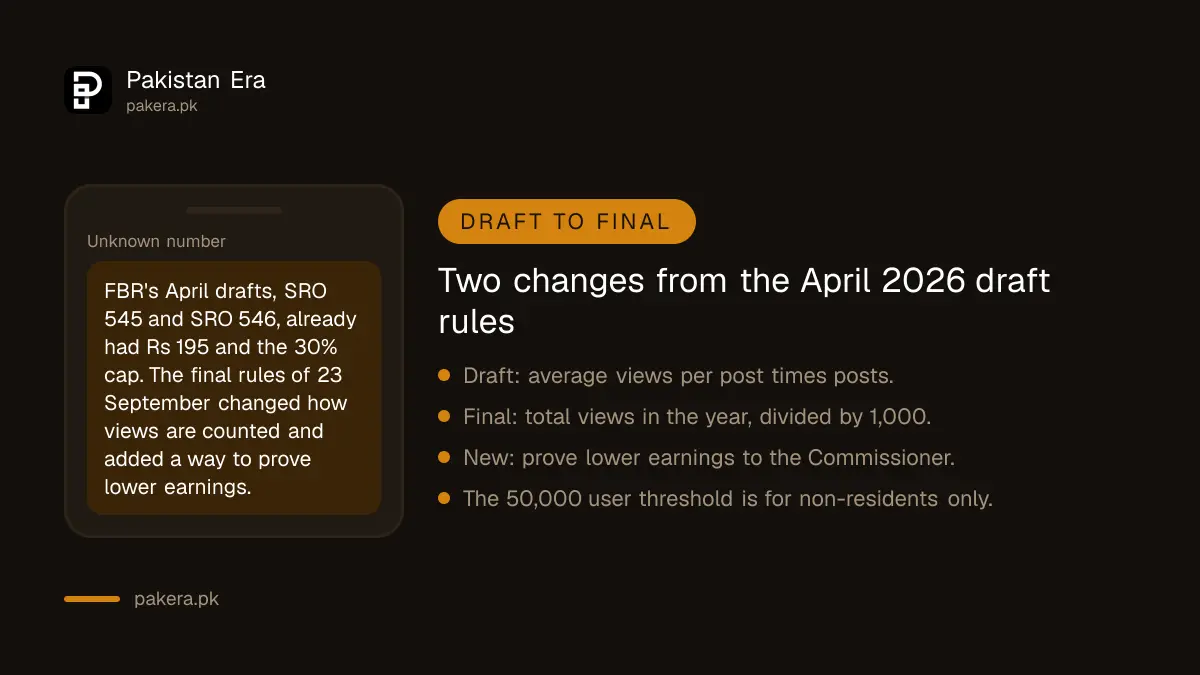
- Views: the draft multiplied average views per post by the number of posts. The final rules use total views for the year, divided by 1,000.
- Proof: the final rules add a proviso. If you believe your real earnings are below the benchmark, you must show evidence "to the satisfaction of the Commissioner".
- Tax year: the final rules add the words "for a tax year" to the income formula.
The 50,000 threshold was in the draft too, and it was always about users, not subscribers. In both versions it sits only in the non-resident rules. Resident creators have no threshold at all.
What the Rs 195 benchmark means for a channel with 1 to 50 million views
For a resident individual with no other income, 1 million views a year produces no tax, and 5 million views produces about Rs 12,375. The tax rises fast after that: about Rs 509,000 at 20 million views, and about Rs 2.16 million at 50 million.
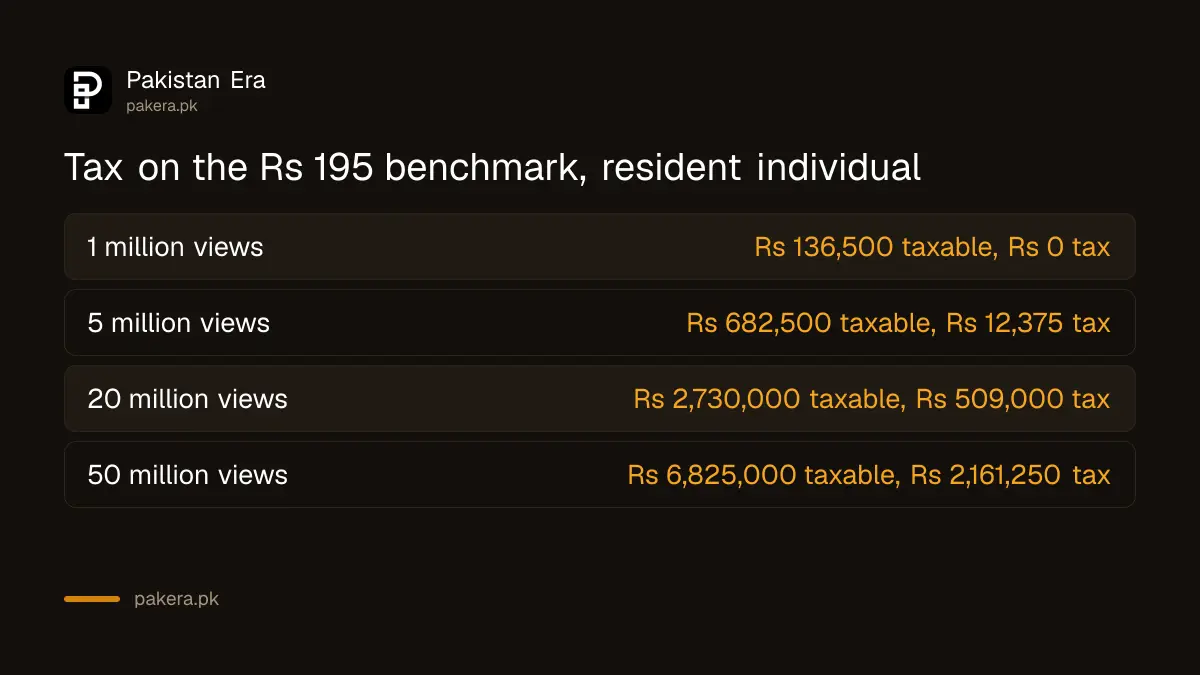
These are our own sums. We assumed a resident individual, not salaried, whose real costs are at least 30% of revenue, and who has no other income. We used the tax table for non-salaried individuals in Division I of the First Schedule, as printed in FBR's copy of the Ordinance amended up to 30 June 2026.
| Views in the year | Benchmark income | Less 30% costs | Taxable income | Tax at normal rates |
|---|---|---|---|---|
| 1 million | Rs 195,000 | Rs 58,500 | Rs 136,500 | Rs 0 |
| 5 million | Rs 975,000 | Rs 292,500 | Rs 682,500 | Rs 12,375 |
| 20 million | Rs 3,900,000 | Rs 1,170,000 | Rs 2,730,000 | Rs 509,000 |
| 50 million | Rs 9,750,000 | Rs 2,925,000 | Rs 6,825,000 | Rs 2,161,250 |
Other income, such as a salary or rent, pushes you into higher slabs, so your real bill can be larger. None of these examples crosses Rs 10 million of taxable income, where a 10% surcharge starts under section 4AB.
The bank deduction still runs alongside this. Since 1 July 2026, section 154B has had your bank take 5% of platform money if you are on the Active Taxpayers List, or 10% if not. That deduction is a minimum tax for residents, and it counts as credit against the bill above. The full mechanics of declaring YouTube and TikTok income in the return are the same as before.
Rs 195 is above what many Pakistani channels really earn per 1,000 views
Rs 195 sits inside the reported range for Pakistani audiences, but near the lower middle. Channels with mostly local viewers, mostly Shorts, or no monetisation can earn far less than Rs 195 per 1,000 views, and the formula would then tax money they never received.
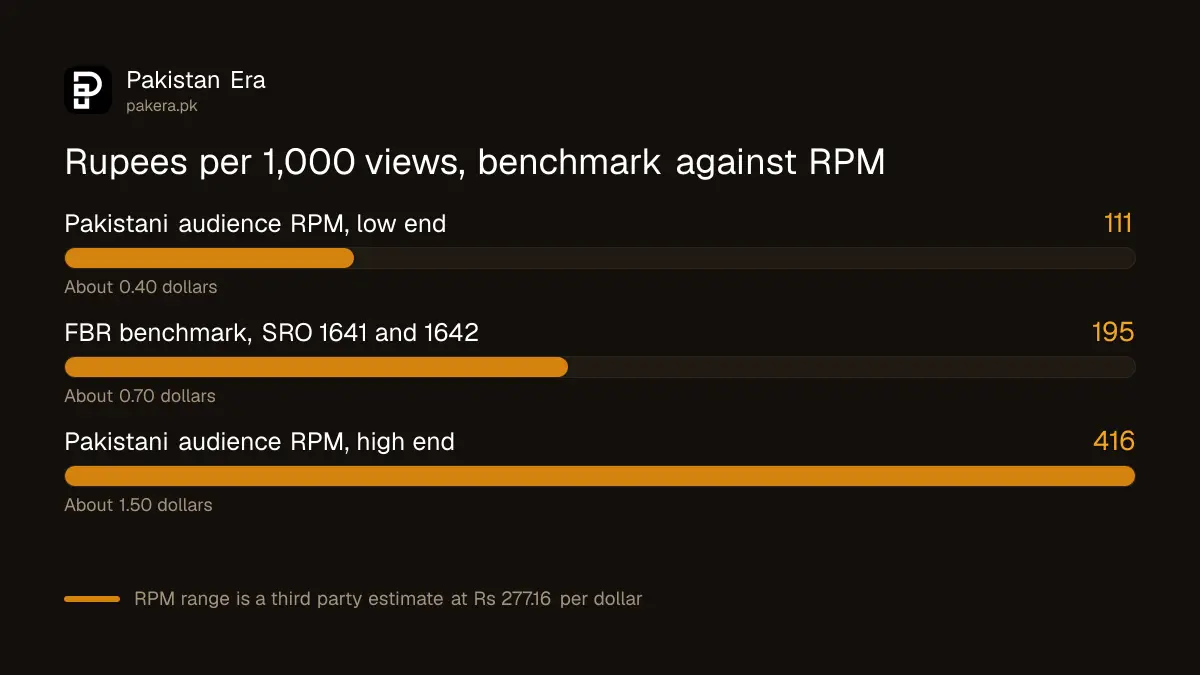
Third party services put YouTube RPM for a Pakistani audience at roughly 0.40 to 1.50 US dollars. At Rs 277.16 to the dollar, that is about Rs 111 to Rs 416. Those ranges are estimates, not YouTube figures.
Take a channel with 5 million views that earns at the bottom of that range. Its real revenue is about Rs 554,000. The benchmark says Rs 975,000. Shorts generally pay much less per view than long videos, so a Shorts-heavy channel can sit further below.
Other platforms are harder still. TikTok's Creator Rewards Program, the one that pays for views, is reportedly not open to Pakistani creators, so most Pakistani TikTokers earn from LIVE gifts and brand deals. Among the platforms that pay Pakistani creators, only YouTube and Facebook are reported to pay into Pakistan at all. If views on the others are counted at Rs 195, the gap between the benchmark and real income is large.
Prove lower earnings with your own records, before the Commissioner asks
The rules let you show that real earnings were below the benchmark, with evidence the Commissioner accepts. They do not list which documents count. Platform statements matched to bank credits are the strongest evidence a creator normally holds.
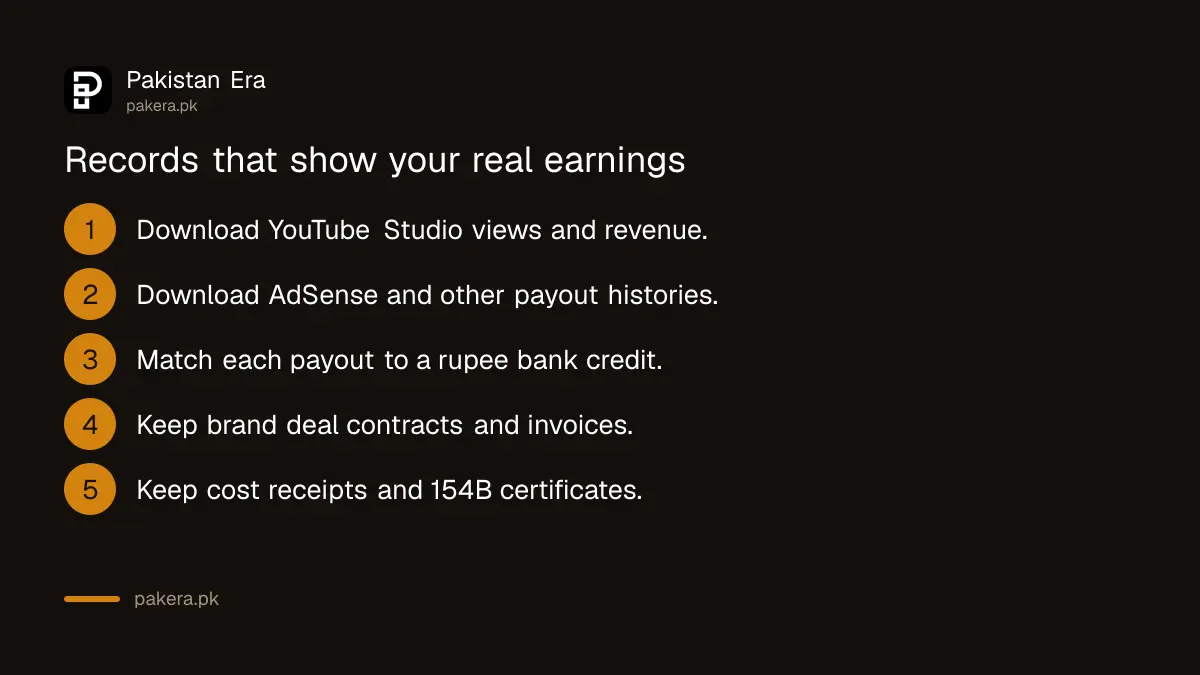
- Download YouTube Studio analytics for the tax year, showing views and estimated revenue by month and by video.
- Download the matching AdSense payment history, and payout records from every other platform.
- Match each payment to the rupee credit in your bank statement.
- Keep contracts and invoices for brand deals, including goods you were given.
- Keep receipts for costs, and the bank's tax deduction certificates under section 154B.
If the income you declare is below the formula, rule 13ZN lets the Commissioner treat it as an error, amend the return and recover the difference. So the time to gather proof is when you file, not after a notice arrives. You can contest an amended assessment through the normal appeal route under the Ordinance.
The rules also ask for advance tax each quarter. Section 147 sets due dates for individuals of 15 September, 15 December, 15 March and 15 June. The first date of tax year 2027 had already passed when the SROs were signed, and FBR has not said how it will treat that quarter.
One question keeps coming up about PSEB registration. The SROs do not mention it, and the 0.25% export rate belongs to IT and software exports, not platform revenue.
Common questions
Is the Rs 195 per 1,000 views a tax?
No. Rs 195 per 1,000 views is an assumed income, not a tax rate. Your normal income tax rate then applies to that income after costs.
Do the rules apply to TikTok, Facebook and Instagram?
The rules cover all social media platforms. The Rs 195 rate is defined for YouTube views only, and FBR has not said how views on other platforms are counted.
Is there a 50,000 subscriber threshold?
Not for residents. The 50,000 figure is users in Pakistan in a tax year, or 12,250 in a quarter, and it applies only to non-residents under SRO 1642.
What if my channel earns less than Rs 195 per 1,000 views?
You must show evidence, such as AdSense statements and bank records, that satisfies the Commissioner. Without it, FBR can use the benchmark.
How much can I claim as expenses?
Your real expenses, up to 30% of total revenue. Costs above 30% are not deducted under these rules.
When do the new rules start?
The SROs are dated 23 September 2026 and name no start date. They fall in tax year 2027, and FBR has not said if they touch tax year 2026 returns.
How we verified this
What we checked, where we read it, and what we could not confirm.
Last checked 25 September 2026. We read SRO 1640(I)/2026, SRO 1641(I)/2026 and SRO 1642(I)/2026, all dated 23 September 2026, and the April drafts SRO 545(I)/2026 and SRO 546(I)/2026, as PDFs from FBR's Income Tax SRO list. Sections 99C, 101(3B), 147, 154B and 4AB, and the tax table for non-salaried individuals, come from FBR's Income Tax Ordinance 2001, amended up to 30 June 2026. The dollar rate is the State Bank of Pakistan's M2M revaluation rate for 25 September 2026, from sbp.org.pk. The RPM range is a third party estimate, not a YouTube figure. A 5% tax on non-residents has been reported; the SROs set no rate of their own, and the only 5% we found in the law is the section 154B bank deduction. The worked examples are our own arithmetic, not tax advice for your case.
About the author

Tax, Bills and Technology Writer
Ali Akhtar is a young and curious voice here at Pakistan Era. He is currently pursuing his A-Levels and has a growing interest in Pakistan’s changing industrial landscape and educational trends. Ali likes to write in a way that helps him explain and explore the world around him. His writing reflects the perspective of the new generation navigating the evolving trends of Pakistan where technology, youth innovation, and shifting opportunities are reshaping the country’s future.