FBR Drafts Rs 195 per 1,000 Views Benchmark for All Social Media Platforms in Pakistan
FBR is reported to have drafted a change so the Rs 195 per 1,000 views creator benchmark covers TikTok, Instagram and Facebook. See what is confirmed.
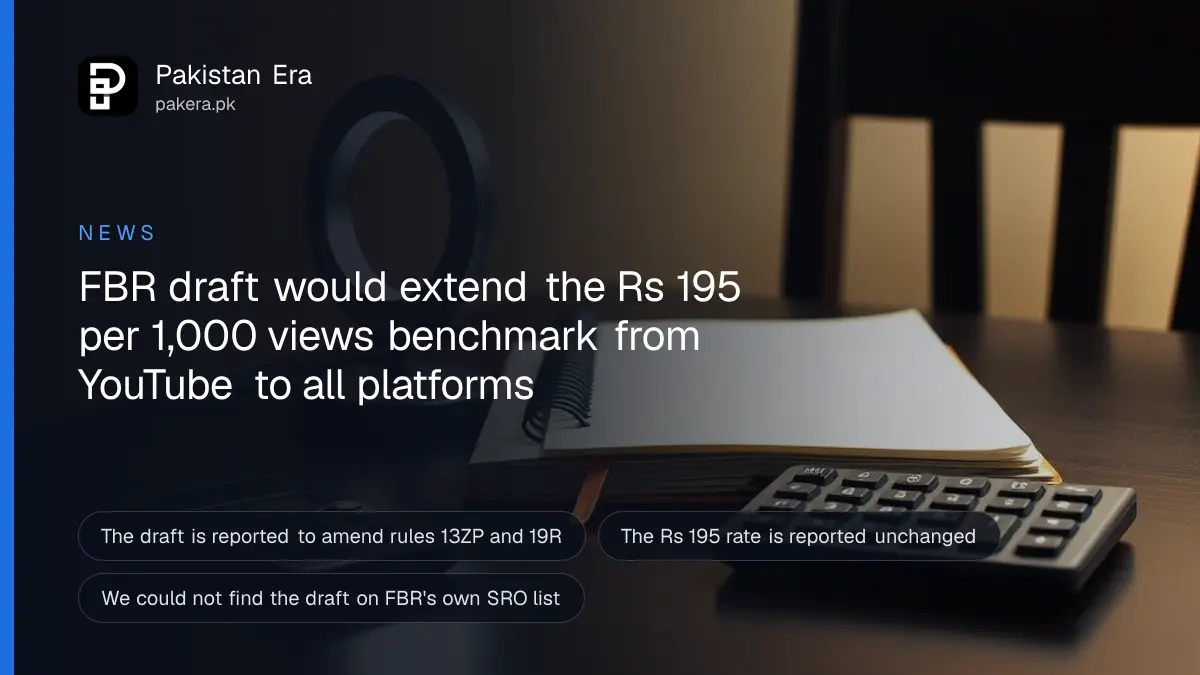
FBR is reported to have drafted a change that would apply its Rs 195 per 1,000 views benchmark to every social media platform, not only YouTube. The draft would amend the definition rules 13ZP for residents and 19R for non-residents. It is a draft. We could not find it on FBR's own SRO list on 11 October 2026, so treat the details as reported.
The question this answers is one we raised in September. FBR's final rules of 23 September 2026 count "total views" in the income formula. But they define the Rs 195 rate only for views on the video shared on YouTube. Creators on TikTok, Instagram and Facebook asked whether their views count.
The reported draft answers it: yes, the same benchmark would apply. If it is notified as drafted, a creator on any platform would face the same minimum income formula.
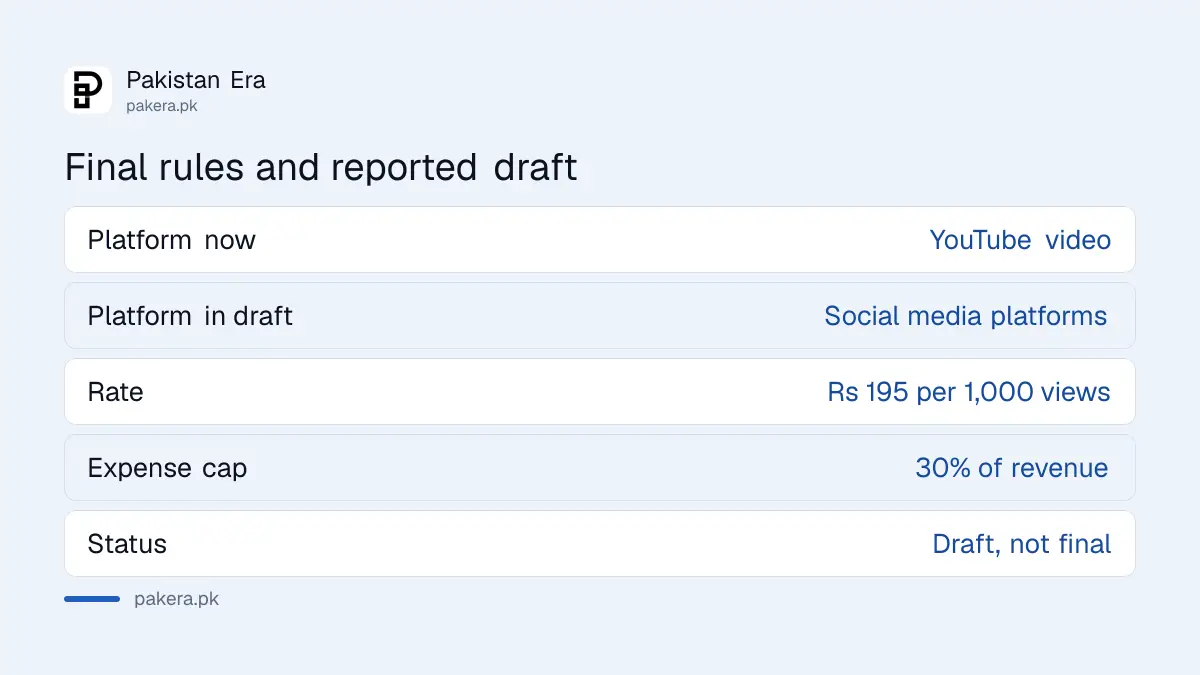
The draft replaces YouTube with social media platforms in two definitions
According to reports on 9 October 2026, the draft changes the word "YouTube" to "social media platforms" in the definition of revenue per mille, the income earned per 1,000 views. It does this in rule 13ZP, which covers residents, and rule 19R, which covers non-residents. The Rs 195 figure itself is reported unchanged.
In the final rules, SRO 1641(I)/2026 and SRO 1642(I)/2026, the definition ties the Rs 195 rate to views "on the video shared on Youtube". That is the wording the draft is reported to replace.
| Point | Final rules, 23 September 2026 | Reported draft, 9 October 2026 |
|---|---|---|
| Platform in the definition | YouTube video | Social media platforms |
| Rate | Rs 195 per 1,000 views | Rs 195, reported unchanged |
| Expense cap | 30% of total revenue | Not reported as changed |
| Status | In force | Draft, open to objections |
The reports say FBR has given stakeholders seven days from publication of the draft in the Gazette to send objections. We could not confirm the Gazette date, so we cannot give you a deadline.
What stays the same for creators
The formula is unchanged: your taxable income is the higher of the benchmark (views divided by 1,000, times Rs 195) or what you actually earned, less costs of up to 30% of revenue. This is a floor under your income, not a flat tax on views. The details are in FBR's Rs 195 per 1,000 views rule.
Non-residents keep the user threshold in the final rules: more than 50,000 users in a tax year, or 12,250 in a quarter. For overseas creators, the full rule is in SRO 1642 for foreign creators.
The draft is not reported to add a new tax rate. It widens where an existing formula applies.
Who would be affected if it is notified
Anyone earning from TikTok, Instagram, Facebook or any other platform could face the same minimum income test. Before, a reader could argue that the Rs 195 rate had no meaning for non-YouTube views. If the draft is notified, that argument gets much weaker.
Our view: assume the formula applies to every platform from now on, and keep records accordingly. That costs nothing, and it avoids a surprise if the draft becomes final.
What to do while it is a draft
You do not need to change your filing today because of a draft. You should keep your records in order, so that you can prove your real earnings if they are lower than the benchmark. The final rules, as we read them, let a creator show lower real income with evidence to the satisfaction of the Commissioner.
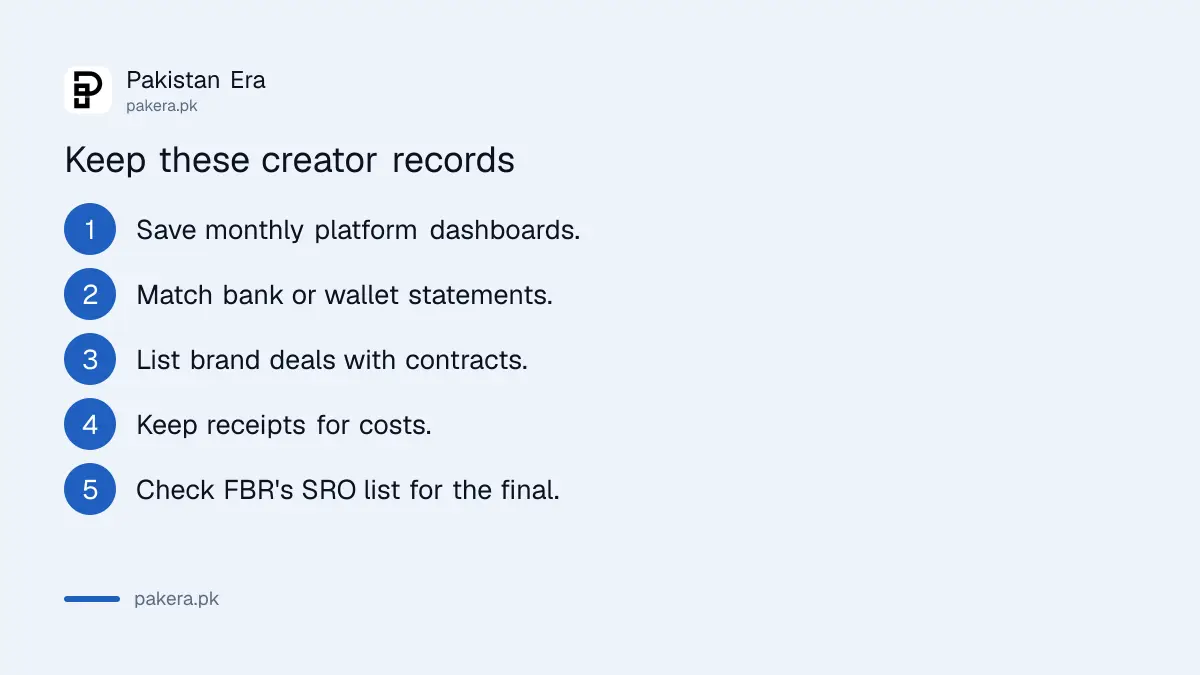
- Download your platform dashboards for each month, with views and payouts.
- Keep bank or wallet statements that match each payout.
- Note brand deals separately, with the contract and the payment received.
- Keep receipts for costs you plan to deduct, up to the 30% cap.
- Check FBR's SRO list again after seven days for a final notification.
If you earn from YouTube and want to understand where the income goes in your return, declaring YouTube and TikTok income in your FBR return walks through it. Creators on YouTube also face platform changes of their own, covered in YouTube's Partner Program changes for 2027.
Announcement, draft and notification are different stages
A draft is not law. FBR publishes draft rules for comment, reads objections, then notifies the final rule as an SRO. Only the notified SRO has legal effect. Until FBR posts a final SRO, the Rs 195 definition still refers to YouTube.
The reports we read agree on the draft's substance, but they are press accounts of a document we have not seen on FBR's page. If FBR's SRO list later shows the draft or the final rule, that text is the one to trust.
Common questions
Does the Rs 195 benchmark apply to TikTok, Instagram and Facebook today?
The final rules define the rate for YouTube views. A reported draft would extend it to all social media platforms, but it is not yet a final rule.
Has FBR published the draft on its website?
We could not find it on FBR's SRO list on 11 October 2026. The details are reported, not confirmed from FBR's own page.
Is the tax rate changing?
The draft is not reported to change the rate. It is reported to change the platform wording in the definition of revenue per mille.
Which rules would change?
Reports name rule 13ZP for residents and rule 19R for non-residents, both made under section 99C of the Income Tax Ordinance, 2001.
How long do creators have to object?
Reports say seven days from Gazette publication. We could not confirm the publication date, so check FBR's list for the exact window.
Do I have to pay tax on the benchmark if I earned less?
The formula starts from the benchmark. Under the final rules you may show lower real earnings with evidence to the Commissioner.
How we verified this
What we checked, where we read it, and what we could not confirm.
Last checked 11 October 2026. We read FBR's own SRO list and its newsroom, where the draft did not appear, and relied on our own earlier reading of the final SROs 1640, 1641 and 1642 of 2026, which we downloaded from FBR on 25 September 2026. The draft's wording and the seven day objection period come from press reports and are marked as reported. This is general information, not tax advice.
About the author

Founder and Editor
Umer Kureshi founded Pakistan Era in July 2024 and runs it as administrator, SEO lead and writer, overseeing website operations, search growth, content strategy and coverage of technology and current affairs.