FBR SRO 1642: Social Media Tax Rules for Overseas and Foreign Creators
FBR's SRO 1642 taxes non-resident creators only above 50,000 users in Pakistan a year. Check if you are non-resident and which income counts, with an example.
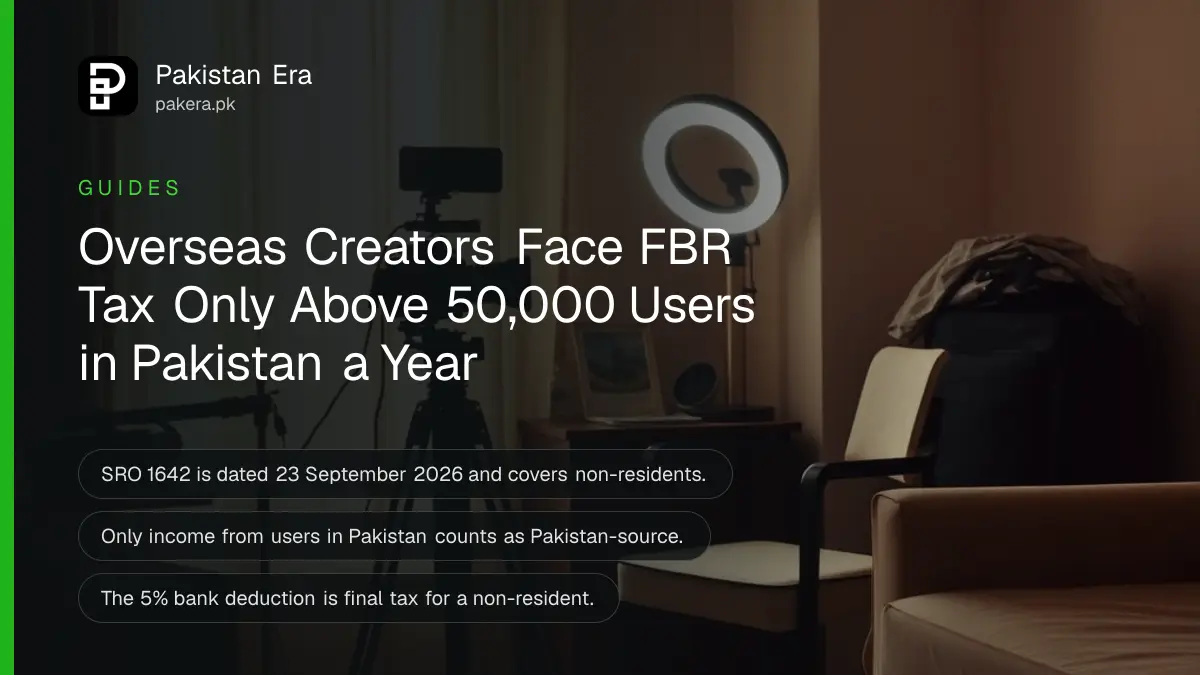
FBR's SRO 1642(I)/2026, dated 23 September 2026, taxes non-resident creators on income from viewers in Pakistan, but only once they reach more than 50,000 users in Pakistan in a tax year, or 12,250 in a quarter. Below that line the rules do not apply. Above it, FBR counts Rs 195 per 1,000 views as minimum income, less costs of up to 30%.
Update, 11 October 2026: A reported FBR draft would apply the Rs 195 benchmark to all social media platforms. Read the report.
That covers overseas Pakistanis who no longer count as resident, and foreign creators with a Pakistani audience. We downloaded SRO 1642 from FBR's site again on 6 October 2026 and read it with the Income Tax Ordinance 2001, amended up to 30 June 2026.
Creators living in Pakistan fall under a sister notification, SRO 1641, and their AdSense money is taxed under section 154B, not at PSEB's 0.25% export rate. Everything below is about creators outside Pakistan.
Your residency decides whether SRO 1641 or SRO 1642 applies
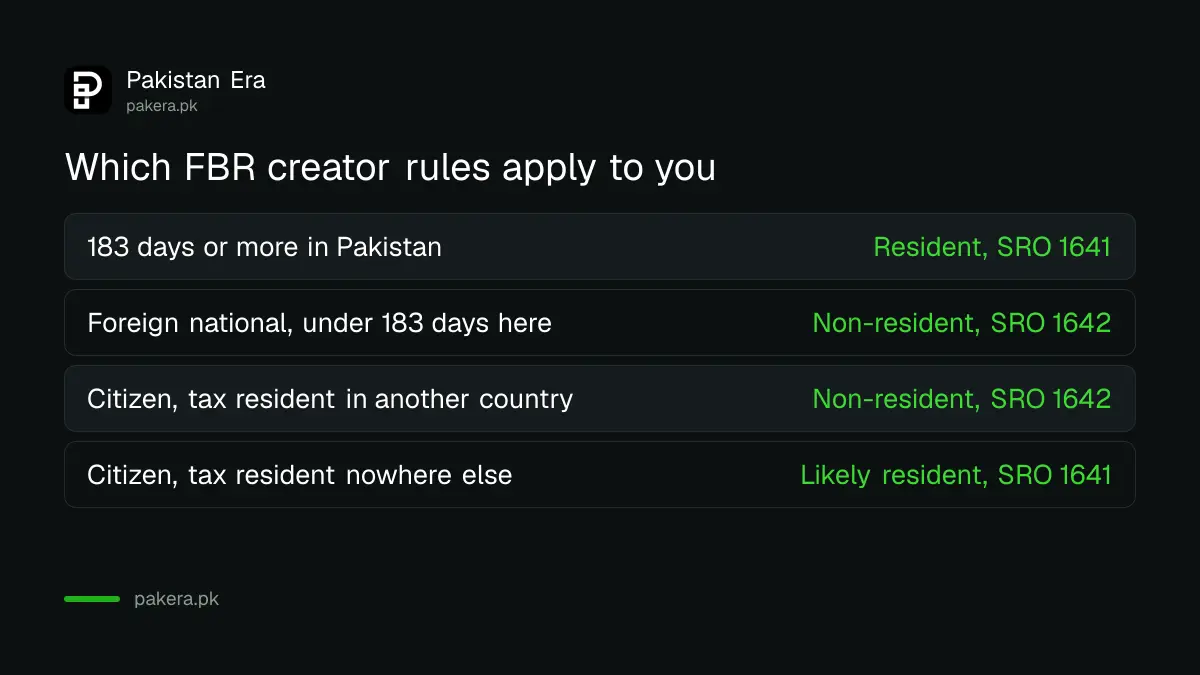
Section 82 of the Ordinance makes you resident for a tax year if you spend 183 days or more in Pakistan. A Pakistani citizen can also be resident without that, if they were not in any other country for more than 182 days, or are not a resident taxpayer of any other country.
Pakistan's tax year runs from 1 July to 30 June. Tax year 2027 started on 1 July 2026, and SRO 1642 falls inside it.
| Your situation in the tax year | Likely status | Rules that apply |
|---|---|---|
| In Pakistan 183 days or more | Resident | SRO 1641, no user threshold |
| Foreign national, under 183 days in Pakistan | Non-resident | SRO 1642, above 50,000 users |
| Pakistani citizen, more than 182 days in one other country, and a tax resident there | Non-resident | SRO 1642, above 50,000 users |
| Pakistani citizen abroad, but not a resident taxpayer of any other country | Resident, on a plain reading of section 82(d) | SRO 1641, no user threshold |
| Federal or provincial government employee posted abroad | Resident | SRO 1641 |
The fourth row is the one overseas creators miss. If you live in a country with no personal income tax and never became its tax resident, section 82(d) can keep you resident in Pakistan. Then the resident rules apply to you, with no 50,000 threshold at all. We found no FBR guidance applying this test to creators, so a tax residency certificate from your host country is the strongest proof you can hold.
For the rest of an overseas Pakistani's return, such as rent or bank profit here, the rules in filing a tax return as an overseas Pakistani still apply.
SRO 1642 starts at more than 50,000 users in Pakistan
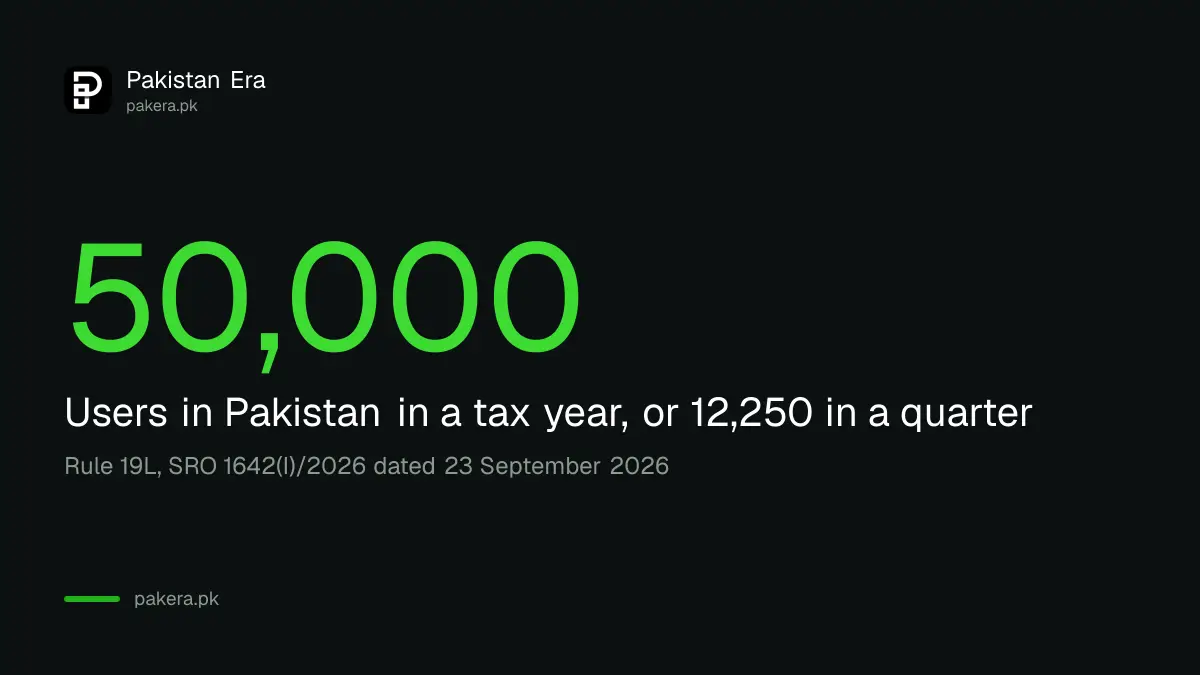
Rule 19L sets the line at more than 50,000 users in Pakistan in a tax year, or more than 12,250 in a quarter. Cross either and your income from Pakistani users counts as Pakistan-source income under section 101(3B)(b). Below both, these rules do not reach you.
Section 101(3B)(b) was added by the Finance Act 2024. It treats "systematic and continuous" digital interaction with a set number of users in Pakistan as a business presence here. That applies even if you have no office in Pakistan, sign nothing here and never visit. FBR calls this "significant economic presence".
Two words matter. The rule counts users, not views and not subscribers. And the SRO does not say how a user is counted, or whether a person who watches 20 videos is one user or 20. Until FBR explains, unique viewers from Pakistan is the closest figure most platforms give you.
Only the income from Pakistani users is taxed
The proviso to section 101(3B) says only income attributable to the Pakistani activity counts as Pakistan-source. So a creator in Toronto with a mostly Canadian audience is not taxed in Pakistan on the whole channel. Only the Pakistani slice is in scope.
Inside that slice, rules 19M and 19N set minimum income. It is the higher of Rs 195 per 1,000 views or what you actually earned, in cash or goods. Then you subtract costs of up to 30% of revenue. The rules do not say in plain words that the views must be Pakistani views. We read them together with the proviso, which limits the income to the Pakistani part.
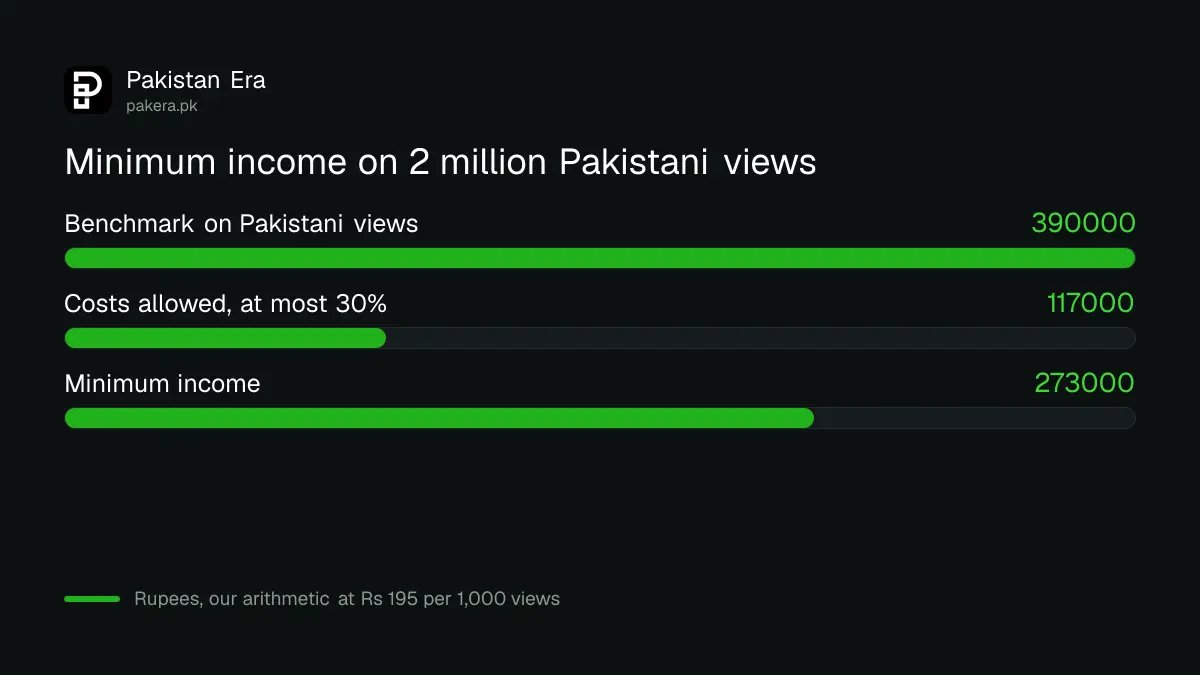
Here is what that means in rupees, using our own sums. Take a creator with 10 million views in the tax year, of which 2 million came from Pakistan.
| Step | Pakistani views only | If FBR counted all views |
|---|---|---|
| Views used | 2,000,000 | 10,000,000 |
| At Rs 195 per 1,000 | Rs 390,000 | Rs 1,950,000 |
| Less costs, at most 30% | Rs 117,000 | Rs 585,000 |
| Minimum income | Rs 273,000 | Rs 1,365,000 |
The gap between the two columns is why the Pakistani share of your audience matters so much. Keep the country report that proves it. The resident version of the formula, with tax worked out at several view counts, is in FBR's Rs 195 per 1,000 views rule.
The 5% bank deduction is a final tax for non-residents
Section 154B makes a Pakistani bank deduct tax when platform money lands in an account here. The Ordinance sets the rate at 5%. For a non-resident with no permanent establishment in Pakistan, that deduction is a final tax. For a resident it is only a minimum tax.
A final tax settles the bill on that money. It is not added to other income or taxed again. But 154B only works on money that reaches a Pakistani bank or wallet. If YouTube pays you in Dubai or London, no Pakistani bank deducts anything. Residents treat the same deduction as a minimum and settle the rest when declaring YouTube and TikTok income in their return.
One question the law leaves open. SRO 1642 sets a minimum income for non-residents. Section 154B says the bank deduction is their final tax. Neither the SRO nor the Ordinance says how the two fit together when a non-resident is paid into a Pakistani account. We could not find an FBR circular on this, so treat it as unsettled.
What a non-resident creator should do now
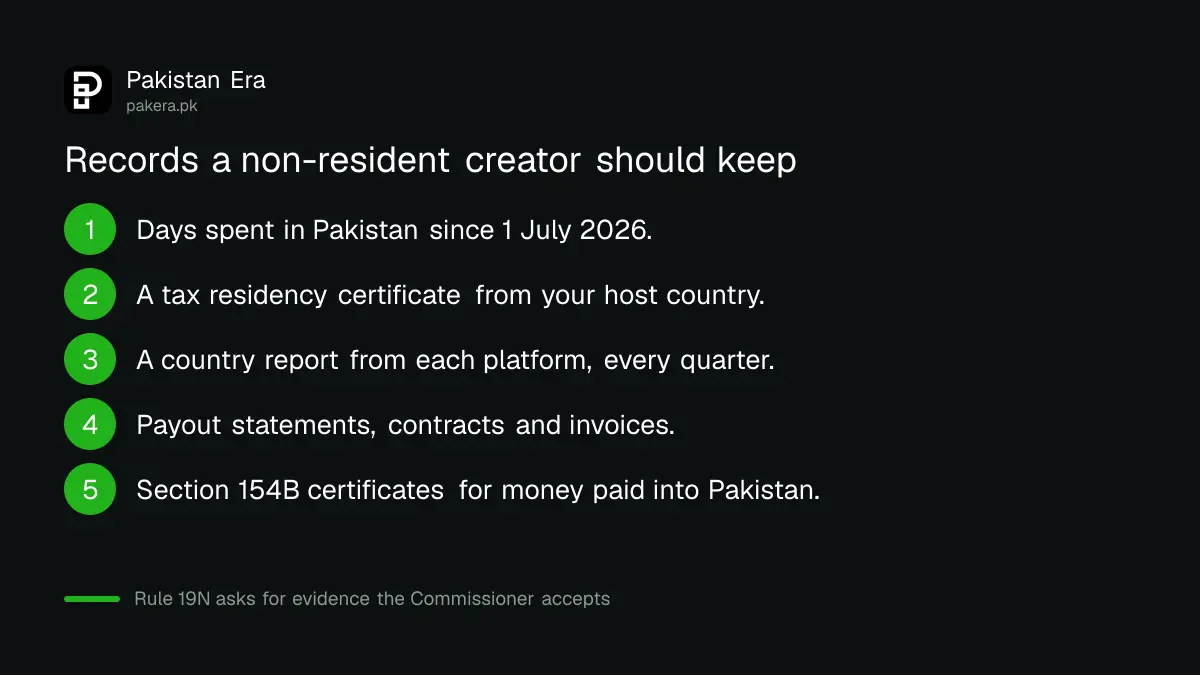
Start with your days and your audience, because those two facts decide everything else. Then keep the records the Commissioner may ask for. Rule 19N lets you prove real earnings below the Rs 195 benchmark, but only with evidence "to the satisfaction of the Commissioner".
- Count your days in Pakistan for the tax year, from 1 July 2026. Keep passport stamps or travel records.
- Get a tax residency certificate from the country you live in, if it issues one.
- Download your platform's country report each quarter. YouTube Studio's advanced analytics shows views and viewers by country.
- Keep payout statements, brand contracts and invoices, and mark which came from Pakistani clients.
- If money comes into a Pakistani account, keep the bank's section 154B deduction certificates.
If you cross the threshold, rule 19P says the income goes in a special part of the return, and rule 19O asks for advance tax each quarter under section 147. FBR has not said how a non-resident with no NTN, the national tax number, should start. Registering on IRIS, FBR's online system, is the usual first step for anyone with Pakistan-source income.
Common questions
Does SRO 1642 apply to overseas Pakistani YouTubers?
Only if they are non-resident under section 82 and have more than 50,000 users in Pakistan in a tax year, or 12,250 in a quarter. A citizen who is not a tax resident anywhere else may still count as resident.
Is the 50,000 threshold subscribers or views?
Neither. SRO 1642 counts users in Pakistan. It does not define how a user is counted.
Is my whole channel's income taxed in Pakistan?
No. Section 101(3B) limits Pakistan-source income to the part attributable to Pakistani users. The rest of your income is outside these rules.
What tax rate applies to non-resident creators?
SRO 1642 sets no rate. It sets minimum income. The only rate we found is the 5% bank deduction under section 154B, which is final tax for a non-resident with no permanent establishment here.
When do the non-resident rules start?
SRO 1642 is dated 23 September 2026 and names no start date. That date falls in tax year 2027, which began on 1 July 2026.
What if I am paid into a foreign bank account?
No Pakistani bank deducts the section 154B tax. The SRO 1642 rules can still apply if you cross the user threshold.
How we verified this
What we checked, where we read it, and what we could not confirm.
Last checked 6 October 2026. We read SRO 1642(I)/2026, dated 23 September 2026, from FBR's download server, including rules 19J to 19R. Sections 82, 101(3A) and (3B), 147 and 154B, and Division IIIAB of the First Schedule, come from FBR's Income Tax Ordinance 2001, amended up to 30 June 2026. The worked example is our own arithmetic and not tax advice for your case. FBR has not published guidance on counting users, on how section 82(d) applies to creators, or on how SRO 1642 and section 154B interact.
About the author

Senior Writer, Public Services and Technology
Shahid joined us in 2024 as an author. He is a senior contributor to Pakistan's leading technology websites. He writes detailed articles, mostly covering his expertise in the latest tech, mobiles, apps, gadgets, and step-by-step guides. His ideology is to help people understand the latest trends and explain complex methods through very easy-to-understand guides.