File a Tax Return as an Overseas Pakistani: Non-Residents Declare Only Pakistan Income
Overseas Pakistanis under 183 days in Pakistan file as non-residents and declare only Pakistan income. Who must file, what to declare, steps by 15 October.
An overseas Pakistani who spent fewer than 183 days in Pakistan in tax year 2026 files as a non-resident. Only Pakistan-source income goes in the return, such as rent, bank profit or a property gain here. Salary earned abroad does not. File on IRIS by 15 October 2026.
Many Pakistanis abroad skip the return because they think they have nothing to declare. Then they buy a plot at home, or a parent registers a car in their name, and the non-filer rates hit them. A nil-looking return filed in time would have avoided most of it.
We read the residence and income rules below in FBR's copy of the Income Tax Ordinance 2001, amended up to 30 June 2026, on 2 October 2026. FBR has extended the tax year 2026 due date to 15 October 2026 by Circular No. 3 of 2026-27.
Your days in Pakistan decide whether you are resident
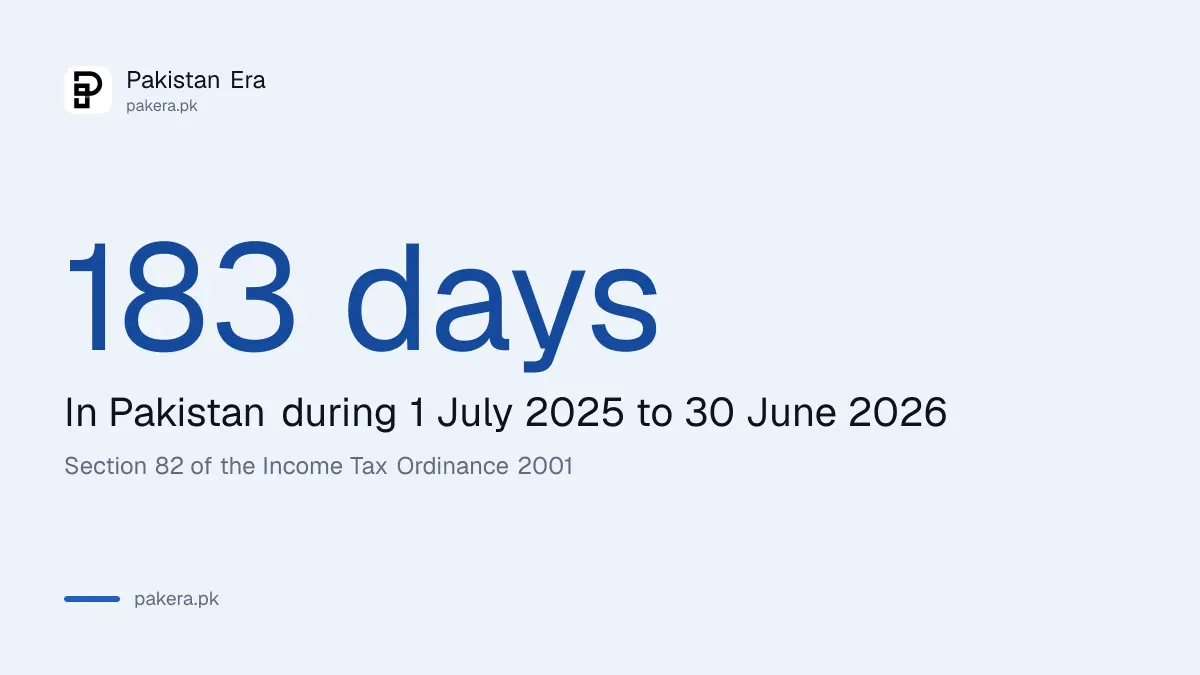
Under section 82, you are a resident individual for the tax year if you were in Pakistan for 183 days or more in total. Tax year 2026 ran from 1 July 2025 to 30 June 2026. Fewer than 183 days usually makes you non-resident.
Two other rules can make you resident even with fewer days here. A federal or provincial government employee posted abroad is resident. And clause (d), added in 2022, treats a citizen as resident if they were not present in any other country for more than 182 days in the year.
Clause (d) catches people who move between countries and never settle long in one. If that is you, count days in every country, not just Pakistan. Your passport stamps and air tickets are the evidence. Keep them.
Non-residents declare only Pakistan-source income
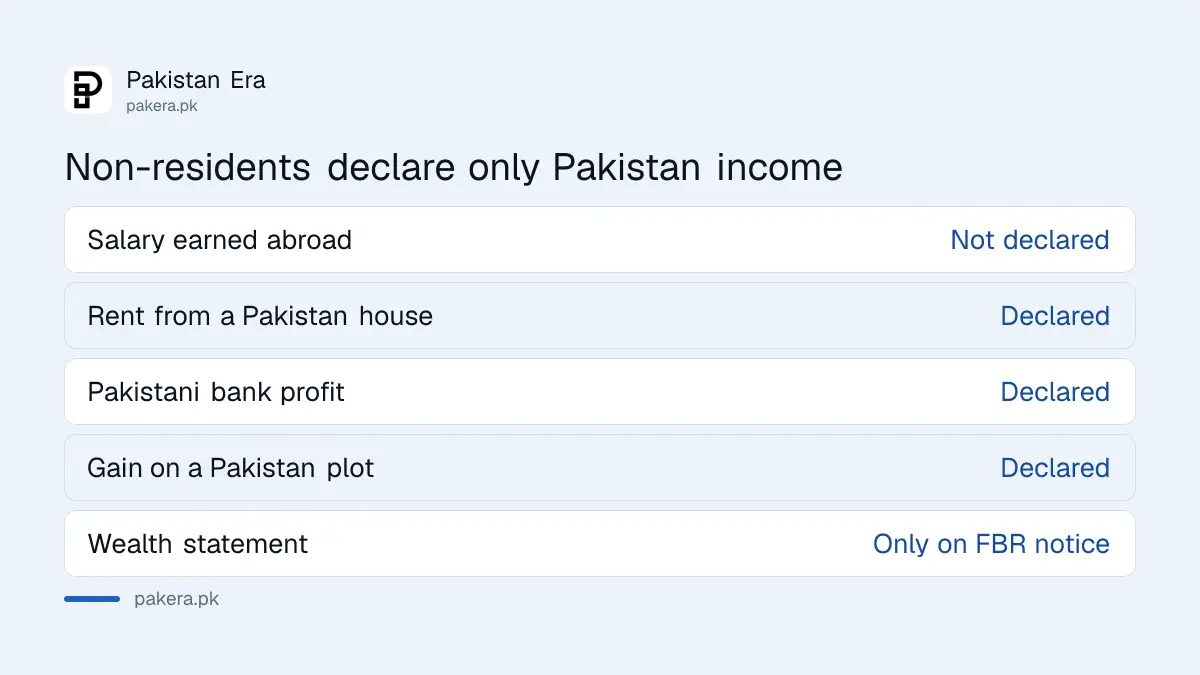
Section 11(6) says a non-resident's income is worked out using only Pakistan-source income. A resident, under section 11(5), counts both Pakistan and foreign income. That single difference decides what goes in your return.
| Income | Non-resident | Resident |
|---|---|---|
| Salary from a job in Dubai, London or Riyadh | Not declared | Declared as foreign income |
| Rent from a house in Pakistan | Declared | Declared |
| Profit on a Pakistani bank account | Declared | Declared |
| Gain on selling a plot in Pakistan | Declared | Declared |
| Wealth statement | Only if FBR asks by notice | Required with the return |
Rent is the item most often missed. If a brother collects rent on your house in Lahore, the income is still yours. The rules on tax on rental income apply to you as a non-resident too.
Non-residents do not have to attach a wealth statement
Section 116(2) requires a wealth statement with the return from every resident individual. A non-resident is outside that subsection. But under section 116(1), the Commissioner can still ask anyone for one by written notice.
This makes a non-resident return shorter. You file the income part and skip the wealth statement, unless a notice arrives. If one does, answer it by the date it gives.
Once you return to Pakistan and become resident again, the wealth statement comes back. It then has to explain everything you own, including what you built up abroad. Starting a clean record while you are away makes that first resident year far easier.
Filing still cuts the tax on property, cars and bank profit
A return puts you on the Active Taxpayers List. That list, not your passport, decides the withholding rate when you buy property or a car, or earn bank profit in Pakistan. The gap is large.
On a Rs 10 million property purchase, a filer pays Rs 125,000 in advance tax and a non-filer pays Rs 1,050,000, under the rates in force from 1 July 2026. On bank profit, a filer pays 20% and a non-filer 40%. These are the same rates every buyer faces.
There is also a special rule for overseas sellers. When a non-resident who bought through a Foreign Currency Value Account or a Non-Resident Pakistani Rupee Value Account sells, the tax collected at sale can be the final tax. The details are in the breakdown of tax when you buy or sell property.
File as a non-resident on IRIS in five steps
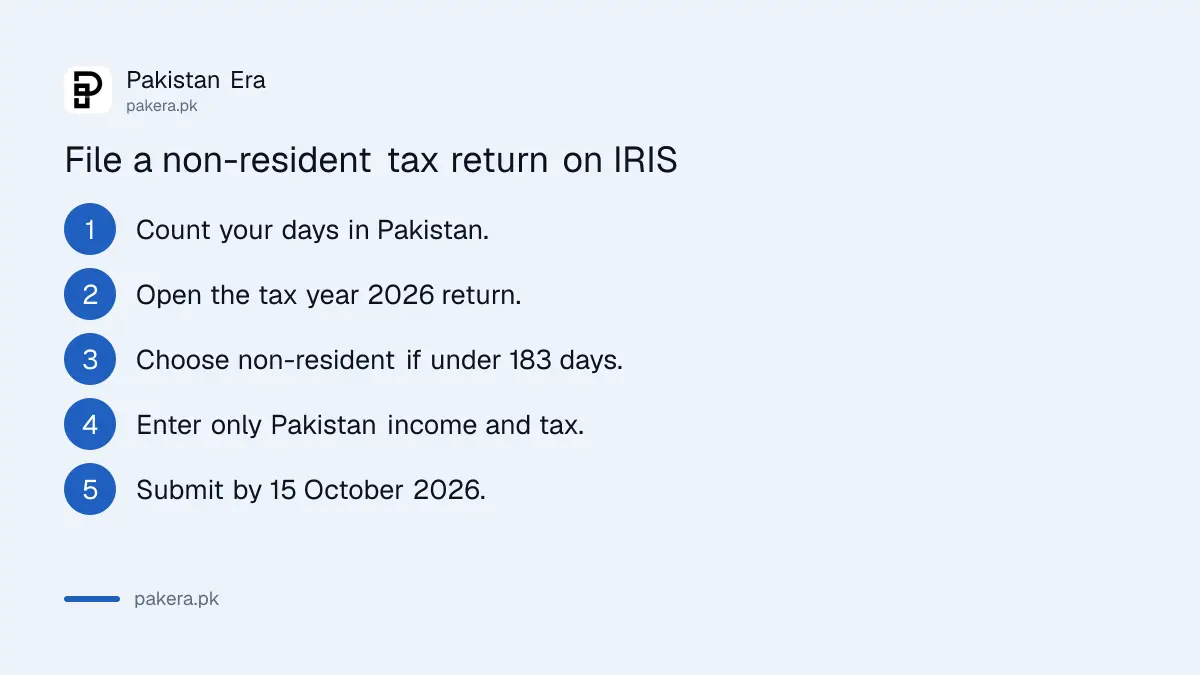
You can file from abroad. You need your CNIC or NICOP number, an IRIS login, and the Pakistani income figures for July 2025 to June 2026. Bank profit and the tax deducted on it are on your bank's yearly tax certificate.
- Count your days in Pakistan for 1 July 2025 to 30 June 2026.
- Log in to IRIS, or the Tax Asaan app, and open the tax year 2026 return.
- Answer the residence question as non-resident if you were here fewer than 183 days and no other rule applies.
- Enter only Pakistan-source income, such as rent and bank profit, and the tax already deducted.
- Submit by 15 October 2026 and save the acknowledgement.
The Tax Asaan app asks the resident question near the start. After filing, you can check your filer status from abroad on FBR's website. Miss 15 October and a Rs 25,000 surcharge applies to get back on the list.
Common questions
Do overseas Pakistanis need to file a tax return?
Only if they have taxable Pakistan-source income or meet a section 114 condition, such as holding an NTN. But filing is worth it for anyone who buys property, a car or keeps savings in Pakistan.
Is my foreign salary taxed in Pakistan?
Not if you are non-resident. Section 11(6) counts only Pakistan-source income for a non-resident.
How many days make me resident in Pakistan?
183 days or more in the tax year, under section 82. A citizen not present in any other country for more than 182 days can also be resident.
Do non-residents file a wealth statement?
Not with the return. Section 116(2) applies to resident individuals, though FBR can ask anyone for one by notice.
What is the deadline for overseas Pakistanis?
15 October 2026 for tax year 2026, the same as everyone else covered by FBR's Circular No. 3 of 2026-27.
How we verified this
What we checked, where we read it, and what we could not confirm.
Last checked on 2 October 2026. The 183 day test and the clauses on government employees abroad and on citizens not present in another country for more than 182 days are from section 82. The Pakistan-source rule for non-residents is section 11(6), and the resident rule is section 11(5). The wealth statement rule is section 116(1) and (2), and the reasons to file are in section 114. All are read in FBR's Income Tax Ordinance 2001, amended up to 30 June 2026. The filer and non-filer rates were read in the First and Tenth Schedules on 21 September 2026. The 15 October 2026 date is from FBR's Circular No. 3 of 2026-27. Nothing here is tax advice for your own case, and tax treaties with your country of work may add rules we have not covered.
About the author

Tax, Bills and Technology Writer
Ali Akhtar is a young and curious voice here at Pakistan Era. He is currently pursuing his A-Levels and has a growing interest in Pakistan’s changing industrial landscape and educational trends. Ali likes to write in a way that helps him explain and explore the world around him. His writing reflects the perspective of the new generation navigating the evolving trends of Pakistan where technology, youth innovation, and shifting opportunities are reshaping the country’s future.