What Landlords in Pakistan Pay in Tax on Rent
A non-adjustable deposit counts as rent across ten tax years, and renting below market rate does not cut the bill. What the Ordinance says.
A deposit your tenant pays that is not adjustable against rent is not a one off receipt. The law treats it as rent across ten tax years. So a large advance taken once produces taxable income every year for a decade.
We read sections 15, 16 and 155 of the Income Tax Ordinance, 2001 on 29 August 2026, in the consolidated text FBR publishes on its own download site. There is a limit on that copy which we set out at the end, and no rate is quoted here for that reason.
The deposit rule, which catches almost every landlord
Section 16 deals with what it calls non-adjustable amounts received in relation to buildings. That is the security deposit or advance that will not be set against the rent.
Where the owner of a building receives such an amount from a tenant, it is treated as rent chargeable under the head Income from Property in the tax year it was received and the following nine tax years, in equal proportion.
- The amount is divided into ten equal parts.
- One part is taxed in the year you received it.
- One part is taxed in each of the next nine years.
- If you refund it before ten years, no part is allocated to that year or later ones.
- A new tenant's deposit is reduced by whatever was already taxed.
That last step is worth reading twice. Where the earlier amount is refunded and the building is let to a succeeding tenant who pays another non-adjustable amount, the succeeding amount is reduced by the portion of the earlier amount that was already charged to tax, and the balance is then spread the same way.
So the ten year clock does not simply restart at the full figure each time a tenant changes. Keep a record of how much of each deposit has already been taxed, because without it you will pay twice on the same money.
Renting cheaply to a relative does not reduce the tax

Section 15(4) closes the obvious move. Where the rent received or receivable is less than the fair market rent for the property, the person is treated as having derived the fair market rent for the period the property was let during the tax year.
A nominal rent to a family member therefore does not produce a nominal tax bill. The exception in subsection (5) is narrow: it does not apply where the fair market rent is already included in the tenant's own income under the head Salary, which covers accommodation provided as part of employment.
Not all of your rent is Income from Property
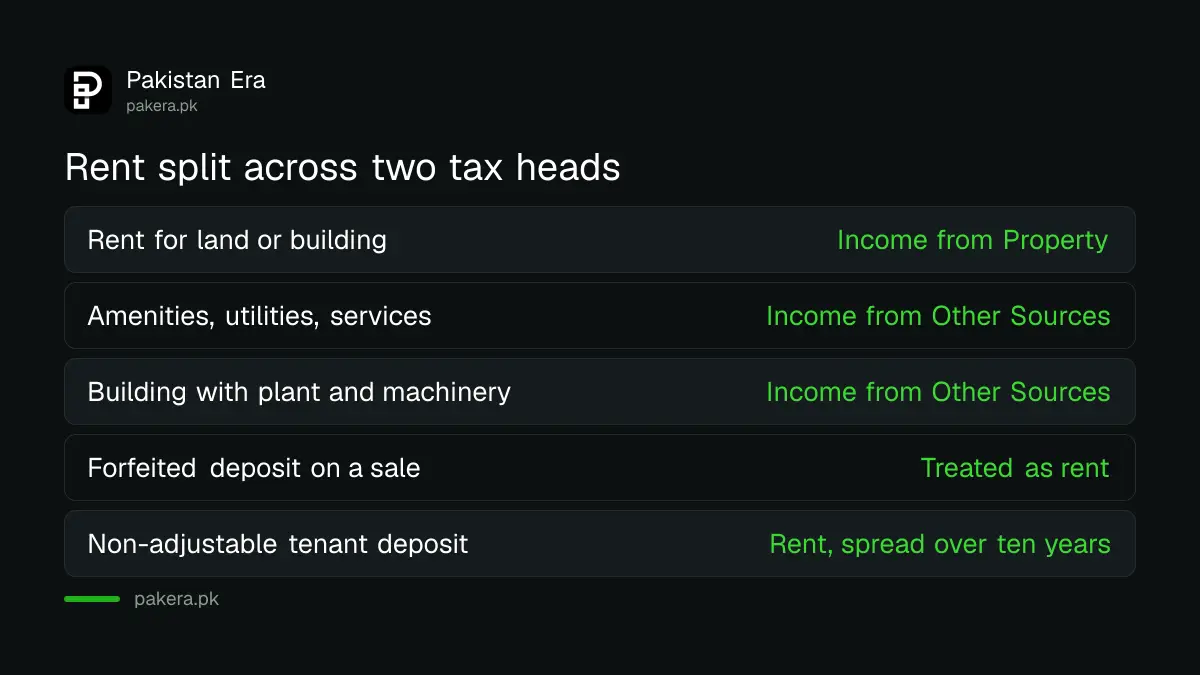
This is the split people miss when they file. The Ordinance sends parts of a single monthly payment to different heads of income.
| What you receive | Which head it falls under |
|---|---|
| Rent for the land or building | Income from Property |
| Amounts for amenities, utilities or services | Income from Other Sources |
| A building let together with plant and machinery | Income from Other Sources |
| A forfeited deposit under a contract for sale | Treated as rent |
| A non-adjustable deposit from a tenant | Rent, spread over ten years |
Section 15(3A) is explicit that where an amount is included in rent for the provision of amenities, utilities or any other service connected with the renting of the building, that amount is chargeable under Income from Other Sources. If your agreement bundles maintenance or utility charges into one figure, the return has to separate them.
Section 15(2) also defines rent to include any forfeited deposit paid under a contract for the sale of land or a building. A buyer who walks away and loses their deposit leaves you with taxable rent, not a windfall.
Someone may be deducting tax before you are paid
Section 155 requires every prescribed person making a payment, in full or in part and including a payment by way of advance, on account of rent of immovable property to deduct tax from the gross amount of rent paid.
Two details in it matter to a landlord. The section covers rent of furniture and fixtures and amounts for services relating to the property, so the deduction is not limited to the bare rent. And an explanation states that the gross amount of rent includes the amount referred to in section 16, which means the non-adjustable deposit falls inside the withholding as well.
If your tenant is a company or another prescribed person, expect tax to be deducted at source. Ask for the deduction certificate every time, because that is what lets you claim the credit when you file, in the same way we set out for tax collected on a property transfer.
A discrepancy in FBR's own document
We should record something we noticed while reading, because anyone checking the primary source will hit it too.
In the consolidated Ordinance we downloaded, the table of contents lists section 155 as omitted by the Finance Act, 2021. The body of the same document contains section 155 in force, headed Rent of immoveable property, with a footnote showing that the Finance Act, 2021 substituted words in the heading rather than removing the section.
So the contents page and the body of the same official document disagree. The body carries the operative text and the footnote explains the 2021 change, which is the better reading, but confirm the position with a tax adviser rather than relying on either page alone.
What to keep, and where the tenant side sits
Records win these arguments. Keep the tenancy agreement, a note of every deposit taken with the date, a running tally of how much of each deposit has already been charged to tax, every deduction certificate, and evidence of any refund made on termination.
The tenant's position is governed by provincial rent law rather than by this Ordinance, and our guides to tenant rights on rent and eviction and to putting a rent agreement on stamp paper cover that side. Tax and tenancy are separate systems, and complying with one does not settle the other.
Common questions about tax on rent
Is a security deposit taxable?
A deposit that is not adjustable against rent is treated as rent across the year of receipt and the following nine tax years in equal proportion.
What if I refund the deposit early?
Where it is refunded on termination before ten years, no portion is allocated to the year of refund or to later years.
Can I charge my brother a token rent?
You can, but section 15(4) treats you as having derived the fair market rent where the rent received is less than it.
Do utility charges count as rental income?
Amounts for amenities, utilities or services connected with the renting are chargeable under Income from Other Sources rather than Income from Property.
Will my tenant deduct tax?
A prescribed person must deduct from the gross amount of rent, which includes furniture, fixtures, services and the section 16 deposit.
How we verified this
What we checked, where we read it, and what we could not confirm.
Last checked 29 August 2026. We downloaded the consolidated Income Tax Ordinance, 2001 from FBR's own download site on that date, the version amended up to 20 February 2026, and read sections 15, 16 and 155 in it. The charge on rent under Income from Property, the definition of rent including a forfeited deposit under a contract for sale, the exclusion of a building let with plant and machinery, the treatment of amenities, utilities and services under Income from Other Sources, the fair market rent rule and its salary exception, the ten year spreading of a non-adjustable amount, the effect of a refund before ten years, the reduction of a succeeding tenant's amount by what was already charged, and the withholding obligation on prescribed persons including the explanation that gross rent includes the section 16 amount, are all taken from that text. The contents page of that same document records section 155 as omitted by the Finance Act, 2021 while the body contains it in force, and we have reported that discrepancy rather than resolving it. The published version predates the Finance Act, 2026, whose changes took effect on 1 July 2026, so no rate or threshold is quoted anywhere on this page. Nothing here is tax advice.
About the author

Public Services and Education Journalist
Fajr Riaz is a journalist and content writer at Pakistan Era, based in Lahore. She covers the questions people meet in everyday life in Pakistan: how a public service works, what a change in the rules means, and where to find a reliable answer.