The Lahore High Court Ruling Is Being Called a Tenant Rights Win. Read It Again.
A tenant stays a tenant until possession is handed back, and cannot block eviction with a third party ownership claim. What renters should know.
A Lahore High Court judgment on tenancy is going around today under the heading of tenant rights being clarified. We read what the court actually decided, and the framing is generous to the point of misleading.
The ruling closes a door tenants have used. It is worth understanding correctly, because a renter who thinks this judgment protects them has it backwards.
What the court decided
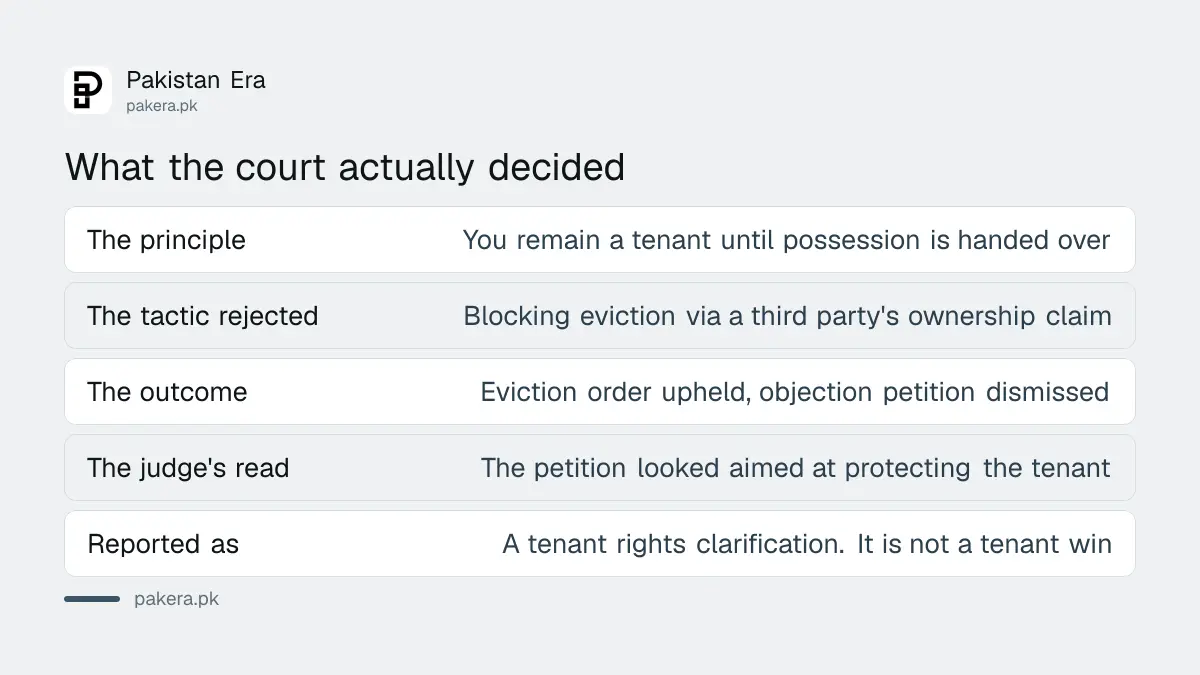
Justice Muzammal Akhtar Shabbir dismissed an ownership objection petition brought by Bilqis Begum and upheld an eviction order against Nahal Din, a shop tenant.
The principle stated is clean: once you are a tenant, you remain a tenant until you physically hand possession back to the owner. You cannot hold on to occupancy by producing a third party who claims to own the place.
The court found the ownership claim unsupported by sufficient evidence, noted the shop had already been excluded from an earlier eviction order, and observed that the petition looked aimed at protecting the tenant rather than safeguarding anyone's legal rights. The lower court decisions were found free of legal or jurisdictional defect.
Read that back. A tenant facing eviction produced a competing ownership claim, and the court treated it as a delaying device. That is a ruling for enforceability of eviction orders. Calling it a tenant rights clarification is technically true, in the sense that it clarifies that a tenant does not have that particular right.
Why it matters even though it went the other way
Because the delay tactic is common, and both sides of the rental market should know it just got harder.
Eviction disputes in Pakistan often turn less on who is right than on how long the process can be stretched. A tenant who cannot pay, or will not leave, has historically had procedural room to extend occupancy for a long time, and ownership objections have been part of that toolkit. The judgment says that particular tool does not work when the claim is not evidenced.
For landlords that is straightforwardly useful. For tenants it means the protection you actually have is the protection written into your agreement and your provincial statute, not a manoeuvre you found on the internet.
Rent law is provincial, and that is the first thing to know
There is no single national tenancy law in Pakistan. Punjab, Sindh, KP and Balochistan each legislate their own, with their own rent tribunals hearing disputes, and the notice periods, deposit rules and permitted rent increases differ between them.
We are not going to print a table of notice periods and deposit caps here, because those are provincial statute and we have not verified the current text of each today. What we will tell you is where the answer lives: your province's rent law and its rent tribunal, and for court matters the high court of your province, whose case systems we cover in the case status guide. The Lahore High Court's own site, lhc.gov.pk, publishes judgments and we opened it before writing this.
| Question | Where the answer lives |
|---|---|
| Notice period before eviction | Your province's tenancy law, and your agreement |
| How much rent can rise | Provincial statute, and any clause you signed |
| Getting the deposit back | The agreement, in writing, or nowhere |
| Where a dispute is heard | The provincial rent tribunal |
| Appeals beyond that | The high court of your province |
What actually protects a renter
Unglamorous, and it is the whole answer.
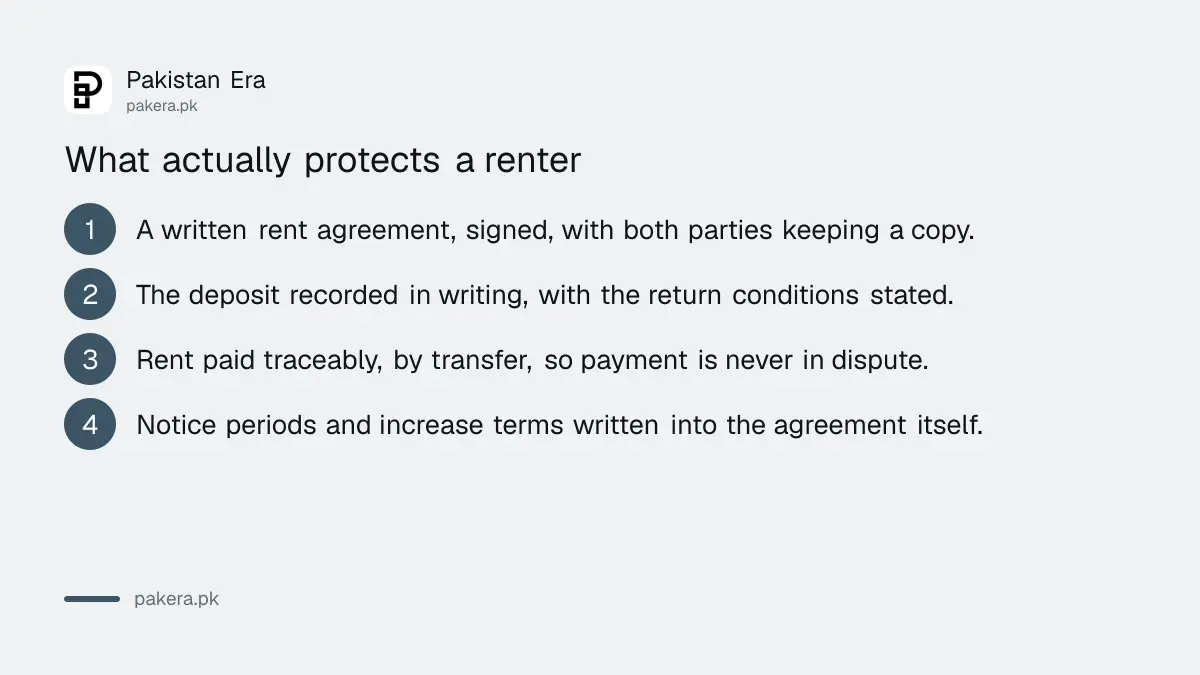
- A written agreement, signed, both parties holding a copy. Verbal tenancies are common and they are decided, when they go wrong, on whatever documents exist. Usually none.
- The deposit in writing, with the amount and the conditions for its return stated. Deposit disputes are the most common renter grievance in Pakistan and almost all of them are undocumented.
- Rent paid traceably. Bank transfer or wallet, not cash in an envelope. A payment history that exists is worth more than any clause, and our guide to digital payments covers the rails.
- Notice periods and increase terms in the agreement, so neither side is relying on memory or on what is customary.
Several provinces also require tenancy registration with the police, which exists for security reasons but incidentally creates an official record that a tenancy existed and on what terms. If your province requires it, do it, and for the identity side of that paperwork a valid CNIC is the precondition.
The verbal tenancy, and why "we are like family" costs money
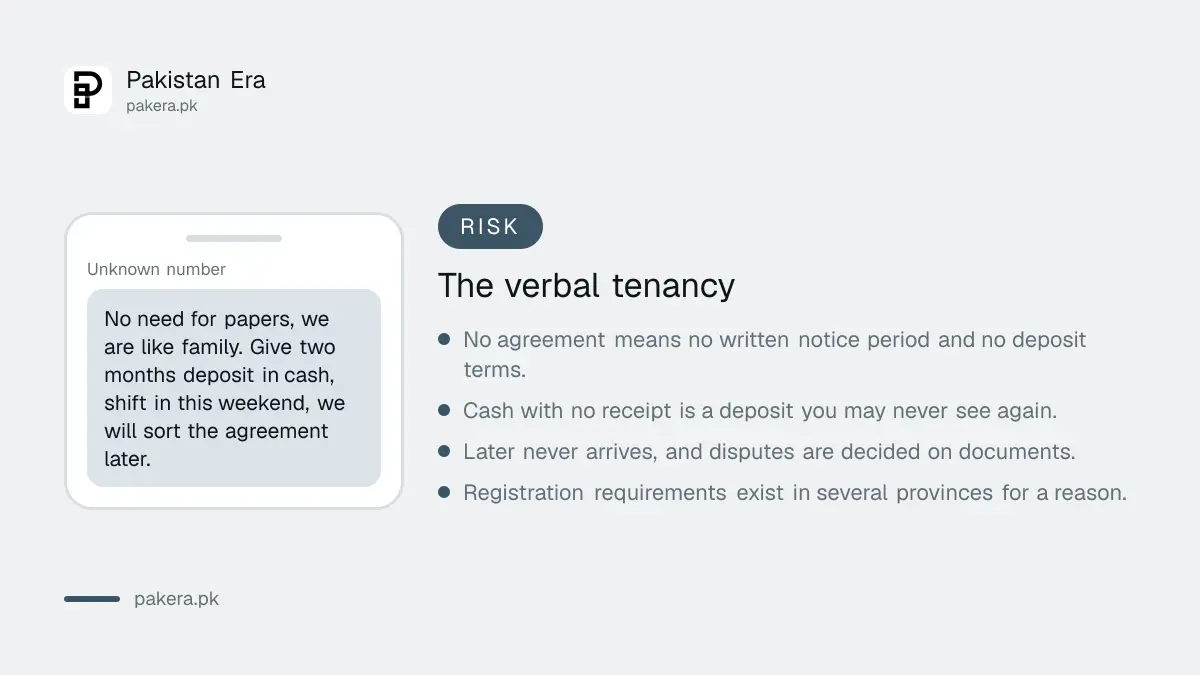
The pitch is always warm: no need for papers, we are like family, give two months in cash, shift in this weekend, we will sort the agreement later.
Later does not arrive. What arrives, eventually, is a disagreement about how much notice was due, whether the deposit covered that damage, or whether the rent was raised by agreement. And every one of those is decided on documents, at which point the family framing evaporates and the person with a piece of paper wins.
This is not cynicism about landlords, most of whom are fine. It is the same principle that runs through verifying land records before buying: the check costs nothing while everyone is friendly, and is impossible once they are not.
If you are already in a dispute
Gather documents before arguments: the agreement if one exists, payment records, and any written communication. Understand which tribunal has jurisdiction in your province. And get advice from a lawyer rather than from a forum, because tenancy law is provincial, procedural and unforgiving about deadlines.
What this week's judgment adds is a realistic expectation: courts are not sympathetic to devices that look designed to extend occupancy. Whatever your position, arguing the substance beats arguing the clock.
The paperwork behind the tenancy
Most tenancy disputes turn on what was written down at the start, and what was not.
A rent agreement on the correct stamp paper, properly executed, is what makes the rest of your position enforceable. The denominations, who pays, and what an unstamped agreement is actually worth are in the rent agreement guide.
Where a tenancy sits inside a family breakdown, the legal process runs on a different track with its own court, timelines and documents, which we cover in the khula procedure.
Questions readers are asking
What did the Lahore High Court rule?
That a tenant remains a tenant until possession is physically handed back to the owner, and cannot maintain occupancy by claiming a third party owns the property. The eviction order was upheld and the ownership objection dismissed.
Is this good news for tenants?
No, despite the headlines. It removes a delaying tactic and reinforces that lawful eviction orders are enforceable. Tenant protection comes from the agreement and provincial statute, not from procedural manoeuvres.
Which law governs rent in Pakistan?
There is no single national law. Each province legislates its own tenancy law with its own rent tribunals, so notice periods and deposit rules differ by province. Check your province's statute rather than a generic summary.
Do I need a written rent agreement?
Practically, yes. Disputes are decided on documents, and a verbal tenancy leaves you with nothing to show about notice, deposit or agreed rent.
How do I get my security deposit back?
By having recorded the amount and return conditions in writing at the start. Without that, the dispute becomes one person's word against another's, which is why deposits are the most common renter grievance.
Where are tenancy disputes heard?
Before your province's rent tribunal, with appeals into the higher courts. Case status for higher courts can be checked online, which our court status guide covers.
About the author

Senior Writer, Public Services and Technology
Shahid joined us in 2024 as an author. He is a senior contributor to Pakistan's leading technology websites. He writes detailed articles, mostly covering his expertise in the latest tech, mobiles, apps, gadgets, and step-by-step guides. His ideology is to help people understand the latest trends and explain complex methods through very easy-to-understand guides.