How to Get Admission in a Dar-ul-Aman Shelter Home in Pakistan
A woman in distress can walk into a Dar-ul-Aman directly, or get referred by a court, police or NGO. How admission works, what it costs, and who runs it.
A woman in distress can get admitted into a Dar-ul-Aman shelter home directly, by walking into the nearest facility, a district Social Welfare office, a police station or a court, without waiting for anyone's permission first. Admission is immediate in an emergency. Stay, food, medical care and legal help cost nothing, and a child can stay with his or her mother.
We read the Punjab Social Welfare Department's own monthly reporting form for Dar-ul-Aman facilities directly on 4 October 2026, the document staff use to record every admission. It lists direct admission as one of the recognised ways a woman enters, alongside referral by a court, the police, or a registered welfare agency. That detail matters, because a lot of people assume you need a court order or a police escort to get in. You do not.
Dar-ul-Aman means house of safety. Every province runs its own network of these shelters under its own Social Welfare Department, and Punjab's is the one with the clearest paper trail we could verify directly.
A woman can be admitted directly, or through a court, police or NGO referral
The Social Welfare Department's own admission records track six separate sources of referral: the courts, a voluntary agency or NGO, the department's own staff, press or media, community figures and advisory committees, and direct admission with no referral at all. Direct admission sits as its own recognised category, not an exception.
In practice, this means a woman does not have to go through a lawyer, a police report, or a hearing before she can be let in. If she walks up to the gate and asks for shelter, that itself counts as a valid route onto the record.
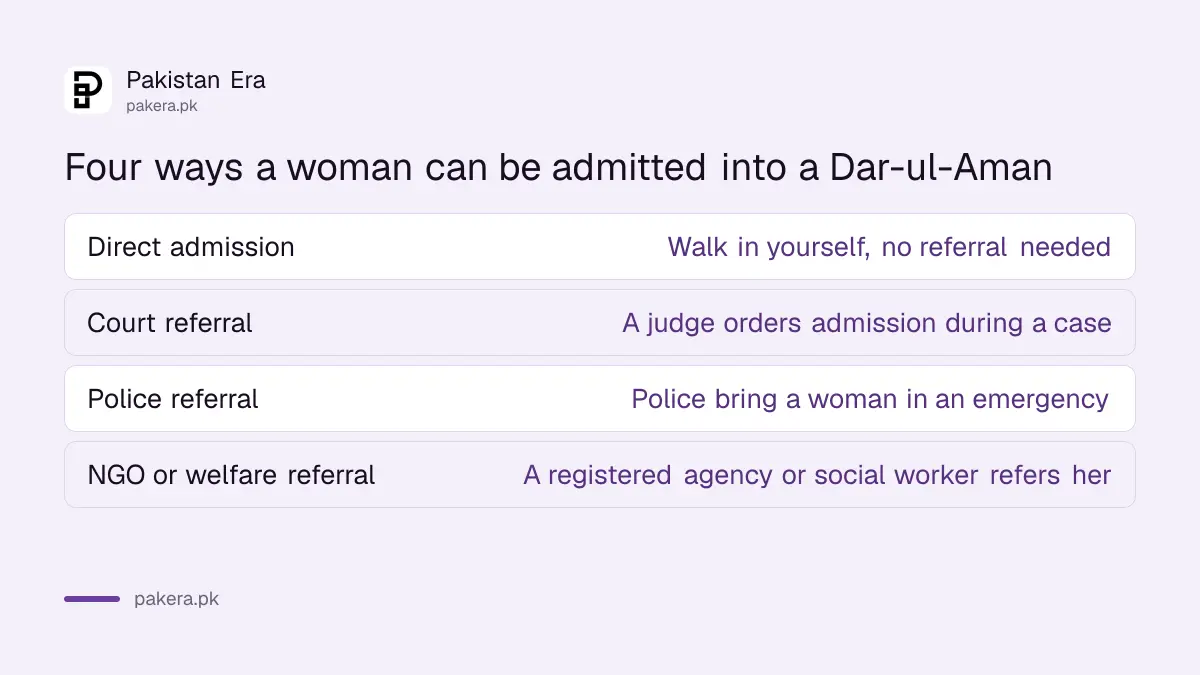
| Route | How it works |
|---|---|
| Direct admission | Walk in yourself, no referral needed |
| Court referral | A judge orders admission during a case |
| Police referral | Police bring a woman in an emergency |
| NGO or welfare referral | A registered agency or social worker refers her |
Getting admitted follows a short, practical sequence
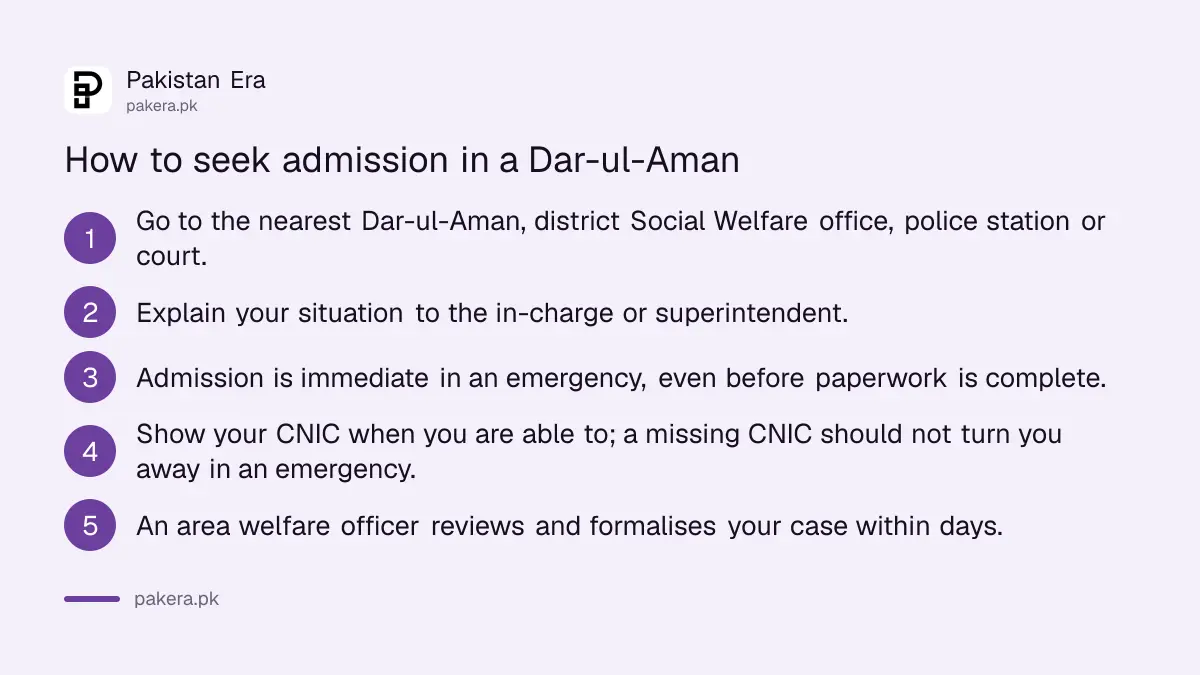
You do not need a complete case file to be let in. An emergency comes first, the paperwork catches up after.
- Go to the nearest Dar-ul-Aman, district Social Welfare office, police station or court.
- Explain your situation to the in-charge or superintendent on duty.
- Admission happens immediately if it is an emergency, even before paperwork is complete.
- Show your CNIC when you are able to; not having it on you should not be a reason to turn you away in an emergency.
- An area welfare officer reviews your case and formalises the admission within days, not weeks.
That last step is where your situation gets properly recorded, including whatever support you need next, medical, legal or otherwise. It is administrative, not a test of whether you deserve to stay.
Nothing about admission or your stay costs money
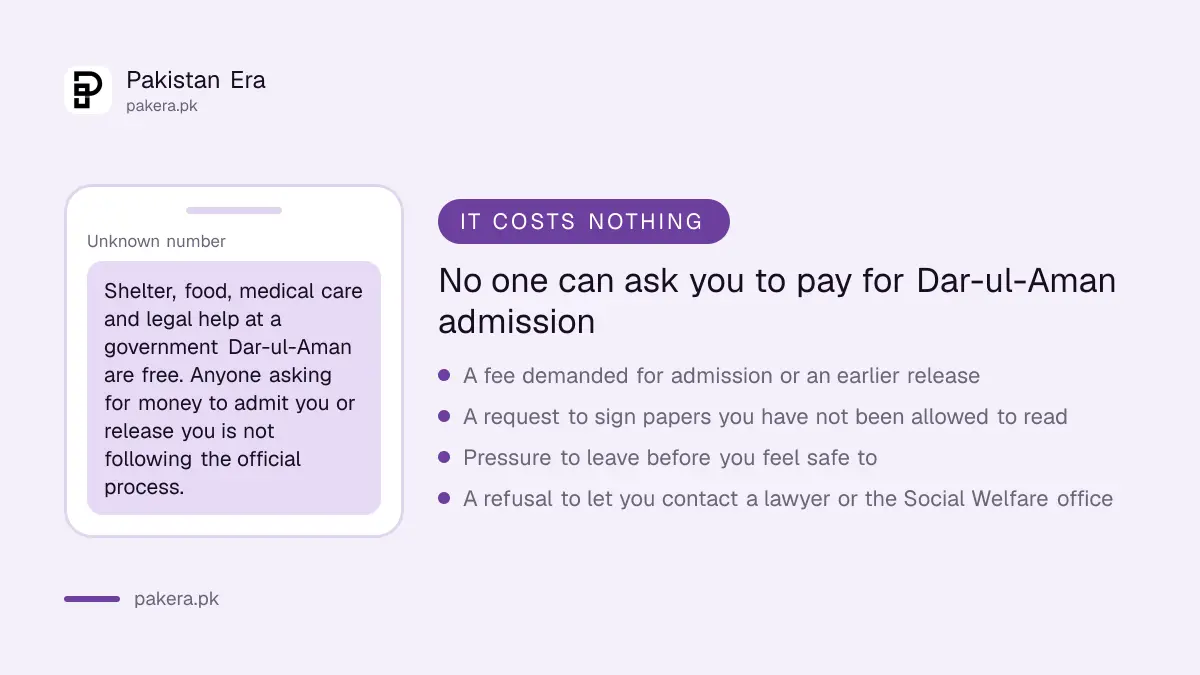
Shelter, food, medical attention and legal support inside a Dar-ul-Aman are free. The department's own reporting form tracks legal cases filed out of the facility's own budget and individual legal counselling given to residents, both as services provided, not services billed.
That matters because distressed women are sometimes the target of people claiming to help for a fee, including claims that a payment speeds up admission or an earlier release. Neither is a real part of the process. If anyone asks you or your family for money at any stage, that is not the department's process.
Children stay with their mother, and support goes beyond a roof
A woman admitted with children is not separated from them to get in. The department's own records track children accompanying their mother as a standard part of every admission, alongside the woman's own case.
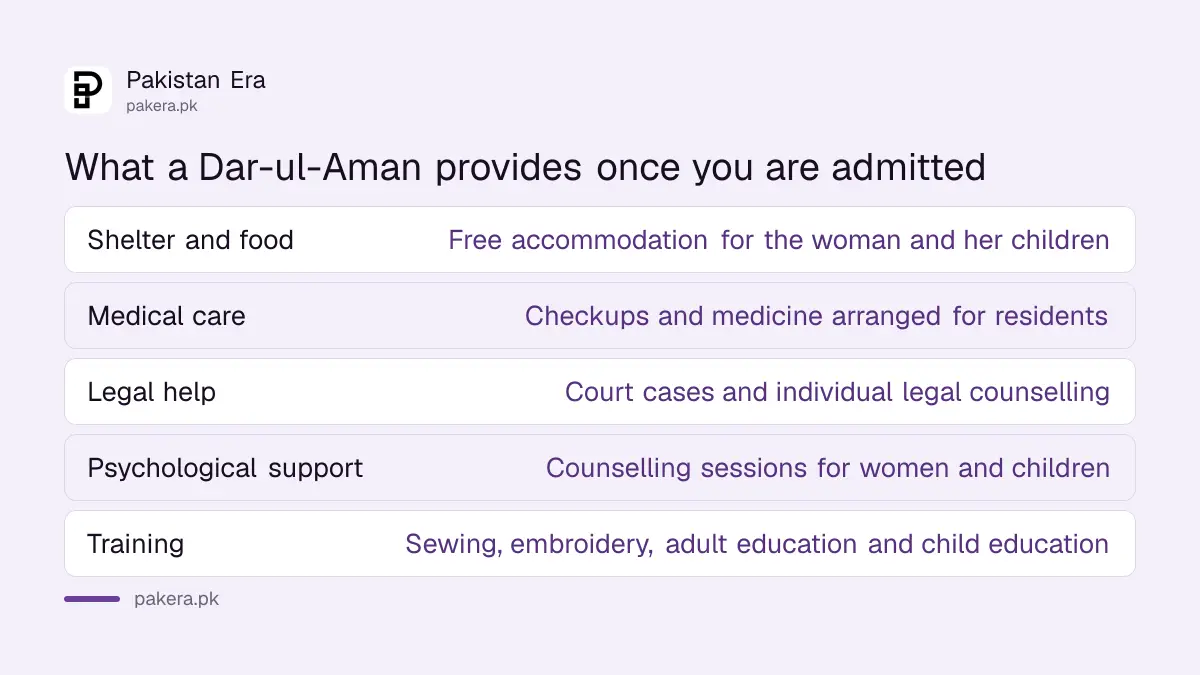
Once inside, a resident gets more than a bed. The facility's own tracked services include medical checkups and medicine, psychological counselling, vocational training in sewing, cutting and embroidery, religious classes, and both adult and child education for residents who want it. An Advisory Committee and a notified pool of lawyers are meant to operate at each facility, giving residents a route to raise a complaint about the facility itself, not only about the situation that brought them there.
Security is also something the department tracks formally: guards, security cameras, a boundary wall required to be more than two metres high, and a record of whether police patrol nearby. That is not decoration. It is part of what the government itself checks at each Dar-ul-Aman on a regular basis.
| Service | What it covers |
|---|---|
| Shelter and food | Free accommodation for the woman and her children |
| Medical care | Checkups and medicine arranged for residents |
| Legal help | Court cases and individual legal counselling |
| Psychological support | Counselling sessions for women and children |
| Training | Sewing, embroidery, adult education and child education |
Leaving a Dar-ul-Aman follows a few recorded outcomes, not a fixed deadline
The department tracks how a woman's stay ends, and the categories it records are worth knowing, because they show the shelter is built around what happens after, not just where she sleeps tonight. Outcomes recorded include reconciliation with parents, reconciliation with a husband or other relatives, rehabilitation through employment, rehabilitation through marriage, and leaving at her own will.
If your case also involves ongoing harassment or threats from a specific person, a Dar-ul-Aman admission and a court order are not the same thing and you may need both. The separate process for a protection order in a domestic violence case runs through the courts and can apply whether or not you are staying in a shelter.
Sindh and Khyber Pakhtunkhwa run their own Dar-ul-Aman networks under their own provincial Social Welfare Departments. The admission principles described here, direct entry, court or police referral, and a free stay, are consistent with how Punjab's department records its own facilities, but contact details for each province's offices are best confirmed with the nearest district Social Welfare office rather than assumed from Punjab's.
Common questions
Do I need a court order to get into a Dar-ul-Aman?
No. Direct admission, without any referral, is one of the recognised routes the Social Welfare Department records. You can walk in yourself.
Does admission to a Dar-ul-Aman cost anything?
No. Shelter, food, medical care and legal help are free. Anyone asking for a fee to admit you, speed things up, or release you early is not following the official process.
Can I bring my children with me?
Yes. Children accompanying their mother are recorded as a normal part of admission, not an exception that needs separate approval.
What if I do not have my CNIC with me?
In an emergency, admission happens first and the paperwork, including your CNIC, follows once you are safe. Not having it on you should not be a reason to be turned away.
What kind of help can I get once I am admitted?
Medical checkups, legal support including help filing a court case, psychological counselling, and vocational or educational training, alongside shelter and food.
Is a Dar-ul-Aman the same as a protection order?
No. A Dar-ul-Aman is a shelter you can enter directly. A protection order is a separate court process against a specific person, and you may need both depending on your situation.
How we verified this
What we checked, where we read it, and what we could not confirm.
Last checked on 4 October 2026. Admission routes, services, security standards and outcome categories were read directly from the Punjab Social Welfare & Bait-ul-Mall Department's own Dar-ul-Aman monthly reporting proforma. The department's homepage was checked directly and confirmed it uses both Shelter Home and Dar-ul-Aman as names for the same facility. No fee schedule, helpline number, or child age limit was found on an official page in this session, so none is stated here. Sindh and Khyber Pakhtunkhwa run separate provincial networks not verified in this check; readers there should confirm details with their own district Social Welfare office.
About the author

Public Services and Education Journalist
Fajr Riaz is a journalist and content writer at Pakistan Era, based in Lahore. She covers the questions people meet in everyday life in Pakistan: how a public service works, what a change in the rules means, and where to find a reliable answer.