FBR Building Value per Sq Ft 2026: Superstructure Rates in 10 District Tables, From Rs 350 to Rs 3,500
FBR superstructure rate 2026: the building value per sq ft in 10 district tables, from Attock and Chakwal to Kohat and DI Khan, and how age changes it in KP.
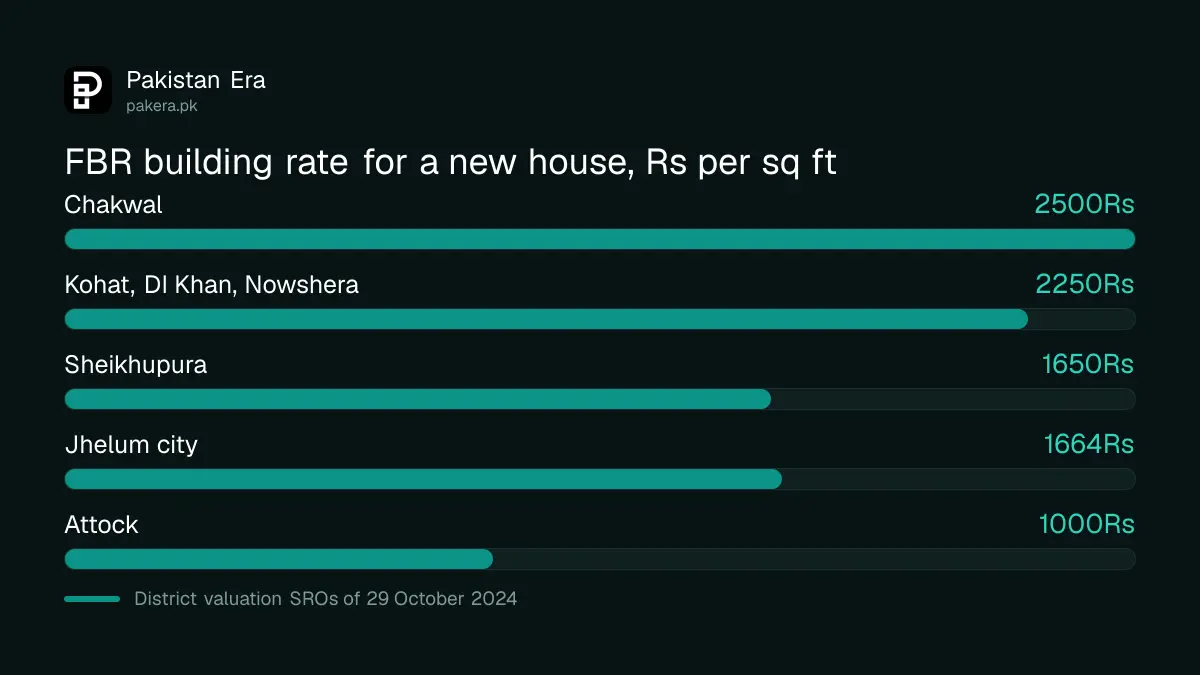
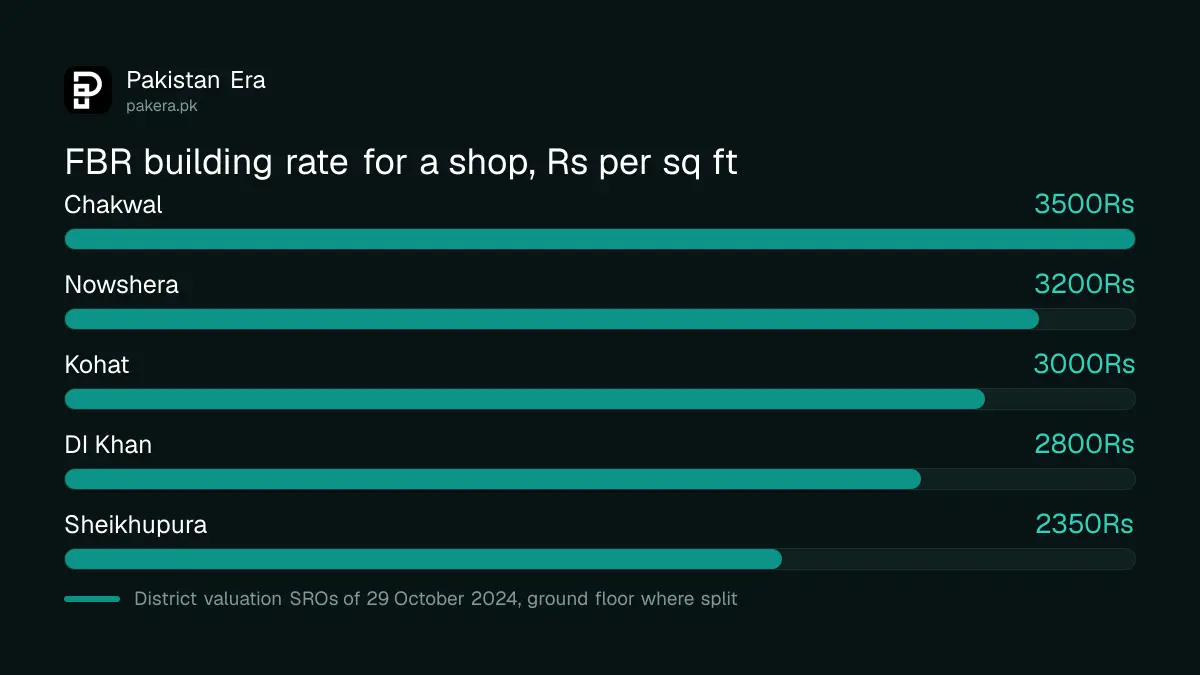
Every FBR valuation table adds a value for the building on top of the land. In 10 district tables, it runs from Rs 350 to Rs 3,500 a square foot. Chakwal is the highest flat rate at Rs 2,500 for a house and Rs 3,500 for a shop. In Kohat, DI Khan and Nowshera the rate falls with the building's age, from Rs 2,250 for a new ground floor to Rs 400 for one over 16 years old.
FBR calls this the superstructure value. It matters as much as the land rate: on a small plot with a new house, the building can be worth more than the land. This page puts the building paragraph or column from ten district tables side by side.
Each FBR table values the building in one of three ways
FBR's district tables do not all work the same way. Three methods appear in the ten tables.
- One rate for the district. A single paragraph gives a rate per square foot for houses and one for shops. Attock, Chakwal and Sheikhupura work like this.
- A rate on every row. Each area has its own building rate in a column next to the land value. Jhelum, Okara, Rahim Yar Khan and Mandi Bahauddin work like this.
- A rate by age and floor. A separate table sets rates for basements, ground floors and upper floors, falling as the building gets older. Kohat, Dera Ismail Khan and Nowshera work like this.
Haripur is a fourth case. It has no building rate at all. Instead it gives a "built up" land rate that is higher than the open plot rate.
District building rates side by side
The table below shows what each notification says. All ten are dated 29 October 2024 and took effect on 1 November 2024.
| District | House (Rs per sq ft) | Shop (Rs per sq ft) | How it works |
|---|---|---|---|
| Attock | 1,000 | 1,500 | One rate for the district |
| Chakwal | 2,500 | 3,500 | One rate; industrial Rs 1,430 |
| Sheikhupura | 1,650 | 2,350 | One rate for the district |
| Jhelum | 732 to 1,760 | 907 to 3,300 | Printed on every row |
| Okara | Varies by row | 770 to 2,311 seen | Printed on every row |
| Rahim Yar Khan | Varies by row | 950 to 2,400 seen | Printed on every row |
| Mandi Bahauddin | Varies by row | 485 to 1,475 seen | Printed on every row |
| Kohat | 350 to 2,500 | 2,600 to 3,000 | By age and floor |
| Dera Ismail Khan | 350 to 2,500 | 2,300 to 2,800 | By age and floor |
| Nowshera | 350 to 2,500 | 2,600 to 3,200 | By age and floor |
For Okara, Rahim Yar Khan and Mandi Bahauddin, the ranges are the values in the rows listed here. Their PDFs are large and tightly packed, so read your own row in the PDF rather than relying on a range.
In Khyber Pakhtunkhwa tables, an old house is valued at a fraction of a new one
Kohat, Dera Ismail Khan and Nowshera use the same residential rates by age. A ground floor drops from Rs 2,250 to Rs 700 after 10 years, and to Rs 400 after 15.
| House age | Basement | Ground floor | First floor and above |
|---|---|---|---|
| Up to 10 years | 2,500 | 2,250 | 2,000 |
| 11 to 15 years | 1,000 | 700 | 500 |
| 16 years or more | 450 | 400 | 350 |
Shops are not split by age. Nowshera has the highest shop rate of the three: Rs 3,200 for the ground floor, Rs 3,000 for a basement and Rs 2,600 upstairs. Kohat is Rs 3,000 on the ground floor, and DI Khan Rs 2,800.
How to add the building to an FBR property value
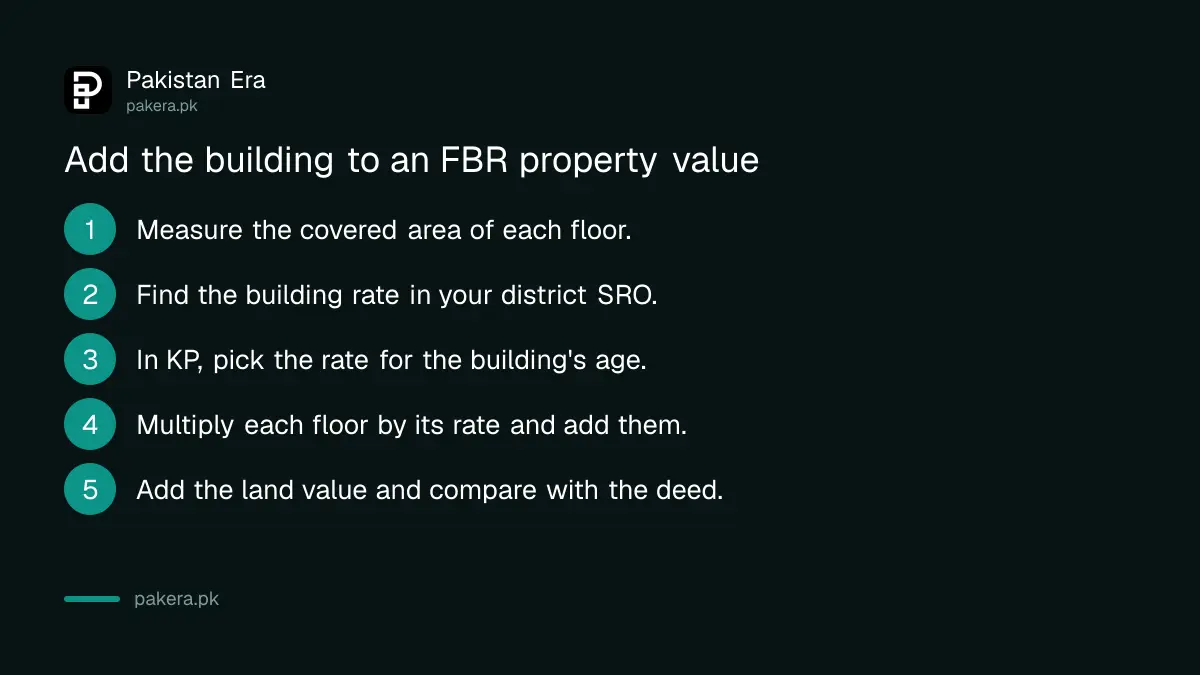
Measure the covered area of each floor, multiply it by the building rate in your district's SRO, and add the land value. Tax is charged on the higher of this total and the deed price.
- Measure the covered area of each floor in square feet. The approved map or the deed often states it.
- Open your district's FBR table and find the building rate: the paragraph, the column on your row, or the age table.
- In Kohat, DI Khan and Nowshera, pick the rate for the building's age and each floor.
- Multiply each floor's area by its rate and add them up.
- Add the land value: plot size times the land rate.
Example: a house with a 1,000 square foot ground floor and a 1,000 square foot first floor. In Chakwal it adds Rs 5,000,000 (2,000 times Rs 2,500). In Attock it adds Rs 2,000,000 (2,000 times Rs 1,000). In Kohat, if the house is 5 years old, it adds Rs 4,250,000 (Rs 2,250,000 plus Rs 2,000,000); if it is 20 years old, only Rs 750,000 (Rs 400,000 plus Rs 350,000). Our arithmetic.
Our reading is that the building rate applies to covered area, not plot area, in tables that state one rate. The notifications do not spell this out, so confirm it with the sub-registrar before you register a deed.
Where the building value fits in the tax
FBR adds land and building to get the fair market value. If that is higher than the deed price, advance tax on the purchase or sale is charged on it. See the Finance Act 2026 property tax rates and our list of all 56 FBR district tables. Stamp duty is provincial and uses the DC valuation instead.
Common questions
What is the FBR superstructure rate?
It is the value FBR gives a building per square foot, added to the land value. Each district table sets its own rate.
Which district has the highest FBR building rate?
Of the ten tables, Chakwal has the highest flat rate: Rs 2,500 for houses and Rs 3,500 for commercial buildings.
Does the age of my house matter?
Only in tables that set rates by age. In Kohat, DI Khan and Nowshera, a house over 16 years old is valued at Rs 350 to Rs 450 a square foot.
Does FBR add a building value for an empty plot?
No. An open plot is valued on land alone. The building rate applies only when there is a structure.
What is the industrial building rate in Chakwal?
Rs 1,430 a square foot, under paragraph 2 of SRO 1684(I)/2024.
How we verified this
What we checked and where we read it.
Last checked 12 November 2026. Sources: FBR's district valuation notifications dated 29 October 2024 and effective 1 November 2024, published on fbr.gov.pk, including Chakwal SRO 1684(I)/2024. The worked examples are our own arithmetic on the printed rates.
About the author

Tax, Bills and Technology Writer
Ali Akhtar is a young and curious voice here at Pakistan Era. He is currently pursuing his A-Levels and has a growing interest in Pakistan’s changing industrial landscape and educational trends. Ali likes to write in a way that helps him explain and explore the world around him. His writing reflects the perspective of the new generation navigating the evolving trends of Pakistan where technology, youth innovation, and shifting opportunities are reshaping the country’s future.