Property Tax in Pakistan From 1 July 2026: 2.75% for Sellers, 1.25% for Buyers
The Finance Act 2026 sets property advance tax at 2.75% for sellers and 1.25% for buyers in Pakistan. See how to work out your bill and what to confirm first.
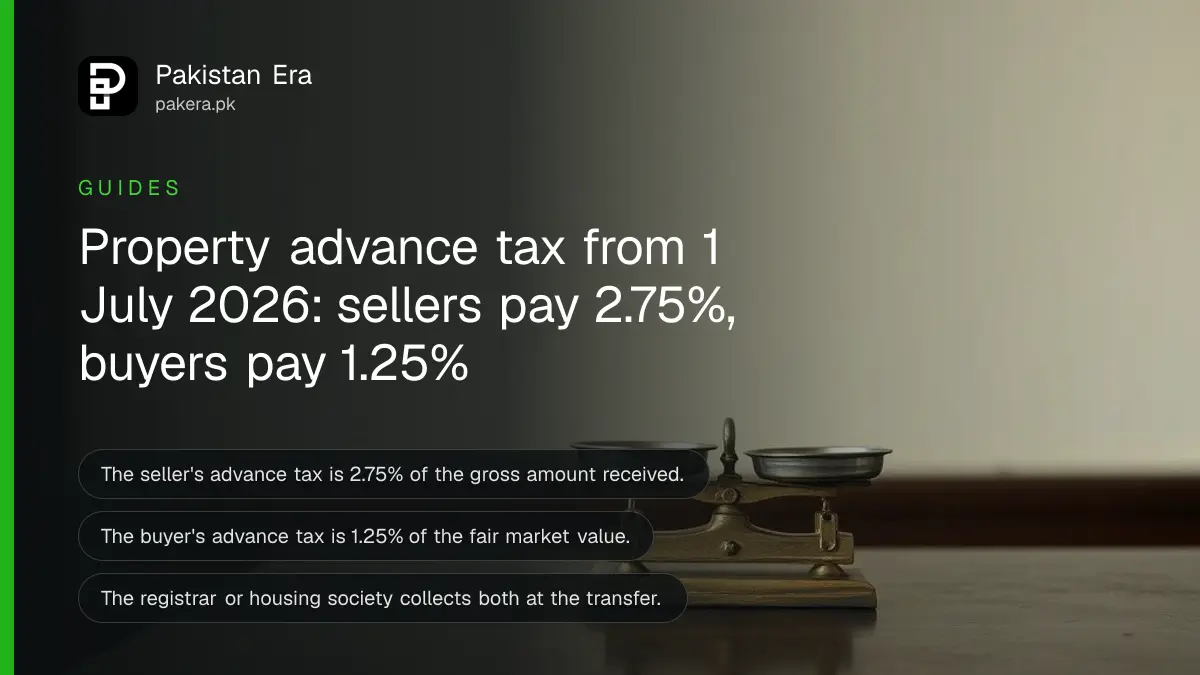
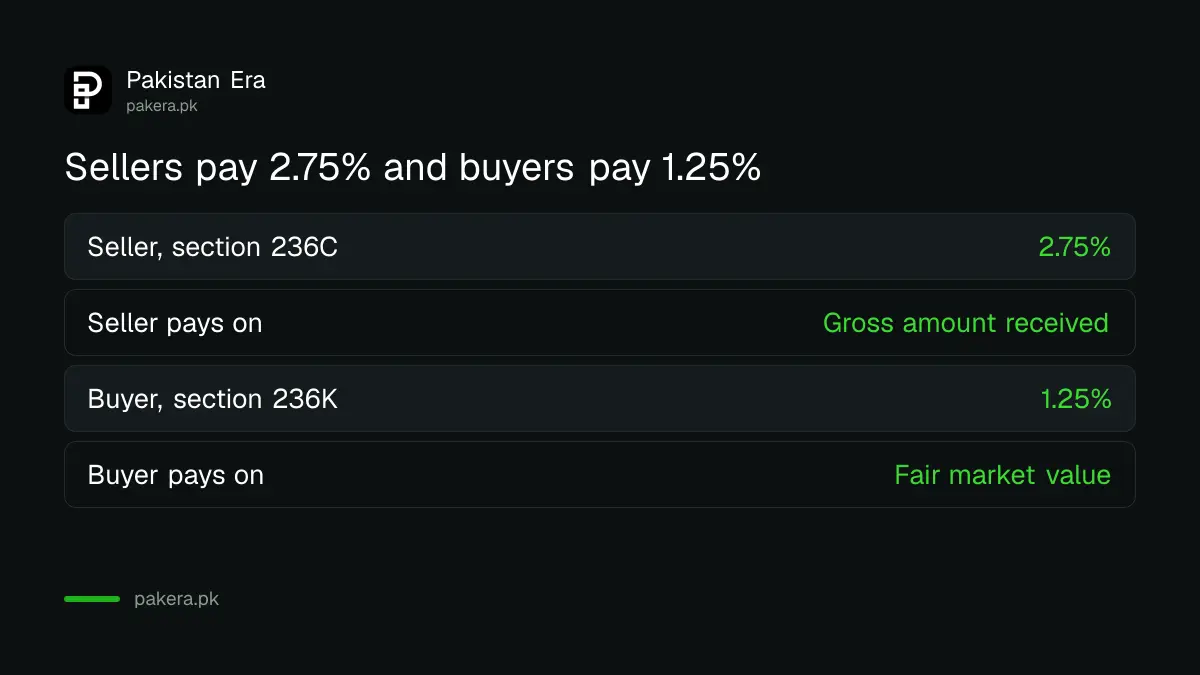
Short answer: From 1 July 2026 the Finance Act 2026 sets the advance tax a seller pays on property at 2.75% of the gross amount received (section 236C). It sets the buyer's advance tax at 1.25% of the fair market value of the property (section 236K). The registrar or housing society collects both at the time of transfer.
Property deals in Pakistan used to carry a table of rates. The rate depended on the price band and on whether you were on the Active Taxpayer List. We read the Finance Act 2026 on FBR's own download site on 13 October 2026, and the property rates there are now single figures.
This page shows the two rates, how to work out your bill, and the points we could not confirm from the Act alone.
The Act replaces the rate tables with one rate each
The Finance Act 2026 substitutes Division X and Division XVIII of Part IV of the First Schedule. Division X now fixes the seller's rate at 2.75%. Division XVIII fixes the buyer's rate at 1.25%. The Act came into force on 1 July 2026 unless it says otherwise.
| Who pays | Section | Rate in the Finance Act 2026 | Charged on |
|---|---|---|---|
| Seller or transferor | 236C | 2.75% | Gross amount of the consideration received |
| Buyer or transferee | 236K | 1.25% | Fair market value of the property |
The two bases are different. The seller pays on the price actually received. The buyer pays on the fair market value, which can be higher than the price written in the deed.
The old bands depended on price and filer status
Before the change, the rate rose with the value of the property. We read the Income Tax Ordinance as amended up to 31 July 2025 on FBR's download site. It set the seller's rate at 4.5%, 5% and 5.5% across three value bands, up to Rs 50 million, Rs 50 to 100 million and above Rs 100 million.
The same text set the buyer's rate at 1.5%, 2% and 2.5% across the same three bands. A person not on the Active Taxpayer List paid far more. An FBR FAQ file on its overseas Pakistanis page lists the non-filer buyer rates as 10.5%, 14.5% and 18.5%, and the non-filer seller rate as 11.5%.
Do not use those figures for a deal done now. They come from before the Finance Act 2026, which replaces the divisions that held them.
Work out your own bill in four steps
You can estimate the tax before you go to the registrar. Use the sale price for the seller's figure and the fair market value for the buyer's figure. Then add the result to your other costs of the deal.
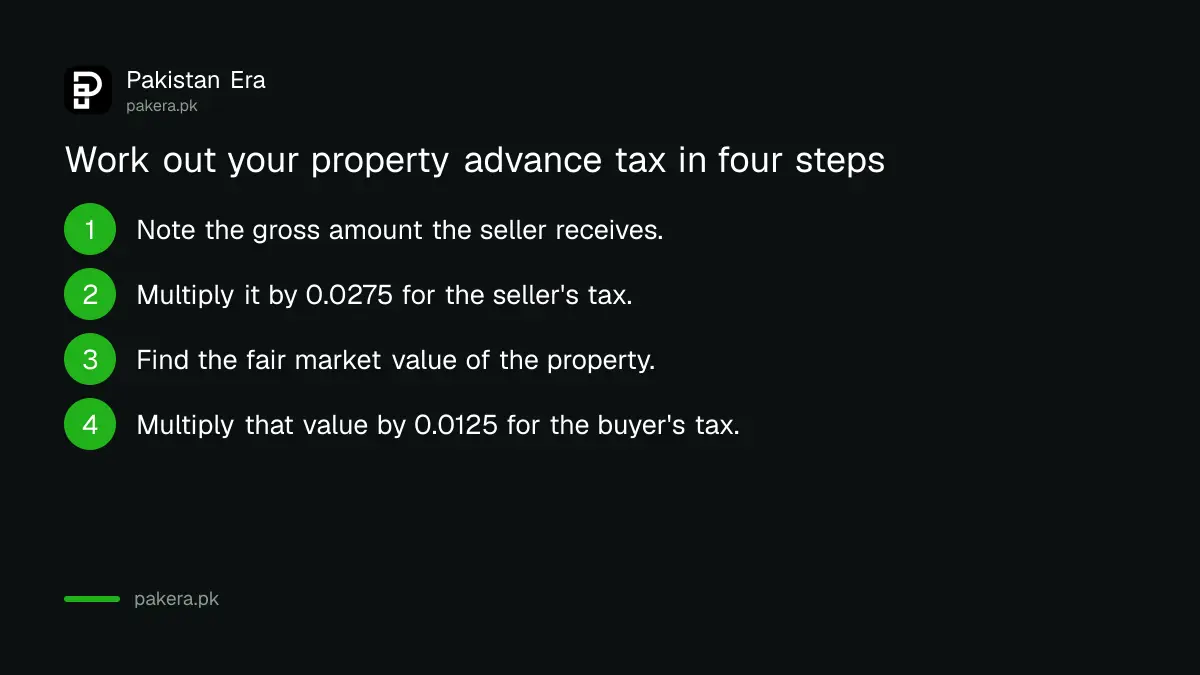
- Write down the gross amount the seller will receive.
- Multiply it by 0.0275 to get the seller's advance tax.
- Find the fair market value of the property. Our guide to FBR property valuation rates shows where to look.
- Multiply the fair market value by 0.0125 to get the buyer's advance tax.
Here is an example. A house sells for Rs 20,000,000 and its fair market value is also Rs 20,000,000. The seller's advance tax is Rs 550,000. The buyer's advance tax is Rs 250,000. Change the figures to match your own deal.
The tax is advance tax, so keep the proof
Advance tax counts against your income tax bill. It is not a separate fee that disappears. If you file a return, you set the amount against what you owe. The proof is the challan or receipt the collector gives you at the transfer.
Ask for the receipt in your own name and CNIC. Check that the amount matches the rate above. Then keep it with the sale papers. We explain how the credit works in our note on tax on buying and selling property.
Sellers should also read how profit on a property sale is taxed. That is a different matter from this advance tax, and we cover it in capital gains tax on property.
Three points the Act does not settle
We read the amending Act, not the full Income Tax Ordinance as it now stands. Three points therefore need a check with the registrar, a housing society office or an FBR office before you pay.
- The Act shows no separate filer or non-filer rate in these two divisions. The old extra charge for persons not on the list sat in the divisions and their provisos, which the Act replaces. We did not read the amended sections themselves, so ask whether any extra charge applies.
- The FBR overseas Pakistanis page offers a payment route for filer rates on these sections. The Act does not say whether that step is still needed, so ask before you rely on it.
- Cash limits still apply. Our guide to buying property above Rs 5 million in cash explains the penalty.
Common questions
What is the property tax rate for sellers in Pakistan from 1 July 2026?
The Finance Act 2026 sets it at 2.75% of the gross amount of the consideration received, under section 236C.
What is the rate for buyers?
It is 1.25% of the fair market value of the immovable property, under section 236K.
Who collects the tax?
The person responsible for registering, recording or attesting the transfer collects it. That can be the registrar or a housing society.
Is the buyer's tax charged on the price or the valuation?
It is charged on the fair market value of the property. The seller's tax is charged on the gross consideration received.
Do the old filer and non-filer bands still apply?
The Act replaces the divisions that held them with single rates. We could not confirm other effects without the amended sections, so check with the collecting office.
Can I get this tax back?
It is advance tax. You set it against your income tax when you file your return, and any excess can be claimed through the normal refund process.
How we verified this
What we checked, where we read it, and what we could not confirm.
Last checked on 13 October 2026, Pakistan time. We read the Gazette text of the Finance Act 2026 on FBR's download site, including Part IV of the First Schedule. We also read the Ordinance as amended up to 31 July 2025 and FBR's overseas Pakistanis FAQ file. We did not read the Ordinance as amended by the 2026 Act, and no registrar or housing society confirmed how it applies in practice.
About the author

Senior Writer, Public Services and Technology
Shahid joined us in 2024 as an author. He is a senior contributor to Pakistan's leading technology websites. He writes detailed articles, mostly covering his expertise in the latest tech, mobiles, apps, gadgets, and step-by-step guides. His ideology is to help people understand the latest trends and explain complex methods through very easy-to-understand guides.