Advertising Rules in Pakistan: What You Can Advertise, What Is Banned, and Who Checks Each Ad
Advertising rules in Pakistan: what you may advertise, what is banned and what needs approval, for medicines, tobacco, housing, billboards and influencers.
یہ صفحہ اردو میں پڑھیں
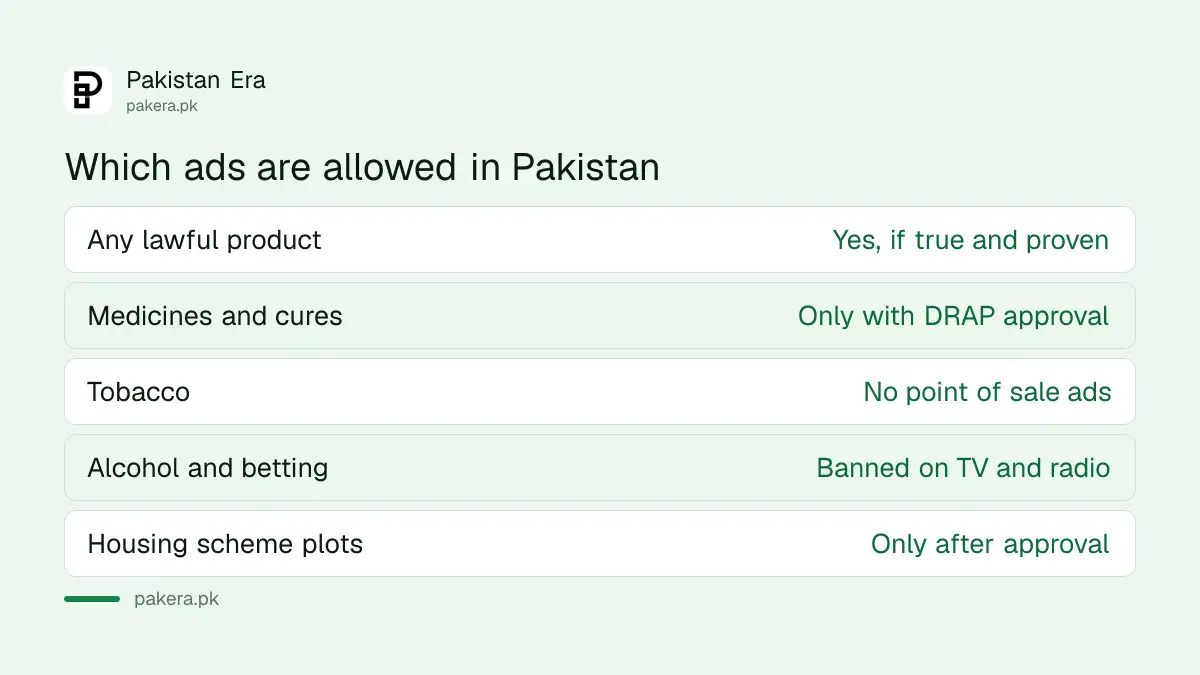
Short answer: In Pakistan you may advertise any lawful product or service, as long as the ad is true and does not mislead. Section 10 of the Competition Act 2010 bans deceptive marketing by every business, in every medium. On top of that, some ads are banned on TV and radio (alcohol, tobacco, illegal drugs, lotteries, gambling, betting, black magic and quackery), and some need permission before they run (medicines and health claims from DRAP, housing schemes from the development authority, billboards in Lahore from PHA).
We read the laws and regulators' own texts on 6 November 2026 for this guide: the Competition Act 2010, the Competition Commission of Pakistan (CCP) guidelines on deceptive marketing, the PEMRA Code of Conduct 2015, the Drugs Act 1976, the 2002 tobacco Ordinance, the Parks and Horticulture Authority Act 2012 and a CDA notice of 3 November 2026. This page is the overview. For the complaint steps, each section links to our detailed guide.
Every ad in Pakistan must be true and must not mislead
The basic rule covers every ad, from a TV spot to a WhatsApp flyer. Section 10 of the Competition Act 2010 says no business shall use deceptive marketing. The CCP can fine a business up to Rs 75 million or 10 per cent of its annual turnover for breaking it.
Section 10(2) lists four kinds of deceptive marketing:
- false or misleading information that can harm another business;
- false or misleading information to consumers, including claims with no reasonable basis, about price, character, place of production, properties, suitability for use or quality;
- a false or misleading comparison of goods in an advertisement;
- fraudulent use of another firm's trademark, name, labelling or packaging.
So comparative advertising is allowed in Pakistan, but only if the comparison is true. "Better than brand X" needs proof. The CCP guidelines of 3 April 2023 add that health and safety claims need "competent and reliable scientific evidence". They also say plain exaggeration that nobody would believe, called puffery, is not an offence. "King of fast food" is puffery. "Consumers prefer our burger more than any other burger in town" is a claim you must be able to prove.
Consumer protection laws add a second layer. In Islamabad, the Consumers Protection Act 1995 makes false advertising punishable with up to 2 years in jail or a Rs 30,000 fine, as our Islamabad false advertisement guide explains. Each province has its own consumer law and consumer courts; see how to file a consumer court complaint. To report a misleading ad to the regulator, use our CCP complaint guide.
TV, radio and cable ads follow the PEMRA Code of 2015
Every ad on a PEMRA licensed TV channel, FM radio or cable network must follow the Electronic Media (Programmes and Advertisements) Code of Conduct 2015. The Federal Government notified it on 19 August 2015. Clause 14 of the Code holds the advertising rules, and clause 15 makes the channel liable for airing an illegal ad.
Under clause 14, the channel must make sure that:
- ads follow the laws in force;
- ads for children do not directly ask children to buy the product;
- ads do not promote obscenity, violence or anything harmful to health or property;
- no ad for alcoholic drinks, tobacco products, illegal drugs or narcotics is aired;
- no health related ad is aired without prior permission from the Federal or Provincial Government;
- no ad for lotteries, gambling or betting banned under the Pakistan Penal Code or any other law is aired;
- black magic, quackery and superstition are not advertised;
- religious or national feelings, symbols and the national anthem are not used just to sell a product;
- ads are easy to recognise as ads and kept separate from programmes;
- ads shown as tickers, logos or sliding text take no more than one tenth of the screen;
- telemarketing and teleshopping ads show the full call charges, including all taxes.
Clause 12 adds that ads meant for children must not be frightening, violent, deceptive or misleading. The Code we read sets no limit on how many minutes of ads a channel may run in an hour, so we do not state one. To complain about an ad on air, see how to complain to PEMRA on 0800-73672.
Medicines and health claims need DRAP approval first
Section 24 of the Drugs Act 1976 says no one may advertise a drug, an ayurvedic, unani, homoeopathic or biochemic remedy, or "any remedy, treatment or offer of a treatment for any disease" except under the prescribed conditions. A clinic's or hospital's signboard is not counted as an advertisement. Breaking a rule under the Act is punishable with up to 5 years in jail or a Rs 50,000 fine under section 27(4), in the copy of the Act on Pakistan Code.
The Drug Regulatory Authority of Pakistan (DRAP) says registered drugs and enlisted health and over the counter products need its prior approval before any advertisement to the public. When we read DRAP's pages on 15 October 2026, an approval was valid for two years. DRAP's 2021 guidelines also rule out words like "miracle" and "100% safe", guaranteed results, celebrity endorsements, a doctor in a white coat, refund offers and free samples for the public.
Herbal and homoeopathic "cures" on social media fall under the same section 24. Our guide on reporting an illegal medicine advertisement to DRAP has the full banned claims list and the complaint form. Before you buy anything advertised, check the medicine is registered with DRAP.
Tobacco, alcohol, betting and baby formula face the tightest limits
Tobacco. Section 7 of the Prohibition of Smoking and Protection of Non-Smokers Health Ordinance 2002 says no person or company shall advertise tobacco products on any media, in any place or on any public service vehicle, except under the guidelines of a federal committee. The Ministry of National Health Services said in a press release of 30 August 2023 that S.R.O. 72(I)/2020 of 30 January 2020 bans tobacco advertising, promotion and sponsorship at the point of sale, inside or outside the shop, through posters, banners, screens and electronic displays. Under section 11(b), a first offence carries a fine of up to Rs 5,000. A repeat offence carries up to 3 months in jail or a fine of at least Rs 100,000, or both. We did not read the full text of the 2020 S.R.O. itself.
Alcohol and drugs. PEMRA's Code bans these ads on TV, radio and cable. We did not find a separate rule for print or online alcohol ads in the texts we read, but selling alcohol is itself tightly restricted in Pakistan, so an ad would almost always promote an unlawful sale.
Betting, gambling and lotteries. PEMRA's Code bans these ads on air. Betting apps promoted on social media are a common route for fraud; see the FIA betting money trail case.
Baby formula. The Protection of Breast-feeding and Child Nutrition Ordinance 2002 bans promoting infant formula, feeding bottles, teats and pacifiers, including advertising, free samples and gifts to health workers. A maker or distributor who breaks it faces up to 2 years in jail or a fine of Rs 50,000 to Rs 500,000. Details are in our baby formula rules guide.
Food, investment and crypto ads need proof or a licence
Food. A food claim such as "lose 10 pounds in a week" is a health claim, and the CCP guidelines say it needs strong proof. For food quality, the CCP may use standards set by the Pakistan Standards and Quality Control Authority. Food businesses also need a licence from their provincial food authority. We did not read the advertising clauses of the provincial food laws for this guide, so we do not state them. In Punjab, the Punjab Food Authority has also warned about a fake ad using its name; see how to check a PFA advertisement.
Investment schemes. Only firms licensed by the Securities and Exchange Commission of Pakistan (SECP) may offer regulated investment, broking, insurance or lending services. SECP's own press release titles from 2024 to January 2026 warn the public against unlicensed investment platforms, fake trading apps, and AI made social media ads that use pictures of celebrities to pull people into WhatsApp groups. SECP's website refused our requests on 6 November 2026, so we could not read those releases in full and we treat their details as reported. Check a firm before you pay with our SECP licence check, and complain through SECP's complaint channels.
Crypto. The Pakistan Virtual Assets Regulatory Authority (PVARA) says a foreign platform needs a Pakistani licence if it targets, solicits or promotes to people in Pakistan, including through marketing. Running an unlicensed virtual asset service can mean up to 5 years in jail or a Rs 50 million fine under the Virtual Assets Act 2026; see the Act's penalties and the foreign exchange rule.
Housing schemes, colleges and job ads must be real and approved
Housing schemes. The Capital Development Authority (CDA) says no private housing scheme can be launched in Islamabad without its approval. Its public notice of 3 November 2026, which we read, lists 143 schemes with no approval whose plots are still advertised in print, on TV and on social media. The notice asks the Press Information Department not to publish ads for unapproved schemes, asks PEMRA and PTA to block their websites, and tells marketing agencies to show the approved layout plan. Our CDA list of 143 illegal schemes has the details. In Punjab, check the scheme first on LDA's lists or RDA's lists.
Colleges and degrees. The Higher Education Commission (HEC) publishes lists of recognised universities and campuses, and a list of illegal or fake institutions. HEC says an institution not on its recognised lists may be treated as non-recognised. An ad for a degree from such a place is a warning sign; see how to check HEC recognition.
Job ads. Public service commissions publish job ads only on their own websites and verified pages. Fake sites copy them to collect fees. See how to spot a fake PPSC job site.
Billboards and signs need local permission
In Lahore, the Parks and Horticulture Authority Act 2012 says anyone who wants to put up a billboard, sky sign or outdoor advertisement, on private or public property, must apply to the Parks and Horticulture Authority (PHA). The Act covers Lahore district, and the Punjab Government can extend it to other areas by notification.
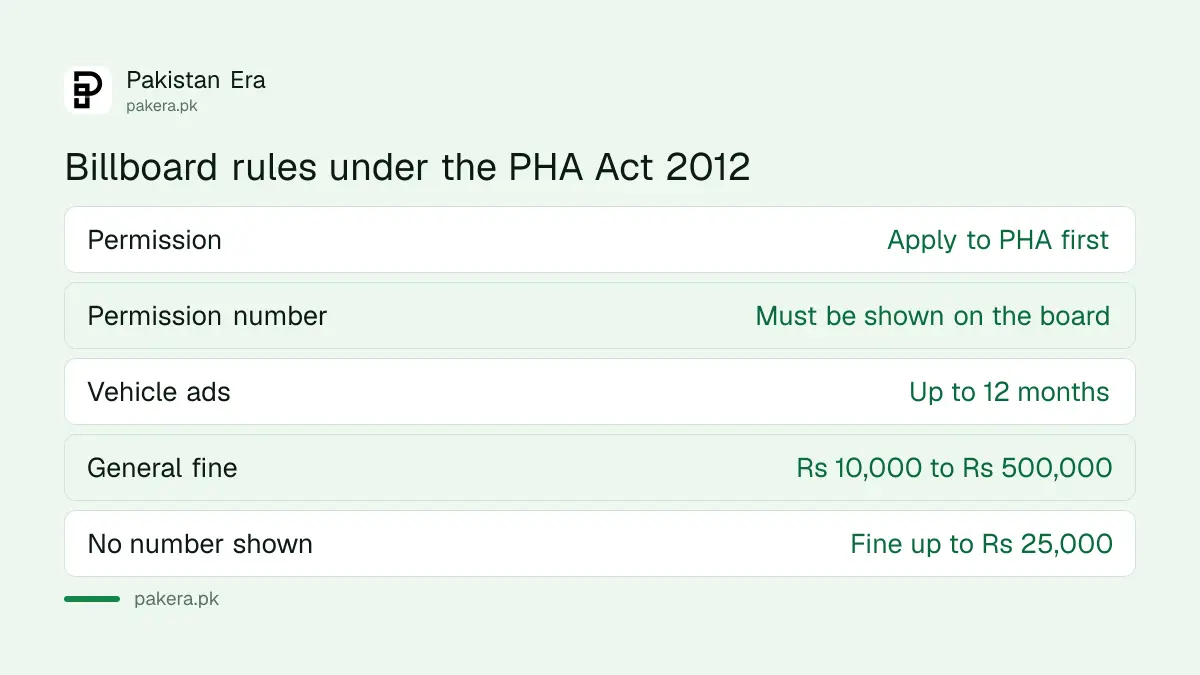
- PHA must refuse a billboard that affects road safety, light and air for residents, or the view of a historical monument (section 12(3)).
- Each approved billboard gets a permission number, which must be shown on it (section 12(6)).
- An ad on a vehicle also needs PHA permission, for no more than 12 months (section 13).
- No indecent sign, or one that may incite public disorder, is allowed (section 21(6)).
- The general penalty is up to 6 months in jail or a fine of Rs 10,000 to Rs 500,000. Not showing the permission number can mean a fine of up to Rs 25,000 (section 23).
PHA sets its own fees. We did not read its current fee schedule, so we do not quote a rate. A small signboard over your own shop may still need permission, so ask PHA before you put one up. Outside Lahore, ask your development authority or local council, which set their own rules. We did not check those for this guide.
Online and influencer ads follow the same laws
Pakistan has no separate law for online ads. A Facebook ad, a YouTube video or an Instagram post must follow the same rules as a newspaper ad: section 10 for truth, DRAP for medicines, the 2002 Ordinance for tobacco and baby formula.
For influencers, the CCP's 2023 guidelines are the closest thing to a rule. Section 6.8 says:
- an endorser should be a genuine user, or should not talk about personal use;
- a "material connection" must be disclosed, meaning paid sponsorship or a personal tie to the company;
- the disclosure must be clear and placed with the endorsement itself;
- the company and the endorser "share equal responsibility".
So a paid post should say it is paid, in the post, not in a hidden comment. Online shops must also show the price, delivery, return, refund and warranty terms clearly, says section 8 of the same guidelines. Section 25 of the Prevention of Electronic Crimes Act 2016 (PECA) also covers spam messages; see our PECA sections list. Platforms add their own rules on top; Google, for example, asks Pakistani advertisers to verify their identity. We found no PTA or PEMRA rule written only for influencers.
Summary table of allowed and banned ads in Pakistan
| Product or ad type | Allowed? | The rule | Who checks it |
|---|---|---|---|
| Any lawful product or service | Yes, if true | Competition Act 2010, s.10 | CCP |
| Comparison with a rival brand | Yes, if true and proven | s.10(2)(c) | CCP |
| Medicines, herbal and homoeopathic cures | Only with DRAP approval | Drugs Act 1976, s.24 | DRAP |
| Health ads on TV or radio | Only with prior government permission | PEMRA Code, clause 14(5) | PEMRA |
| Tobacco | No, outside narrow federal guidelines; no point of sale ads | 2002 Ordinance, s.7; S.R.O. 72(I)/2020 | Ministry of National Health Services |
| Alcohol, illegal drugs | No on TV, radio or cable | PEMRA Code, clause 14(4) | PEMRA |
| Lotteries, gambling, betting | No on TV, radio or cable | PEMRA Code, clause 14(6) | PEMRA |
| Black magic, quackery | No on TV, radio or cable | PEMRA Code, clause 14(7) | PEMRA |
| Infant formula, bottles, teats | No promotion | Breast-feeding Ordinance 2002, s.7 | Infant Feeding Board |
| Investment schemes | Only by SECP licensed firms | SECP licensing | SECP |
| Crypto services | Only by PVARA licensees | Virtual Assets Act 2026, s.50 | PVARA |
| Housing scheme plots | Only after approval | CDA, LDA, RDA rules | Development authority |
| Billboards in Lahore | Only with a permission number | PHA Act 2012, s.12 | PHA |
| Paid influencer posts | Yes, with clear disclosure | CCP guidelines 2023, 6.8 | CCP |
Check these 7 things before you run an ad
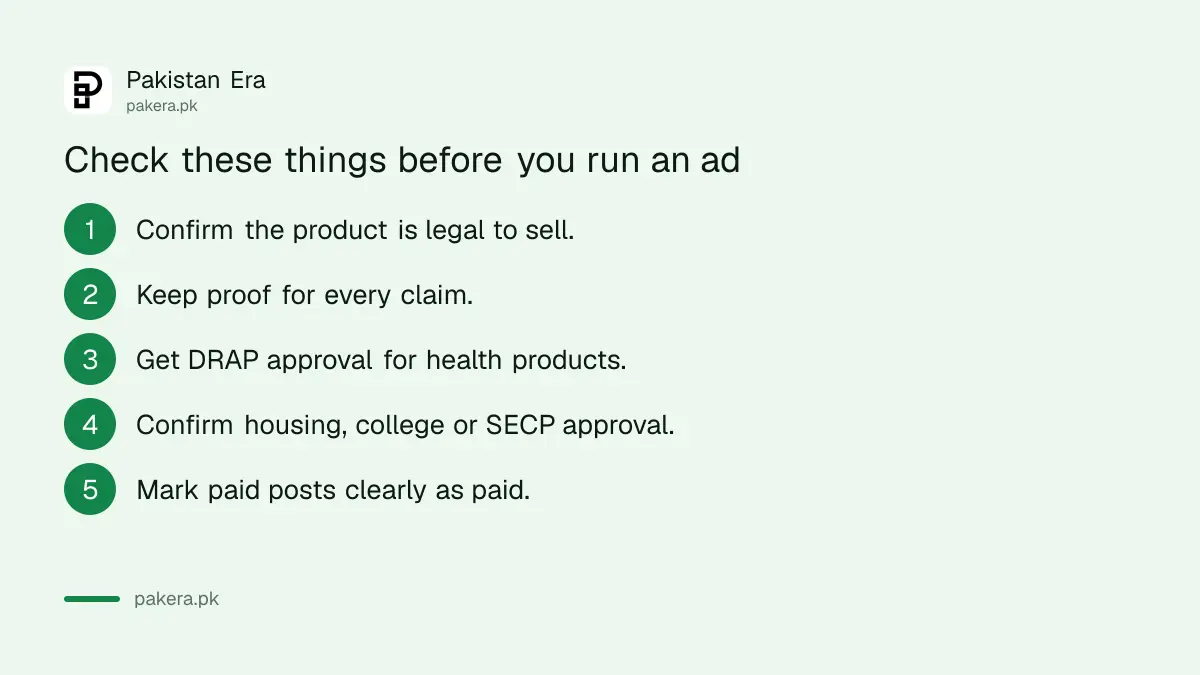
- Make sure the product or service is legal to sell in Pakistan and in your province.
- Keep proof for every claim: test reports for health or quality claims, price records for "sale" offers.
- If you compare with a rival, make sure the comparison is true and you can prove it.
- For medicines, remedies or health products, get DRAP approval first, and keep the approval letter.
- For a housing scheme, college or investment product, confirm the approval, recognition or licence and show it in the ad.
- For a billboard or vehicle ad in Lahore, get PHA permission and display the permission number.
- For a paid post, say clearly in the post that it is paid or sponsored.
Sources and last checked
Last checked on 6 November 2026. We read: the Competition Act 2010, sections 10 and 38, and the Prohibition of Smoking and Protection of Non-Smokers Health Ordinance 2002, sections 7 and 11, and the Drugs Act 1976, sections 24 and 27, all on Pakistan Code; the PEMRA Code of Conduct 2015 (a scanned file, read page by page); the CCP Guidelines on Deceptive Marketing Practices of 3 April 2023; the Health Ministry's press release of 30 August 2023 on the Press Information Department site; the Parks and Horticulture Authority Act 2012 from the Punjab Government; and the CDA notice of 3 November 2026. DRAP, HEC, PVARA and baby formula points come from our own earlier reading of those sources, linked above.
Not verified: the full text of S.R.O. 72(I)/2020; SECP's press releases (its site blocked our requests); the advertising clauses of provincial food and consumer laws; PHA's current fees; and outdoor ad rules outside Lahore. This guide explains the rules. It is not legal advice, and for a large campaign a lawyer should check the final ad.
Advertising rules in Pakistan: common questions
Which law controls advertising in Pakistan?
No single law does. Section 10 of the Competition Act 2010 covers every ad. PEMRA's 2015 Code covers TV, radio and cable. DRAP covers medicines, the 2002 Ordinance covers tobacco, and development authorities and PHA cover housing schemes and billboards.
Can I compare my product with a competitor's in an ad?
Yes, if the comparison is true. Section 10(2)(c) bans only a false or misleading comparison. Keep proof, such as a test report, because the CCP can ask for it.
Are cigarette ads allowed in Pakistan?
Almost never. Section 7 of the 2002 Ordinance allows tobacco ads only under federal guidelines, PEMRA bans them on air, and S.R.O. 72(I)/2020 bans them at shops, inside or outside.
Do I need permission to advertise a herbal medicine?
Yes. Section 24 of the Drugs Act 1976 covers ayurvedic, unani, homoeopathic and other remedies, and any treatment for any disease. DRAP approval comes first.
Do influencers in Pakistan have to say a post is paid?
The CCP's 2023 guidelines say a paid tie must be disclosed clearly, with the endorsement. They are guidelines, but a hidden paid endorsement can be treated as deceptive marketing under section 10.
Do I need permission for a billboard in Lahore?
Yes. The PHA Act 2012 requires PHA permission and a permission number shown on the billboard. Without it, the fine can reach Rs 500,000.
Where do I complain about a misleading ad?
Go to the CCP for any misleading ad, PEMRA for TV, radio or cable, DRAP for medicines, and SECP or PVARA for investment and crypto. A consumer court can also hear your case if you bought the product.
About the author

Founder and Editor
Umer Kureshi founded Pakistan Era in July 2024 and runs it as administrator, SEO lead and writer, overseeing website operations, search growth, content strategy and coverage of technology and current affairs.