Unlicensed Crypto Service in Pakistan Can Mean 5 Years in Jail and a Rs 50 Million Fine
Section 54 of the Virtual Assets Act 2026 sets up to 5 years or Rs 50 million for unlicensed crypto services. See each offence and who it is aimed at.
Short answer: Under section 54 of the Virtual Assets Act, 2026, wilfully providing an unlicensed virtual asset service in Pakistan is punishable with up to 5 years in prison, a fine of up to Rs 50 million, or both. The offence is about providing a service by way of business.
A Telegram admin who matches buyers and sellers for a small fee thinks of himself as a helper. The Act sees a service provider. That gap between how people see themselves and how the law sees them is the reason this section matters.
We read Chapter 9 and Chapter 10 of the Virtual Assets Act, 2026 on the PVARA website on 12 October 2026, and PVARA's FAQ for the licensing rules. This note lists the offences and the penalties in plain words. The PDF on the site is a scanned copy, so quote the official text if you need it for a legal purpose.
The five year, Rs 50 million penalty targets unlicensed services
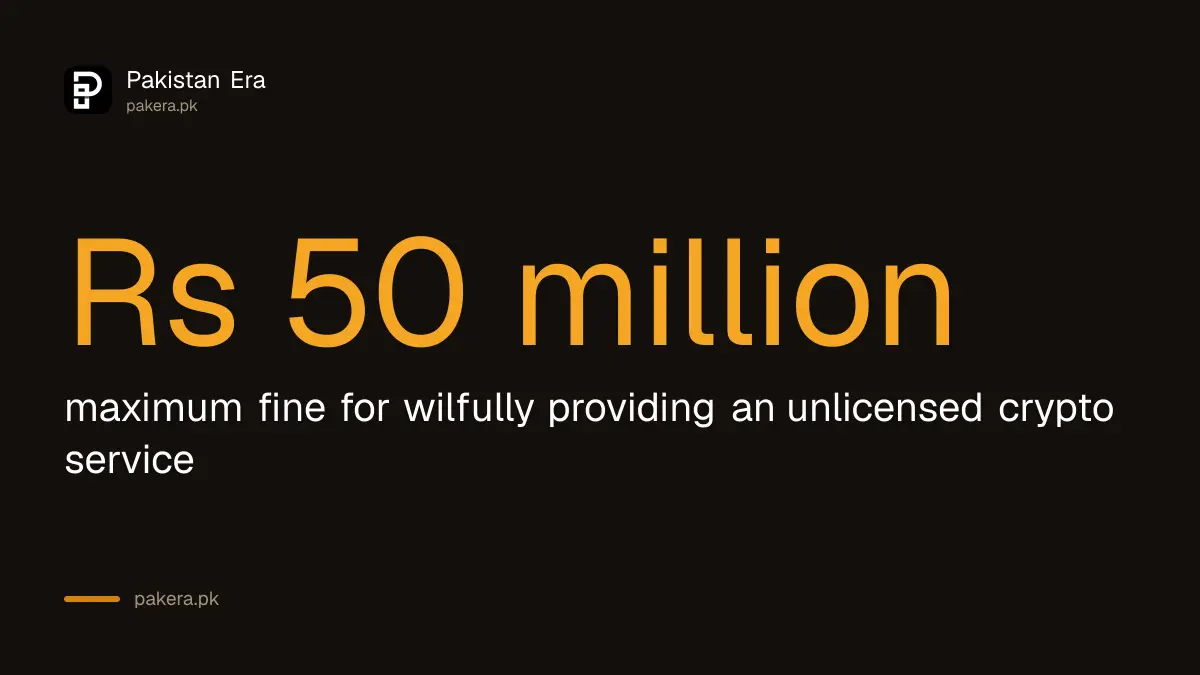
Section 54(1) says whoever wilfully provides an unlicensed Virtual Asset Service shall be punishable with imprisonment up to five years, or a fine up to fifty million rupees, or both. "Wilfully" means on purpose, not by accident.
Section 50 sets the base rule. No person may, by way of business, engage in or present themselves as engaging in any Virtual Asset Service in or from Pakistan unless they are a company incorporated in Pakistan and hold a valid licence from the Authority. A Virtual Asset Service means a category listed in section 18, such as exchange, broker-dealer, custody, transfer and settlement, or lending.
| Offence (section 54) | Maximum prison | Maximum fine |
|---|---|---|
| Wilfully providing an unlicensed Virtual Asset Service | 5 years | Rs 50 million |
| Running an initial virtual asset offering against the Act | 3 years | Rs 25 million |
| Market manipulation or insider trading, natural person | 3 years | Rs 25 million |
| False or misleading statement to the Authority | 3 years | Rs 20 million |
| Obstructing an authorised officer | 2 years | Rs 10 million |
| Wilfully ignoring an order of the Authority | 1 year | Rs 25 million |
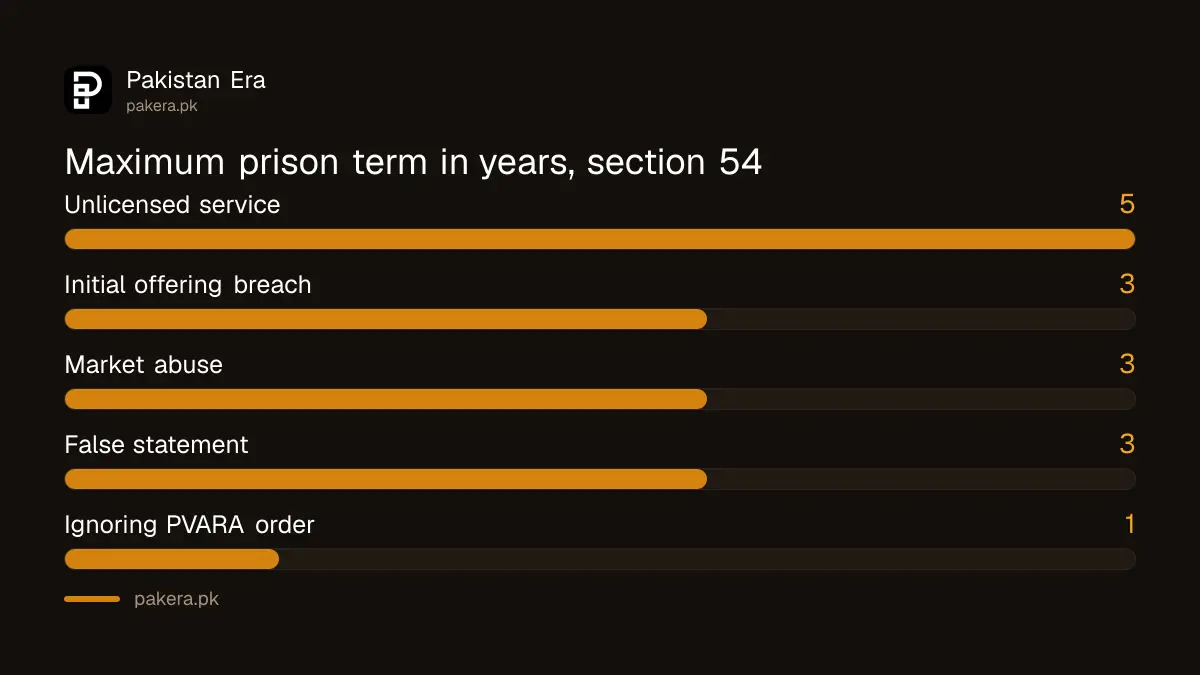
For each line the Act says "or with both", so a court can impose prison, a fine, or both.
The offence is providing a service, not holding crypto
Read the wording again. Section 54(1) punishes whoever provides an unlicensed Virtual Asset Service. Section 50 refers to engaging in services "by way of business". Neither section, as we read them, creates an offence for an ordinary person who buys or holds crypto for themselves.
That fits what the Lahore High Court has said in its ruling, which we covered in our report that P2P crypto trading is not a crime by itself. Still, a person who runs a P2P desk as a regular business, handles other people's funds or advertises an exchange is much closer to the line. We cannot tell you which side of the line your activity falls on. The definitions sit in the Act, and the cost of guessing wrong is a criminal case.
Directors can be held responsible for a company
Section 55 says that when a company commits an offence with the consent, connivance or neglect of a director, manager, secretary or similar officer, that person is deemed to have committed the offence too. So a licence-free business cannot hide behind a company name.
Offences are investigated only by an authorised officer of PVARA under section 56. The officer needs a warrant for search and seizure from a competent court under section 57. The Federal Government may designate special courts for these offences. A person who wilfully refuses to give information to an authorised officer faces up to one year or a fine of up to Rs 1 million.
PVARA can also fine and order restitution
Besides the criminal penalties, the Authority may impose a fine of up to Rs 25 million for any contravention of the Act. A court may order restitution or disgorgement of profits, which means giving back money earned through the breach.
The Act also says a licensed provider that breaks another law in Pakistan can face administrative sanctions under the Regulations. And section 66 requires every licensed provider to meet its obligations under the Income Tax Ordinance, 2001 and FBR rules.
What the transition rule meant for existing platforms
Section 70 told any person already providing services when the Act began to apply for a licence within six months or stop. PVARA's site puts the date for firms operating since 5 March 2026 as 5 September 2026. Our note on the crypto licence deadline has the details.
That deadline has passed. A firm that applied could continue under PVARA's interim directives. A firm that did not apply and kept going is the kind of operator section 54 is written for. If you want to know whether a platform you use is safe, check its PVARA licence before you deposit.
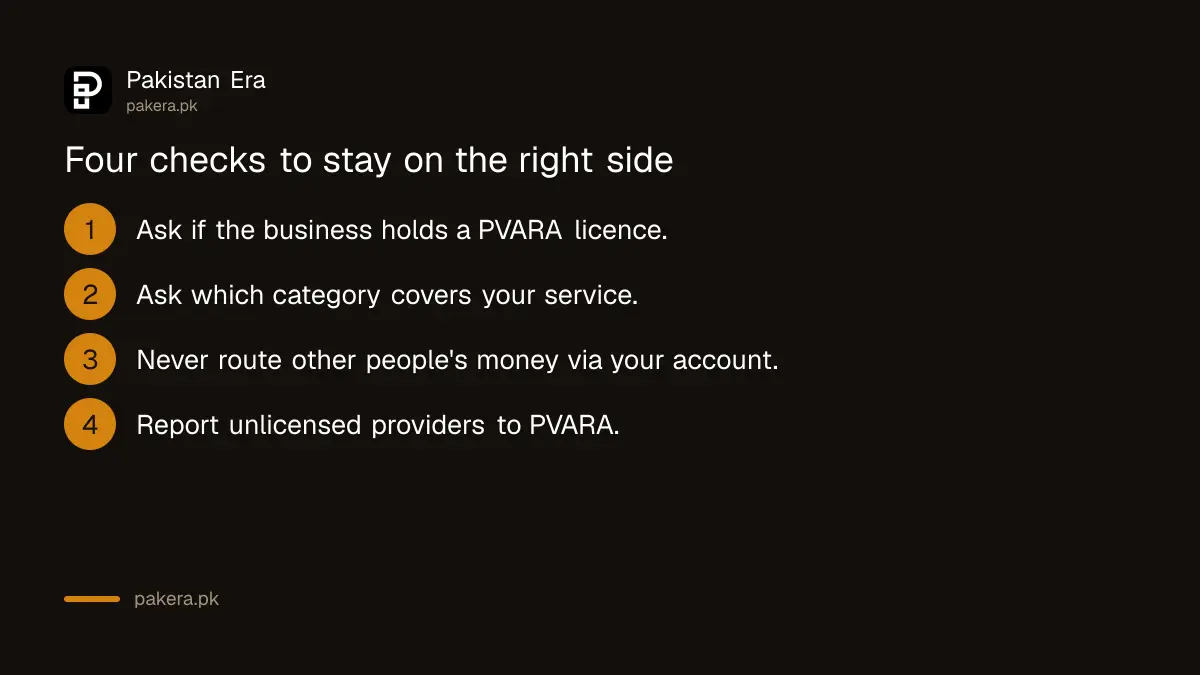
- Ask whether the business is a Pakistani company with a PVARA licence.
- Ask which licence category covers the service you use.
- Do not move customer money through your own account for others.
- Report an unlicensed provider to PVARA through its complaints page.
Common questions
What is the punishment for unlicensed crypto services in Pakistan?
Up to 5 years in prison, a fine up to Rs 50 million, or both, under section 54(1) of the Virtual Assets Act, 2026.
Can I be jailed for owning bitcoin?
Section 54(1) targets people who provide an unlicensed virtual asset service. We found no offence for an individual simply holding crypto. Get legal advice for your own case.
Is P2P trading an offence?
It depends on whether you are providing a service by way of business. Occasional personal trades differ from running a regular desk.
Who investigates these offences?
Only an authorised officer of PVARA has the power to investigate, under section 56 of the Act.
Does a company shield its directors?
No. Section 55 says a director or manager who consented to or neglected an offence is deemed to have committed it.
How we verified this
What we checked, where we read it, and what we could not confirm.
We read the Virtual Assets Act, 2026 PDF linked on pvara.gov.pk and the PVARA FAQ on 12 October 2026. This is an explanation, not legal advice. Rules and regulations under the Act may add detail.
About the author

Public Services and Education Journalist
Fajr Riaz is a journalist and content writer at Pakistan Era, based in Lahore. She covers the questions people meet in everyday life in Pakistan: how a public service works, what a change in the rules means, and where to find a reliable answer.