The Lahore High Court Has Said P2P Crypto Trading Is Not a Crime by Itself
We read the reporting on the LHC ruling and checked what the law now says. Trading is not an offence, and that is not the same as protected.
The Lahore High Court has held that a peer to peer crypto transfer, and receiving the money for it in a bank account, does not by itself amount to fraud or an electronic crime.
That is a bigger statement than it sounds, because a great many people in Pakistan believe crypto trading is flatly illegal here. We went and checked what the law actually says now, and the picture is more interesting than either side of that argument.
What the court decided
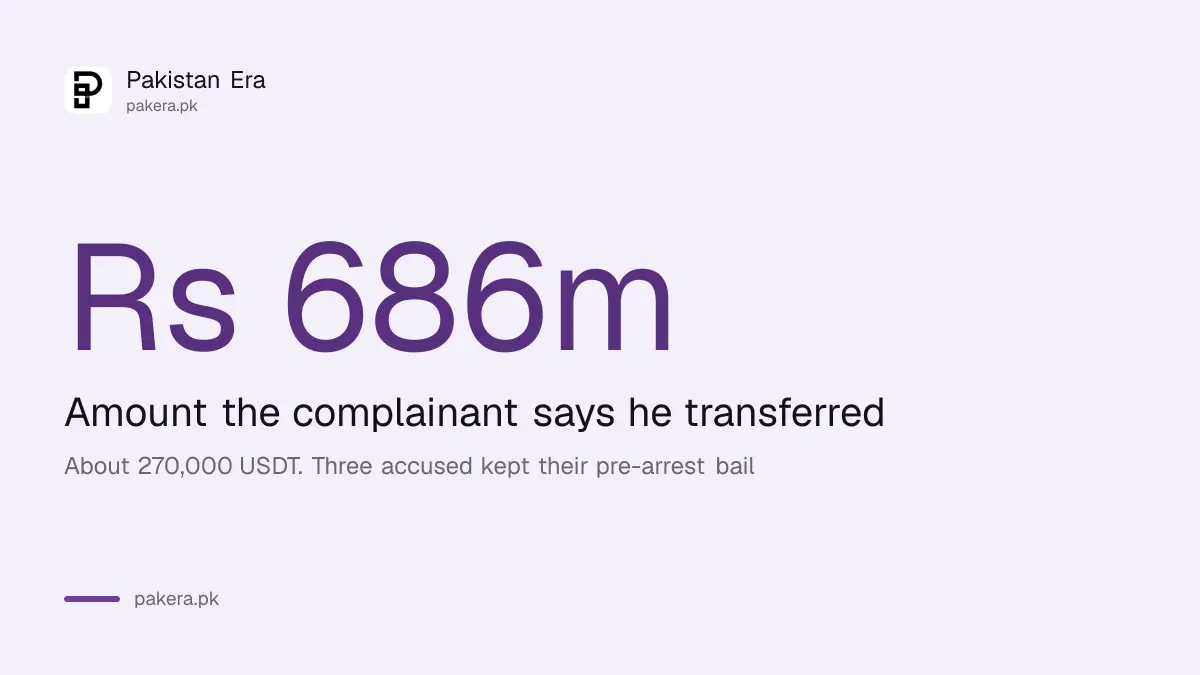
Justice Tariq Saleem Sheikh upheld the pre-arrest bail of three people the Federal Investigation Agency had accused in a case connected to crypto trading. The complainant said he had transferred close to Rs 686 million while buying around 270,000 USDT, after an acquaintance persuaded him to invest.
The court held that merely transferring virtual assets, or receiving money through a bank account, is not enough on its own to establish fraud, forgery or an offence under the Prevention of Electronic Crimes Act. It also held that cryptocurrencies not being legal tender does not make them illegal, and that the State Bank's 2018 circular restricted regulated financial institutions rather than private individuals, creating no criminal offence for personal trading.
Read carefully, that is a ruling about what the prosecution failed to prove, not a ruling that nothing happened. Bail confirmed is not an acquittal, and a case where somebody says they lost Rs 686 million is not a case anyone should read as reassuring.
The part we found that most coverage is leaving out
The judgment discusses the 2018 State Bank circular. We went to check whether that circular is still the operative position, and it is not.
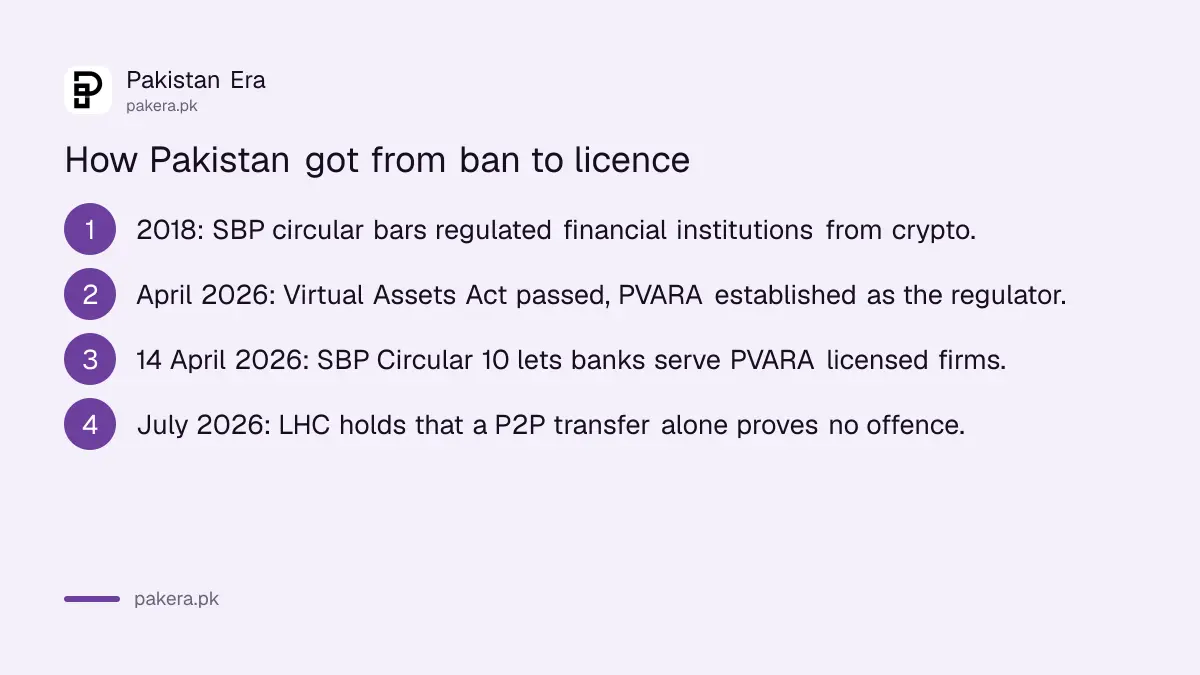
On 14 April 2026, SBP Circular Letter No. 10 lifted the 2018 restriction for virtual asset service providers licensed under the Virtual Assets Act, 2026. That Act established the Pakistan Virtual Assets Regulatory Authority, PVARA, as the statutory regulator with power to licence and supervise exchanges, custodians, wallet providers and token issuers.
We requested pvara.gov.pk before publishing this. It is live.
So the country has moved from a seven year banking restriction to a licensing regime, and the court's reasoning about the 2018 circular sits on top of a legal position that had already changed months earlier. Anyone telling you Pakistan bans crypto is describing 2018.
Where the line actually falls now
| Question | What we found |
|---|---|
| Is P2P trading a crime by itself | No, per this ruling |
| Is crypto legal tender | No, and nobody is claiming otherwise |
| Is there a licensing regime | Yes, PVARA under the Virtual Assets Act 2026 |
| Can banks serve crypto firms | Yes, if the firm is PVARA licensed |
| Can banks trade crypto themselves | No, still barred |
| Are your losses recoverable if you are cheated | Not established, and this case does not help |
The bank account rules that came with Circular 10 are worth knowing if you use an exchange. Licensed providers can hold rupee client money accounts, but those accounts prohibit cash deposits and withdrawals, and prohibit mixing client funds with the firm's own. Both of those exist to make it harder for a provider to quietly spend your money, which tells you what the regulator was worried about.
Not a crime is not the same as safe
This is the part we would want a reader to take away rather than the headline.
A ruling that trading is not itself an offence does nothing about the actual risk, which is being defrauded. The case in front of the court began with somebody saying he handed over Rs 686 million on an acquaintance's advice. Whatever the outcome, that money is the point.
P2P trading in particular is where most of the damage happens here, because the trade is between two individuals and the platform is often just an introduction. If the counterparty vanishes, you are relying on a court, and this judgment is a reminder of how hard that route is.
The tactics are the same ones we keep writing about in other costumes: urgency, a trusted intermediary, a guaranteed return. Our roundup of the most common online scams in Pakistan covers the pattern, and the fake e challan messages circulating this week are the same technique aimed at a different fear.
What we would check before using any platform
- Whether it holds a PVARA licence. There is now an authority to ask, which there was not before. Licensed and unlicensed are genuinely different things.
- How the rupee leg settles. A licensed provider's client account cannot take cash. If somebody wants cash, ask why.
- Whether client funds are segregated. Circular 10 requires it of licensed firms specifically because commingled funds are how people lose money.
- What happens in a dispute. If the answer is nothing written down, that is the answer.
Why this matters beyond crypto
Pakistan has spent two years building the plumbing for money that moves without cash: digital payments, freelancer receipts, and now a virtual assets regulator. Freelancers in particular have been receiving payment in stablecoins for years while the legal position was unclear, and that ambiguity is what made an FIA case possible against people who thought they were doing something ordinary.
A licensing regime plus a court saying a transfer alone proves nothing is the ambiguity narrowing. It is not the ambiguity gone.
Questions readers are asking
Is crypto trading legal in Pakistan now?
Trading is not a criminal offence by itself, per this ruling, and there is now a licensing regime under the Virtual Assets Act 2026. Crypto is still not legal tender.
What did the Lahore High Court actually decide?
It upheld pre-arrest bail for three accused, holding that transferring virtual assets or receiving related money in a bank account does not on its own establish fraud, forgery or a PECA offence.
Is the State Bank's 2018 ban still in force?
Not in the form people remember. SBP Circular Letter No. 10 of 14 April 2026 lifted it for providers licensed by PVARA under the Virtual Assets Act 2026. Banks still cannot trade or hold crypto with their own funds.
What is PVARA?
The Pakistan Virtual Assets Regulatory Authority, the statutory body created to licence and supervise exchanges, custodians, wallet providers and token issuers. Its site, pvara.gov.pk, is live.
Does this mean my crypto losses are recoverable?
No. Nothing in this ruling creates a route to recover money lost to a scam, and the case it arose from involves a complainant saying he transferred Rs 686 million. Treat the legal position and your own protection as separate questions.
Can I use my bank account for crypto?
Banks may operate rupee client money accounts for PVARA licensed providers and their customers. Those accounts bar cash deposits and withdrawals and bar mixing client funds with the firm's own money.
About the author

Senior Writer, Public Services and Technology
Shahid joined us in 2024 as an author. He is a senior contributor to Pakistan's leading technology websites. He writes detailed articles, mostly covering his expertise in the latest tech, mobiles, apps, gadgets, and step-by-step guides. His ideology is to help people understand the latest trends and explain complex methods through very easy-to-understand guides.