Crypto Services in Pakistan Must Apply by 5 September
Anyone providing virtual asset services since 5 March must apply for an NOC by 5 September or cease. What counts, and what does not.
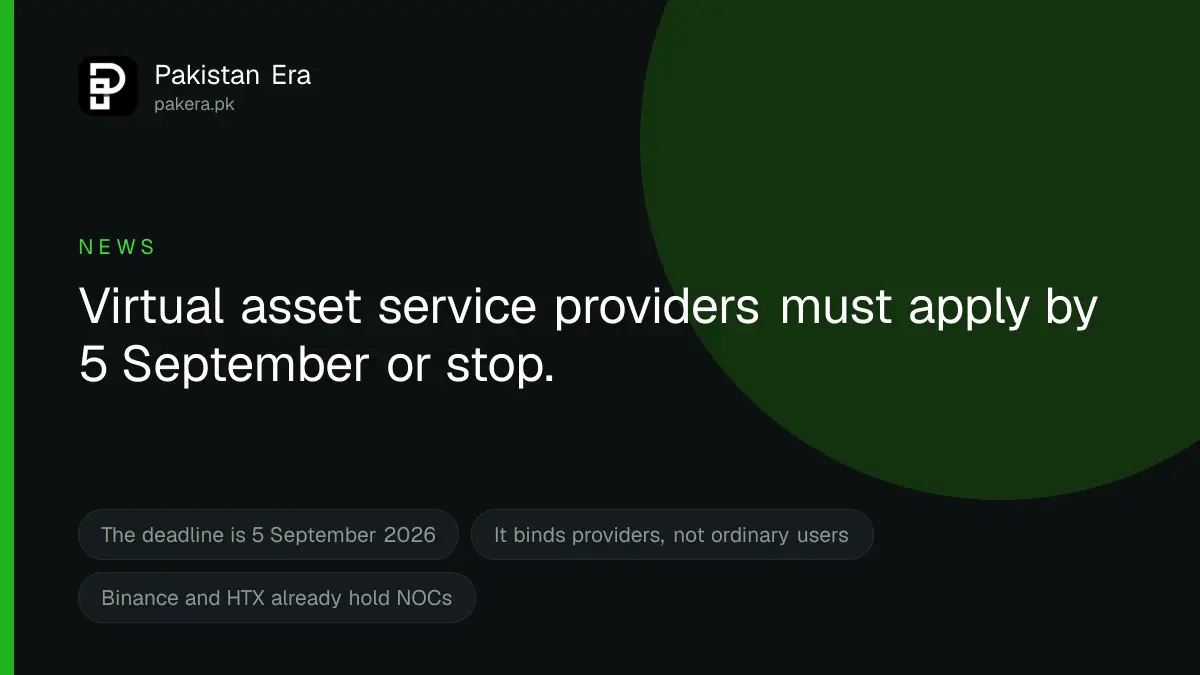
Anyone who has been providing virtual asset services in Pakistan since 5 March 2026 or earlier has until 5 September 2026 to apply for a No Objection Certificate, or stop operating. That is five days from the date of writing.
The requirement comes from Section 70 of the Virtual Assets Act, 2026, and we read it on the Pakistan Virtual Assets Regulatory Authority's own site at pvara.gov.pk on 31 August 2026.
What the deadline actually says
PVARA states the position in the same words in three places on its site, which is a fair signal of how firm it is.
Transitional Persons, meaning those operating since 5 March 2026 or before, must submit an NOC application by 5 September 2026 or cease operations, as required under Section 70 of the Virtual Assets Act, 2026. Everyone else may submit a Sandbox or NOC application as and when they meet the regulatory requirements.
| Point | What PVARA states |
|---|---|
| Who is bound | Transitional Persons, operating since 5 March 2026 or before |
| The deadline | 5 September 2026 |
| The alternative | Cease operations |
| The provision | Section 70 of the Virtual Assets Act, 2026 |
| Everyone else | May apply for Sandbox or NOC when requirements are met |
Using crypto is not the same as providing a service
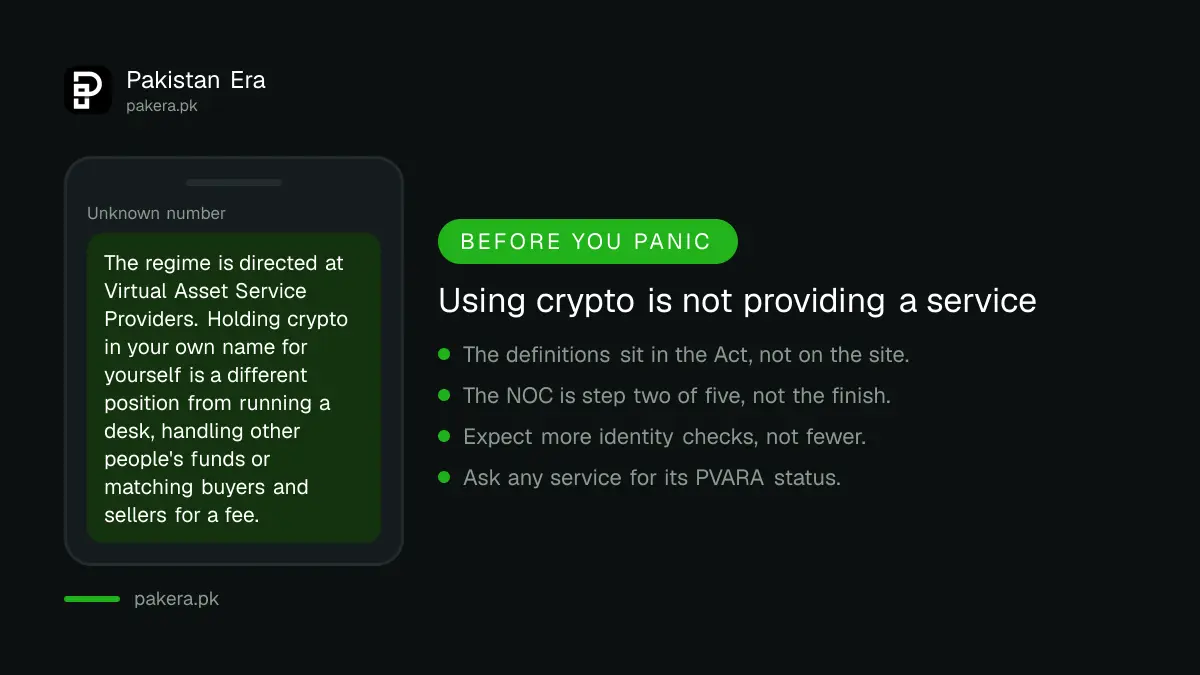
This is the distinction that will decide whether the deadline is your problem, and it is worth getting straight before anybody panics.
PVARA describes itself as the authority responsible for licensing, supervising and regulating virtual assets and Virtual Asset Service Providers operating in the country, and says all Virtual Asset Service Providers must obtain a formal licence before offering services in Pakistan. The regime is aimed at the businesses that provide services.
Someone who buys and holds crypto in their own name, for themselves, is not obviously providing a service to anyone. Someone who runs a P2P desk, handles other people's funds, matches buyers and sellers for a fee, or advertises an exchange service is in a very different position.
We are not going to tell you which side of that line you are on. The definitions sit in the Act itself, which we have not read for this piece, and the consequence of guessing wrong is enforcement rather than a letter. If you take money from other people in connection with virtual assets, get proper advice this week rather than next.
The NOC route in five steps
PVARA sets out two tracks. Track B is the one that matters for the September deadline, and it does not end at the NOC.
- Apply for the NOC, submitting a business plan and corporate documents.
- Receive the NOC, which is preliminary approval to proceed.
- Complete registration with the Financial Monitoring Unit and other applicable requirements.
- Incorporate locally, establishing a subsidiary under the Companies Act 2017.
- Submit the licensing application after incorporation.
Read that list before assuming the deadline is a formality. The NOC is step two of five, and steps three and four involve a separate regulator and a company incorporation. The 5 September date is the start of the process, not the end of it.
The other track, Track A, runs from a Regulatory Sandbox to a licence, for firms testing an innovative product under supervision. It moves through a sandbox application, admission, controlled testing within an agreed scope and customer limit, sandbox exit, and then the licence application.
The exchanges most people use are already inside the system
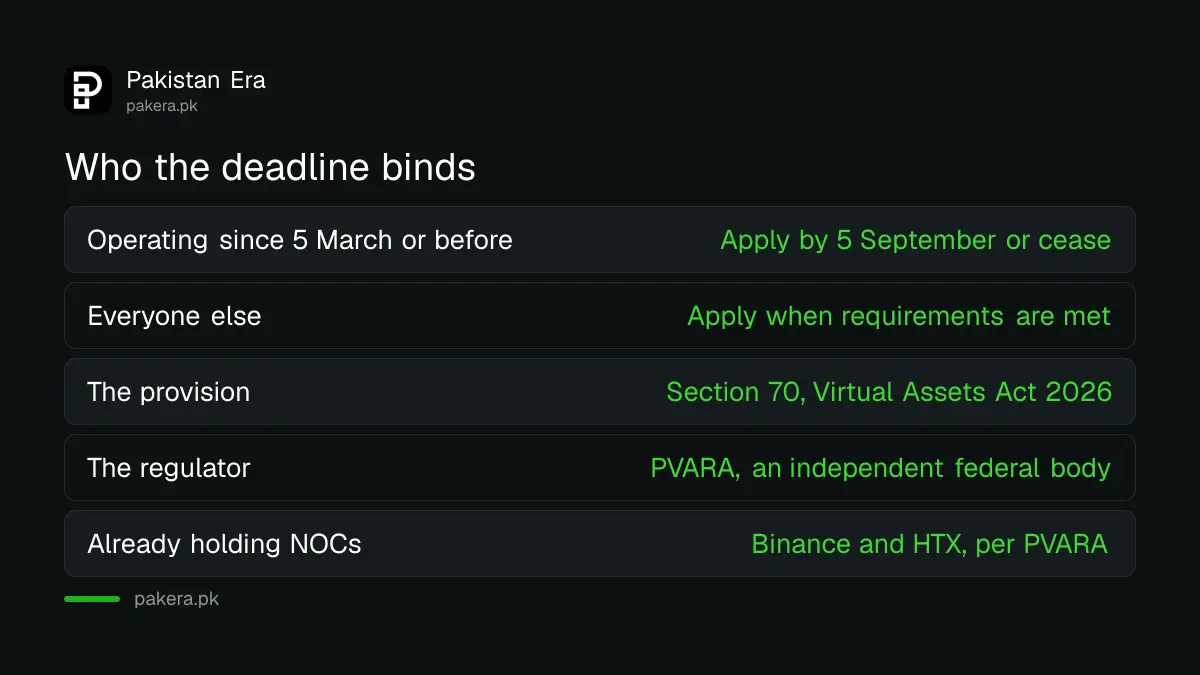
PVARA's own updates section records that it has granted no objection certificates to major global exchanges including Binance and HTX.
For an ordinary user that is the practically useful part. The platforms a lot of Pakistanis already use are named as having taken the regulated route, which is a different situation from an unnamed local operator running a service off a chat group.
It also sets a standard you can apply yourself. If a service is taking your money and cannot tell you what its regulatory status with PVARA is, that answer is information.
What the regime brings with it
The site sets out obligations that will change how services behave, and users will feel some of them.
Licensees must verify customer identities, monitor transactions, maintain records and report suspicious activity, aligning with FATF standards. They must also safeguard customer funds, maintain cybersecurity, provide clear disclosures and follow transparent business practices.
In practice that means more identity checks, not fewer. PVARA also states it can impose penalties, suspend licences and take legal action against non-compliant or unauthorised operators.
Where this sits with what came before
Crypto's legal position in Pakistan has been confused for years, and a licensing regime does not by itself answer every older question. Our guide to whether crypto is legal in Pakistan covers the background, and our report on the Lahore High Court holding that P2P trading is not a crime by itself covers that judgment.
Neither of those is a licence to ignore the new framework. A court saying an activity is not inherently criminal is a different thing from a regulator saying a business needs authorisation to offer it.
If somebody is selling you a guaranteed return
Deadlines like this one produce a rush of people claiming to be registered, approved or about to be licensed. Treat that claim as something to verify rather than accept.
Our report on a licensed broker that ran a Ponzi scheme makes the point that a licence is not a guarantee, and the return being promised tells you more than the paperwork does. If you have already lost money to an operator, our guide to reporting a cybercrime covers that route, and PVARA's own site carries a complaints section.
Common questions about the PVARA deadline
When is the deadline?
5 September 2026, for those operating since 5 March 2026 or before, under Section 70 of the Virtual Assets Act, 2026.
Does it apply to me if I just hold crypto?
The regime is directed at Virtual Asset Service Providers. If you take money from others in connection with virtual assets, take advice rather than assume.
What happens if a provider misses it?
PVARA states the alternative to applying is to cease operations, and that it can penalise and act against unauthorised operators.
Is the NOC the licence?
No. It is preliminary approval, followed by Financial Monitoring Unit registration, local incorporation and then the licence application.
Are any exchanges approved?
PVARA records granting NOCs to major global exchanges including Binance and HTX.
How we verified this
What we checked, where we read it, and what we could not confirm.
Last checked 31 August 2026. We read the Pakistan Virtual Assets Regulatory Authority's website at pvara.gov.pk on that date. The requirement that Transitional Persons operating since 5 March 2026 or before must submit an NOC application by 5 September 2026 or cease operations under Section 70 of the Virtual Assets Act, 2026, the statement that all Virtual Asset Service Providers must obtain a formal licence before offering services in Pakistan, the description of PVARA as the independent federal regulator established under that Act, the two application tracks and their five steps each including Financial Monitoring Unit registration and local incorporation under the Companies Act 2017, the promulgation of the Pakistan Virtual Asset Services Regulations, 2026 and the Pakistan Virtual Asset Activity Specific Regulations, 2026, the advisory numbered PVARA/ADV/001/2026 dated 26 April 2026, the AML and CFT obligations aligning with FATF standards, the enforcement powers to penalise and suspend licences, and the record of no objection certificates granted to major global exchanges including Binance and HTX, are all taken from that site. We did not read the text of the Virtual Assets Act, 2026 or either set of regulations, so no definition of a Virtual Asset Service Provider, no penalty figure and no fee is quoted here. Anyone who may fall inside the definition should take professional advice and confirm the position with PVARA directly. Nothing on this page is legal or investment advice.
About the author

Public Services and Education Journalist
Fajr Riaz is a journalist and content writer at Pakistan Era, based in Lahore. She covers the questions people meet in everyday life in Pakistan: how a public service works, what a change in the rules means, and where to find a reliable answer.