Is Crypto Legal in Pakistan in 2026? What You Can Buy and Hold
Crypto is not legal tender in Pakistan. What the Virtual Assets Act 2026, PVARA and SBP allow, and what is still risky for buyers.
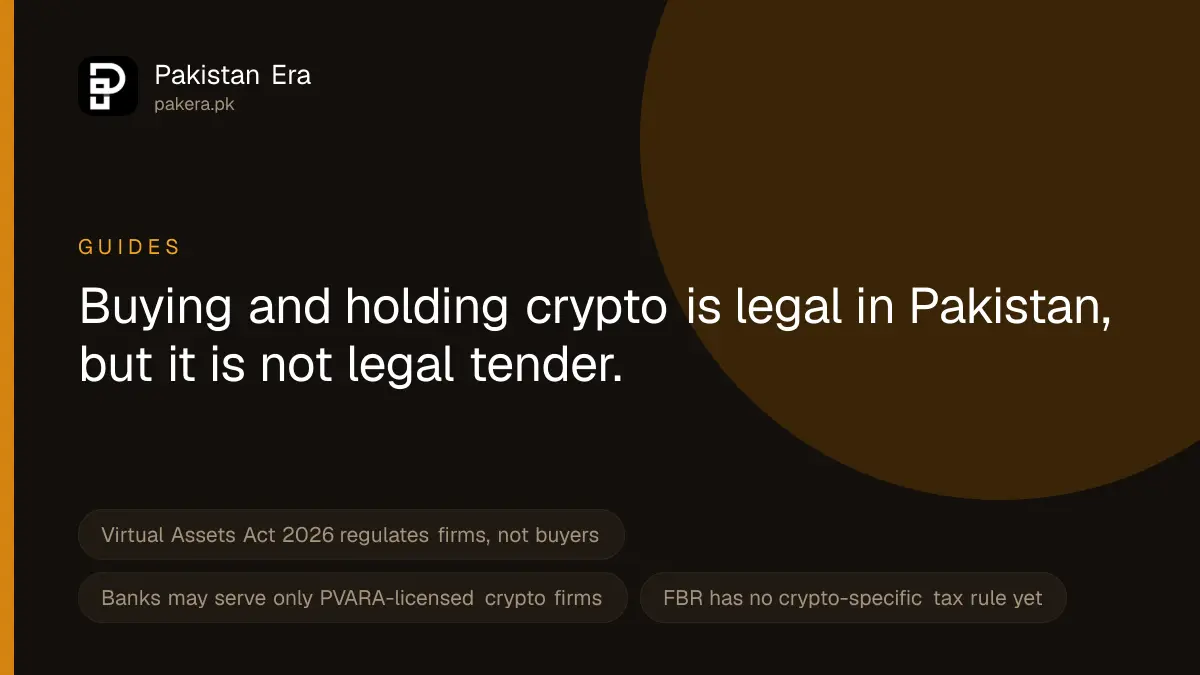
Yes, you can legally buy and hold crypto in Pakistan in 2026, but it is not legal tender, and the businesses that sell it to you need a licence. The Virtual Assets Act 2026 regulates crypto firms, not the people who buy for themselves. We found no offence in it for an ordinary person buying and holding crypto. The risk is the app you use.
That is a big change from the old position. Until April 2026, a 2018 State Bank circular kept banks away from crypto, and many people read that as a total ban. We read the new Act on the website of PVARA, the Pakistan Virtual Assets Regulatory Authority, and the State Bank's replacement circular, on 1 October 2026. Here is what they allow, what they do not, and where your money is still exposed.
Crypto is legal to own in Pakistan, but it is not legal tender
Owning crypto is not a crime in Pakistan. The Virtual Assets Act 2026 defines a virtual asset and states that virtual assets "are not legal tender". So no shop or person has to accept Bitcoin, and the rupee stays the only legal money.
Not legal tender does not mean illegal. It means the state does not stand behind it. The Lahore High Court made the same point in a bail case, which is explained in the court's ruling on P2P crypto trading. The court said crypto not being legal tender does not make it illegal.
The Act's offences in section 54 are aimed at providers. Providing an unlicensed virtual asset service "wilfully" can bring up to five years in jail, a fine of up to Rs 50 million, or both. We found no section that punishes a person for buying crypto for their own account.
PVARA licenses crypto firms, and none has a full licence yet that we could find
PVARA is the federal regulator for crypto businesses. Any firm offering crypto services to people in Pakistan, including foreign apps, needs its licence. PVARA has given no objection certificates, a first step, to Binance and HTX. We found no public list of fully licensed firms on PVARA's site.
PVARA's two sets of regulations came into force on 21 August 2026. Its FAQ says a firm counts as operating "in or from Pakistan" if it targets, promotes to or signs up people in Pakistan, including through an app or rupee payments. So a foreign exchange that serves Pakistani users falls under the rules too.
An NOC is not a licence. PVARA's FAQ says plainly that "an NOC does not constitute a license to carry on any Virtual Asset Service." The full path is set out in PVARA's licensing deadline for crypto services. Its FAQ also says PVARA publishes a public register of licensees, and that every licensee must show its licence number on its own website. On 1 October 2026 we tried the likely register addresses on pvara.gov.pk and each one returned a "not found" page.
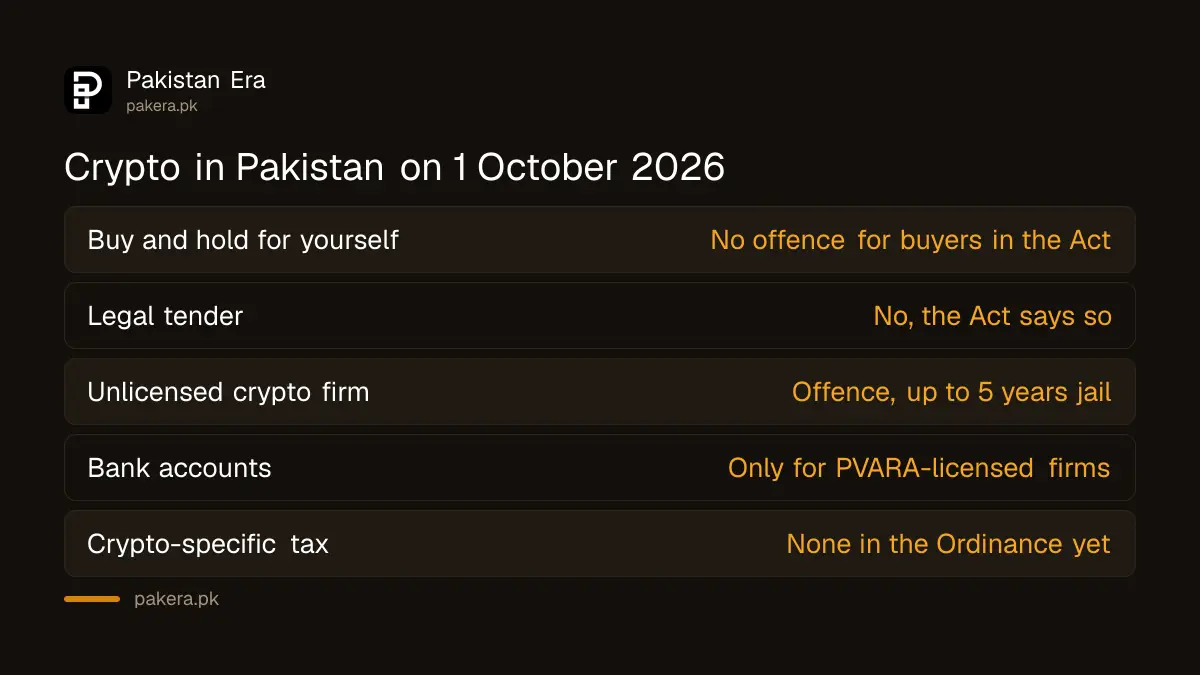
| Question | What the official sources say |
|---|---|
| Can I buy and hold crypto? | No offence for a buyer in the Act we read |
| Is crypto legal tender? | No, the Act says so |
| Can a firm sell crypto without a licence? | No, up to 5 years jail or Rs 50 million fine |
| Can my bank handle crypto money? | Only for PVARA-licensed firms |
| Is mining for yourself licensed? | No licence needed for pure own-account mining |
Banks can serve only PVARA-licensed crypto firms
The State Bank now lets banks open accounts for crypto firms, but only firms licensed by PVARA. Banks still cannot buy or hold crypto with their own money or yours. So a rupee transfer to an unlicensed app has no approved banking route.
SBP's BPRD Circular Letter No. 10 of 2026 replaced the 2018 circular. It lets banks open accounts for "entities duly licensed by PVARA" and their customers, with client money kept in separate rupee accounts that take no cash. The details are in the State Bank's rules for crypto firm accounts.
In practice, this is where ordinary users get hurt. People who buy crypto through P2P deals, sending rupees to a stranger's bank account, can find that account flagged or the money tied to someone else's fraud. That is a banking and fraud risk, not a crime of buying.
FBR has no crypto-specific tax rule yet
We found no mention of crypto or virtual assets in the Income Tax Ordinance 2001 as amended up to 30 June 2026, or in the Finance Act 2026. A crypto tax was discussed before the budget, but it is not in the Act FBR published.
That does not make crypto profit tax-free. Section 37 of the Ordinance taxes a gain on disposal of a "capital asset", which it defines as "property of any kind held by a person", with some exceptions. Our reading is that a crypto gain is likely to fall under that general rule, but FBR has issued no specific guidance we could find. Declare your holdings honestly when you fill in your tax return and wealth statement, and get advice from a tax adviser for large amounts. The tax year 2026 return deadline is 15 October 2026.
How to buy crypto in Pakistan with less risk
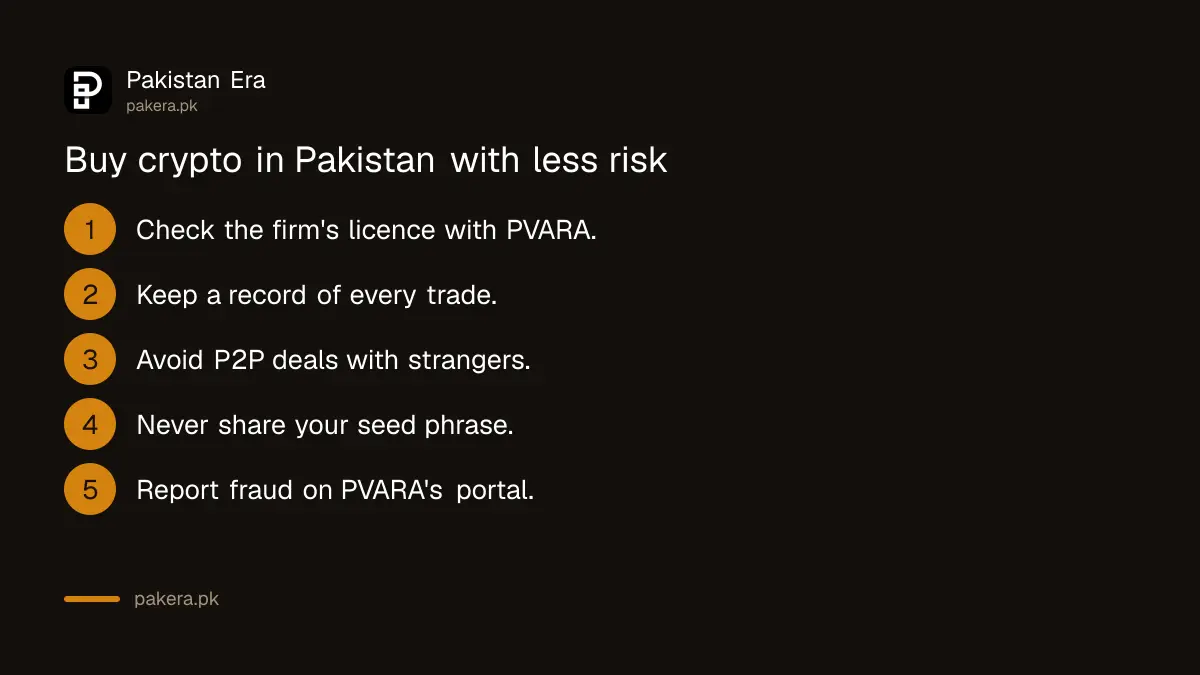
Use a firm that can show PVARA approval, keep records of every rupee in and out, avoid paying strangers' accounts, and never share your wallet recovery words. These steps do not make crypto safe. They cut the chance of losing money to fraud.
- Check the firm's standing. Look for its licence number on its own site, then check it with PVARA. Remember an NOC is only a first step.
- Keep a record of every trade. Save the date, amount, price and the bank transfer slip. You need these for tax and for any dispute.
- Avoid P2P deals with strangers. A transfer into a third party's account is where most bank freezes and frauds start.
- Never share your seed phrase. No exchange, regulator or support agent needs it.
- Report fraud to PVARA. Its grievance portal takes reports on fraud and unlicensed firms, acknowledges within 2 business days and says a full investigation can take 30 to 60 days.
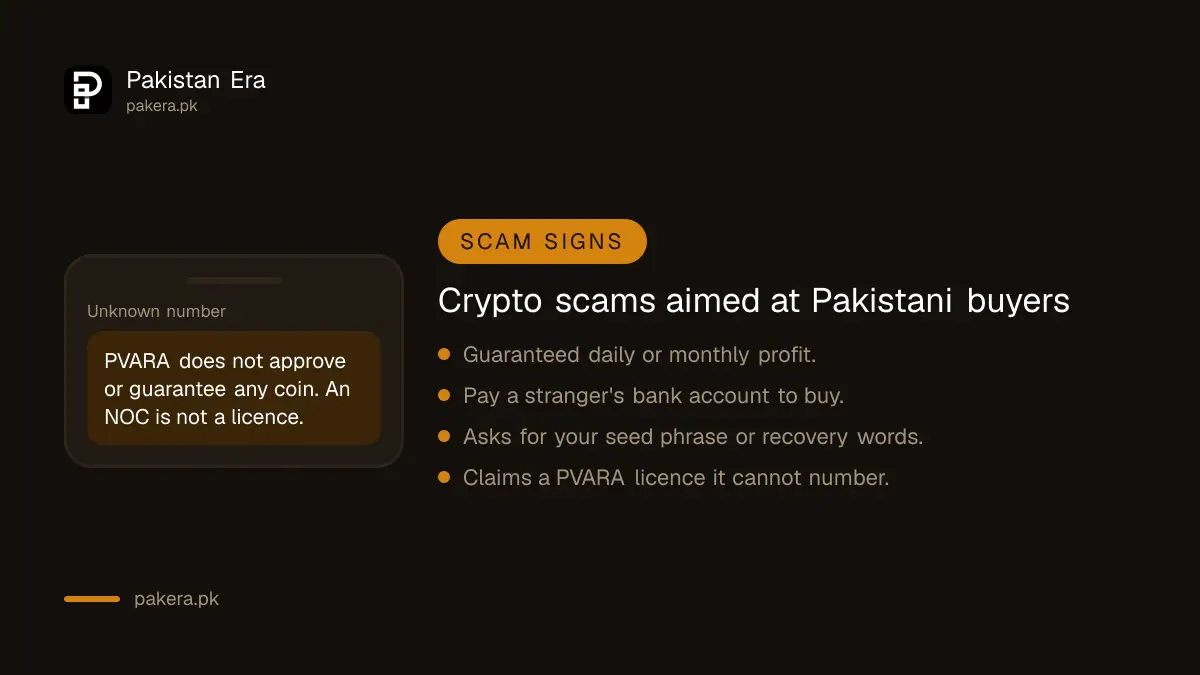
PVARA's FAQ also says it does not approve, endorse or guarantee any virtual asset. A coin listed on an exchange is not a coin the state has checked. If it falls to zero, nobody owes you anything.
Common questions
Is crypto banned in Pakistan in 2026?
No. The 2018 State Bank restriction was replaced in April 2026, and the Virtual Assets Act 2026 regulates crypto firms through PVARA. Crypto is still not legal tender.
Can I go to jail for buying Bitcoin in Pakistan?
We found no offence in the Act for buying for yourself. The jail terms in section 54 apply to people who provide crypto services without a licence.
Is Binance licensed in Pakistan?
PVARA says it has given Binance a no objection certificate. Its own FAQ says an NOC is not a licence. We found no public register showing a full licence.
Do I pay tax on crypto profit in Pakistan?
There is no crypto-specific rule yet. The general capital gains rule in section 37 is likely to apply, so declare it and take advice.
Can my bank block my account for crypto?
Banks may handle crypto money only for PVARA-licensed firms. Transfers linked to unlicensed apps or P2P strangers can be flagged under anti-money laundering rules.
How we verified this
What we checked, where we read it, and what we could not confirm.
We read PVARA's home page, FAQ, advisory PVARA/ADV/001/2026 and complaints page, and the Virtual Assets Act 2026 text as passed by the National Assembly, published on pvara.gov.pk. We read SBP's BPRD Circular Letter No. 10, and FBR's Finance Act 2026 and Income Tax Ordinance 2001 amended to 30 June 2026. All were checked on 1 October 2026. This is not legal or tax advice. Sources: PVARA FAQ and SBP BPRD Circular Letter No. 10.
About the author

Tax, Bills and Technology Writer
Ali Akhtar is a young and curious voice here at Pakistan Era. He is currently pursuing his A-Levels and has a growing interest in Pakistan’s changing industrial landscape and educational trends. Ali likes to write in a way that helps him explain and explore the world around him. His writing reflects the perspective of the new generation navigating the evolving trends of Pakistan where technology, youth innovation, and shifting opportunities are reshaping the country’s future.