How to File a Health Insurance Claim in Pakistan: Cashless or Reimbursement
Private health insurance pays two ways in Pakistan: cashless at a panel hospital, or reimbursement once you pay. The documents and why claims get rejected.
Private health insurance in Pakistan pays claims two ways: cashless, where the insurer settles the hospital bill directly, or reimbursement, where you pay first and the insurer repays you after. Which one applies depends entirely on whether the hospital is on your insurer's panel.
This is about private health insurance bought from an insurer or provided through an employer, not the government-run Sehat Sahulat Program. The Sehat Card scheme pays government and listed private hospitals directly under a different structure entirely, so if that's what you're asking about, the process below won't match your card. We looked at how Pakistani insurers actually run a private claim, cashless and reimbursement, and what gets a claim rejected.
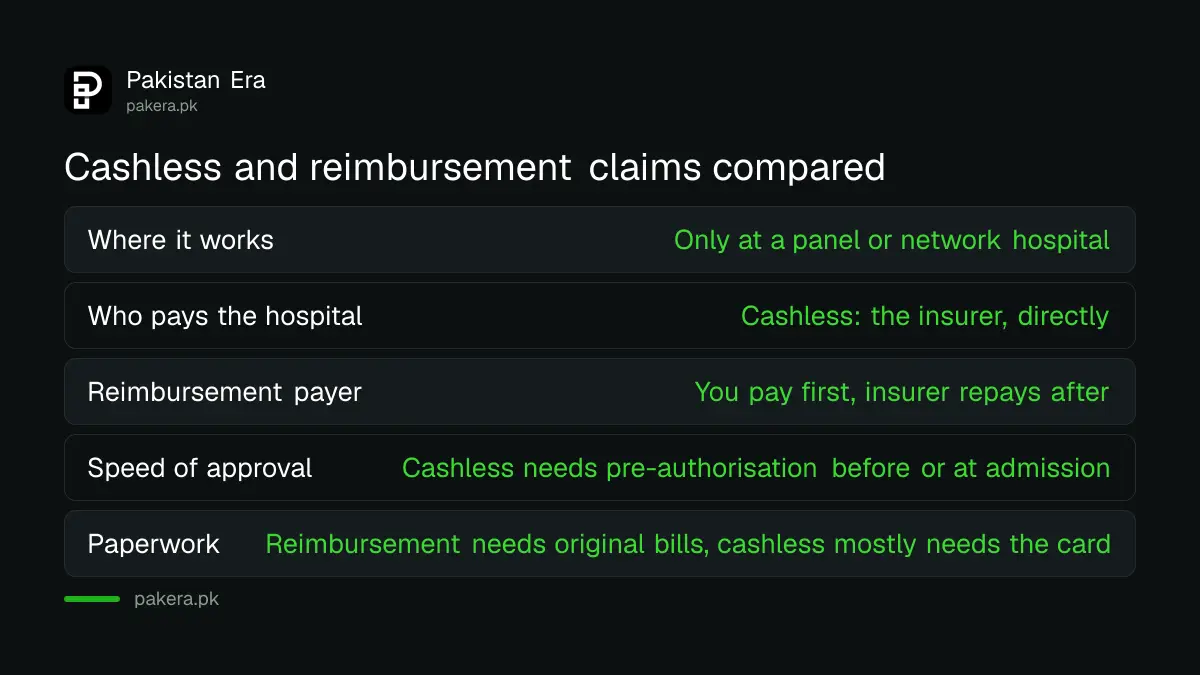
Health insurance claims work two ways: cashless or reimbursement
A cashless claim only works at a hospital on your insurer's panel or network list. A reimbursement claim works anywhere, but you carry the cost until the insurer pays you back. Your policy document lists which hospitals are on the panel, and that list changes, so check it before you're admitted, not during.
Most insurers push cashless for planned treatment and fall back to reimbursement for emergencies at a hospital that isn't on the list. Neither route is automatically faster. A cashless claim at a busy panel hospital can still take hours for pre-authorisation, and a reimbursement claim with a complete file can be settled quickly.
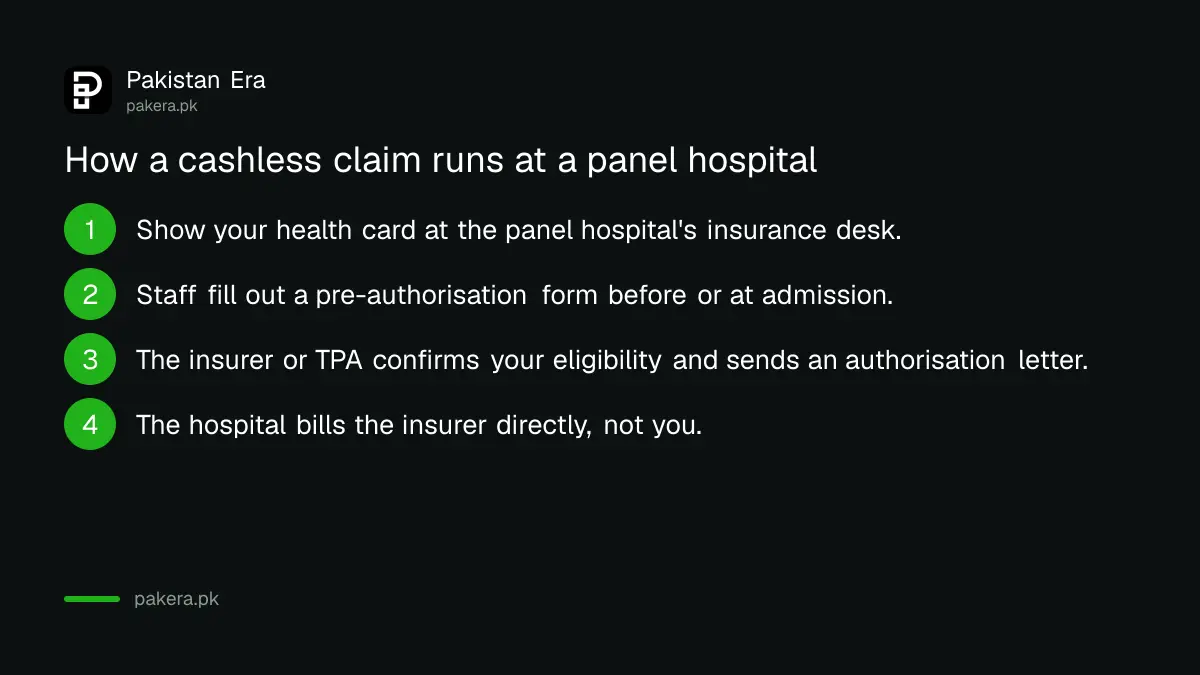
How a cashless claim runs at a panel hospital
Show your health card at the hospital's insurance desk when you arrive, and the desk takes it from there. The hospital, not you, talks to the insurer for approval.
- Show your health card at the panel hospital's dedicated insurance desk.
- Hospital staff complete a pre-authorisation form, ideally before admission for planned procedures, around 48 hours ahead where possible.
- The insurer or its third-party administrator checks your eligibility and sends back an authorisation letter.
- The hospital bills the insurer directly for the approved amount, and you settle only what falls outside your cover.
For a planned procedure, call your insurer's helpline a few days ahead and confirm the hospital is still on the panel. Panels change, and finding out at the admission desk is the worst possible moment.
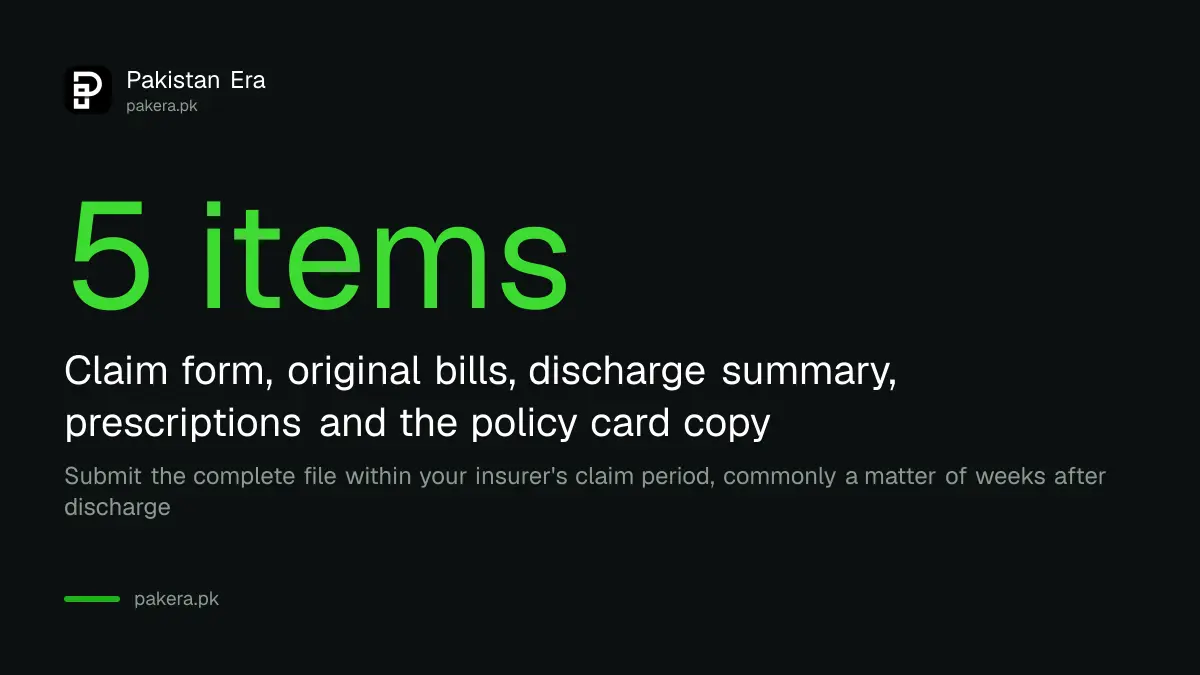
How a reimbursement claim works when you pay first
If you're treated at a hospital outside the panel, or in a genuine emergency where there was no time to check, you pay the bill yourself and claim the money back afterward. The strength of a reimbursement claim comes down entirely to the paper file you submit.
Keep every original bill, not photocopies, because most insurers want originals for a reimbursement file. Collect the discharge summary, the doctor's prescriptions, lab and test reports, and a copy of your policy card. Fill in the insurer's claim form with the event date, the diagnosis and your current address, and send the complete set together rather than piecemeal.
| Document | Why the insurer wants it |
|---|---|
| Claim form | States the event, the diagnosis and your claim details |
| Original hospital bills and receipts | Proves what was actually charged and paid |
| Discharge summary | Confirms the admission, treatment and discharge dates |
| Doctor's prescriptions and test reports | Supports the diagnosis and the treatment given |
| Policy card or membership copy | Confirms you're covered and identifies your plan |
Send a written intimation to the insurer soon after the event, before you gather every document, because most policies set a short window for first notice separate from the longer window for the full file. Check your schedule for both dates.
Common reasons health insurance claims get rejected
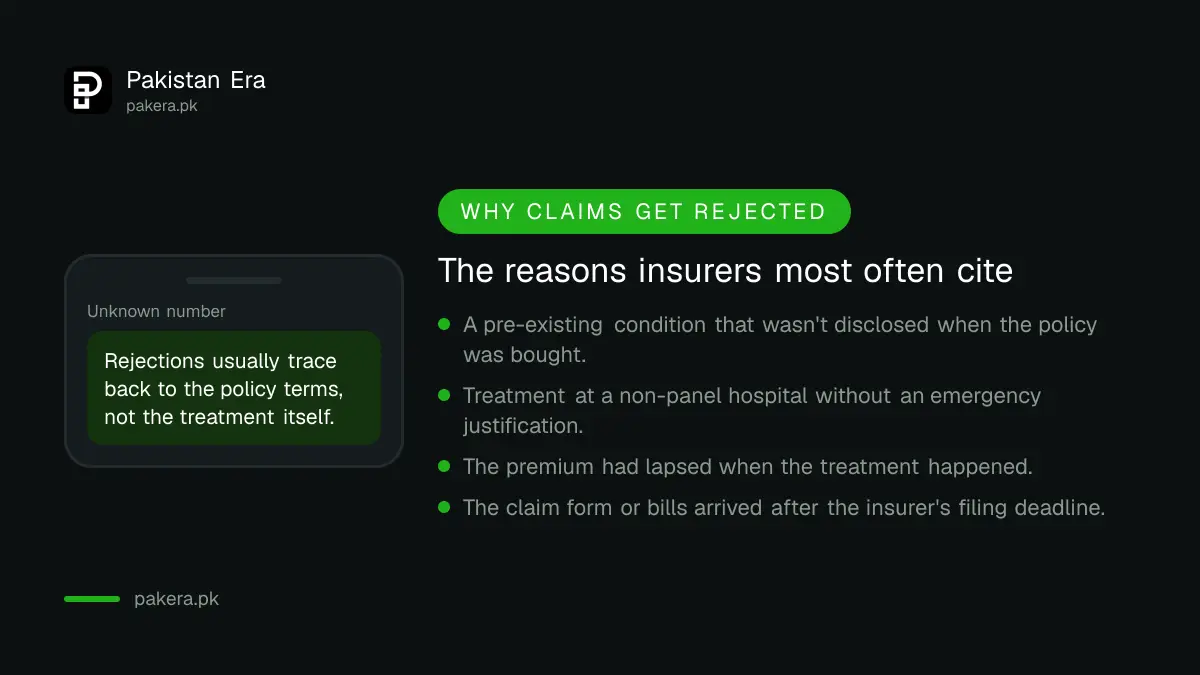
Most rejections are not about the treatment at all. They come from something in the policy terms that the claim quietly runs into.
- A pre-existing condition that wasn't declared when the policy was bought.
- Treatment at a non-panel hospital without a genuine emergency to justify it.
- The premium had lapsed or an instalment was unpaid when the treatment happened.
- The claim form or bills arrived after the insurer's filing deadline.
- The treatment falls under a standard exclusion, such as cosmetic procedures or a waiting period that hadn't ended.
Read your policy's exclusions list once, when you're well, rather than discovering it from a rejection letter.
If your claim is refused, you can still escalate it
Write to the insurer first and ask for the rejection reason in writing. Insurers sometimes reverse a decision once a missing document is supplied, so check exactly what the letter cites before assuming the case is closed.
If the insurer still won't pay and you believe it's unjustified, SECP and the Federal Insurance Ombudsman both take complaints against insurance companies, free of charge. We've laid out that full process, the address, the helpline and the online form, in how to complain when an insurance claim is refused, so check there for the escalation steps rather than this page repeating them.
Common questions
What's the difference between cashless and reimbursement claims?
Cashless means the insurer pays the panel hospital directly. Reimbursement means you pay first and the insurer repays you after you submit the bills.
Is Sehat Card the same as private health insurance?
No. Sehat Card is the government-run Sehat Sahulat Program with its own hospital list and claim structure. Private health insurance is a separate policy bought from an insurer or provided by an employer.
Can I use a cashless claim at any hospital?
Only at a hospital on your insurer's panel or network list. Outside that list, you pay first and claim reimbursement.
How soon do I need to tell my insurer about a claim?
Send written intimation soon after the event. Most policies set a separate, longer deadline for the complete document file, so check both dates on your schedule.
What if the insurer rejects my claim unfairly?
Ask for the rejection in writing, then complain to SECP or the Federal Insurance Ombudsman if the insurer won't reconsider.
How we verified this
What we checked, where we read it, and what we could not confirm.
We reviewed Pakistani insurers' published claims procedures on 5 October 2026 to confirm the two-route structure, cashless and reimbursement, and the general documents each requires. Exact timelines and filing windows vary by insurer and policy, which the body states rather than quoting one figure as universal. Sources: Securities and Exchange Commission of Pakistan and Federal Insurance Ombudsman of Pakistan.
About the author

Senior Writer, Public Services and Technology
Shahid joined us in 2024 as an author. He is a senior contributor to Pakistan's leading technology websites. He writes detailed articles, mostly covering his expertise in the latest tech, mobiles, apps, gadgets, and step-by-step guides. His ideology is to help people understand the latest trends and explain complex methods through very easy-to-understand guides.