How to Fill Your FBR Tax Return and Wealth Statement in Pakistan
Declare your income, claim tax already taken on phone bills, cars and property, and balance your wealth statement on IRIS. Checked on FBR's 2026 form.
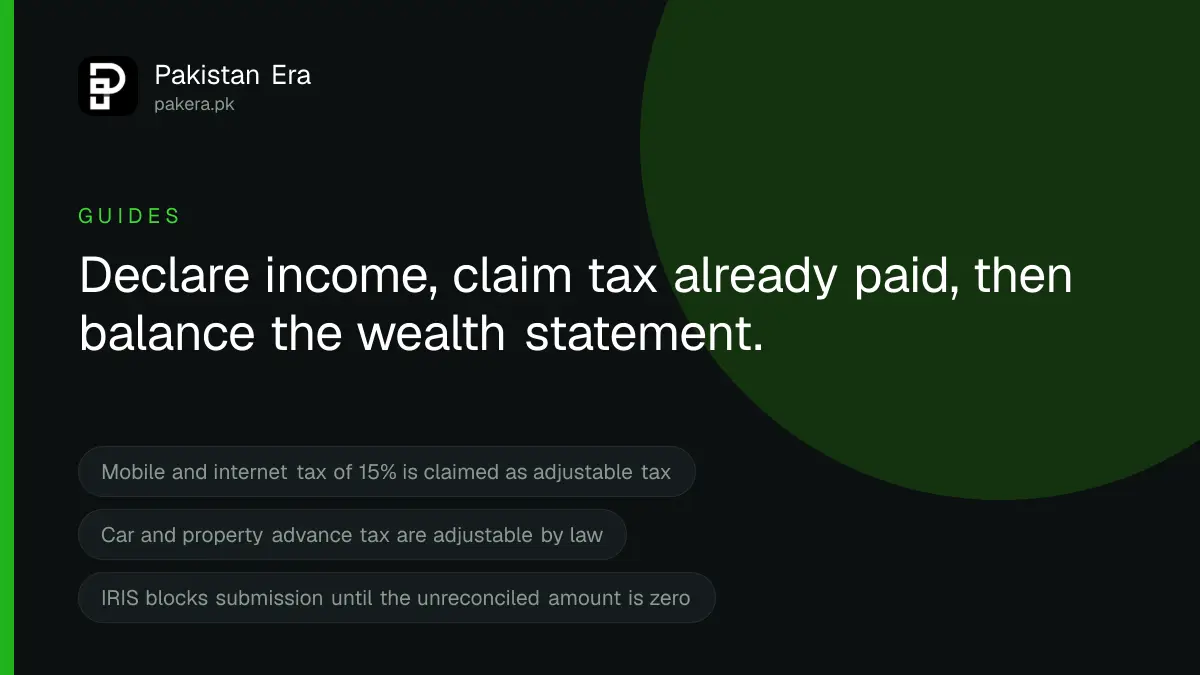
Filing your FBR return is three jobs, and most mistakes come from treating it as one. You declare your income. You claim the tax that was already taken from you on salary, phone bills, a car or a plot. Then you fill a wealth statement that has to balance to zero before IRIS lets you submit.
The last date for tax year 2026 is 30 September 2026. The year covers income from 1 July 2025 to 30 June 2026.
We went through the tax year 2026 return form screen by screen, as FBR notified it in SRO 1495(I)/2026 on 2 September 2026, and checked each claim below against the Income Tax Ordinance, 2001, on 26 September 2026. Where the law was not clear enough for us to be sure, we say so.
Download your own tax record before you type anything
The tax year 2026 return opens with a screen called Summary of Economic Transactions. It lists the tax already withheld from you and the amount it was taken on. Download it first, because it is your checklist and it is what FBR will compare your return against.
After you pick your sources of income, IRIS shows this summary under the heading "Summary of Withholding Tax as Withholdee", with a Download Detailed Data button. FBR's note on the screen says the data is indicative and keeps updating, and that correct reporting is your own responsibility. So treat it as a starting point, not as the truth.
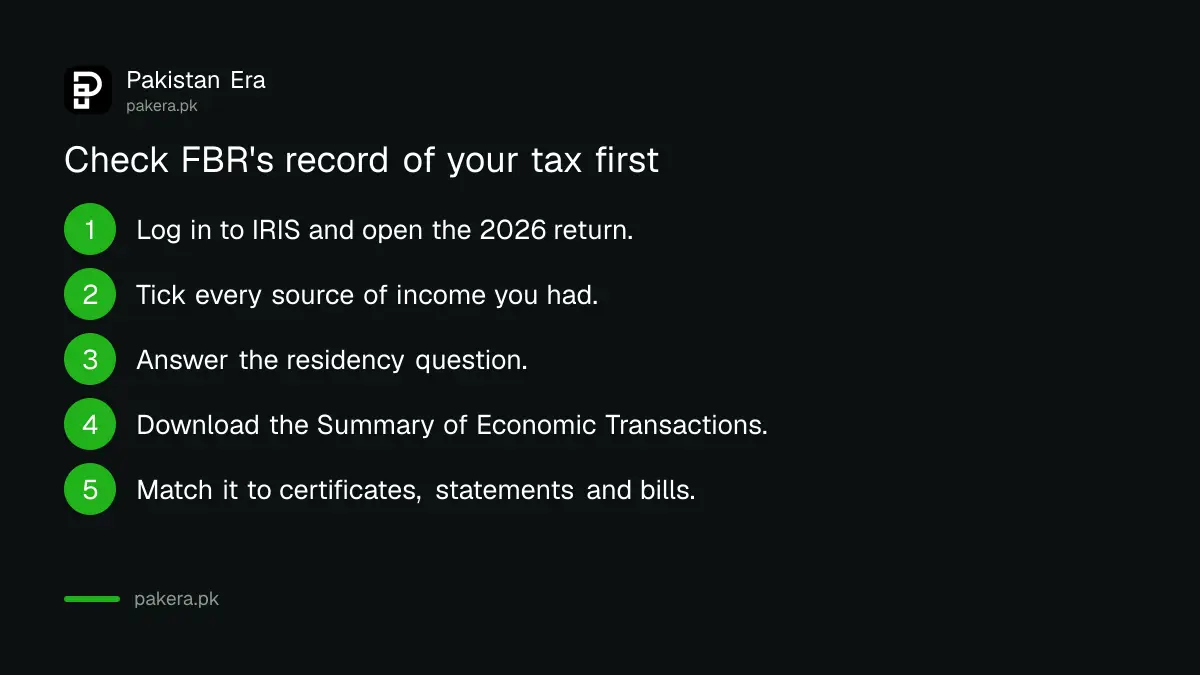
- Log in to IRIS with your CNIC and password, and open the return for tax year 2026.
- Tick every source of income you had, including ones with no tax payable.
- Answer the residency question. Most people living in Pakistan are resident.
- Open the Summary of Economic Transactions and download the detailed data.
- Match each line against your salary certificate, bank statements and bills.
If a line in the summary is not yours, or the amount is wrong, keep the evidence. A tax credit you cannot back with a certificate is worth nothing if the case is picked for audit. And if IRIS itself will not load, the known IRIS login and form errors are usually a browser or password issue rather than your return.
Declare every source of income in its own section
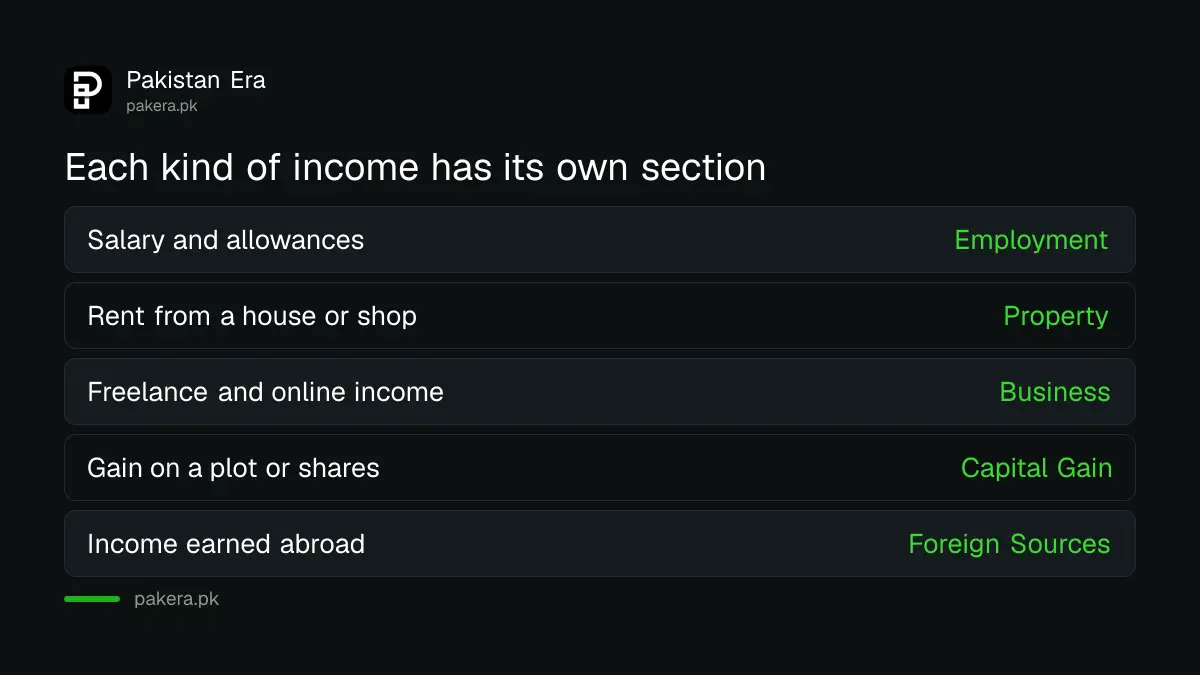
Each kind of income has its own section in IRIS: salary, property rent, business, capital gains, other sources, foreign sources and agriculture. Put each rupee in the right one. The section decides how it is taxed, and a wrong section is the most common cause of a wrong tax figure.
The left-hand menu of the tax year 2026 form runs in this order: Employment, Property, Business, Capital Gain, Other Sources, Foreign Sources, Agriculture, Tax Chargeable and Payments, and finally the 116 Wealth Statement. Here is what goes where for most individuals.
- Salary. Pay, arrears, allowances, perquisites and any termination benefits go under Employment. Copy the figures from your employer's salary certificate. If salary is more than half your income, FBR offers the shorter Declaration form 114(I).
- Rent. Rent from a house, flat or shop goes under Property, even if the tenant never deducted tax.
- Freelance and shop income. This goes under Business. Online earnings are no exception, and YouTube and TikTok income now has its own line.
- Bank profit. Profit on savings accounts and certificates is taxed separately from your salary under section 7B for individuals. You still declare it, with the tax the bank deducted.
- Selling a plot or shares. The gain goes under Capital Gain, not as ordinary income.
The salary slabs for tax year 2026 start at 1% on income between Rs 600,000 and Rs 1,200,000. Check the full salary tax slabs if the tax IRIS calculates looks far from what your employer deducted.
Claim the tax you already paid on bills, cars and property
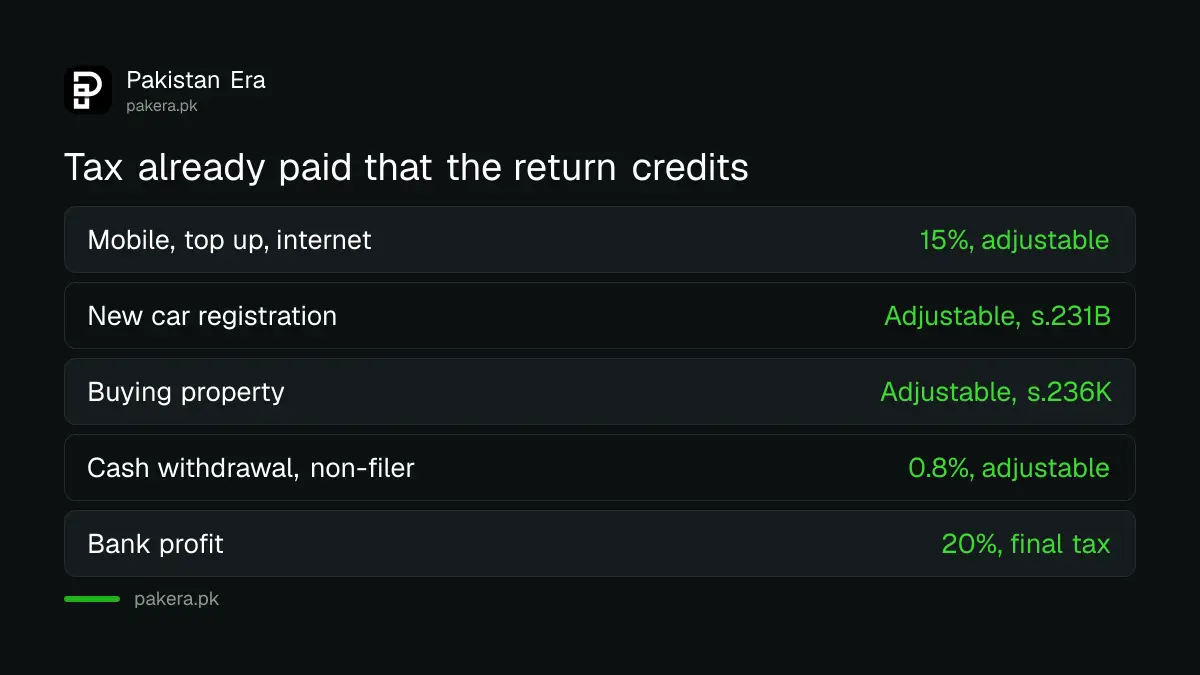
Tax taken on your phone and internet bills, a new car, a property purchase or a cash withdrawal counts as tax you have already paid. Enter it under Withholding Tax and IRIS subtracts it from your final bill. Leave it out and you pay it twice.
The law calls this kind of tax "adjustable". Section 168 of the Ordinance treats tax collected from you as tax paid by you. Two other kinds work differently. Final tax settles that income on its own, so nothing more is owed on it and nothing comes back. Minimum tax can reduce your bill but can never be refunded.
| Tax already taken from you | Law | Filer rate, tax year 2026 | How the return treats it |
|---|---|---|---|
| Salary tax deducted by employer | Section 149 | By salary slab | Credited against your tax |
| Mobile bill, prepaid top up, internet | Section 236 | 15% of bill or card | Own lines under adjustable tax |
| Landline bill over Rs 1,000 | Section 236 | 10% of the excess | Own line under adjustable tax |
| Registering a new car | Section 231B | 0.5% to 12% of value | Adjustable, says section 231B(5) |
| Buying property | Section 236K | 1.5% to 2.5% | Adjustable, says section 236K(2) |
| Cash withdrawal | Section 231AB | Only non-filers pay, 0.8% | "Advance adjustable tax" |
| Bank profit | Section 151 | 20% | Final tax regime for most individuals |
The rates come from FBR's own withholding rate card for tax year 2026. The adjustable lines for phone, internet, vehicle, property and cash withdrawal are each listed by name under "Adjustable Tax Collected / Deducted" on FBR's own paper return.
A few points people miss. The 15% on mobile top ups is taken at the moment you buy, so there is no invoice. Your operator can issue a certificate for the year, and the tax on mobile and internet bills explains why the balance on a Rs 100 card is lower than Rs 100. For a car, keep the excise receipt, because the advance tax on vehicles is often the largest single credit a salaried person has.
Electricity is the odd one out. A household on the Active Taxpayers List should not be charged advance tax on a domestic bill at all, so there is usually nothing to claim. For a shop or other business connection, section 235(4) says tax on the first Rs 360,000 of bills in the year is minimum tax with no refund, and only tax on bills above Rs 30,000 a month is adjustable.
Claim only what you can prove. Entering a credit that no certificate supports is the quickest way to create a mismatch with FBR's own data.
Fill the wealth statement so it balances to zero
The wealth statement lists what you own and owe on 30 June 2026. IRIS then checks that the growth in your net assets equals your income minus your spending. The difference is shown as Unreconciled Amount, and FBR says you cannot submit until it is zero.
Section 116 of the Ordinance requires every resident taxpayer who files a return to file a wealth statement and a wealth reconciliation with it. It covers your assets and liabilities, and those of your spouse, minor children and other dependents. A 2024 amendment limits when a spouse's assets belong in your statement. Our copy of that clause was not fully legible, so if your spouse files their own return, check with a tax adviser before listing their property in yours.
What goes in the statement
- Houses, flats, plots and agricultural land, at what you paid for them.
- Cars and motorcycles, with registration numbers.
- Gold and jewellery.
- Every bank account balance on 30 June 2026, including accounts you rarely use.
- Shares, mutual funds, savings certificates and prize bonds.
- Cash in hand, as a realistic figure.
- Loans you owe, such as a car loan, a house loan or money borrowed from family.
A resident with foreign income of at least 10,000 US dollars, or foreign assets of at least 100,000 US dollars, must also fill the foreign assets statement under section 116A. IRIS shows it as 116A Foreign Assets/Liabilities.
How the reconciliation works
The tax year 2026 reconciliation screen lists money in and money out. Money in is your declared income, including income taxed under final tax, plus foreign remittances, inheritance, gifts received and contributions to household costs by family members. Money out is personal expenses and gifts you gave.
Here is a worked example with round numbers, our own arithmetic on the tax year 2026 slabs:
- Net assets on 30 June 2025, from last year's statement: Rs 2,500,000.
- Salary for the year: Rs 1,800,000. Tax deducted by the employer: Rs 72,000.
- Household spending for the year: Rs 1,200,000.
- Money kept: Rs 1,800,000 minus Rs 72,000 minus Rs 1,200,000, which is Rs 528,000.
- Net assets on 30 June 2026 must therefore be Rs 3,028,000.
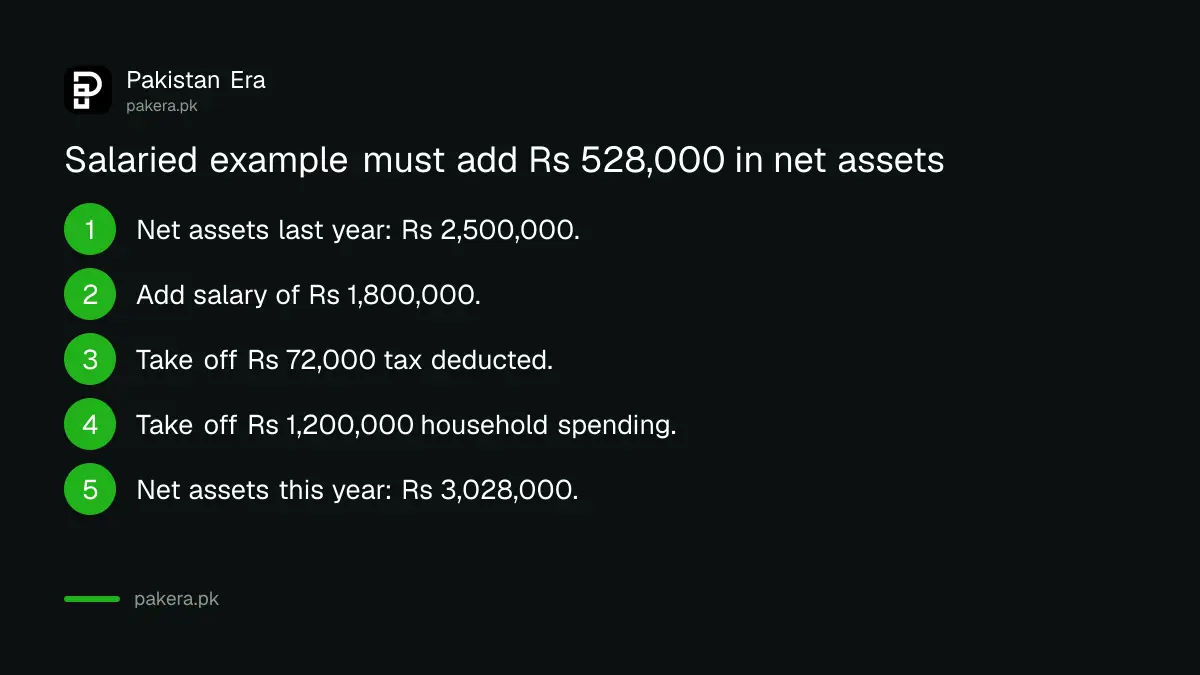
If your listed assets come to Rs 3,300,000 instead, IRIS shows Rs 272,000 unreconciled. The honest fixes are the real ones: a gift you forgot, a loan you took, or an asset valued wrongly. Do not type a smaller expense figure to force the balance.
Mistakes that get a return picked for audit
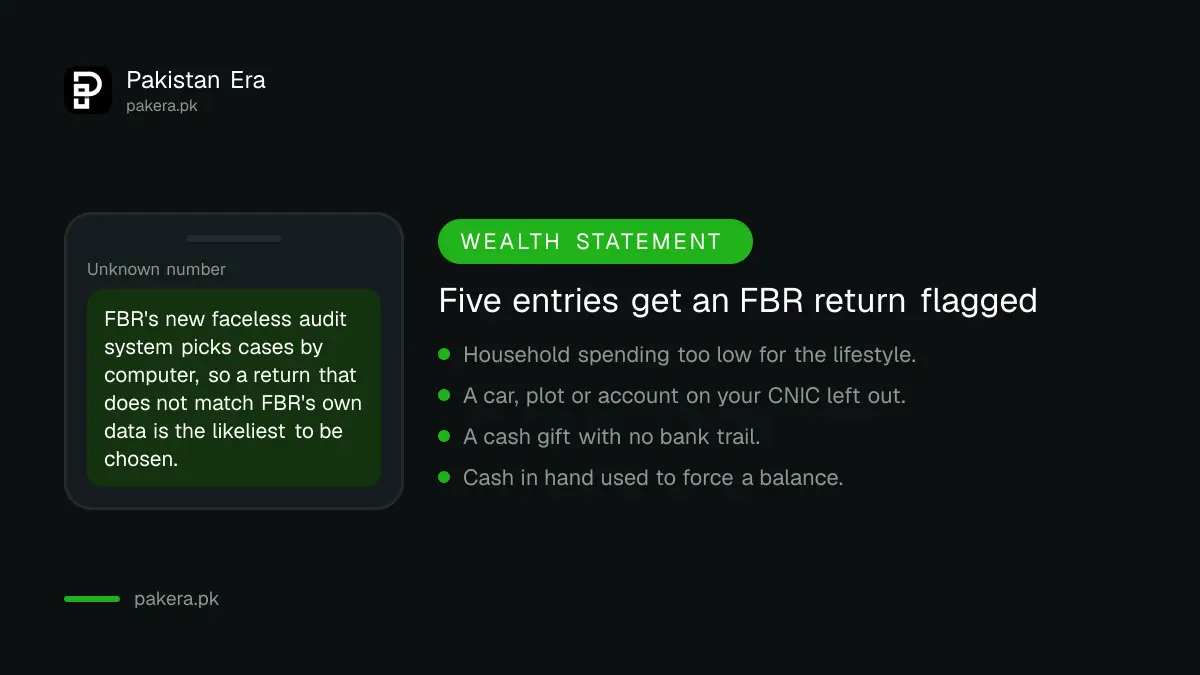
Most flagged returns fail on the same five points: spending that is too low for the lifestyle, a known asset left out, a gift with no source, cash in hand used as a balancing figure, and credits nobody deducted. Each one is easy for a computer to spot.
This matters more from this year. On 25 September 2026 FBR set up a National Faceless Centre, where audit cases will be chosen by a computerised, risk based system rather than by an officer. A return that does not match FBR's own data is the obvious input to that system.
- Household spending that is too low. Rs 20,000 a month for a family with a car, school fees and a foreign trip does not add up, and it is the figure people shrink most often.
- An asset FBR already knows about. A car registered on your CNIC, a plot in your name or a bank account the bank reports will be matched. Banks share more than most people think, as what banks report to FBR shows.
- Gifts with no trail. A large gift from a parent is fine if it came through a bank. A cash gift with no record is hard to defend.
- Cash in hand as a plug. A cash figure that jumps every year to make the statement balance is a known pattern.
- A nil return with withholding. Filing "no income" while the summary shows salary or bank profit is a direct contradiction.
If you find a mistake after submitting, you can fix it. FBR says a return can be revised within five years through an application in IRIS. A wealth statement can be revised without approval, as long as you have not yet received a notice under section 122(9). After you file, check your filer status once the Active Taxpayers List updates.
Common questions
Do I need to file a wealth statement if I only have a salary?
Yes. Section 116(2) requires every resident taxpayer filing a return to attach a wealth statement and reconciliation. IRIS will not accept the return without it.
Can I claim the tax deducted on my mobile top ups?
Yes. The return has separate adjustable tax lines for cellphone bills, prepaid cards, phone units and internet bills under section 236. Ask your operator for a tax certificate for the year.
Should I show my property at today's market value?
No. Show it at what you paid for it, including the costs of buying it. Market value changes every year and would break the reconciliation.
What if the Summary of Economic Transactions shows tax that is not mine?
Do not claim it, and keep the evidence. FBR's own note says the data is indicative, and the responsibility for correct reporting is yours.
Do I include my wife's jewellery?
It depends on whether she files her own return. A 2024 amendment limits when a spouse's assets go in your statement, so ask a tax adviser if she has her own NTN.
What happens if I miss 30 September?
You are left off the Active Taxpayers List, you pay a late filing penalty and a Rs 25,000 surcharge to get back on it. The 30 September deadline sets out the full cost.
How we verified this
What we checked, where we read it, and what we could not confirm.
Last checked on 26 September 2026. The structure of the tax year 2026 return, including the Summary of Economic Transactions screen, the income sections, the minimum tax and computation screens and the Reconciliation of Net Assets screen, is read from the scanned IRIS screens attached to SRO 1495(I)/2026, FBR's notification of the tax year 2026 electronic return for individuals. The requirement to file a wealth statement and reconciliation, and what it covers, is read from section 116 of the Income Tax Ordinance, 2001 in FBR's consolidated copy amended up to 30 June 2026; the foreign assets thresholds from section 116A; credit for tax collected from section 168; the adjustable status of vehicle and property tax from sections 231B(5) and 236K(2); cash withdrawal tax described as advance adjustable tax in section 231AB; the electricity minimum tax rule from section 235(4); and the separate tax on profit on debt from section 7B. The adjustable tax lines for phone, internet, vehicle, property and cash withdrawal are read from FBR's individual paper return for tax year 2024, the latest paper form FBR publishes. The rates are from FBR's withholding tax rate card for tax year 2026. The reconciliation rule and the revision rules are from FBR's own filing pages. The National Faceless Centre is from FBR's press release of 25 September 2026. The worked example is our own arithmetic. This is general guidance, not tax advice for your own situation.
About the author

Senior Writer, Public Services and Technology
Shahid joined us in 2024 as an author. He is a senior contributor to Pakistan's leading technology websites. He writes detailed articles, mostly covering his expertise in the latest tech, mobiles, apps, gadgets, and step-by-step guides. His ideology is to help people understand the latest trends and explain complex methods through very easy-to-understand guides.