Tax on Mobile and Internet Bills in Pakistan: 15% Under Section 236
Mobile and internet bills in Pakistan carry 15% advance tax and landlines 10% above Rs 1,000. Who is exempt, and how filers claim it back.
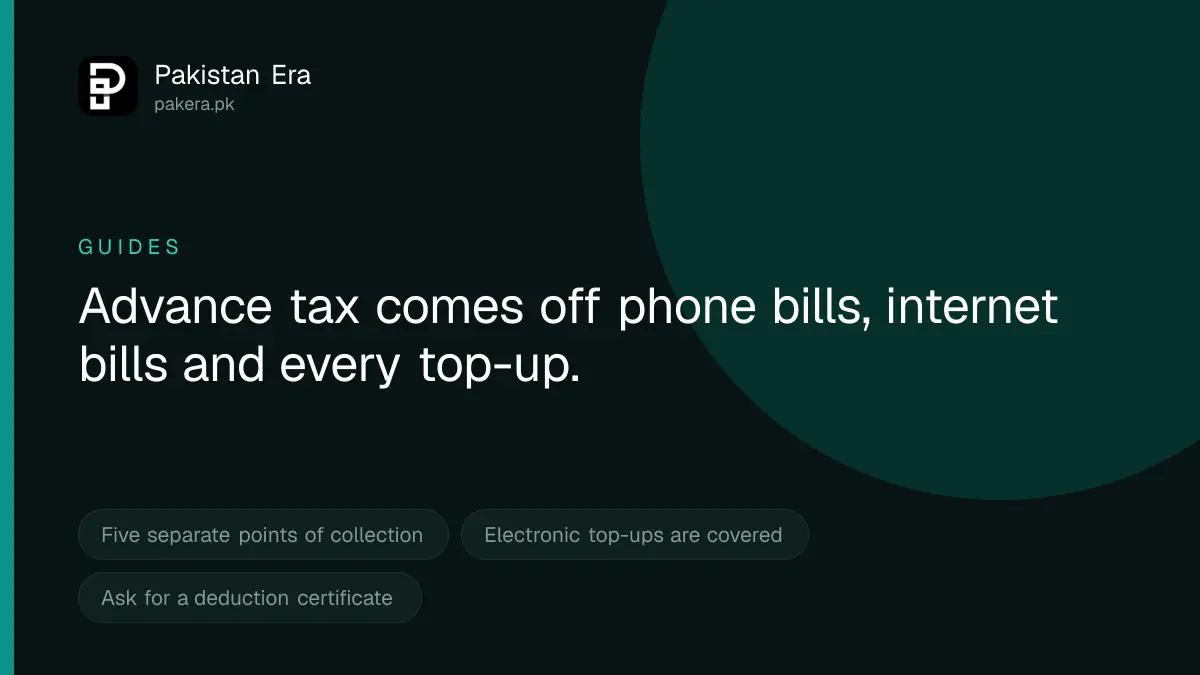
Advance income tax of 15 per cent is collected on every mobile bill, internet bill, prepaid card and electronic top-up in Pakistan. A landline bill pays 10 per cent, but only on the part of the monthly bill above Rs 1,000.
These rates come from FBR's withholding rate card for 2026-27, and the rules come from section 236 of the Income Tax Ordinance, 2001.
The rates on phone and internet bills
| What you pay for | Advance tax | Who collects it |
|---|---|---|
| Postpaid mobile bill | 15% of the bill | The operator preparing the bill |
| Internet or broadband bill | 15% of the bill | The provider preparing the bill |
| Landline bill (not mobile) | 10% of the amount over Rs 1,000 a month | The company preparing the bill |
| Prepaid phone or internet card | 15% of the sale price | The seller, at the time of sale |
| Top-up through an app, wallet or retailer | 15% of the units sold | The seller of the units |
A worked example, using those rates. A landline bill of Rs 1,800 carries Rs 80 of advance tax, which is 10 per cent of Rs 800. A broadband bill of Rs 4,000 carries Rs 600. Provincial sales tax on the service is a separate charge on top.
The top-up line matters. Section 236 covers the "sale of units through any electronic medium or whatever form", so loading credit from a banking app, a wallet or the operator's own app is inside the section too. Our guide to mobile load tax works through what a Rs 100 recharge gives you.
When it is taken
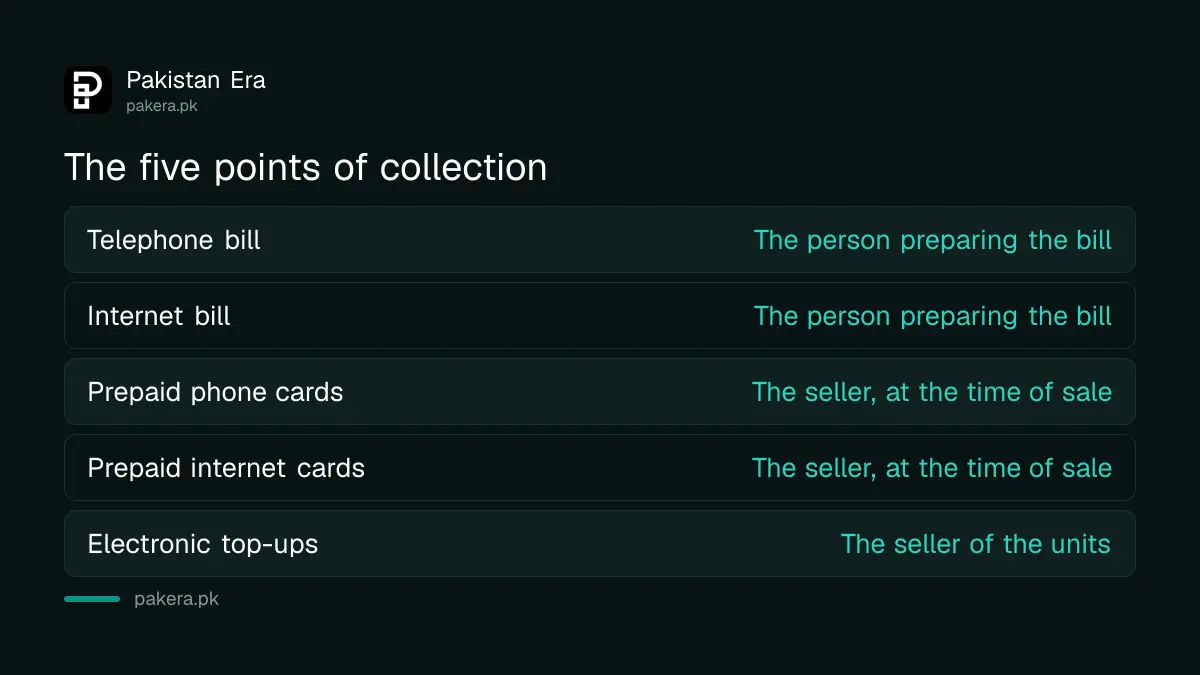
The timing differs between postpaid and prepaid, which is why prepaid users rarely see it.
For a bill, section 236(2) says the company preparing it charges the advance tax in the same way it charges for the service. It appears as a line on the invoice, usually labelled income tax or withholding tax.
For prepaid, section 236(3) and (3A) say the seller collects the tax at the time the card or units are sold. There is no invoice to read afterwards. You simply receive less balance than you paid.
Who does not pay it
Section 236(4) lists the only people it is not collected from:
- The Government.
- A foreign diplomat or a diplomatic mission in Pakistan.
- A person who produces a certificate from the Commissioner that their income for the tax year is exempt from tax.
There is no filer exemption on phone and internet bills, unlike a home electricity bill. Being on the Active Taxpayer List does not stop this collection. Our guide to advance tax on electricity bills explains that different rule.
How filers claim it back
Section 236 does not call this tax final or minimum, so a person who files a return can count it as tax already paid against their income tax for the year. A person who never files simply bears it as a cost.
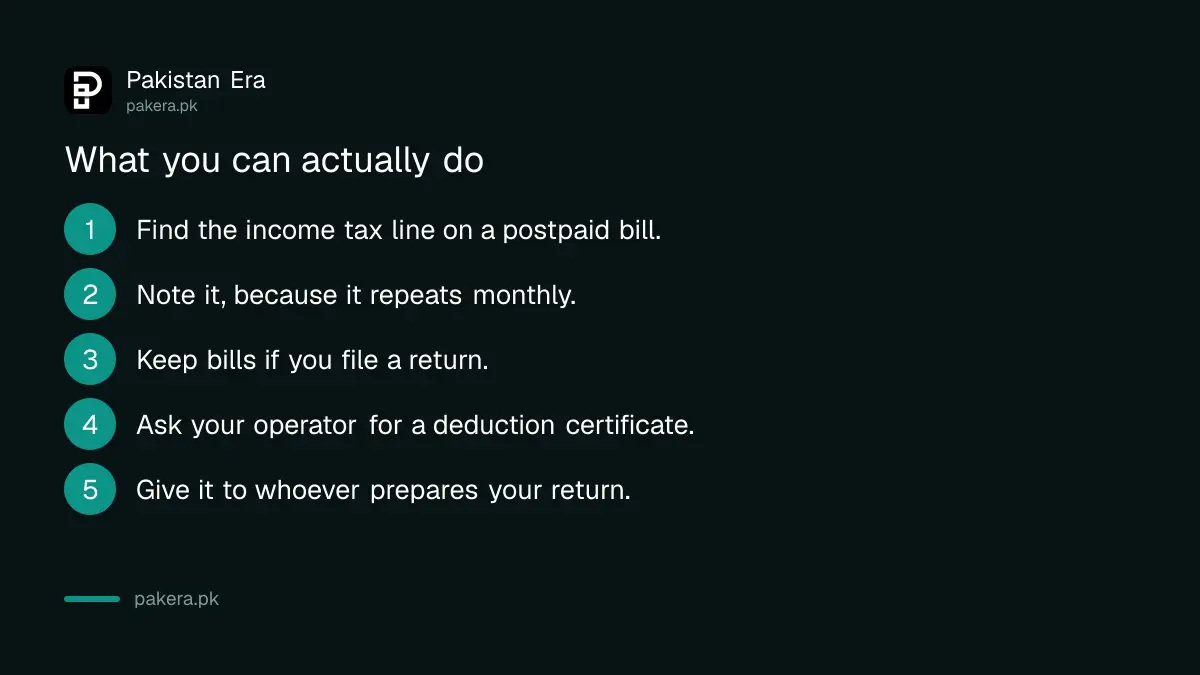
- Find the income tax line on each postpaid or broadband bill.
- Download or request the yearly tax deduction certificate from your operator or internet provider.
- Check your CNIC is on it.
- Keep it with your other withholding certificates for that tax year.
- Enter the amount as tax already paid when you file.
Our guide to getting withholding tax certificates from your employer, bank and mobile company covers where each certificate comes from.
Why the balance looks so much lower
Income tax under section 236 is not the only charge. Provincial sales tax on telecom services applies as well, and the two are separate charges levied by different governments.
So a top-up loses value to more than one thing at once. Separately, balance can drain after a top-up because of subscription services rather than tax. That has a different fix, and our guide to balance save codes for every network covers the codes that stop it.
If your balance goes missing entirely
Tax explains a predictable shortfall. It does not explain balance disappearing days later, or a recharge that never arrived.
For those, the operator is the first stop and the regulator is the second. Our guide to complaining about your mobile network to PTA sets out that route.
Common questions
How much tax is on a mobile bill in Pakistan?
15 per cent advance income tax on the bill amount, under section 236, plus provincial sales tax on the service.
How much tax is on a PTCL or landline bill?
10 per cent, but only on the part of the monthly bill above Rs 1,000. A bill of Rs 1,000 or less carries no advance tax.
Is there tax on internet bills?
Yes. Internet bills and prepaid internet cards both carry 15 per cent advance tax.
Do filers pay less?
No. The rate card has one rate for these bills, and section 236 has no filer exemption. A filer can claim the tax back in the return instead.
Can I claim this tax back?
Yes, if you file. Section 236 does not make it final or minimum tax, so it counts as tax already paid. Keep the operator's deduction certificate.
Who is exempt?
The Government, foreign diplomats, diplomatic missions, and a person with a Commissioner's certificate that their income is exempt.
How we verified this
What we checked and where we read it.
We read both on 8 November 2026 on FBR's own download site, the Ordinance in the version amended up to 30 June 2026.
Last checked 8 November 2026. We read section 236, subsections 1 to 4, in the Income Tax Ordinance, 2001 amended up to 30 June 2026, and the section 236 rates in FBR's withholding tax rate card for tax year 2027, both on FBR's own download site. The worked examples are our arithmetic. Provincial sales tax on telecom services is a separate charge set by the provinces. Nothing here is tax advice.
About the author

Senior Writer, Public Services and Technology
Shahid joined us in 2024 as an author. He is a senior contributor to Pakistan's leading technology websites. He writes detailed articles, mostly covering his expertise in the latest tech, mobiles, apps, gadgets, and step-by-step guides. His ideology is to help people understand the latest trends and explain complex methods through very easy-to-understand guides.