Check If Your Home Broadband Gives 80% of the Speed You Pay For, Under PTA Rules in Pakistan
PTA's broadband regulations set 80 percent of the advertised download speed as the benchmark. See the table by plan, test your line and complain with proof.

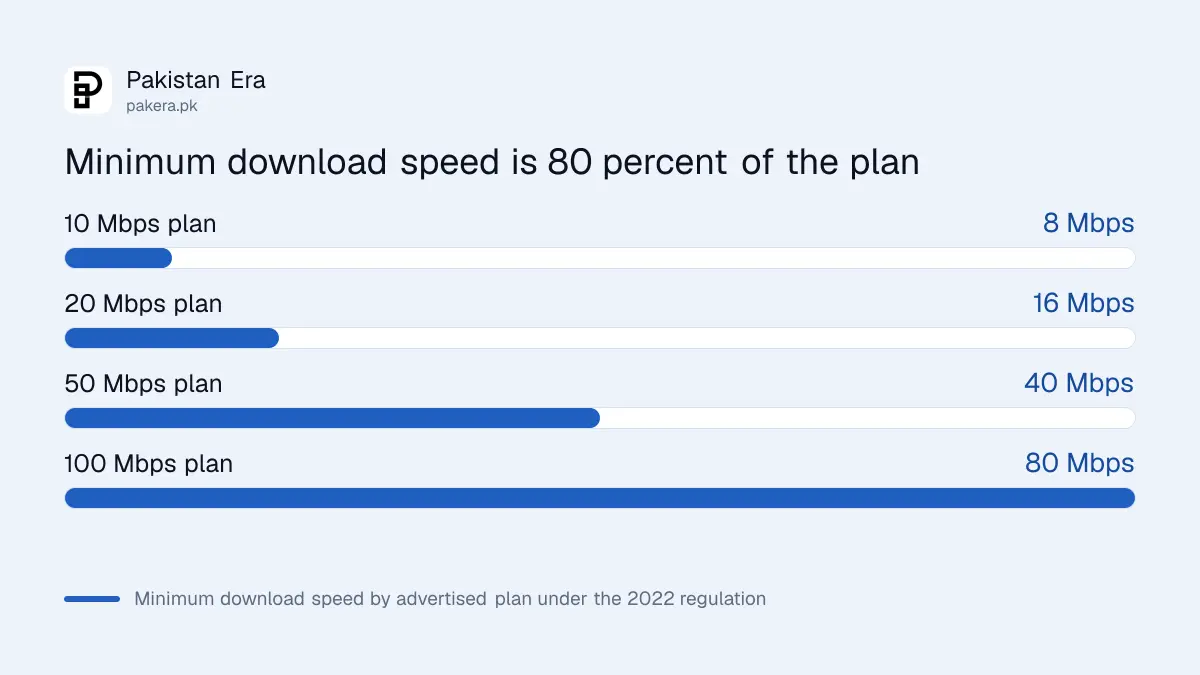
Short answer: PTA's Fixed Broadband Quality of Service Regulations, 2022 set the benchmark for download speed at 80 percent or more of the speed your plan advertises, and upload at 50 percent or more (25 percent on xDSL lines). A 20 Mbps plan should therefore deliver at least 16 Mbps down, at all times.
A speed test shows 6 Mbps. Your plan says 10. Is that legal? The provider says "up to". PTA's regulation says something firmer, and few customers have read it. We read the regulation and its 2025 amendment, and this guide turns the numbers into a check you can run tonight.
One honest limit first. These rules set standards that PTA monitors and enforces on licensed providers. They do not give you an automatic refund for one slow test. What they do give you is a clear benchmark to put in a complaint.
The benchmark is 80 percent of the advertised download speed
The regulation says download throughput should be at least 80 percent of the advertised speed of the plan, and that this must be experienced at all times. Upload should be at least 50 percent, or 25 percent for xDSL lines, which run over copper telephone wire.
The rules apply to broadband service providers, defined as fixed local loop, wireless local loop and class data licensees. That covers fibre, cable and most home internet companies. It does not cover your mobile data. For mobile data speeds, see how to check mobile internet speed, which uses a different test.
| Advertised plan | Minimum download (80%) | Minimum upload (50%) | Minimum upload on xDSL (25%) |
|---|---|---|---|
| 10 Mbps | 8 Mbps | 5 Mbps | 2.5 Mbps |
| 20 Mbps | 16 Mbps | 10 Mbps | 5 Mbps |
| 50 Mbps | 40 Mbps | 25 Mbps | 12.5 Mbps |
| 100 Mbps | 80 Mbps | 50 Mbps | 25 Mbps |
Other limits cover uptime, delay and loss
Speed is one test among several. The regulation also sets limits for how often the line connects, how much the network is down, how long data takes to travel, and how many packets are lost. Each has a number you can compare with your own results.
| Measure | PTA benchmark | What it means for you |
|---|---|---|
| Service up time success rate | 98 percent or more | The modem connects within 60 seconds in nearly every attempt |
| Network availability, access nodes | 99 percent or more | The local equipment is down less than 1 percent of the month |
| Local latency | 40 milliseconds or less | Delay to the provider's network edge |
| International latency, terrestrial | 110 milliseconds or less | Delay to servers abroad over cables |
| Packet loss | Under 1 percent | Fewer dropped video calls and stalls |
| Jitter | Under 15 milliseconds | Steady voice and video quality |
| Web page loading | 4 seconds or less | A standard page loads quickly |
Scheduled maintenance is excluded from the availability figure, but the provider must keep users informed of maintenance times. The regulation also says providers shall not block or throttle applications, websites or content, and must treat traffic equally.
How to test your line the way the rule is written
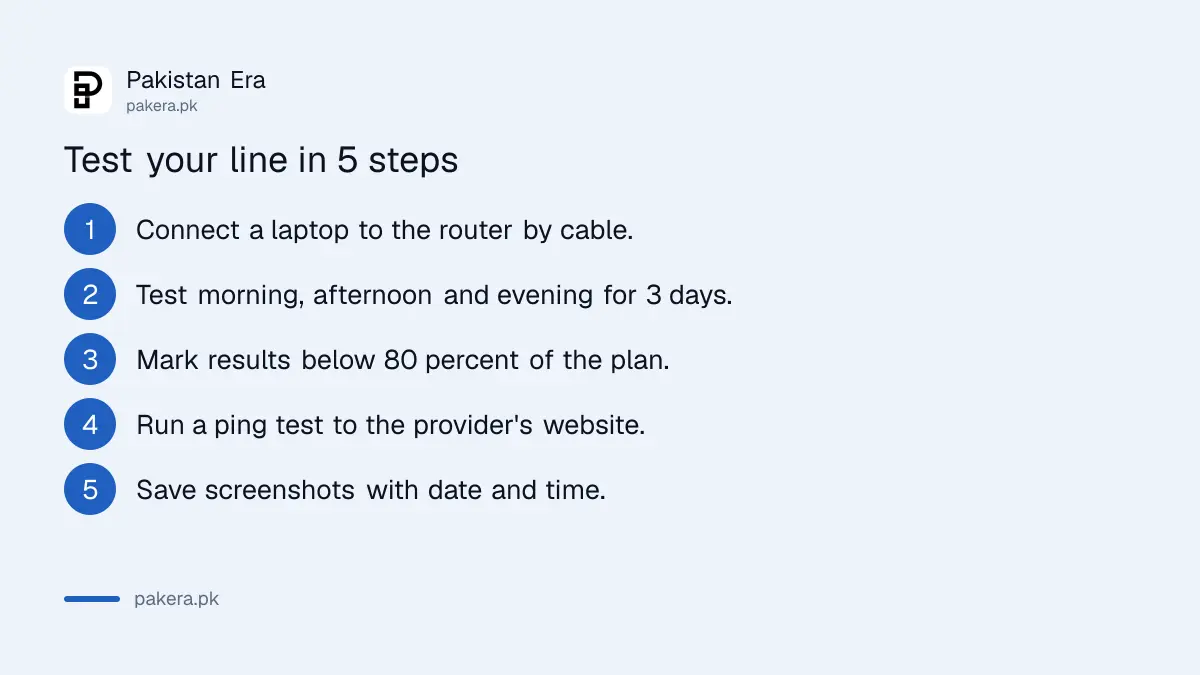
Test on a cable, not Wi-Fi, with one device, at several hours of the day. Compare the result with the minimum for your plan in the table. A single low number proves little. A pattern over several days is evidence.
- Connect a laptop to the router with an Ethernet cable and close all other apps and downloads.
- Run a speed test in the morning, afternoon and evening for three days. Write each result with the time.
- Calculate 80 percent of your plan speed. Mark every result below it.
- Run a ping test to the provider's own website and note the average in milliseconds.
- Save screenshots of every result with the date and time visible.
PTA's own method is stricter. It uses very large test files, a download of at least 10 GB and an upload of at least 500 MB, measured at the network termination point, which is where your equipment connects to the line. Your quick test is a first sign, not a final proof. Before you test, our guide to router placement and speed removes the usual home causes of a slow reading.
If the results fall short, complain in two steps
Report the pattern to your provider and ask for a ticket number. If it does not fix the line, file a complaint with PTA, with your logs and the benchmark. The 2022 regulation requires an automated ticket system so every complaint gets a record.
The regulation names three duties on the provider side: record the reasons for an outage, keep a computerised complaint system that issues tickets, and resolve provisioning and billing complaints under its licence conditions. We set out the full complaint route in how to complain to PTA about slow internet, and the general steps in how to complain about a telecom operator.
The 2025 first amendment changed the reporting text. It removed the sub-regulations on the national volunteer measurement programme and reworded the quarterly reporting of network performance. The 80 percent and other benchmarks were not changed in the pages we read.
What the regulation does not promise
The text checks providers against the benchmarks through PTA tests and the providers' own quarterly tests. It does not set a refund per missed test, and it does not say that a single reading below 80 percent is a breach. Treat the benchmark as strong supporting evidence.
The regulation also notes that service for customers on a committed information rate, a fixed guaranteed speed usually sold to businesses, is governed by their own agreement. If you hold such a contract, the contract matters first. Before you sign a new one, read what PTA's standard ISP contract guarantees.
Common questions
What speed must my home broadband deliver?
At least 80 percent of the advertised download speed, and at least 50 percent of the advertised upload speed, or 25 percent on xDSL, according to the 2022 regulation.
Does "up to" in an advertisement change this?
The regulation measures against the advertised speed of the plan. We did not find a clause that lets "up to" lower the benchmark.
Do these rules cover mobile internet?
No. They apply to fixed broadband providers. Mobile networks are covered by separate cellular QoS regulations.
Is a speed test on my phone enough for a complaint?
It is a start. A series of wired tests with times and screenshots is stronger, because PTA measures at the point where your equipment connects.
Where do I complain if the provider does nothing?
Complain to PTA with the ticket number, your test log and the plan details. PTA lists a helpline of 0800-55055 on its website.
Did the 2025 amendment change the speed benchmark?
Not in the pages we read. It removed two sub-regulations on the volunteer measurement programme and reworded the reporting of network performance data.
How we verified this
What we checked, where we read it, and what we could not confirm.
Last checked on Sunday 11 October 2026. We read the Fixed Broadband Quality of Service (QoS) Regulations, 2022 and the first amendment of 2025 on the regulations page of the Pakistan Telecommunication Authority. Both files are scans that we read page by page, so confirm each number on PTA's page before you quote it. We did not test any provider's line.
About the author

Technology Journalist & Multimedia Producer
Ahmad Ali is a technology journalist and multimedia producer at Pakistan Era, joining the team in October 2026. He covers consumer technology and digital life for Pakistani readers, combining research with hands-on product testing.