What Records You Can Ask a Punjab Office For Under the Right to Information Law
Punjab offices share eight kinds of record under the RTI law: budgets, officer pay, rules, subsidies and permits. See the list and how to word your request.
Short answer: Under the Punjab right to information law you can ask a public body for its budget and spending, its list of officers and pay, its rules and circulars, who received a subsidy, and which permits it granted. Ask for a record that exists on file, and name the period you want.
Many people file a request and get nothing because they asked a question, not for a record. A Public Information Officer (PIO) only has to hand over information the office holds. The Punjab Information Commission publishes a list of what a public body should be ready to share. We use that list below.
We read the Commission's pages on accessible information on 13 October 2026. The page says some records can be held back under section 13 of the Act, but it does not list those exemptions. We did not file test requests for these records.
Eight kinds of record are listed as accessible
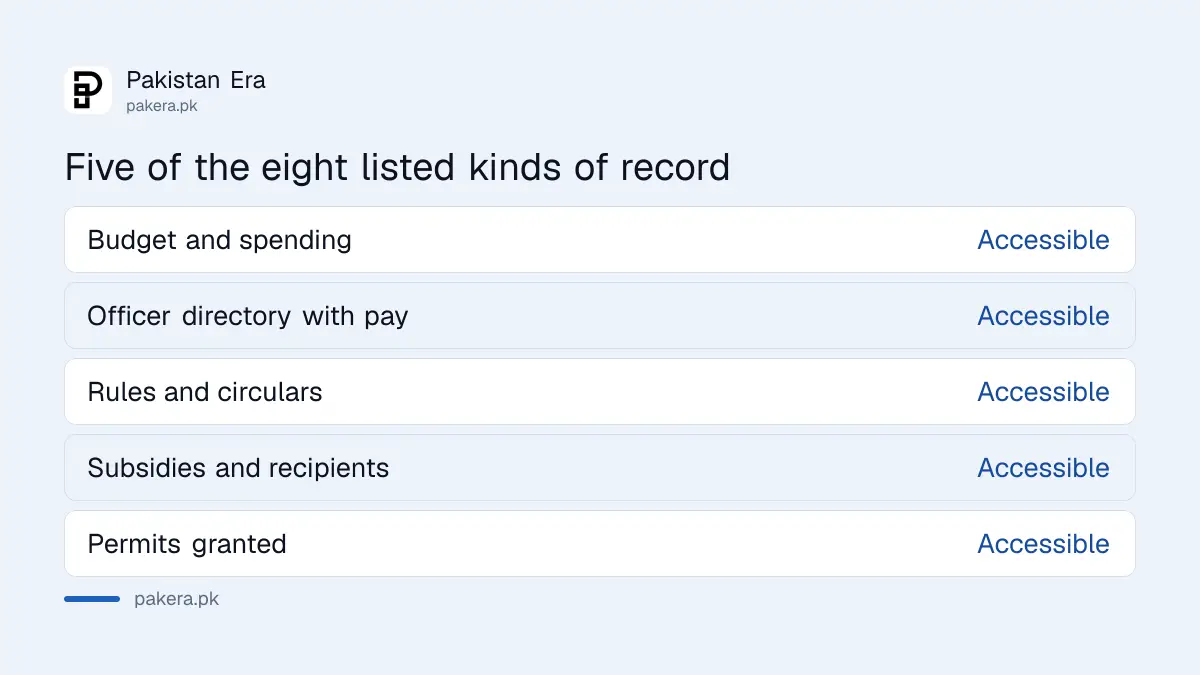
The Commission lists the kinds of information a public body should give. They cover who the body is, what it spends, what rules it follows, how it decides and whom it helps. Use this list to word your request.
| Kind of record | Example of what to ask for |
|---|---|
| Particulars, functions and duties | The list of duties of the office |
| Directory of officers and staff with pay and perks | The pay scale of the posts in your district office |
| Budget, proposed and actual spending | Spending on a named scheme in 2025-26 |
| Acts, rules, regulations and circulars | The circular that sets a fee |
| Decision-making process and public consultation | How a licence decision is made |
| Subsidies and who received them | The list of subsidy recipients in a district |
| Permits, concessions and authorisations granted | Permits given for a named activity |
| Categories of information held and how to get it | The office's own index of records |
Ask for money records by scheme and year
Budget and spending records are the clearest use of the law. The Commission lists budget details, including proposed and actual expenditure. Name the scheme, the office and the financial year, so the PIO knows which file to open.
A good request reads: "Please give a copy of the actual expenditure on the scheme named X in the district office of Y for the year 2025-26." A weak request reads: "Where did the money go?" The first names a record. The second asks for an opinion.
Ask for rules and circulars when a fee seems wrong
If an office asks you for a fee or a paper that nobody explained, ask for the rule or circular behind it. The Commission lists Acts, rules, regulations and circulars as accessible. A written rule settles an argument at the counter.
Ask for the number and date of the notification, and for a certified copy if you plan to use it in a complaint. Before you do, check whether the fee is already public. For land records, our page on Punjab land record fees shows the figures we read.
Subsidy and permit records show who got what
The Commission lists subsidy details with beneficiaries, and permits, concessions and authorisations granted. A farmer, a trader or a resident can ask whether a scheme reached people in their area, and whether a permit was issued under the stated rules.
Keep the request narrow. Ask for one scheme, one district and one year. A broad request gives the office a reason to say the work is too large. A narrow one is easier to answer within 14 working days.
Know what may be held back
The Commission's page says information may be restricted if it is exempt under section 13 of the Act. It does not list the exemptions. If the PIO refuses, ask for the reason in writing and the section relied on.
A refusal can be challenged. Read how to complain to the Punjab Information Commission. Do not assume a refusal is final. The Commission's pages say it can order a body to disclose information.
Turn the list into a request
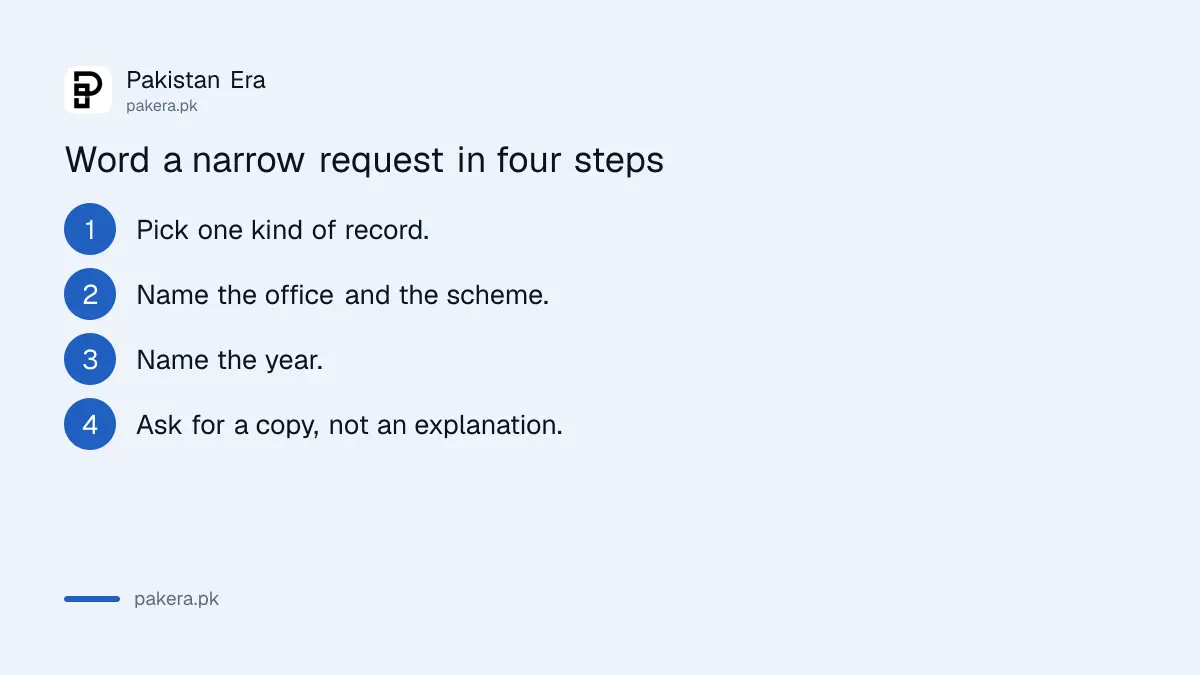
- Pick one kind of record from the list above.
- Name the office, the scheme or topic, and the year.
- Ask for a copy or an inspection of the record, not for an explanation.
- Send it to the PIO, by hand, registered post or electronically.
- Keep your proof of delivery for the 14 working day count.
The full steps are in the page on how to file a right to information request in Punjab.
Common questions
Can I ask why a decision was made?
The Commission lists the decision-making process as accessible. Ask for the file notes or the order, not for the reason in your own words.
Can I see who received a subsidy?
The Commission's list includes subsidy details and beneficiaries. Ask for one scheme, one district and one year.
Can I ask for staff salaries?
The Commission lists a directory of officers and employees with their pay, perks and privileges as accessible.
Can an office refuse a request?
Yes, for exempt information under section 13 of the Act. The Commission's page does not list the exemptions. Ask for the reason in writing.
Is the law the same in Sindh?
No. Each province has its own law and Commission. The Sindh route is on a separate page.
Do I need a lawyer?
The Commission's pages describe a plain letter on plain paper. We found no rule that asks for a lawyer.
How we verified this
What we checked, where we read it, and what we could not confirm.
Last checked on 13 October 2026, Pakistan time. We read the Punjab Information Commission's pages on accessible information and on the application procedure. We could not read the full Act on an official page, so we do not list the section 13 exemptions. The examples in the table are our own wording, not the Commission's.
About the author

Tax, Bills and Technology Writer
Ali Akhtar is a young and curious voice here at Pakistan Era. He is currently pursuing his A-Levels and has a growing interest in Pakistan’s changing industrial landscape and educational trends. Ali likes to write in a way that helps him explain and explore the world around him. His writing reflects the perspective of the new generation navigating the evolving trends of Pakistan where technology, youth innovation, and shifting opportunities are reshaping the country’s future.