How to Get CDA Permission to Mortgage a Plot or House in Islamabad
Get CDA permission to mortgage a plot or house in Islamabad: the agreement, deed, stamp paper rate and Rs 500 lien marking. Check steps before the bank asks.
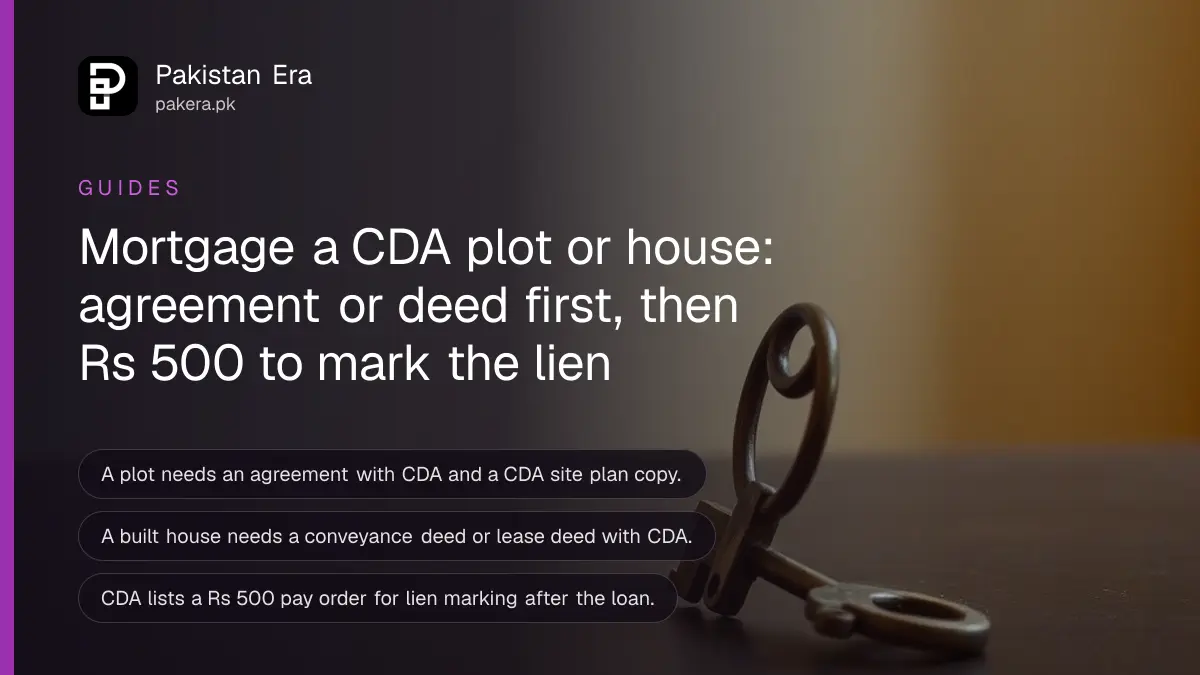
Short answer: To mortgage a CDA plot or house in Islamabad, you need CDA's permission first. For a plot, you sign an agreement with CDA and apply to the Director Estate Management. For a built house, you sign a conveyance or lease deed. After the loan, CDA marks the bank's lien for a Rs 500 pay order.
A bank in Islamabad will not release a home loan against a CDA plot on your word alone. It wants to see CDA's permission and, later, proof that its claim is recorded. Many buyers learn this only after the bank has asked for a "mortgage NOC". An NOC is a no objection certificate, a letter that says CDA has no objection.
We read CDA's procedures page and its frequently asked questions page on 13 October 2026. Both are undated. The steps below follow what CDA lists. We did not apply for a mortgage permission, so call the Estate Management office before you plan dates around this.
A plot needs an agreement with CDA before the bank lends
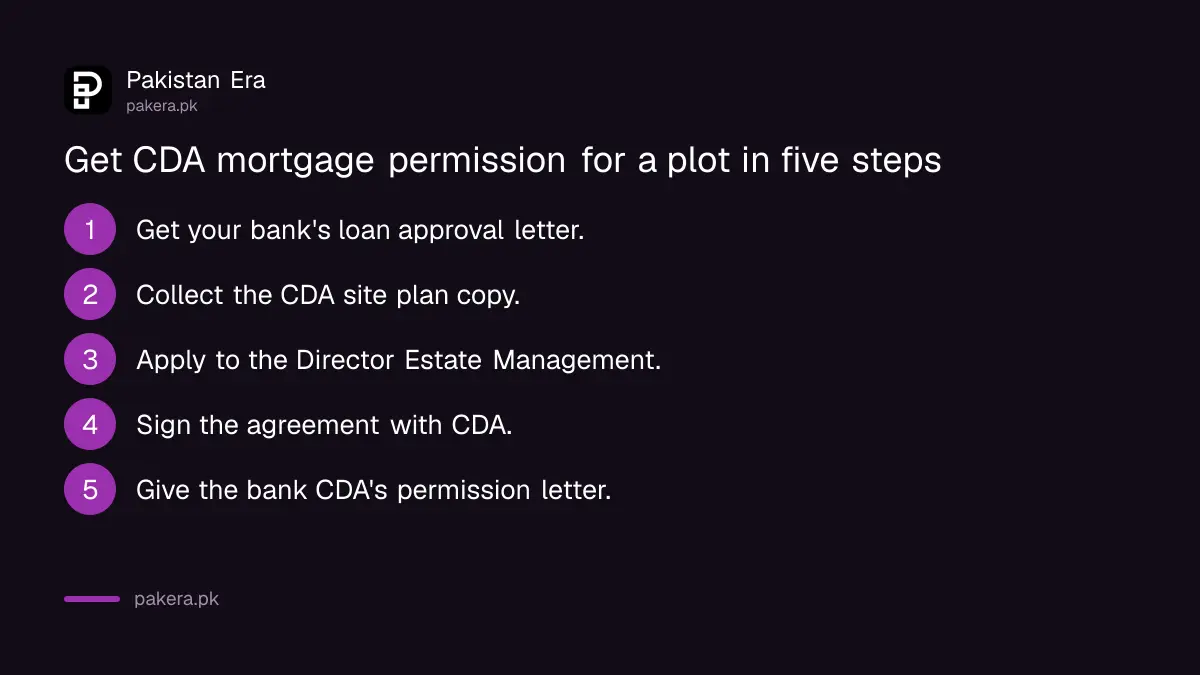
For a plot, CDA lists three things: an agreement signed with CDA, a copy of the site plan that CDA provides, and an application addressed to the Director Estate Management asking permission to assign the plot to the lender.
The lender can be a bank or the House Building Finance Corporation. CDA names it in its procedure heading. The word "assign" here means you hand the bank a legal claim on the plot while you keep ownership.
- Ask your bank for its loan approval letter and the form it wants CDA to sign.
- Collect the site plan copy from CDA.
- Write the application to the Director Estate Management, CDA.
- Sign the agreement with CDA on stamp paper.
- Give the bank CDA's permission letter.
A built house needs a conveyance or lease deed
If a house already stands on the plot, CDA asks you to execute a conveyance deed or a lease deed with it instead. Stamp paper costs Rs 40 per thousand of the original price of the plot, plus any commercial or industrial premium and ten years of advance ground rent.
Here is our own example. If the original plot price was Rs 1,000,000, the Rs 40 per thousand rate gives Rs 40,000 of stamp paper before the other items. CDA does not publish a sample, so this is arithmetic and not a quote.
| Property | What you sign with CDA |
|---|---|
| Plot with no building | Agreement with CDA |
| House or built-up property | Conveyance deed or lease deed |
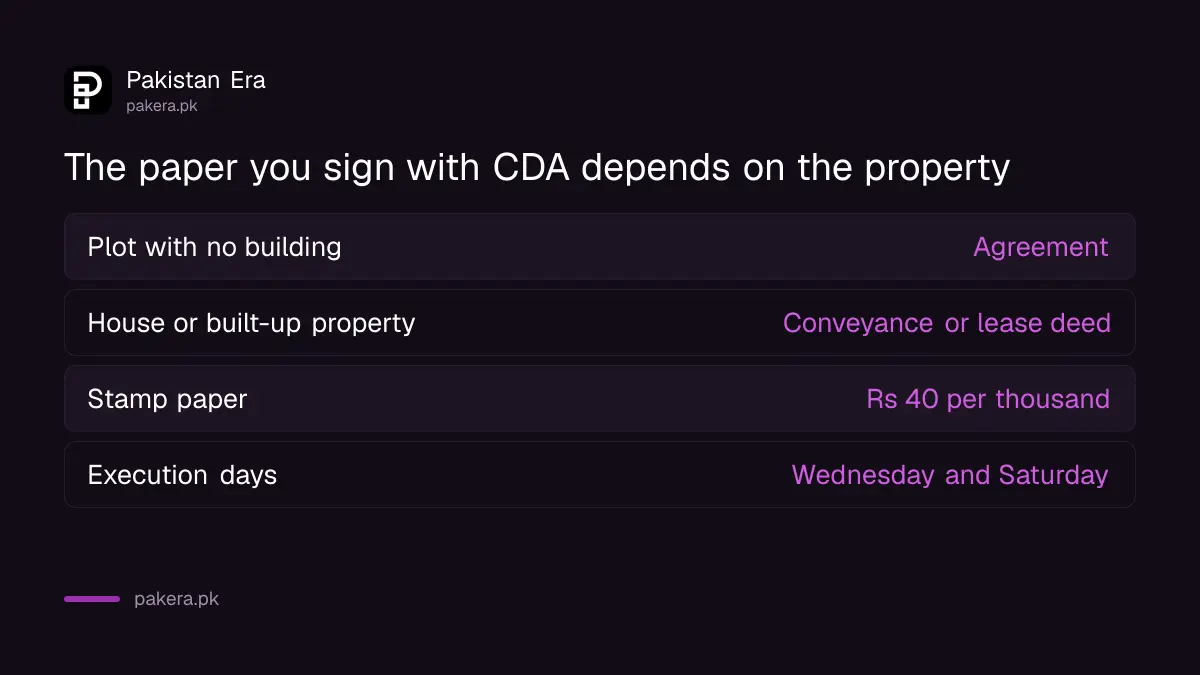
CDA says the agreement and the conveyance deed take two days to execute. Its FAQ page names Wednesday and Saturday as the two execution days. Plan around those days. If you reach the counter on a Thursday, you wait until Saturday.
CDA marks the bank's lien after the loan
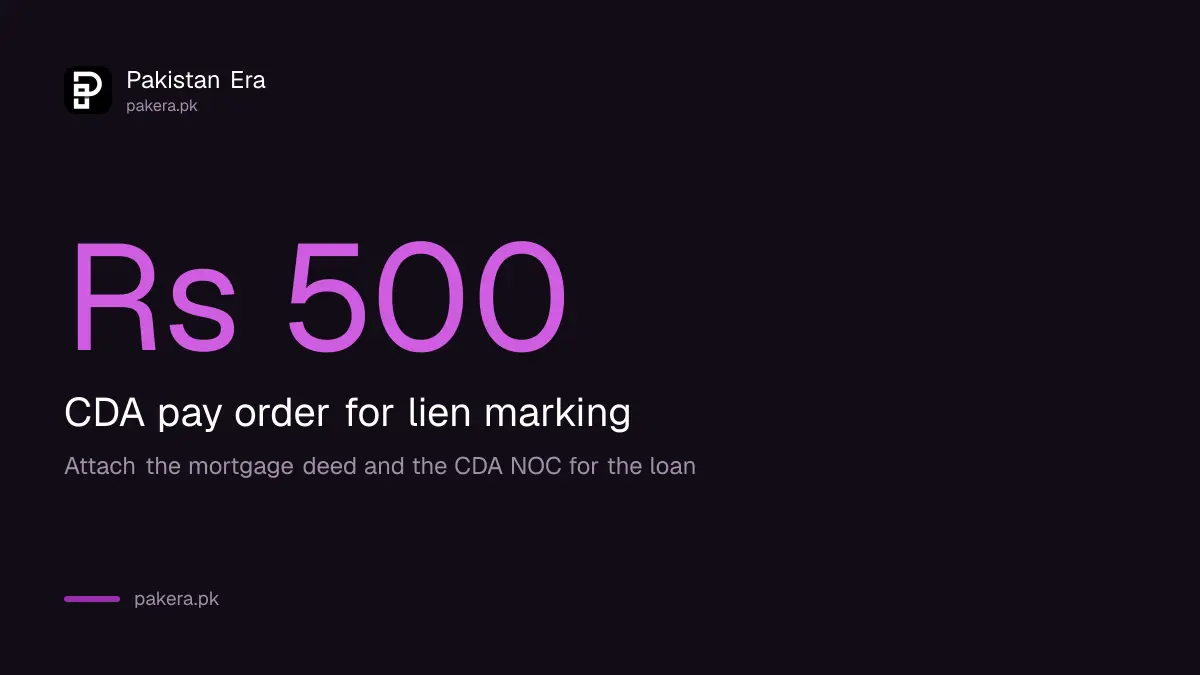
A lien is the bank's recorded claim on your property. To have CDA mark it, you apply with an attested CNIC copy, an attested allotment letter copy, an attested copy of the mortgage deed, a copy of CDA's NOC for the loan, and a Rs 500 pay order.
Lien marking matters because it blocks a quiet sale. A buyer or lawyer who checks CDA's record sees that the property is mortgaged. The page on the CDA property information report explains how a buyer can check the record, and it is worth knowing that the same report type costs Rs 500 per CDA's list.
A mortgaged plot cannot be sold without the lender's consent
CDA's procedure for transfer to legal heirs asks for an NOC from the loan-providing agency. The same logic applies to any sale in the middle of a loan. Pay off the loan or get the lender's written consent before you list the property.
That is our reading of CDA's lists, not a separate CDA rule we found. The sale steps are in the page on transferring a CDA plot or house. The usual blocks to transfer include outstanding dues, a disputed title, a fraud scrutiny reference or a court stay order.
If you lose your allotment letter while a loan is running, get a certified copy early. The bank will hold the original, and CDA may need a copy for other work. See the steps to replace a lost allotment letter.
Check your dues before you ask for permission
CDA stops many applications over unpaid dues. A permission request on a plot with open dues can be refused, so clear Estate Management and property tax dues first. CDA says it answers a dues enquiry within four working days.
You can ask at the One Window Operation counter or by mail. The address is Main CDA Secretariat, Chairman Office, G-7/4, Islamabad. Ask in writing so you have a date on your request.
Building a house on the plot is a separate step with its own approval. If you plan to borrow for construction, read the page on getting a building plan approved by CDA first, because the bank may want that approval before it releases the second payment.
Common questions
Does CDA allow a plot to be mortgaged to a bank?
Yes. CDA lists a procedure for mortgage permission in favour of HBFC or banks, starting with an agreement with CDA.
What does CDA need to mortgage a plot?
It needs an agreement with CDA, a copy of the CDA site plan and an application to the Director Estate Management.
What does CDA need for a built house?
It needs a conveyance deed or lease deed, signed with CDA on stamp paper.
How is the stamp paper worked out?
CDA lists Rs 40 per thousand of the original plot price, plus any commercial or industrial premium and ten years of advance ground rent.
How much does lien marking cost?
CDA lists a Rs 500 pay order with an application, attested copies and the CDA NOC for the loan.
On which days does CDA execute agreements?
CDA's FAQ names Wednesday and Saturday for executing the agreement and conveyance deed.
How we verified this
What we checked, where we read it, and what we could not confirm.
Last checked on 13 October 2026, Pakistan time. We read the CDA procedures page and its frequently asked questions page. Neither is dated. CDA does not publish a sample stamp paper calculation or a processing time, and we did not apply for a permission or call the office.
About the author

Public Services and Education Journalist
Fajr Riaz is a journalist and content writer at Pakistan Era, based in Lahore. She covers the questions people meet in everyday life in Pakistan: how a public service works, what a change in the rules means, and where to find a reliable answer.