Transfer a CDA Plot or House in Islamabad: Papers, NOCs and Fees
Transfer a CDA plot or house in Islamabad at One Window: the 21-item checklist, property tax and Building Control NOCs, 2% CVT, and the fees CDA prints.
To transfer a CDA plot or house in Islamabad, both buyer and seller apply at CDA's One Window counter with the original allotment letter, a transfer fee pay order, a property tax NOC and a Building Control NOC. Residential plots of 500 square yards or more also pay 2% CVT.
CDA's Estate Management directorate keeps the ownership record for more than 75,000 residential plots and houses, by its own count. A CDA sector property changes hands in that record, not just on a stamp paper. Until CDA issues a transfer letter in the buyer's name, the seller is still the owner on CDA's books.
We read CDA's procedures page and its One Window checklist on 2 October 2026. Two of its papers disagree on small details, and we point those out below so you are not sent back from the counter.
Where a CDA property transfer is done
Transfers of CDA sector plots and houses go through the Front Office, One Window Operation, CDA. Estate Management-I handles residential property. Its listed number is 051-9252428, at the CDA Facilitation Centre, Block III, Sector G-7/4.
This applies to plots and houses CDA allotted in its own sectors. A plot in a private housing society is transferred by that society, and a rural plot through the revenue record. If you are unsure which applies, the allotment letter tells you who allotted it.
Before you pay anything, you can ask CDA for a Property Verification Report through its Initial Property Verification Service. You need to register an account first. CDA says the service was built mainly for overseas Pakistanis buying from abroad.
Papers you need for a CDA transfer
CDA's One Window checklist has 21 items. Most buyers need about ten of them. The rest apply only if there is an attorney, a mortgage, a government servant seller, an overseas buyer or an oustee allotment.
| Paper | Who needs it |
|---|---|
| Transfer application signed by both parties and attested | Every transfer |
| Transfer fee by pay order | Every transfer |
| Original allotment, offer or transfer letter, surrendered | Every transfer |
| Attested CNIC copies of seller, buyer and attesting officer | Every transfer |
| Three attested specimen signatures and photos of both parties | Every transfer |
| Affidavit or undertaking by both parties on stamp paper | Every transfer |
| NOC from CDA's Revenue Directorate (property tax) | Built property; vacant plots are exempt |
| NOC from Building Control Section | Built property, to show no misuse or rule breach |
| 2% CVT paid | Residential plots of 500 sq yards and up; all commercial and industrial plots |
| NOC from the lender and CDA's mortgage permission | If the property is mortgaged |
| Special power of attorney attested by a Pakistani embassy | If the buyer is abroad |
| NOC from the employer department | If the seller is a government servant |
Two details differ between CDA's own papers. The checklist says the form can be attested by a gazetted officer or a bank manager with a name stamp. The procedures page says a first class officer. The checklist asks for an affidavit on Rs 10 non-judicial stamp paper, while the procedures page mentions an indemnity bond on Rs 30 judicial stamp paper. Ask the One Window counter which one it wants before you buy the stamp paper.
How to transfer a CDA plot, step by step
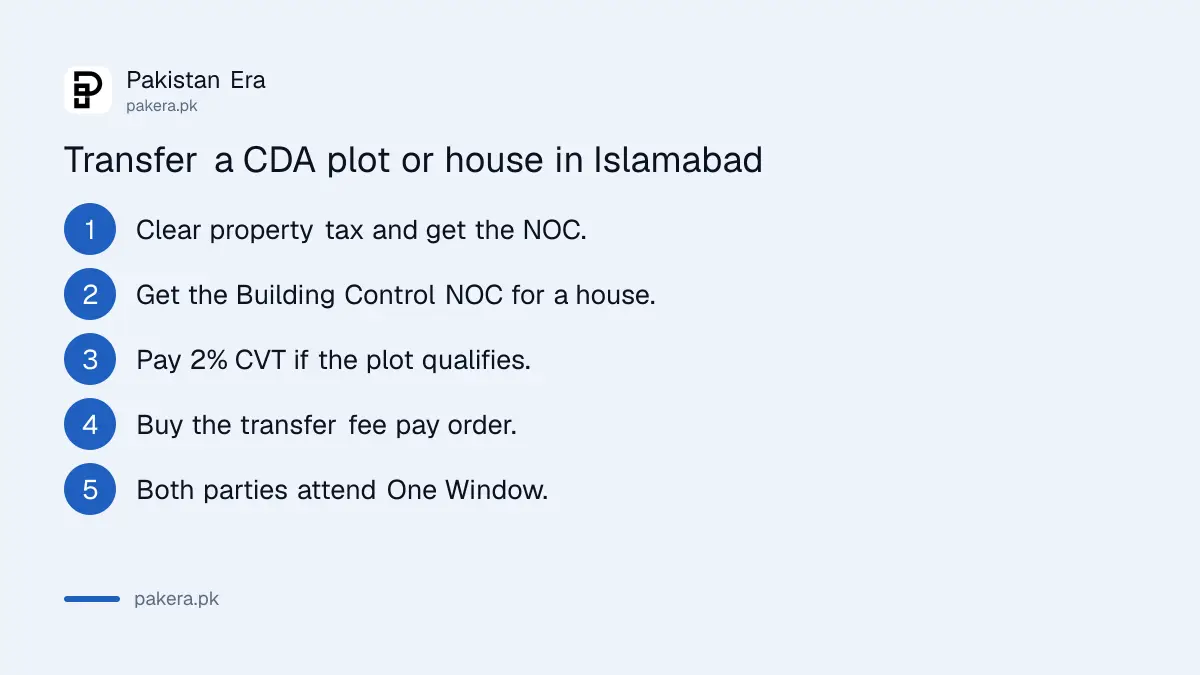
Clear the property tax and get the NOCs first, then buy the pay order, then submit everything at One Window with both parties present. CDA records statements and issues a fresh transfer letter in the buyer's name.
- Clear property tax. Pay any arrears and ask CDA's Revenue Directorate for a clearance NOC. You can check and pay CDA property tax online first, then take the receipt.
- Get the Building Control NOC. For a built house, CDA's Building Control Section checks that the house is used as a home and breaks no building rule. A house used as an office can be held up here.
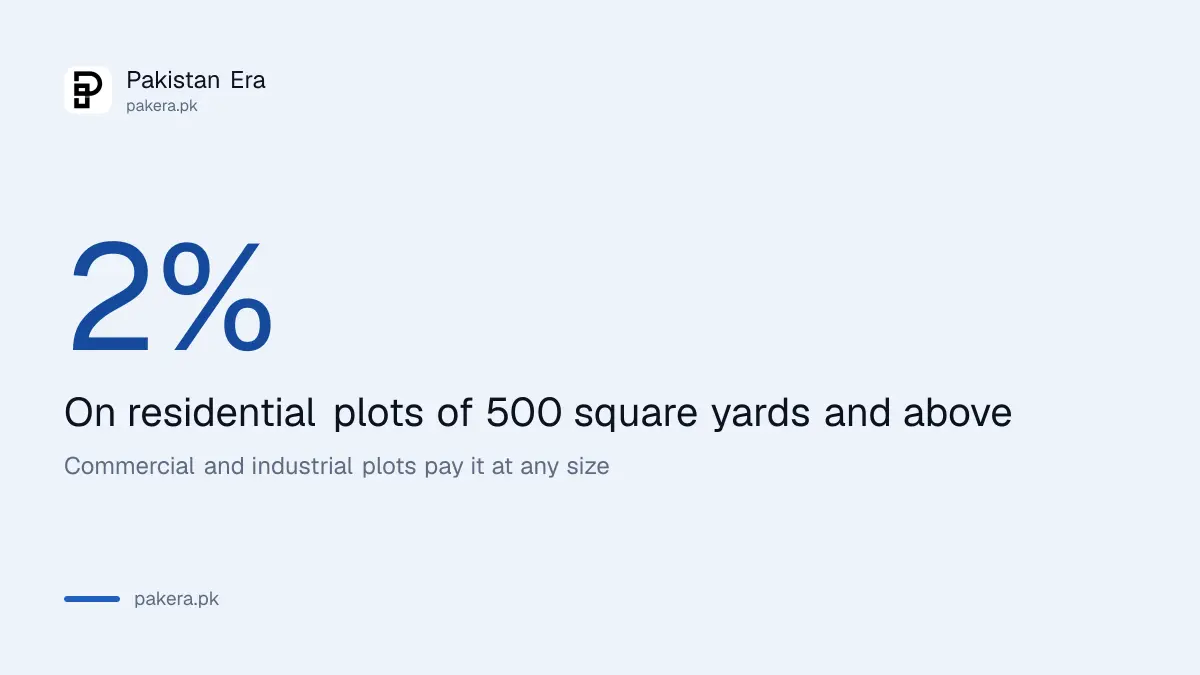
- Pay CVT if it applies. The checklist sets 2% CVT for residential plots of 500 square yards or more, and for commercial, agro, industrial and similar plots of any size.
- Get the transfer fee pay order. The checklist says "as per prescribed rate". CDA does not print the sale transfer fee on its procedures page, so ask the counter for the exact amount.
- Attend One Window together. Seller and buyer both go, with originals and attested copies. A woman allottee must be identified by a close relative such as her father, brother, son or daughter.
- Collect the transfer letter. Keep it with the old allotment letter copy. It is your proof of title in CDA's record.
CDA fees that are printed, and the ones that are not
CDA's procedures page prints fees for some transfer types but not for an ordinary sale. A sale deed title change costs Rs 7,500 for a home, and a gift to family Rs 3,000 or Rs 5,000. The sale transfer fee is not listed.
| Transfer type | Fee on CDA's procedures page |
|---|---|
| Sale through One Window | "As per prescribed rate", not printed |
| Title change through a registered sale deed | Rs 7,500 residential, Rs 10,000 commercial |
| Gift to family members | Rs 3,000 or Rs 5,000 |
| Transfer to legal heirs | Rs 5,000 residential, Rs 10,000 commercial |
| Certified copy of a lost allotment letter | Rs 1,000 process fee, with a police report |
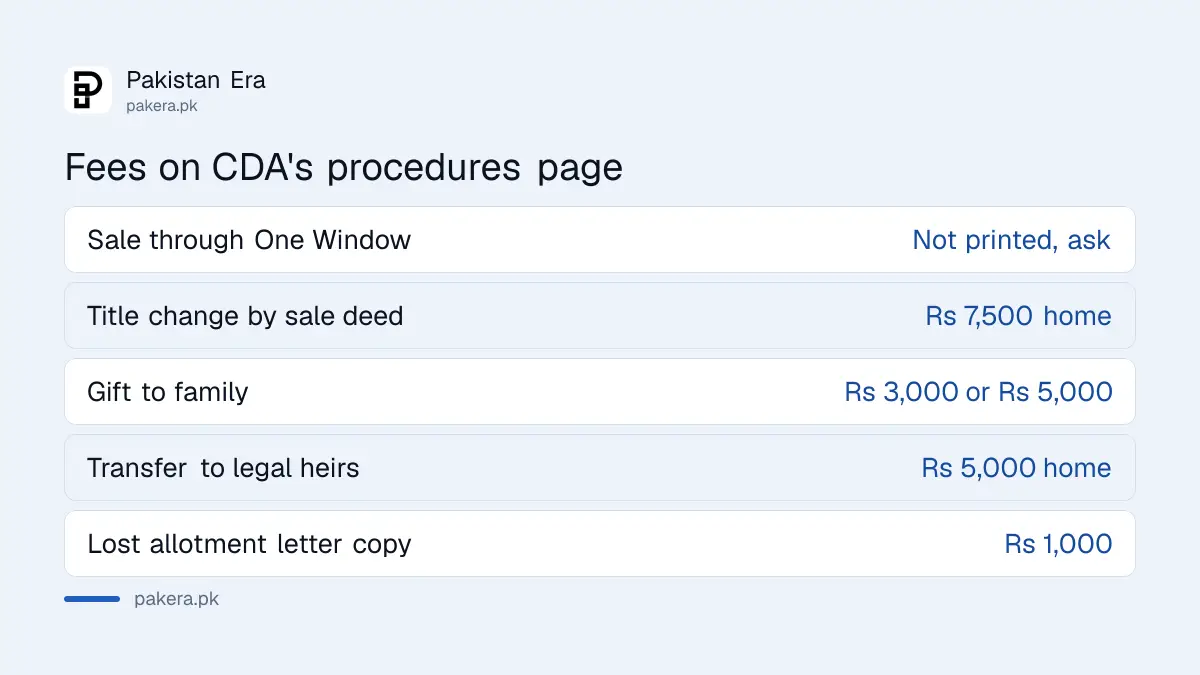
The procedures page carries no date. Treat these amounts as a guide and confirm them at the counter.
FBR's advance taxes are separate from CDA's fees. The seller pays under section 236C and the buyer under section 236K, the two taxes on buying and selling property. FBR's valuation FAQ says these taxes also apply when a transfer is attested, not only at a registry office.
Gifts and inheritance follow a different route
A gift to family needs an oral gift acknowledgement on Rs 5 stamp paper, attested by a first class magistrate. An heirs' transfer needs a death certificate, an heirs' affidavit and a public notice in two newspapers.
For a gift, CDA also asks for the property tax clearance, a Building Control NOC, indemnity bonds and a statement before the Deputy Director. For heirs, every heir's CNIC is needed, Form B for minors, and a registered release deed if some heirs give up their share. A succession certificate from NADRA helps settle who the heirs are.
Common questions
How long does a CDA transfer take?
CDA does not publish a time limit for an ordinary transfer. Ask at One Window when you submit, and keep your receipt number.
Is CVT paid on every CDA transfer?
No. CDA's checklist applies 2% CVT to residential plots of 500 square yards or more, and to commercial and industrial plots of any size.
Can I transfer a CDA plot while living abroad?
Yes, through an attorney. The power of attorney must be attested by a Pakistani embassy, high commission or consulate.
Do I need a property tax NOC for an empty plot?
No. CDA's checklist exempts vacant plots from the Revenue Directorate NOC.
What if the original allotment letter is lost?
Apply for a certified true copy first. CDA asks for a police report, an indemnity bond, an affidavit and a Rs 1,000 process fee.
Does this apply to private societies in Islamabad?
No. A society plot is transferred by the society. Check the society is approved before buying, as CDA lists illegal schemes too.
How we verified this
What we checked, where we read it, and what we could not confirm.
Last checked on 2 October 2026. We read CDA's procedures page, its One Window checklist for transfer of plot or property (a scanned form linked from that page), its Estate Wing page and its Initial Property Verification Service page. CDA's sale transfer fee and the time a transfer takes are not published there, so we could not state them. The procedures page is undated, so the fees in our table may have changed.
About the author

Tax, Bills and Technology Writer
Ali Akhtar is a young and curious voice here at Pakistan Era. He is currently pursuing his A-Levels and has a growing interest in Pakistan’s changing industrial landscape and educational trends. Ali likes to write in a way that helps him explain and explore the world around him. His writing reflects the perspective of the new generation navigating the evolving trends of Pakistan where technology, youth innovation, and shifting opportunities are reshaping the country’s future.