How to Get Your Building Plan Approved by CDA in Islamabad
Get a building plan approved by CDA in Islamabad: Forms A-1 and A-2, the documents, two published scrutiny fee rates, DVC fee and the completion certificate.
To get a building plan approved by CDA in Islamabad, your licensed architect and structural engineer sign Forms A-1 and A-2, you pay the scrutiny fee through CDA's Estate Management, and you file the set at CDA's One Window Operation in the CDA Secretariat, G-7/4. Commercial buildings also go before CDA's Design Vetting Committee.
Most families building a house in Islamabad do this once in their lives, and they usually learn the rules from a contractor. That is risky. A house built without an approved plan cannot get a completion certificate, and CDA's own transfer checklist asks for a no objection certificate from its Building Control Section before a built house changes hands.
We read CDA's procedures page, its FAQ, its forms page, its Building Control directorate listings, two 2026 CDA press releases on approvals, the ICT Building Control Regulations 2023 as printed in the Gazette of Pakistan on 16 August 2023, and the printed Form A-1, on 3 October 2026. We did not file a plan ourselves.
Which CDA office approves your building plan
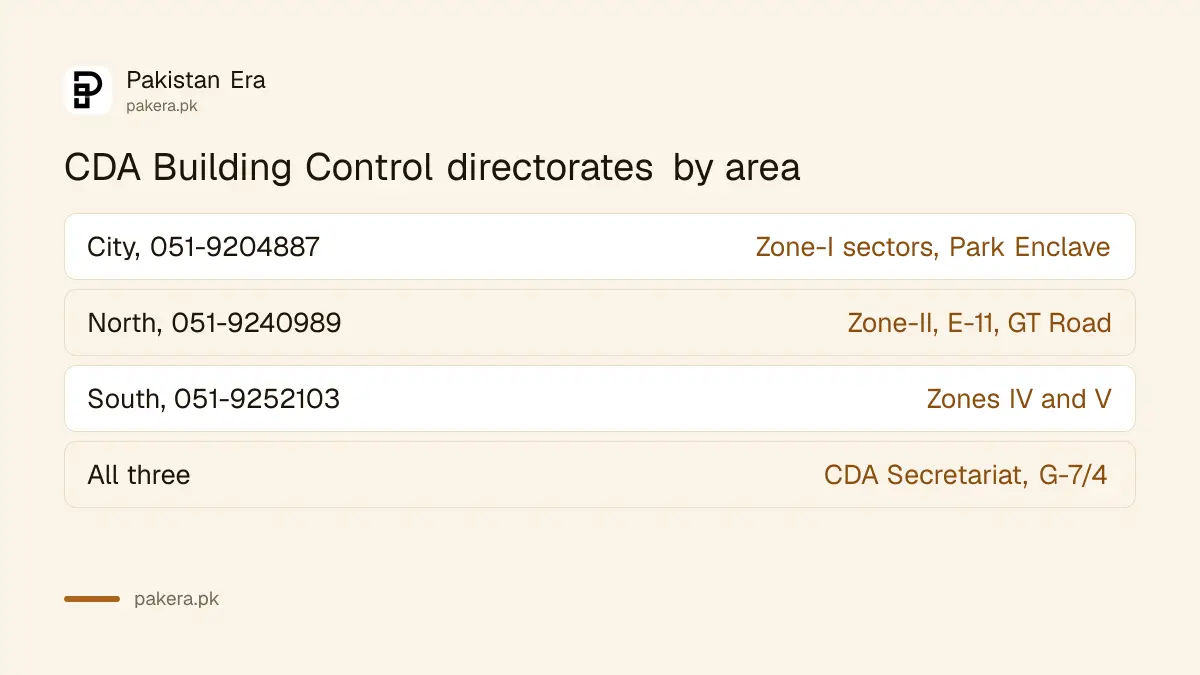
CDA splits building plan approval between three Building Control directorates, all based at the CDA Secretariat in G-7/4. Which one handles your plan depends on where the plot sits: a CDA sector, an approved private scheme, or an unplanned area.
| Directorate | Area it covers, as CDA lists it | Phone |
|---|---|---|
| Building Control (City) | Zone-I sectoral area, Park Road, Islamabad Highway, Murree Road, CDA's own schemes such as Park Enclave | 051-9204887 |
| Building Control (North) | Approved schemes and unplanned areas in Zone-II, E-11, unplanned areas in Zone-I, GT Road in Zones II and V | 051-9240989 |
| Building Control (South) | Approved schemes and unplanned areas in Zones IV and V | 051-9252103 |
A plot in a private society adds one more step. CDA's 2017 guidelines for private housing schemes ask for a no objection certificate from the society itself, and the plan is then examined by CDA's Building Control Section. Before you buy in a society, check the housing society is approved by CDA. An illegal scheme cannot give you a plan CDA will accept.
Documents you need for CDA building plan approval
For a house in a CDA sector you need Forms A-1 and A-2, sets of architectural and structural drawings, the Estate Management letter showing the scrutiny fee was paid, your CNIC copy, the allotment or transfer letter, and the possession certificate.
- Form A-1, the application for approval of plans, signed by the allottee. The printed form carries a price of Rs 150.
- Form A-2, signed with your licensed architect and structural engineer, after validation by CDA's Architecture Directorate.
- Copies of the building plans, architectural and structural.
- Estate Management forwarding letter showing the scrutiny fee was received.
- Copy of the CNIC of the allottee, transferee or attorney.
- Copy of the allotment letter or transfer letter, and the possession certificate.
- Sub-division letter, if the plot was divided, and acceptance of attorney, if one acts for you.
- Indemnity bond on Rs 30 stamp paper attested by a notary, the engineer's soundness and stability certificate, and the structural calculation book. These three appear on CDA's procedures page but not on its FAQ.
CDA's pages do not agree on the number of copies. The FAQ asks for 4 copies of the plans. The procedures page asks for 6, and the 2017 private schemes guidelines ask for 6 sets of architectural and 6 sets of structural drawings. Take 6 of each and you will not be sent back.
Plots of 400 square yards and above must also show rainwater harvesting tanks in the drawings. Your architect should know this, but check the sheet yourself.
The scrutiny fee: CDA publishes two different rates
CDA's FAQ puts the residential scrutiny fee at Rs 1 per square foot, minimum Rs 500. Its procedures page says Rs 3 per square foot for residential and Rs 10 for commercial. Both pages were live on 3 October 2026, so confirm the rate at the One Window counter before you pay.
| Building type | CDA FAQ | CDA procedures page |
|---|---|---|
| Residential | Rs 1 per sq ft, minimum Rs 500 | Rs 3 per sq ft |
| Institutional, agro farming, industrial | Minimum Rs 2,000 | Not listed |
| Commercial, offices, foreign missions | Rs 2 per sq ft, minimum Rs 3,000 | Rs 10 per sq ft |
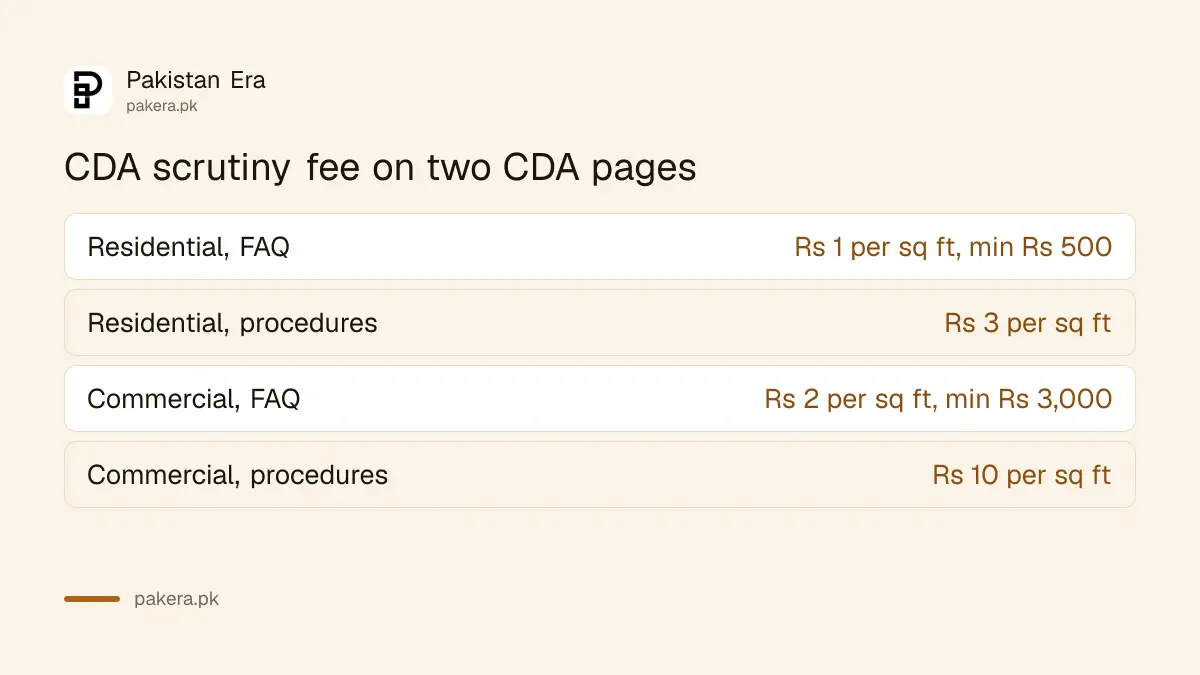
The gap is not small. For a house with 4,500 square feet of covered area, the FAQ rate works out to Rs 4,500 and the procedures rate to Rs 13,500. We tried to settle it in the 2023 Building Control Regulations, but CDA posts that Gazette as scanned pages, and the fee schedule we found there covers marriage halls only.
The fee is paid through Estate Management, which then issues the forwarding letter you file with the plan. Keep the receipt. The completion certificate is charged at the same rates later.
How to apply at CDA's One Window, step by step
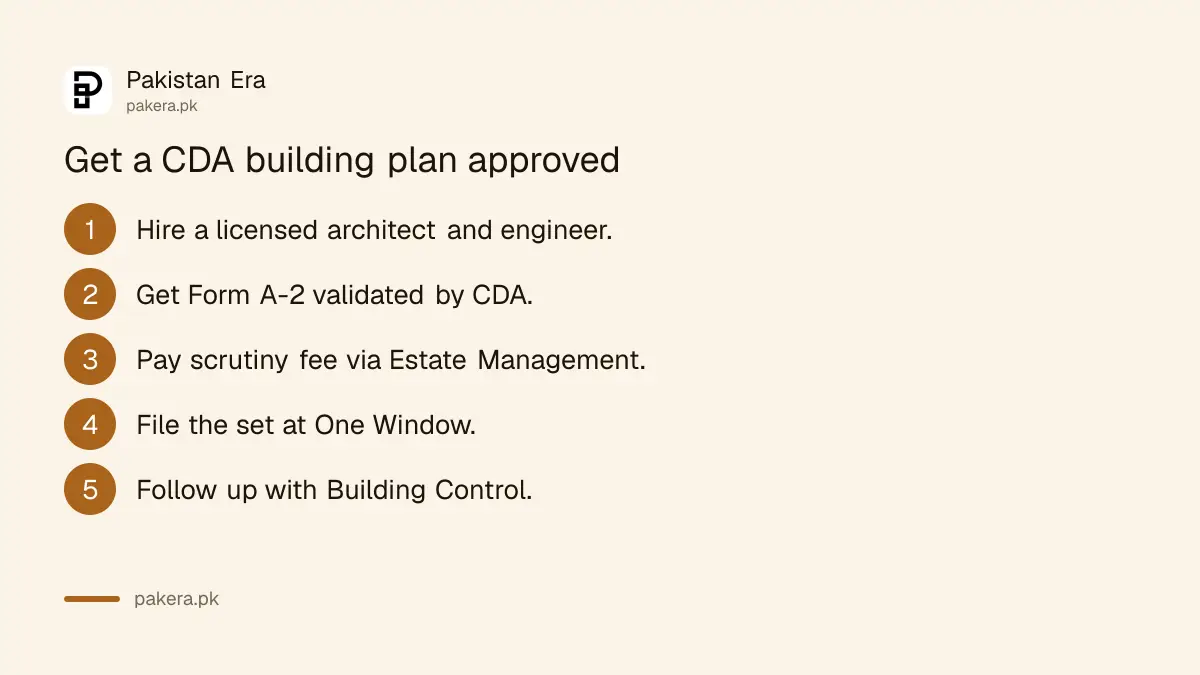
Hire a licensed architect and structural engineer, get Form A-2 validated by the Architecture Directorate, pay the scrutiny fee through Estate Management, and file the full set at the One Window Operation front office. Building Control then examines the plan under CDA's bylaws.
- Hire a licensed architect and a structural engineer. They prepare the drawings and sign Form A-2. CDA's forms page carries the licensed architect and engineer certificate they must sign.
- Get the forms validated by CDA's Architecture Directorate.
- Pay the scrutiny fee and collect the Estate Management forwarding letter.
- Clear any CDA dues on the plot first. You can pay CDA property tax and water bills online.
- File Forms A-1 and A-2, the drawings and the documents at the One Window Operation front office, CDA Secretariat.
- Follow up with the Building Control directorate for your area, using the numbers in the table above.
CDA's pages we read give no fixed time limit for approving a residential plan. Ask for a diary number when you file. It is the only proof you have that the file exists.
A CDA board decision of September 2023 to offer pre-approved house designs, and an online approval system, have both been reported but not yet seen working. We found no online submission on cda.gov.pk on 3 October 2026, so the paper route above is the one that works.
Commercial plans go to the Design Vetting Committee
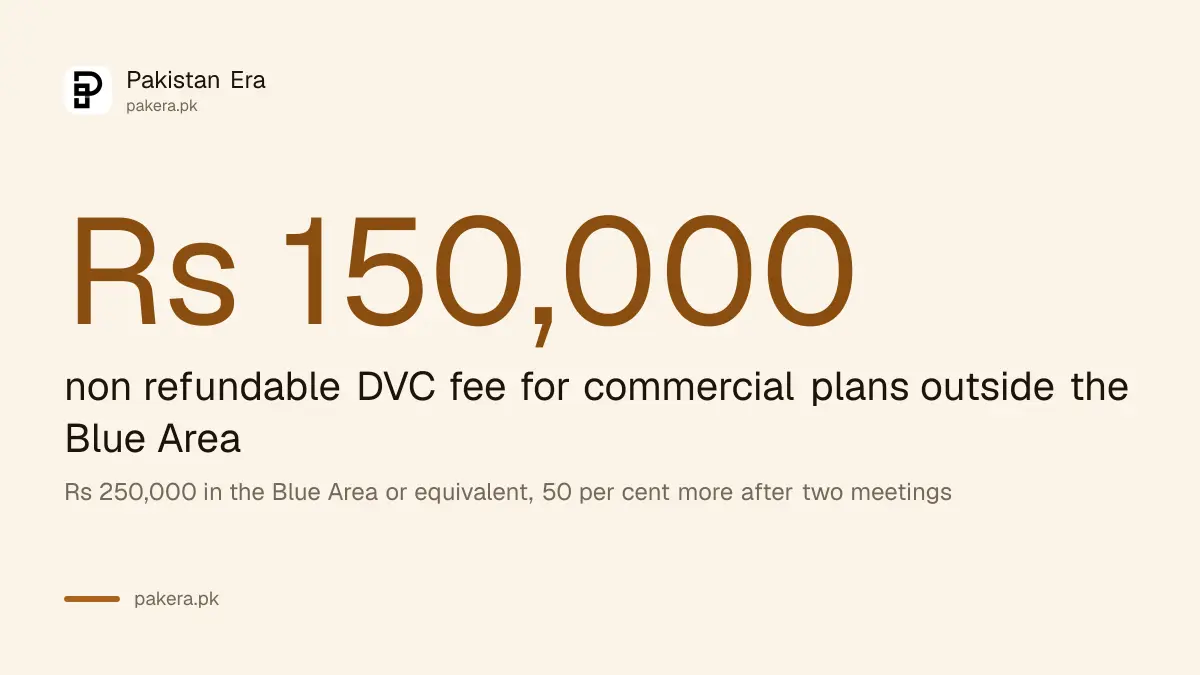
Commercial buildings, apartments and mixed use projects need a Design Vetting Committee (DVC) presentation by the architect. The 2023 regulations set a non refundable DVC fee of Rs 250,000 in the Blue Area or equivalent and Rs 150,000 for other types.
If the DVC does not approve a project in principle within two meetings, the owner pays 50 per cent more. The architect must bring 8 copies of the presentation at A-3 size, a site plan, photographs from all sides and schematic sheets for plumbing, electrical, firefighting, parking and rainwater harvesting.
The committee is not a rubber stamp. CDA said on 23 August 2026 that out of 40 commercial cases, 8 were withdrawn by architects for incomplete documents, and 23 of the remaining 32 were approved. Deferred cases mostly failed on parking requirements. Across seven DVC meetings in 2026 up to 10 August, CDA reported 37 approvals out of 42 projects reviewed.
CDA now prints the owner's and the architect's names on the DVC's final letter, and they must also be displayed at the site. If the building departs from the approved design, CDA says legal action can follow against both.
Completion certificate after construction
When the building is finished, file Forms B-1 and B-2 with completion plans that match what was actually built, Estate Management and Revenue dues clearances, your CNIC copy and the completion scrutiny fee. Non residential plots also need proof of withholding tax paid.
Completion is where unapproved changes show up. An extra room or a covered setback that is not in the approved plan will appear in the completion drawings, and CDA has a separate form for "works carried out without permission". Build what was approved.
The completion certificate matters again when you sell. Before a CDA property transfer of a built house, CDA asks for a no objection certificate from its Building Control Section.
Common questions
Can I start construction before CDA approves my plan?
No. Form A-1 asks CDA for permission to erect the building. Building first leaves you with a structure that may not pass completion.
Do I need an architect for a small house?
Yes. Form A-2 must be signed by a licensed architect and a structural engineer, whatever the size of the house.
How much is the CDA scrutiny fee for a house?
CDA publishes two rates: Rs 1 per square foot, minimum Rs 500, on its FAQ, and Rs 3 per square foot on its procedures page. Confirm at One Window before paying.
Where is CDA's One Window Operation?
At the CDA Secretariat in G-7/4. CDA's FAQ places the front office in Block-III.
Can I apply for CDA building plan approval online?
Not as far as we found on 3 October 2026. CDA's site lists no online submission for building plans, so file at One Window.
How we verified this
What we checked, where we read it, and what we could not confirm.
Last checked on 3 October 2026. The documents list and the Rs 1, Rs 2, Rs 500, Rs 2,000 and Rs 3,000 fee figures are read on CDA's FAQ page. The Rs 3 and Rs 10 rates, the 6 copies, the Rs 30 indemnity bond, the stability certificate and the completion requirements are read on CDA's procedures page. The three Building Control directorates, their areas and phone numbers are read on CDA's Planning and Design Wing page. The Rs 150 price is printed on Form A-1, and the private scheme steps are in CDA's guidelines No. CDA/M(P&D)/Guidelines/2017/7035 of 23 August 2017, both on CDA's forms page. The DVC fees, the 50 per cent surcharge and the presentation list are in the ICT Building Control Regulations 2023, Gazette of Pakistan, 16 August 2023, as posted by CDA. The 2026 DVC figures are from CDA's press releases of 11 and 25 August 2026. The 2023 board decision on pre-approved designs and the online system were reported, not read on a CDA page. We did not file a plan.
About the author

Tax, Bills and Technology Writer
Ali Akhtar is a young and curious voice here at Pakistan Era. He is currently pursuing his A-Levels and has a growing interest in Pakistan’s changing industrial landscape and educational trends. Ali likes to write in a way that helps him explain and explore the world around him. His writing reflects the perspective of the new generation navigating the evolving trends of Pakistan where technology, youth innovation, and shifting opportunities are reshaping the country’s future.