Islamabad Rainwater Harvesting Is Mandatory on Plots of 400 Sq Yards and Up
CDA rules make rainwater harvesting mandatory on Islamabad plots of 400 sq yards and above. Who must comply, the tanks needed, approval and the deadline claim.
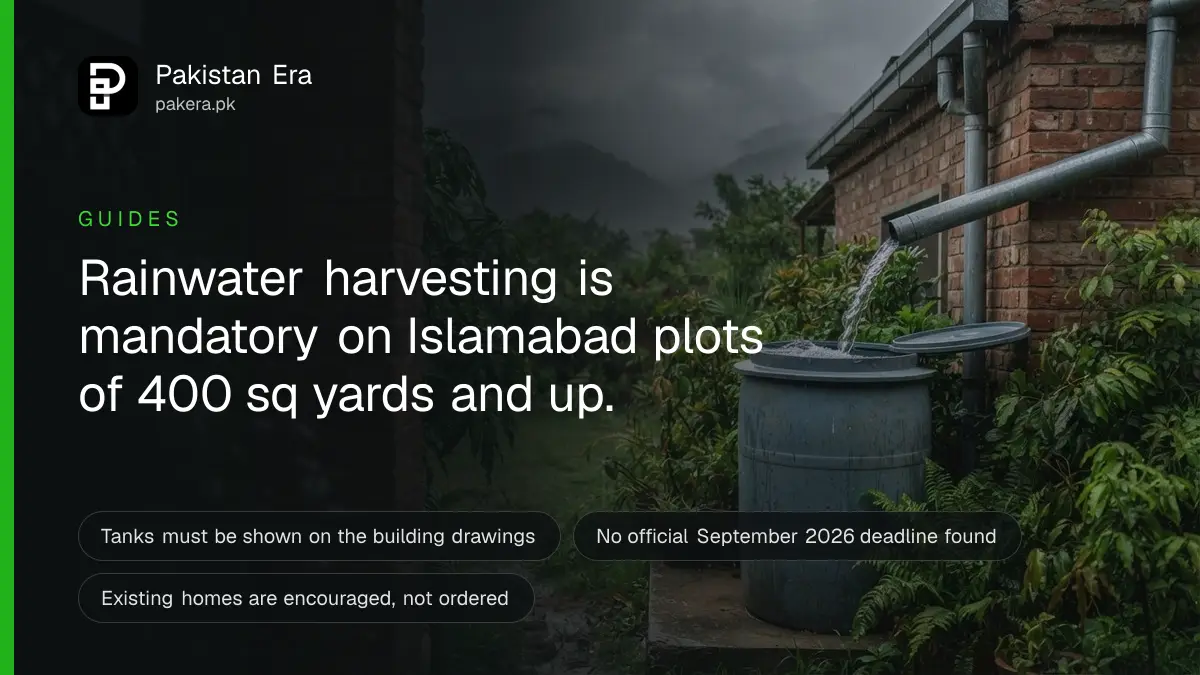
Rainwater harvesting is mandatory in Islamabad on plots of 400 square yards and above. The rule is in CDA's building regulations, published in the Gazette of Pakistan on 16 August 2023. We found no official September 2026 deadline for existing houses, despite what is being shared online.
The rule works through your building plan. If your plot is 400 square yards or bigger, the drawings you submit to the Capital Development Authority (CDA) must show rainwater tanks of approved design and capacity. That is how CDA checks it.
We read the regulation itself, CDA's releases of 25 March and 23 September 2026, and a technical note from the Pakistan Council of Research in Water Resources (PCRWR) on 27 September 2026. Here is what each one actually says.
What the Islamabad rainwater harvesting rule says
Regulation 4.1.2 says rainwater harvesting "shall be mandatory on plots 400 sq. yds. and above". Overhead and underground tanks of approved design and capacity must be built, and their design must be shown on the drawings submitted to CDA. That is the full text.
The same regulations define rainwater harvesting as collecting rain from rooftops and land runoff through pipes and tanks, so it can be used again. So the legal rule is about storing water in tanks. It does not, in its own words, demand a recharge well.
In March 2026, CDA said again that rooftop rainwater harvesting is mandatory under its building bylaws. Its chairman, Muhammad Ali Randhawa, directed "strict compliance" across the capital.
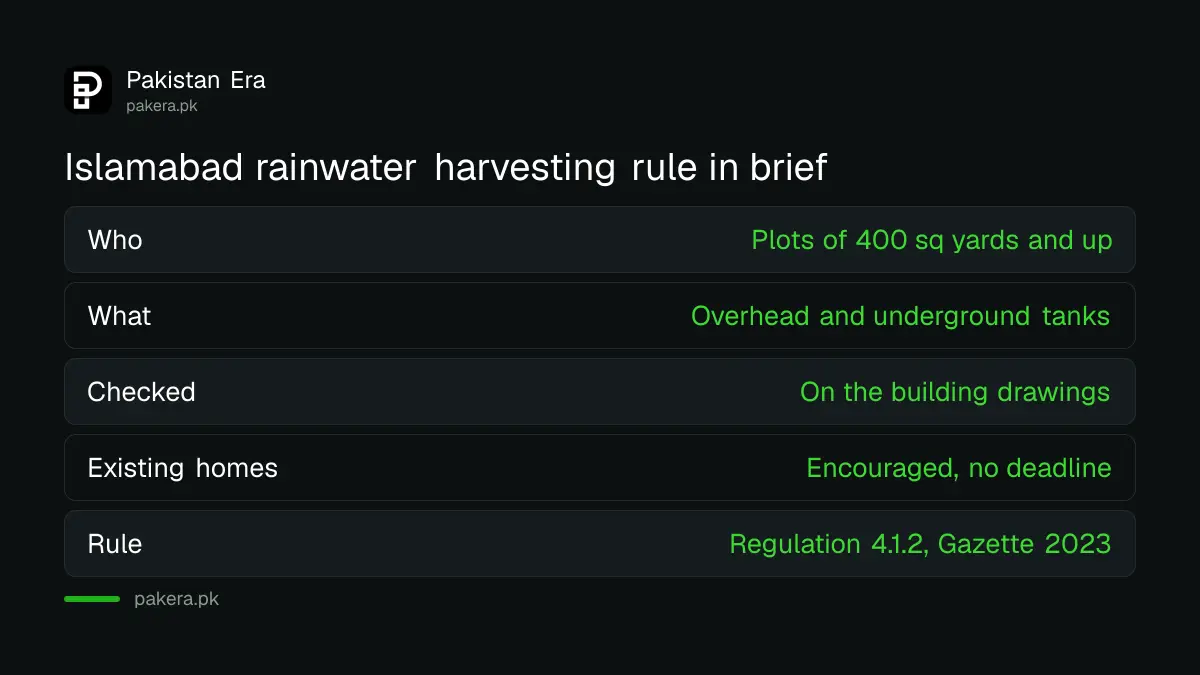
| Point | Official position | Source |
|---|---|---|
| Who must comply | Plots of 400 sq yards and above | Regulation 4.1.2, Gazette 16 Aug 2023 |
| What to build | Overhead and underground tanks of approved design | Regulation 4.1.2 |
| How it is checked | Tank location and size on building drawings | Regulation 3.4.2(vii) |
| Status in 2026 | Mandatory, strict compliance ordered | CDA release, 25 March 2026 |
| Existing buildings | Encouraged, where technically feasible | CDA release, 23 September 2026 |
No official September 2026 deadline for existing homes
Messages say every Islamabad house must fit a system by September 2026 or face fines. We could not find that deadline in any CDA notice, release or regulation. CDA's own 23 September release only "encourages" existing buildings to adopt systems where technically feasible.
That wording matters. A release that encourages is not an order with a deadline. If CDA does set a retrofit deadline, it should appear as a public notice on cda.gov.pk, and we will update this page when it does.
Reports also differ on the size limit. Some press reports in 2023 said the rule applied to plots above four kanals. The regulation in the Gazette says 400 square yards. The Gazette is the one that counts.
Who has to install a rainwater system
Anyone building or rebuilding on a plot of 400 square yards or more in areas under CDA's building regulations. The duty bites when you submit plans. Smaller plots are not covered by regulation 4.1.2, though CDA encourages everyone to collect rain.
- New house on 400 sq yards or more: tanks must be on the drawings.
- Major rebuild or alteration: you submit plans again, so expect the same check.
- Plot under 400 sq yards: not required by 4.1.2, but encouraged.
- Existing house, no new work: encouraged by CDA in September 2026, with no deadline we could find.
For scale, a one kanal plot is about 500 to 605 square yards, depending on the marla size used, so it is covered. A 10 marla plot is about 250 to 303 square yards, so it is not. Housing societies approved by CDA may carry their own conditions, so check your society's bylaws too.
What system you need to build
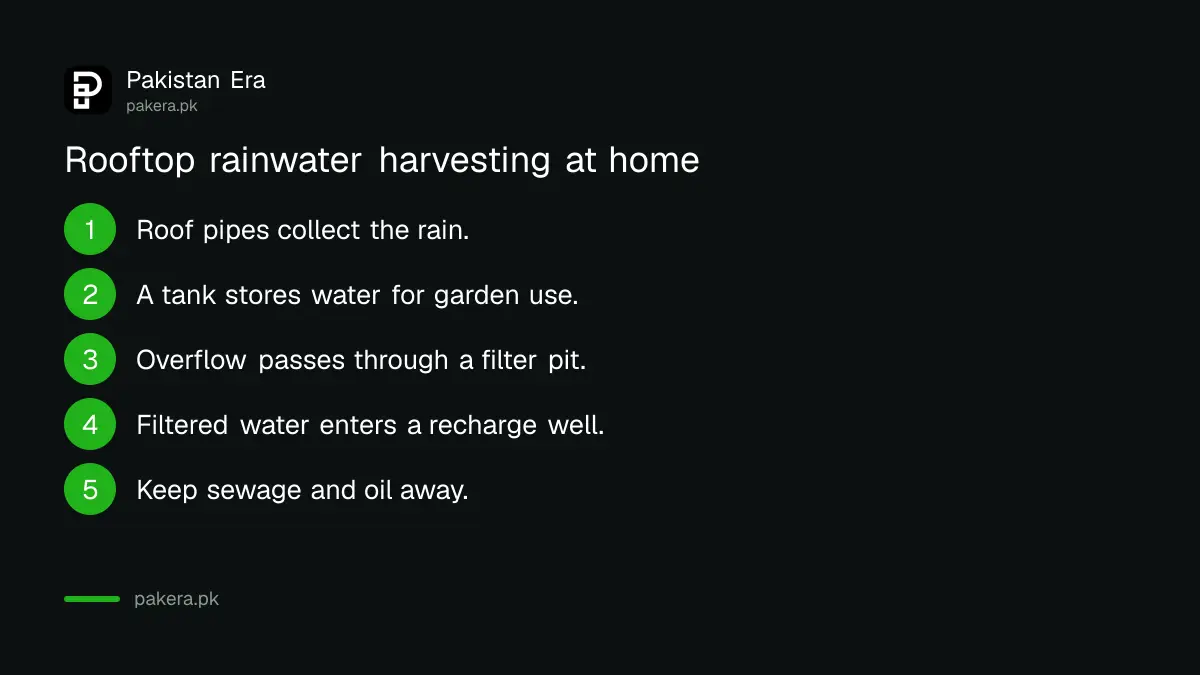
The regulation asks for overhead and underground tanks of approved design and capacity. CDA's newer push also promotes filtration and groundwater recharge. PCRWR's design sends roof water through a filter pit into a recharge well, leaving about 10 metres of soil above the water table to clean it.
The reason is simple. PCRWR says Islamabad's water table was about 10 metres deep in 1960 and has fallen below 50 metres. The city gets about 1,330 mm of rain a year, and most of it runs off into drains and nullahs.
- Collect rain from the roof through rainwater pipes.
- Send it to a storage tank for garden and cleaning use.
- Pass overflow through a filter pit of sand, crushed stone and boulders.
- Let filtered water enter a recharge well, if your design has one.
- Keep sewage, oil and chemicals away from the system.
CDA says harvested water can be used for gardening, landscaping and cleaning. It is not for drinking without treatment. One more rule is worth knowing: regulation 4.1.20 bans taking underground water except as CDA permits, and all underground tanks must be leak proof.

How to get approval from CDA
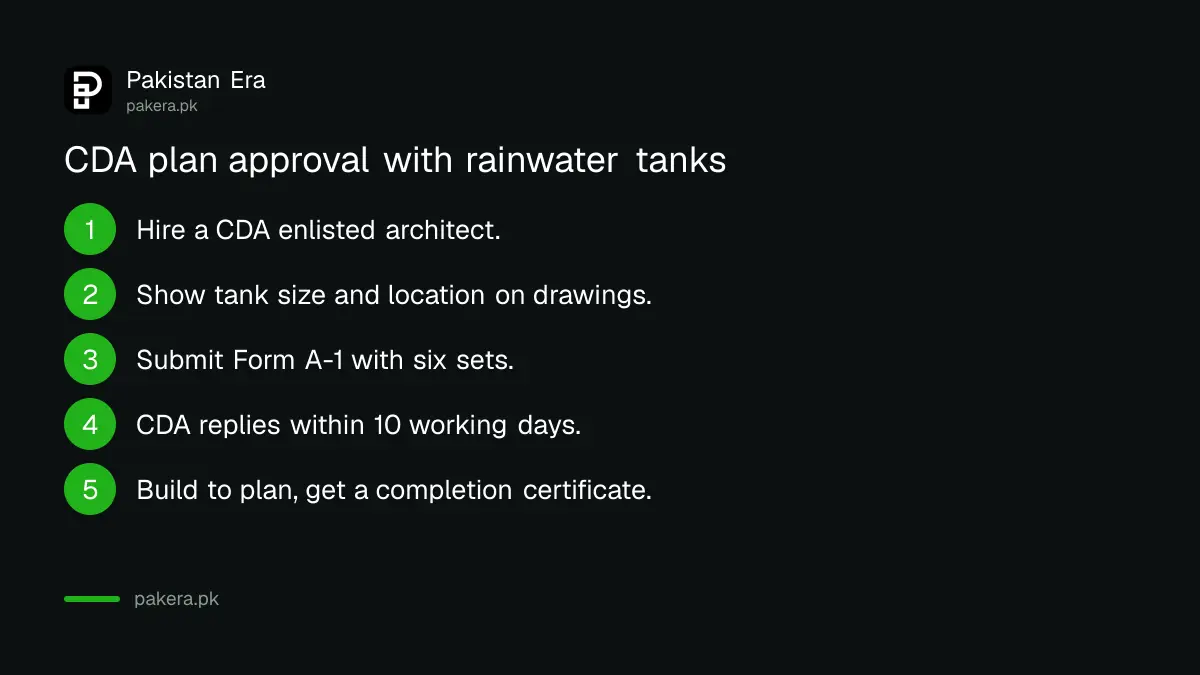
Hire a CDA enlisted architect and engineer, show the rainwater tanks on your drawings, and submit the plans on Form A-1. CDA should reply within 10 working days. Build what was approved, because the completion certificate comes after an inspection.
- Appoint an architect and engineer enlisted with CDA. The regulations require this for building work.
- Ask them to show the location and size of the rainwater tanks, overhead and underground, on the drawings.
- Submit Form A-1 with six sets of drawings to CDA's Building Control Section.
- Wait for CDA's decision. Regulation 3.7.1 gives 10 working days, longer for buildings over 10,000 sq ft.
- Build to the approved plan and apply for a completion certificate before you move in.
Penalties and costs
Regulation 4.1.2 carries no fine of its own. The real penalty is that CDA can refuse your plans, or act against work that breaks the regulations. We found no official cost figure for a private home system, so we are not quoting one.
Under regulation 3.10, CDA can order building work that breaks the rules to stop, and ask why it should not be removed or changed. Living in a house without a completion certificate is fined Rs 5,000 a month for residential buildings in the first year, doubling after that, under regulation 2.8.1.
On cost, the only official figure is for public sites. PCRWR says CDA's project for 100 recharge wells costs Rs 125.969 million. Those are large public wells in parks and buildings, so do not use that as a price for a house. Ask two or three contractors for quotes instead.
Where to get help
For plan approval, go to CDA's Building Control Section through your enlisted architect. For design advice, PCRWR has built and tested recharge sites in Islamabad. For general questions, CDA's head office is on 051-9252573, Monday to Friday, 8am to 4pm.
The rule also connects to flooding. PCRWR links rising runoff to urban flooding, including the July 2021 flood in Sector E-11. Pakistan was expected to get below normal rain this September, according to the PMD rain outlook, which is one more reason to store what falls.
Paying your CDA water bill is a separate matter. It can now go through the federal PAK App, and CDA says water bills should reach homes every month.
Common questions
Is rainwater harvesting mandatory in Islamabad?
Yes, on plots of 400 square yards and above, under regulation 4.1.2 of CDA's building regulations. Tanks must be shown on the building drawings.
Is there a September 2026 deadline for existing houses?
We found none. CDA's release of 23 September 2026 only encourages existing buildings to adopt systems where technically feasible.
Does a 10 marla house in Islamabad need rainwater harvesting?
Not under regulation 4.1.2. A 10 marla plot is about 250 to 303 square yards, below the 400 square yard limit. CDA still encourages it.
Do I need a recharge well?
The regulation asks for overhead and underground tanks. Recharge wells are part of CDA's wider push and PCRWR's design, but the regulation's text does not name them.
What is the fine for not having rainwater harvesting in Islamabad?
Regulation 4.1.2 sets no fine of its own. CDA can refuse plans that leave it out, and act under regulation 3.10 against work that breaks the rules.
Can I drink harvested rainwater?
Not without proper treatment. CDA suggests using it for gardening, landscaping and cleaning.
How we verified this
What we checked, where we read it, and what we could not confirm.
Last checked on 27 September 2026. The 400 square yard rule, the tank requirement and the drawings duty are read in regulation 4.1.2 of the Islamabad Capital Territory building control regulations, Gazette of Pakistan Extraordinary, 16 August 2023, as published on cda.gov.pk. The definition is regulation 117 of the definitions, the drawings detail is 3.4.2(vii), the 10 working day reply is 3.7.1, enforcement is 3.10, the completion certificate fine is 2.8.1 and the underground water rule is 4.1.20. CDA's release of 25 March 2026 states the rule is mandatory and records the chairman's direction. CDA's release of 23 September 2026 encourages existing buildings. The water table, rainfall, pit design and Rs 125.969 million project figure are read in PCRWR's note on rainwater harvesting in Islamabad. The four kanal figure and the September 2026 deadline appear only in reports and not in any official document we found.
About the author

Tax, Bills and Technology Writer
Ali Akhtar is a young and curious voice here at Pakistan Era. He is currently pursuing his A-Levels and has a growing interest in Pakistan’s changing industrial landscape and educational trends. Ali likes to write in a way that helps him explain and explore the world around him. His writing reflects the perspective of the new generation navigating the evolving trends of Pakistan where technology, youth innovation, and shifting opportunities are reshaping the country’s future.