Pakistan Expects Below Normal Rain and Floods Anyway
The weather service expects a dry month over most of the country, then warns of flash floods, urban flooding and hill torrents in the same paper.
Pakistan's weather service expects below normal rainfall over most of the country this September, and warns in the same document that flash flooding, urban flooding and hill torrents are still likely.
Those two statements are not in conflict. A dry month with a few violent days is exactly how flooding happens here, and the outlook says so explicitly.
We downloaded and read the Pakistan Meteorological Department's Outlook for September 2026, issued on 2 September 2026.
What the outlook says
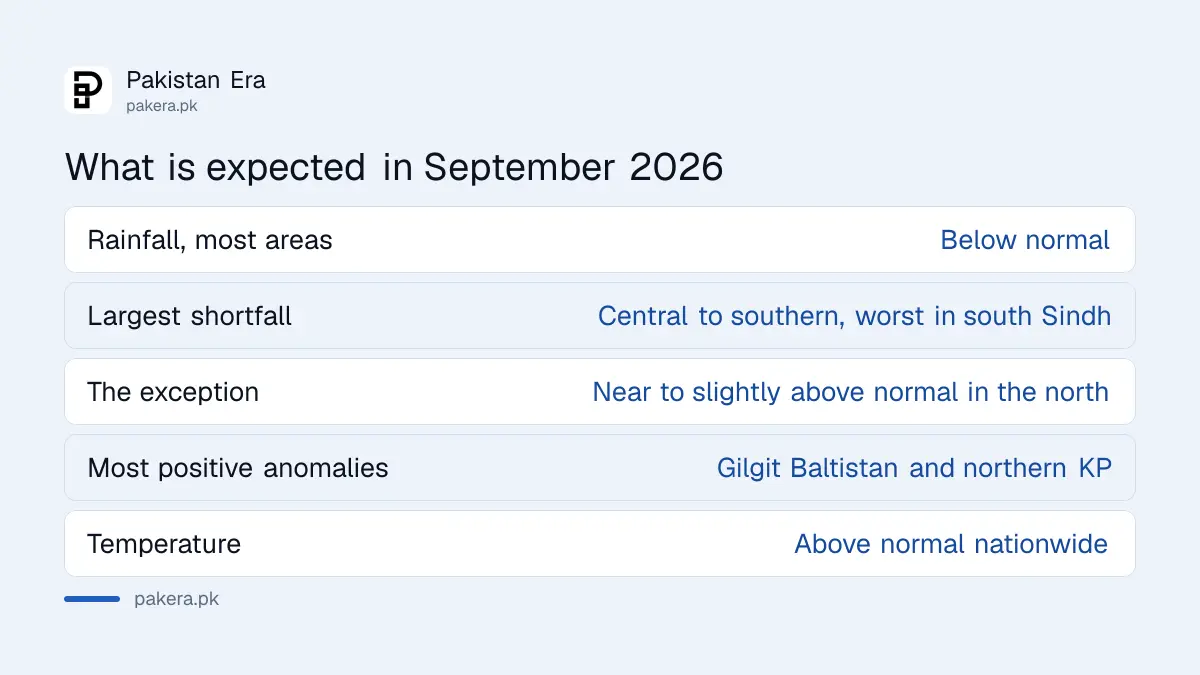
| Element | What is expected in September 2026 |
|---|---|
| Rainfall, most of the country | Below normal |
| Largest shortfall | Central to southern Pakistan, worst over southern Sindh |
| The exception | Near normal to slightly above normal in the north |
| Most positive anomalies | Gilgit Baltistan and northern Khyber Pakhtunkhwa |
| Temperature | Above normal nationwide |
| Hottest departures | Eastern Gilgit Baltistan and western Balochistan |
The department describes the result as a distinct north south contrast in rainfall for the month.
Why a dry forecast still carries a flood warning
The impacts section of the outlook is where the practical warnings sit, and it is the part worth reading twice.
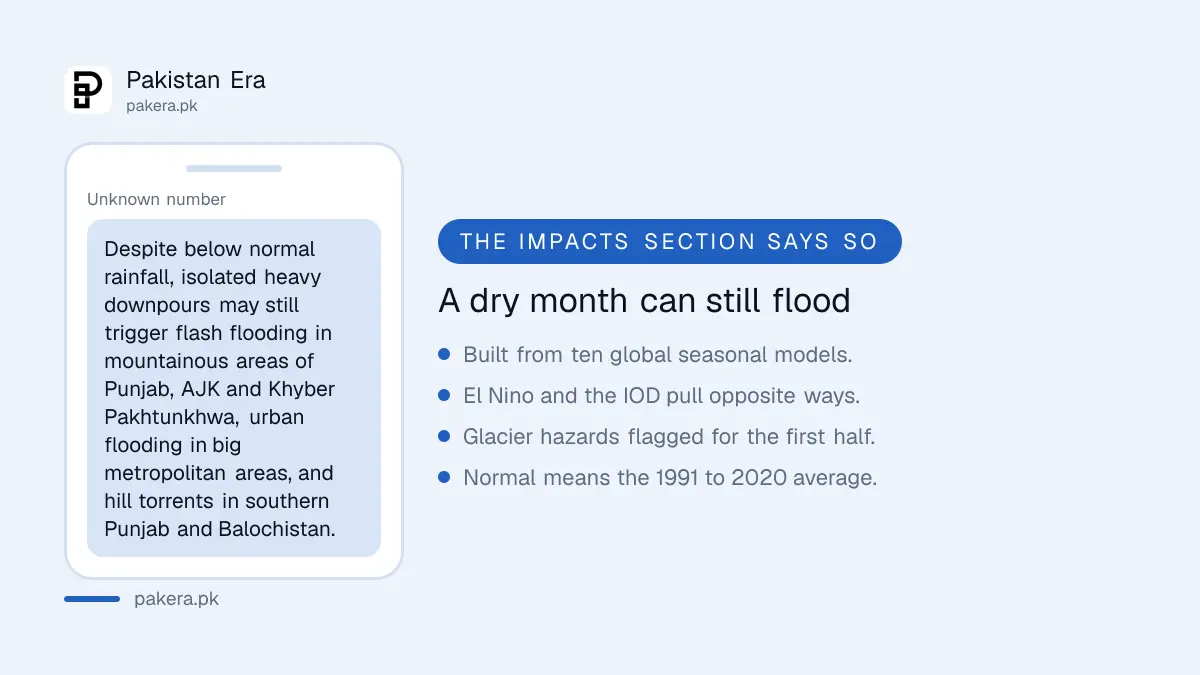
It says that despite below normal rainfall, isolated heavy downpours during the start of the season may still trigger flash flooding in mountainous areas of Punjab, Azad Jammu and Kashmir and Khyber Pakhtunkhwa, urban flooding in big metropolitan areas, and hill torrents in southern Punjab and Balochistan.
A monthly total can be below average while a single afternoon overwhelms a drain. The monthly figure describes the season. It does not describe the worst day in it.
The outlook adds a second hazard that follows from the heat rather than the rain. Above normal temperature combined with a rainfall spell may raise the probability of glacier related hazards, which it names as glacial lake outburst flood events, flash floods and landslides in mountainous and other vulnerable areas, particularly during the first half of the month.
Our guide to staying safe in urban flooding covers what to do when a city floods, and our guide to which official flood warning sites actually update covers where to look, because we tested them.
What it means for farmers
The outlook is unusual among forecasts in naming crops directly, and it cuts both ways.
Dry conditions are described as much supportive for harvesting, particularly for cotton and peanut.
Against that, the reduced rainfall may fail to meet irrigation needs for seasonal vegetables and growing Kharif crops, particularly in Sindh and Punjab, and supplemental irrigation is expected to be required.
There is a third warning aimed at growers. The spatial temperature gradient may cause strong winds, dust storms, thunderstorms and hailstorms which may affect seasonal crops, vegetables and orchards, and the department advises farmers to take precautionary measures to protect standing crops.
Our guide to agriculture schemes for farmers in Punjab covers the support programmes, and our guide to where a Kisan Card actually works covers buying inputs.
How the forecast is built
The department states its method rather than leaving it implied, which is worth knowing when deciding how much weight to give a monthly forecast.
The outlook is developed from the ensemble mean of ten selected global seasonal prediction models, and that ensemble provides the basis for the operational rainfall and temperature forecasts.
Two large scale drivers are named. The positive phase of the El Nino Southern Oscillation is expected to persist through the forecast month. Positive Indian Ocean Dipole conditions are present over the Indian Ocean and are likely to persist.
The department then notes something that a less careful forecast would leave out. El Nino and the Indian Ocean Dipole have compensating effects on precipitation over Pakistan, so the two are pulling in opposite directions.
Throughout the document, normal means the thirty year average climatology, with the reference period given as 1991 to 2020.
The probability version
Alongside the single outlook the department publishes a tercile probability forecast, which expresses the same expectation as likelihoods rather than as a single answer.
On that basis, below normal rainfall is pronounced as a likelihood over the eastern part of the country. Near normal conditions are favoured across the western regions, including Balochistan and southern Khyber Pakhtunkhwa. Above normal rainfall is more likely over the northwest, particularly Gilgit Baltistan and parts of northern Khyber Pakhtunkhwa.
For temperature the majority of models favour above normal across most of the country, with the highest probabilities over central Punjab, adjoining parts of Khyber Pakhtunkhwa and western Balochistan.
What to do with a monthly outlook
- Treat it as the shape of the month, not as a forecast for any particular day.
- Use the daily and three day forecasts for decisions about this week.
- Take the impacts section seriously even when the headline says dry.
- In a hill or mountain district, watch the first half of the month for glacier related hazards.
- In a city, treat any heavy downpour as a drainage problem regardless of the monthly total.
Our guide to where to get the official weather forecast covers the daily and three day products and how to read a warning properly.
What comes after this
Reporting on 12 September described a further monsoon spell affecting Punjab into the middle of the month, and provincial disaster authorities issuing alerts accordingly.
We have not verified that spell against a published departmental bulletin, so we are describing it as reported. The outlook we did read is a monthly document issued on 2 September and does not name individual spells.
The seasonal turn is worth noting too. Our guide to smog season in Punjab covers what replaces the monsoon as the main air quality problem once the rain stops.
Common questions
Will it rain less than usual in September 2026?
The department expects below normal rainfall over most of the country, with the largest shortfall over central to southern Pakistan.
Where is rain expected to be near or above normal?
The north, with positive anomalies most evident across Gilgit Baltistan and northern Khyber Pakhtunkhwa.
Is flooding still possible in a dry month?
Yes. The outlook warns of flash flooding in mountainous areas, urban flooding in big cities and hill torrents in southern Punjab and Balochistan.
What about temperatures?
Above normal nationwide, with the largest departures over eastern Gilgit Baltistan and western Balochistan.
How is the outlook produced?
From the ensemble mean of ten selected global seasonal prediction models.
What does normal mean here?
The thirty year average climatology, with the reference period stated as 1991 to 2020.
How we verified this
What we checked, where we read it, and what we could not confirm.
Last checked 12 September 2026. We downloaded the Outlook for September 2026 published by the Pakistan Meteorological Department from weather.gov.pk and read it. The document carries an issue date of 2 September 2026. The statements that below normal rainfall is expected over most parts of the country during September 2026, that the highest negative anomalies are expected over central to southern Pakistan with maximum departure over southern parts of Sindh, that near normal to slightly above normal rainfall is anticipated over the northern parts with positive anomalies most evident across Gilgit Baltistan and northern Khyber Pakhtunkhwa, and that the outlook suggests a distinct north south contrast; the tercile probability forecast indicating a pronounced likelihood of below normal rainfall over the eastern part of the country, near normal conditions favoured across western regions including Balochistan and southern Khyber Pakhtunkhwa, and above normal rainfall more likely over northwestern parts particularly Gilgit Baltistan and parts of northern Khyber Pakhtunkhwa; the temperature outlook of above normal mean temperatures nationwide with maximum departure over eastern Gilgit Baltistan and western parts of Balochistan, and the probabilistic temperature outlook favouring above normal temperatures with the highest probabilities over central Punjab, adjoining parts of Khyber Pakhtunkhwa and western Balochistan; the method statement that the monthly outlook is developed from the ensemble mean of ten selected global seasonal prediction models; the statements that the positive phase of the El Nino Southern Oscillation is expected to persist through the forecast month, that positive Indian Ocean Dipole conditions are present and likely to persist, and that El Nino and the Indian Ocean Dipole have compensating effects on precipitation over Pakistan; and the definition of normal as the thirty year average climatology with a stated normal period of 1991 to 2020, are all taken from that document. The impacts section, including that dry conditions are much supportive for harvesting particularly for cotton and peanut, that reduced rainfall may fail to fulfil irrigation needs for seasonal vegetables and growing Kharif crops particularly in Sindh and Punjab requiring supplemental irrigation, that above normal temperature along with a rainfall spell may enhance the probability of glacier related hazards such as glacial lake outburst flood events, flash floods and landslides in mountainous and other vulnerable areas particularly during the first half of the month, that despite below normal rainfall isolated heavy downpours during the start of the season may still trigger flash flooding in mountainous areas of Punjab, Azad Jammu and Kashmir and Khyber Pakhtunkhwa, urban flooding in big metropolitan areas and hill torrents in southern Punjab and Balochistan, and that the spatial temperature gradient may cause strong winds, dust storms, thunderstorms and hailstorms affecting seasonal crops, vegetables and orchards with farmers advised to take precautionary measures, is quoted from the same section of that document. The document also contains a table of observed August 2026 rainfall and temperature by region; the column alignment did not survive text extraction cleanly, so we have not reproduced those figures. Reporting of 12 September 2026 describing a further monsoon spell affecting Punjab into the middle of the month is not verified by us against a departmental bulletin and is described as reported. A monthly outlook is not a forecast for a particular day; use the daily and three day forecasts for that.
About the author

Public Services and Education Journalist
Fajr Riaz is a journalist and content writer at Pakistan Era, based in Lahore. She covers the questions people meet in everyday life in Pakistan: how a public service works, what a change in the rules means, and where to find a reliable answer.