Kisan Card Registered Dealers in Punjab: Find One in Your District
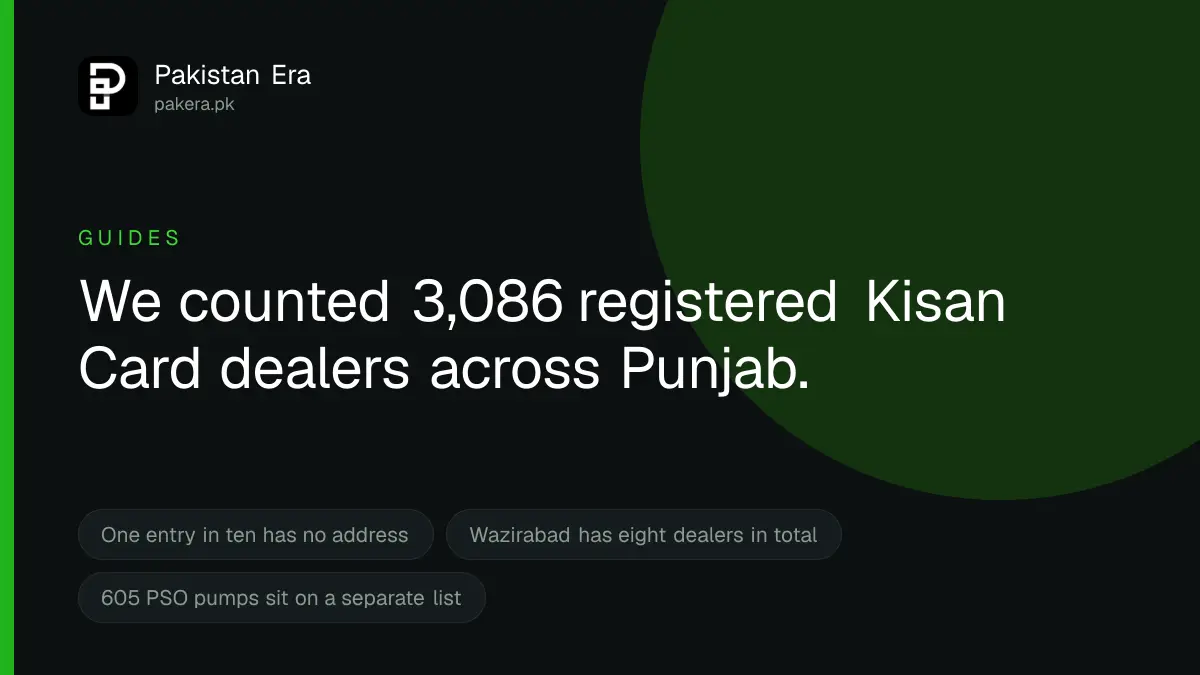
We downloaded all 36 district lists and counted them. One district has eight dealers, and one entry in ten carries no business address.
The Punjab Kisan Card works only at dealers registered by the Agriculture Department. To find one, open the Chief Minister's Punjab Kissan Card page on agripunjab.gov.pk and download your district's PDF list; fuel is bought at the PSO stations on a separate list.
We downloaded all 36 district lists on 7 September 2026 and counted 3,086 registered input dealers, plus 605 PSO filling stations. About one in ten dealer entries, 305, has no business address. We downloaded the same 36 files again on 8 November 2026. The districts we compared had not changed, but our quick recount of all rows came to 3,119, so some lists may have grown slightly.
If you do not have a card yet, start with how to apply for the Punjab Kissan Card. Bill dates and the Phase II loan size are in the Kissan Card Phase II plan.
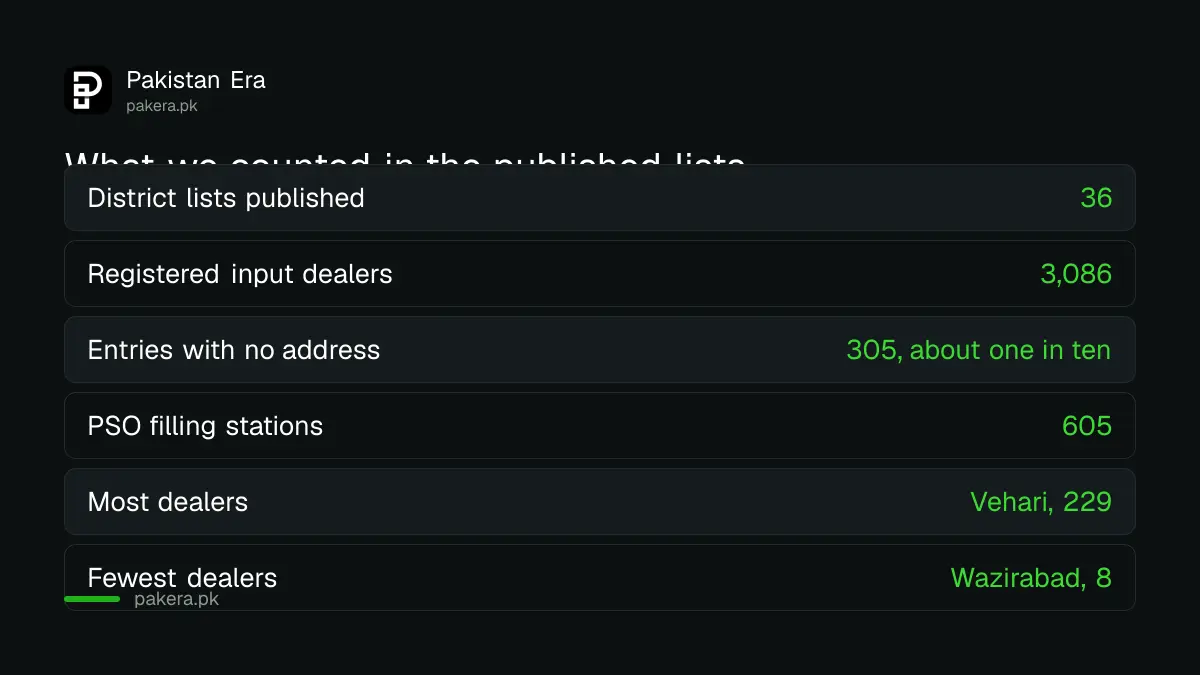
Kisan Card Dealers in Punjab: What We Counted
| Measure | Count |
|---|---|
| District dealer lists published | 36 |
| Registered input dealers listed | 3,086 |
| Entries with no business address | 305, about one in ten |
| PSO filling stations on the fuel list | 605 |
| District with the most dealers | Vehari, 229 |
| District with the fewest | Wazirabad, 8 |
Each dealer record carries the merchant legal name, business address, city, district, tehsil and division. The fuel list is laid out differently, with city, district, tehsil, merchant name and address.
Some Districts Have Very Few Dealers
The spread across districts is far wider than a farmer would guess, and it does not track district size in any simple way.
The five largest lists are Vehari with 229 dealers, Bahawalpur with 205, Rahim Yar Khan with 187, then Multan and Lodhran with 152 each. Those are the cotton and southern Punjab districts, and the card clearly has depth there.
The five thinnest are Wazirabad with 8, Jhelum with 11, Chakwal with 17, Kot Addu with 25 and Lahore with 27.
Eight dealers for a whole district is the number to sit with. If you farm in Wazirabad, the practical question is not whether the card works but whether any of those eight is within reach of your land.
One in Ten Dealers Has No Address
Across the 36 lists, 305 entries out of 3,086 carry a merchant legal name with the business address column left empty. The name is there. The district and tehsil are there. Where to go is not.
The rate is not evenly spread either. Chakwal and Jhelum have no blank addresses at all. Attock has 11 blanks out of 33 entries, which is a third of the district. Wazirabad has 2 of 8. Mandi Bahauddin has 15 of 61, Sialkot 11 of 51, and Gujranwala 14 of 69.
So in the districts with the fewest dealers, the chance that a listed dealer has no printed address is often highest. That is the opposite of what a farmer in a thin district needs.
How to Check a Dealer Before You Travel
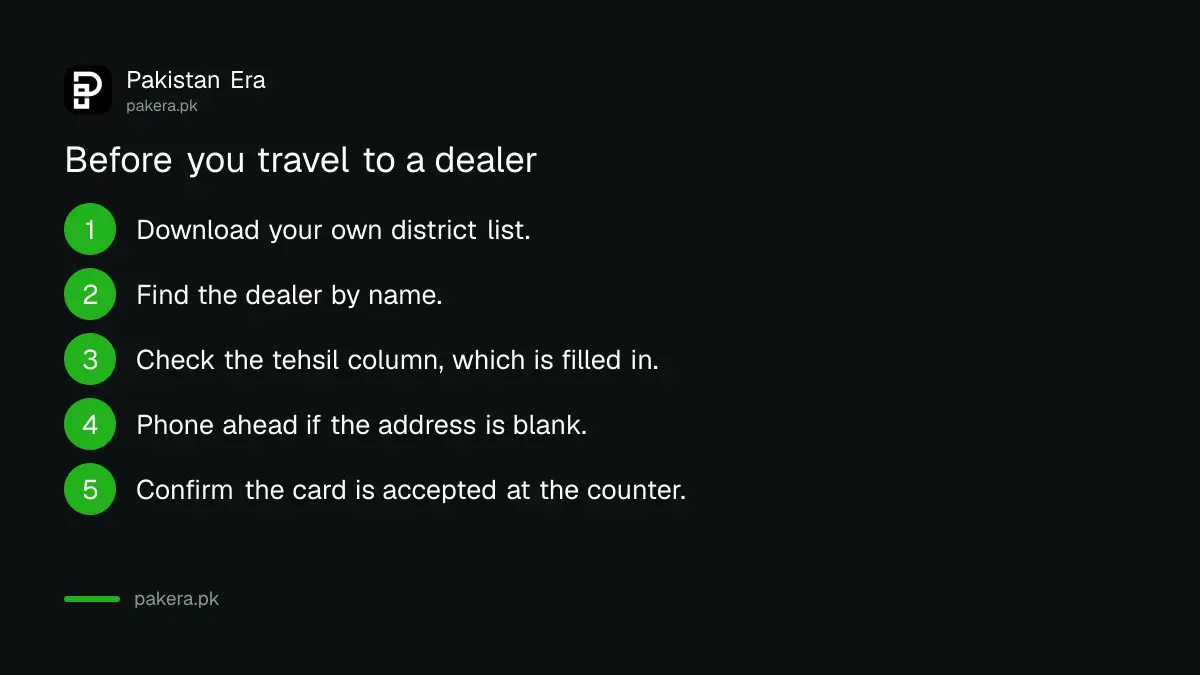
- Download your own district's list from the Kissan Card page rather than relying on a shop's claim.
- Find the dealer by name and check the tehsil column, which is filled in even where the address is not.
- If the address is blank, ask the dealer for it by phone before making the trip.
- For fuel, use the separate PSO registered filling stations list, not the input dealer list.
- Confirm at the counter that the card is accepted before loading anything.
The tehsil column is the useful fallback. Even in the entries with no street address, the district and tehsil are recorded, which narrows a search to something walkable rather than a whole division.
Why Only Registered Dealers Accept the Card
The card is not cash. It is a mechanism for buying agricultural inputs from merchants the department has registered, which is what makes the published list the operative document rather than a convenience.
A shop that is not on the list cannot take the card, whatever it tells you at the counter. That cuts both ways: it protects the scheme from misuse, and it limits where a farmer can spend.
The same page now also carries the Phase III loan payers winners list and the first lucky draw ballot winners, covered in the Kissan Card lucky draw result. For other questions, see the Punjab agriculture helpline and contact numbers.
The Kisan Card or a Private Loan
Most farmers reading about input credit are weighing it against the alternative they already use, which is borrowing privately against the crop.
That comparison changed in 2022 and a lot of people do not know. Our guide to private money lending on interest in Punjab covers a law that makes the practice an offence carrying three to ten years, extinguishes the obligation to pay interest, and treats interest already paid as payment towards the principal.
Our guide to getting a fard online in Punjab covers the land record, which sits behind most agricultural credit applications, and our guide to the deadlines on government offices in Punjab covers what to do when a department application sits without an answer. Young farmers who want to start a farm business can also look at the 0 per cent first tier in the PM Youth Business and Agriculture Loan.
How We Counted
We took the district wise registered dealer PDFs linked on the Kissan Card page, downloaded all of them, converted each to text preserving the column layout, and counted rows that begin with a serial number.
For the address test we read the business address column by its fixed position in each row and counted a row as having no address where that column was empty after trimming spaces.
We excluded the separate PSO fuel list and the Phase III loan payers list from the dealer totals, and counted the PSO list separately. Our count is of published rows, so a dealer that has closed since the list was compiled still counts here, and the department may update the files at any time.
On 8 November 2026 we downloaded the files again. The page links the same 36 district files, and the district totals we compared matched, including Vehari 229, Bahawalpur 205, Rahim Yar Khan 187, Multan 152, Lodhran 152, Lahore 27, Attock 33, Gujranwala 69, Mandi Bahauddin 61, Sialkot 51, Kot Addu 25, Chakwal 17, Jhelum 11 and Wazirabad 8, with 605 rows on the PSO list. Counting every row that begins with a number across all 36 files gave 3,119, against 3,086 in September; we did not repeat the full column check, so the September figures stand above.
Common Questions About Kisan Card Dealers
How many Kisan Card dealers are there in Punjab?
We counted 3,086 registered input dealers across the 36 district lists published on 7 September 2026.
Can I use the card at any shop?
No. It works at dealers registered by the department, which is why the district list is the document to check.
Can I buy fuel with it?
The department publishes a separate list of registered PSO filling stations, on which we counted 605 entries.
Why do some dealers have no address?
We do not know. We counted 305 entries with a merchant name and an empty business address column, and the district and tehsil are still recorded for those.
Which district has the fewest dealers?
Wazirabad, with 8, followed by Jhelum with 11 and Chakwal with 17.
Where do I get my district's list?
From the Chief Minister's Punjab Kissan Card page on the Agriculture Department site, which links a PDF per district.
How we verified this
What we checked, where we read it, and what we could not confirm.
Last checked 8 November 2026, when we downloaded the lists again from the Chief Minister's Punjab Kissan Card page on agripunjab.gov.pk. We first opened that page on 7 September 2026 and downloaded every district dealer PDF and the PSO filling stations file. All counts are our own, by the method above. The department may update the files at any time.
About the author

Tax, Bills and Technology Writer
Ali Akhtar is a young and curious voice here at Pakistan Era. He is currently pursuing his A-Levels and has a growing interest in Pakistan’s changing industrial landscape and educational trends. Ali likes to write in a way that helps him explain and explore the world around him. His writing reflects the perspective of the new generation navigating the evolving trends of Pakistan where technology, youth innovation, and shifting opportunities are reshaping the country’s future.