Private Money Lending on Interest Is a Crime in Punjab
Lending privately on interest carries three to ten years, the interest owed is extinguished, and anything paid above the principal is returned.
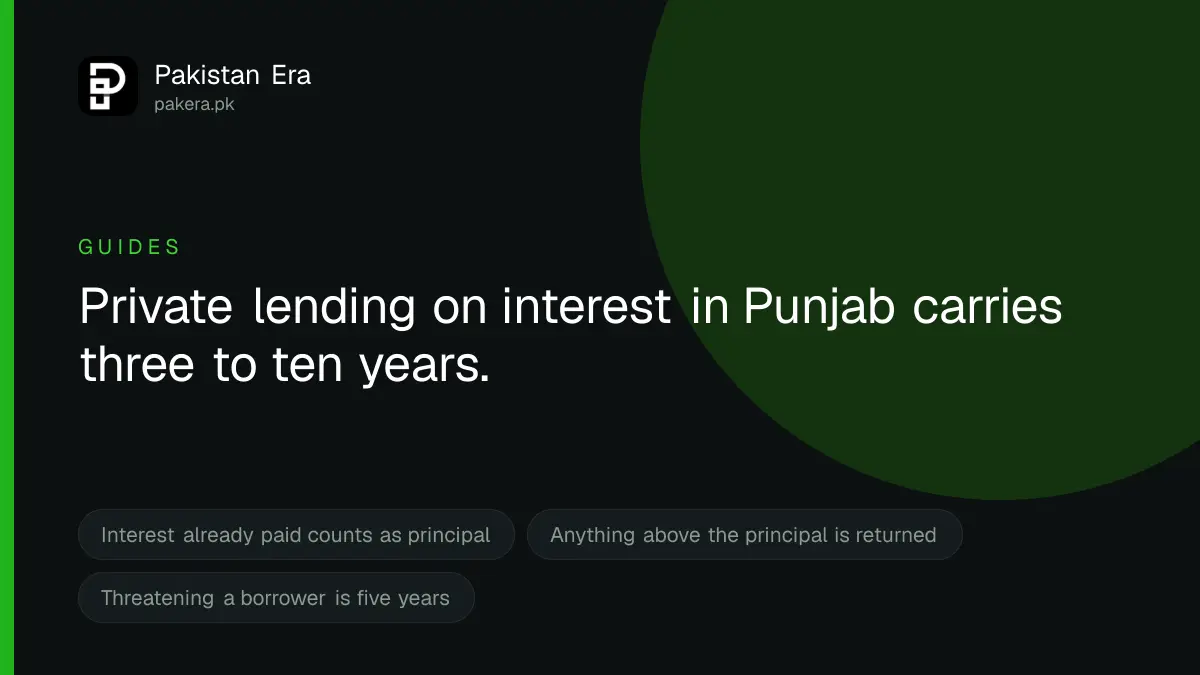
Lending money on interest privately in Punjab is a crime carrying three to ten years in prison. The obligation to pay that interest is extinguished by law, interest already paid counts against the principal, and anything paid beyond the principal must be returned to you.
Threatening a borrower to force repayment is a separate offence with up to five years. Both are non bailable.
We read the Punjab Prohibition of Interest on Private Loans Act 2022 on 6 September 2026 in the text published by the Law and Parliamentary Affairs Department, Government of the Punjab.
What the Act does
| Point | What the Act says |
|---|---|
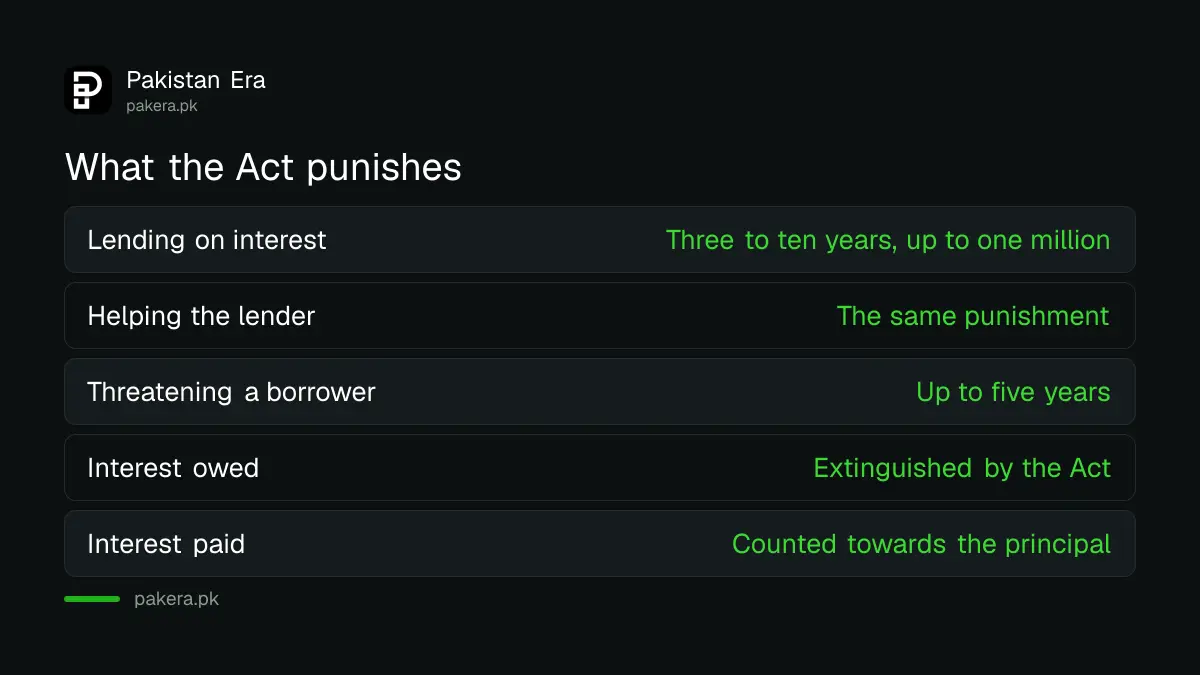
| Lending on interest | Three to ten years, fine up to one million rupees |
| Helping the lender | The same punishment as the lender |
| Threatening a borrower | Up to five years, fine up to five hundred thousand rupees |
| Interest owed | Extinguished from the commencement of the Act |
| Interest already paid | Counted towards the principal |
| Paid beyond the principal | Ordered returned to the borrower |
Banks and other financial institutions are outside this Act. It is aimed at private lending.
Who counts as a money lender
The definition is wide, and it is written to catch the arrangements people actually use.
A money lender is a person other than the Federal or Provincial Government or a financial institution who lends money on interest or deals in interest based transactions. It includes anyone put in charge of a branch or liaison office of the lender's business. It includes a pawn broker taking goods in pawn or pledge for a loan. And it expressly includes payday loans, small personal loans and credit chits.
Interest is defined just as widely. It means any amount, big or small, over the principal, whether the loan was taken for consumption or for production, and whether it is called interest or something else.
The Act also names three patterns as interest based transactions. Exchanging price differences with no intention of exchanging goods. Selling on credit at a higher price and repurchasing for less in cash. And stipulating two prices in the same deal, a lower one for a shorter period and a listed one for longer.
The part that changes what you owe
Section 7 is a single sentence with a large effect. On the commencement of the Act, every obligation of a debtor to pay interest on a debt, or any part of that interest, stands extinguished.
Section 10 then deals with what has already been handed over. If the court finds the lender committed an offence, it shall order that interest already paid is treated as payment towards the principal. And where the interest paid exceeds the principal, the court shall order the lender to return the excess to the borrower.
So a borrower who has been paying for years may owe far less than the ledger says, or nothing, or be owed money.
Threats and pressure are their own offence
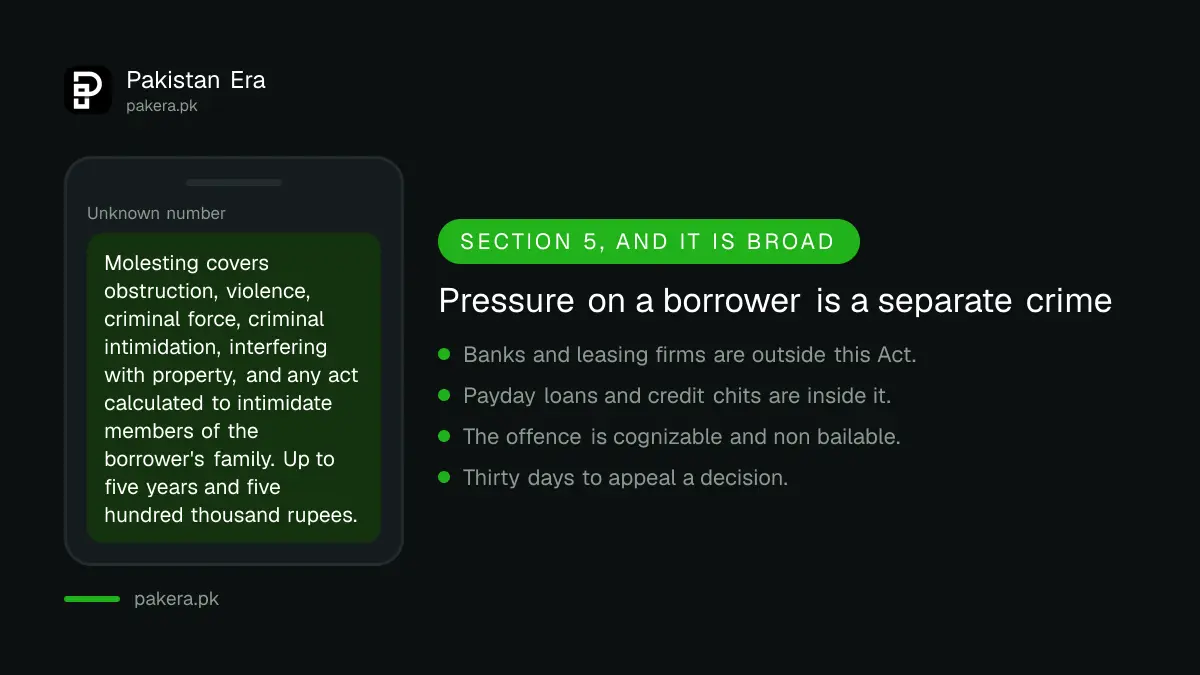
Section 5 covers what the Act calls molesting a borrower, and the definition is broader than physical harm.
A person molests another if they obstruct, use violence or criminal force, or criminally intimidate that person. Or interfere with property owned or used by them, or deprive or hinder them in using it. Or do any act calculated to intimidate the members of that person's family.
Doing any of that to force repayment of a loan, a part of it, or interest on it, carries imprisonment up to five years and a fine up to five hundred thousand rupees.
Section 4 catches the helpers. Anyone who intentionally and wilfully abets, engages, assists or aids the lender in lending, in recovering interest, or in an interest based transaction, is liable to the same punishment as the lender.
What to do if the police will not register the case
- Write out the complaint, with the dates, the amounts and the names.
- Take it to a justice of the peace rather than only to the police station.
- The justice of peace must, within three days, order the local police to register a case.
- Keep every receipt, transfer record and message showing what was paid and demanded.
- If the lender refuses repayment without interest, deposit the money in court under section 13.
That last step matters. Section 13 says where a lender refuses to accept the whole or part of what is due without payment of interest, the debtor may deposit the money or property with the court that would hear a recovery suit, and apply for the loan to be recorded as satisfied in full or in part.
Section 9 makes the offence cognizable, non compoundable and non bailable. Section 8 puts the trial no lower than a Judicial Magistrate of the first class. Section 12 gives thirty days to appeal.
Borrow where the law protects you
The Act exists because private lending sits outside every consumer protection that applies to a bank. If you need credit, the regulated routes leave a record and a complaint channel.
Our guide to the PM Youth Business Loan covers a government backed scheme, and our guide to how banks decide a home loan covers the State Bank rules on secured lending. Our guide to complaining to the Banking Mohtasib covers the route when a regulated lender is the problem.
Common questions
Is private money lending on interest illegal in Punjab?
Yes. Section 3 prohibits it and sets imprisonment of not less than three years and up to ten, with a fine up to one million rupees.
Do I still owe the interest?
Section 7 says the obligation to pay interest on a debt stands extinguished from the commencement of the Act.
What about interest I already paid?
On conviction the court treats it as payment towards the principal, and orders any excess over the principal returned to you.
Does this apply to banks?
No. Financial institutions as defined in the Act, including banks and leasing companies, are outside the definition of a money lender.
The lender is threatening my family. Is that covered?
Yes. Section 5 covers acts calculated to intimidate family members, with up to five years and a fine up to five hundred thousand rupees.
The police will not register my complaint.
A justice of the peace must, within three days of receiving the complaint, order the local police to register a case.
How we verified this
What we checked, where we read it, and what we could not confirm.
Last checked 6 September 2026. We downloaded the Punjab Prohibition of Interest on Private Loans Act 2022 from the Punjab Code portal at punjablaws.punjab.gov.pk, in the text published by the Law and Parliamentary Affairs Department, Government of the Punjab, and read it. The definitions of money lender, interest, interest based transactions and molest; section 3 prohibiting private money lending and setting imprisonment of not less than three years and up to ten with a fine up to one million rupees; section 4 giving an abettor the same punishment; section 5 setting up to five years and a fine up to five hundred thousand rupees for molesting a borrower; section 6 requiring a justice of peace to order registration of a case within three days; section 7 extinguishing the obligation to pay interest; section 8 restricting trial to a court not inferior to a Judicial Magistrate of the first class; section 9 making the offence cognizable, non compoundable and non bailable; section 10 treating interest already paid as payment towards the principal and requiring return of any excess; section 11 on recovery including as arrears of land revenue; section 12 giving thirty days to appeal; and section 13 allowing a debtor to deposit money in court where the lender refuses repayment without interest, are all taken from that text. The Act was passed on 16 August 2022, assented to on 22 August 2022 and published in the Punjab Gazette (Extraordinary) dated 23 August 2022. This is the Punjab Act and applies in the Punjab. Nothing here is legal advice, and anyone facing threats should treat their safety as the first priority.
About the author

Senior Writer, Public Services and Technology
Shahid joined us in 2024 as an author. He is a senior contributor to Pakistan's leading technology websites. He writes detailed articles, mostly covering his expertise in the latest tech, mobiles, apps, gadgets, and step-by-step guides. His ideology is to help people understand the latest trends and explain complex methods through very easy-to-understand guides.