How to Apply for the PM Youth Business Loan
Tier one of the PM Youth Business Loan runs to Rs 500,000 at 0 percent markup. The tiers, the age limits, and how the online application works.
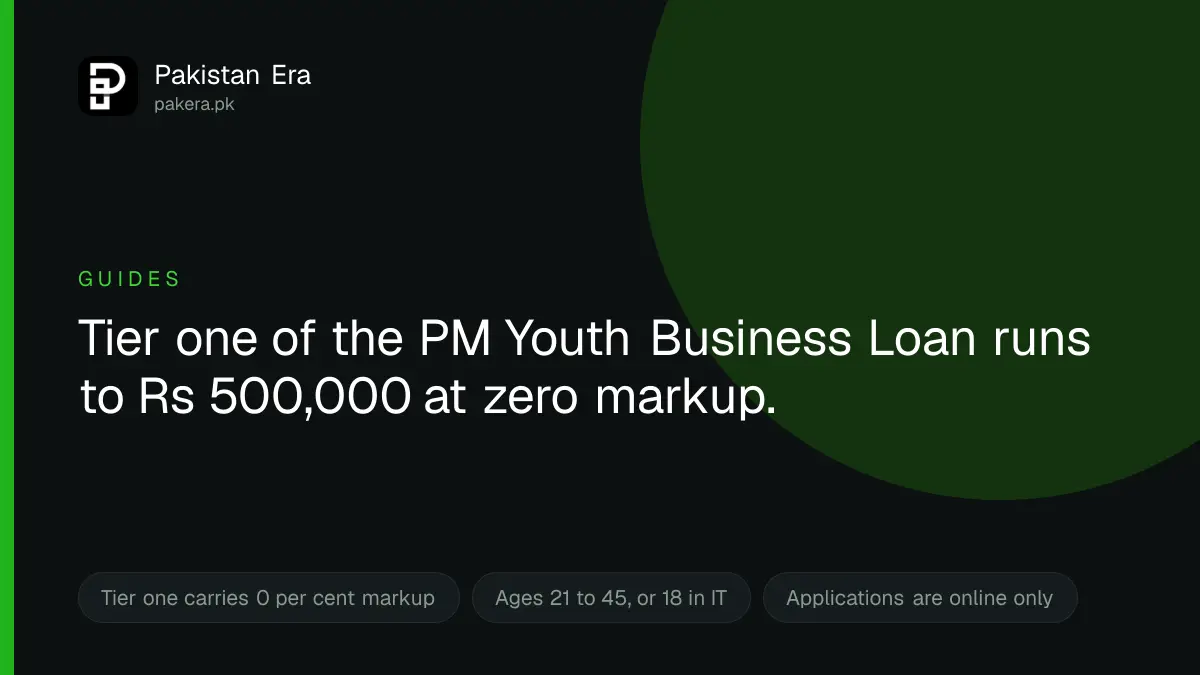
The first tier of the Prime Minister's Youth Business and Agriculture Loan Scheme carries no markup at all. We read the tiers on the scheme's own site at pmybals.pmyp.gov.pk on 26 August 2026. Tier one runs up to 0.5 million rupees at 0 per cent markup, tier two from above 0.5 million up to 1.5 million at 5 per cent, and tier three from above 1.5 million up to 7.5 million at 7 per cent.
Eligibility is stated on the same page. All Pakistani residents aged between 21 and 45 with entrepreneurial potential may apply, and for information technology and e-commerce businesses the lower age limit drops to 18.
The three tiers, read from the scheme's own page
| Tier | Amount | Markup |
|---|---|---|
| Tier 1 | Up to Rs 0.5 million | 0 per cent |
| Tier 2 | Above Rs 0.5 million up to Rs 1.5 million | 5 per cent |
| Tier 3 | Above Rs 1.5 million up to Rs 7.5 million | 7 per cent |
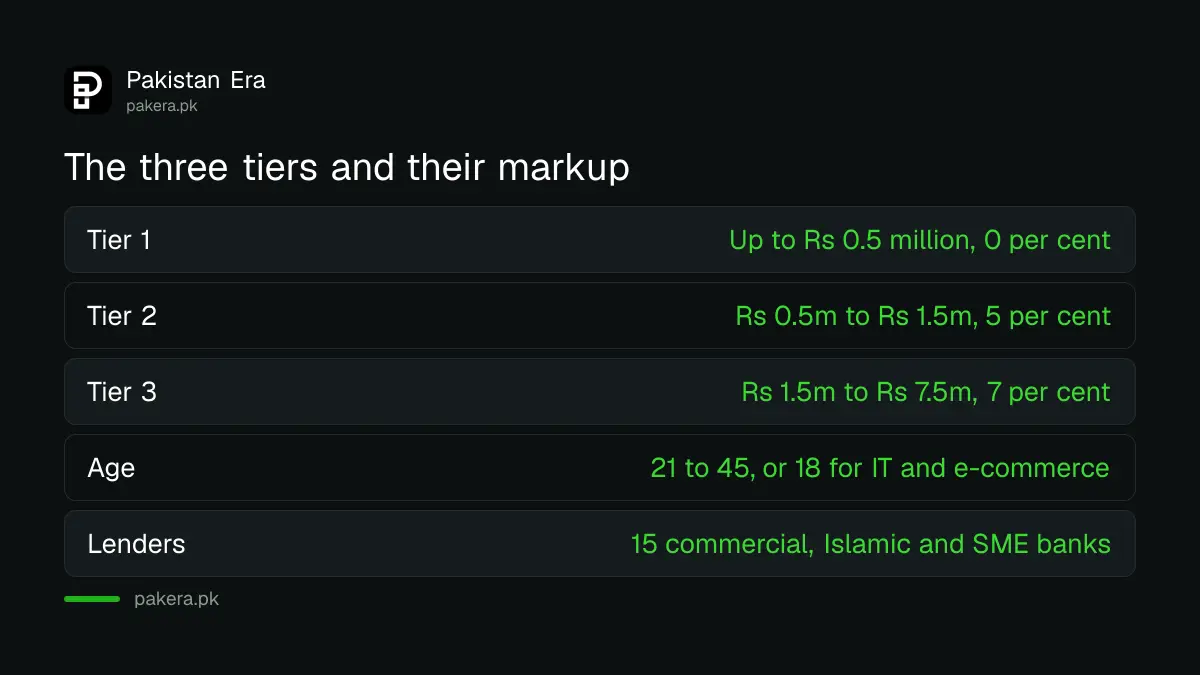
The scheme describes itself as lending through 15 commercial, Islamic and SME banks. That matters more than it sounds, because the bank, not the scheme, makes the credit decision on your file.
Applications go through the website, not the branch
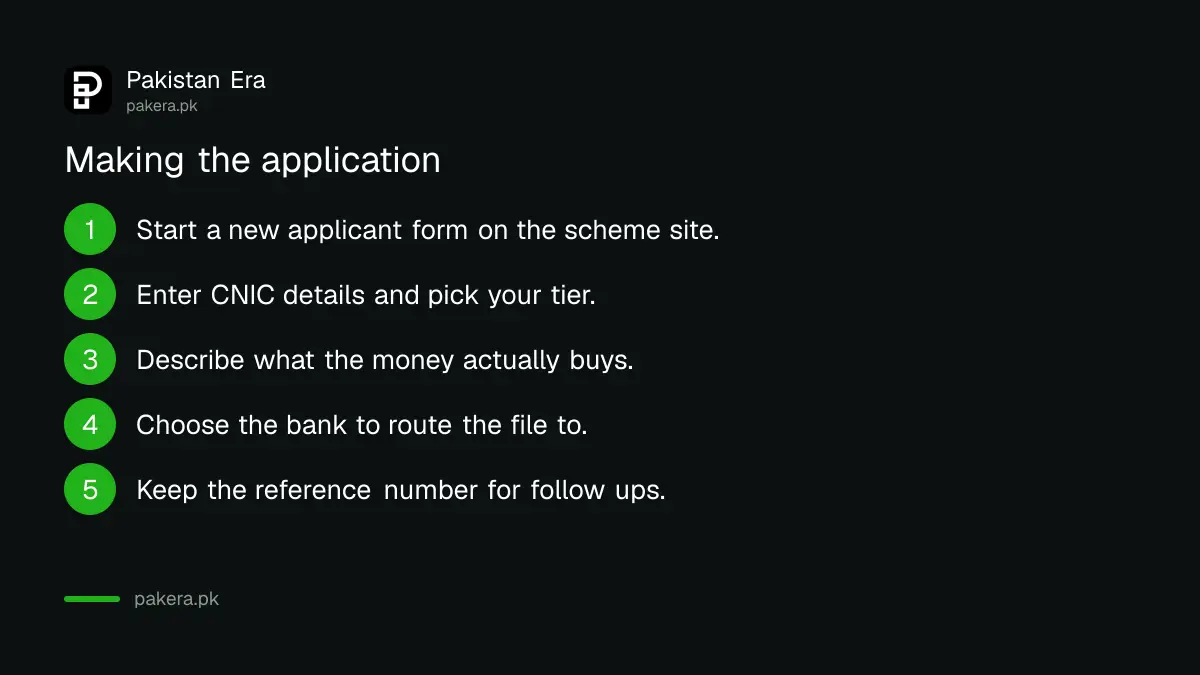
The scheme states that applications have to be submitted online through its website. Walking into a branch with a file is not the entry point, and anyone offering to submit one on your behalf for a fee is selling you something the scheme gives away.
- Open the scheme site and start a new applicant form.
- Enter your CNIC details and choose the tier that matches what you need.
- Describe the business honestly, including what the money buys.
- Pick the bank you want the application routed to.
- Keep the application or reference number for every follow up.
After submission the file goes to the bank you selected. The bank does its own checks, may call you in, and decides. That step is where most applications actually succeed or fail.
Equity and what the bank looks at
Reporting of the scheme describes an equity contribution for new businesses, put at around 10 per cent for the first two tiers and about 20 per cent for tier three, with existing businesses not required to contribute. We did not read those percentages on the scheme's own page, so treat them as reported and confirm with the bank before you plan around them.
Beyond equity, expect the ordinary things a lender wants: who you are, what the business does, whether the numbers make sense, and whether you already owe money elsewhere. Your filer status and tax registration come up for business lending, and our guides to registering as a sole proprietor with FBR and to verifying an NTN cover that groundwork.
Write the business case, not a wish
The weakest applications ask for a round number with no explanation. The strongest ones say what the money buys, what that produces, and how the repayment comes out of the earnings rather than out of hope.
Be specific. Name the machine, the stock, the vehicle or the premises. Show what you already have, because an existing business with records is a materially easier case than a plan on paper. Ask for the amount you can service, not the maximum the tier allows, since the tier ceiling is not a target.
Nobody can approve a loan for you
Government lending schemes attract a predictable industry of intermediaries. The application is free and online, the decision sits with a bank, and no agent has the ability to guarantee approval regardless of what they claim.
Never pay a fee to be enrolled, never hand over your CNIC and bank details to a middleman, and be suspicious of anyone quoting a different amount or markup from the ones the scheme publishes. If a number does not match the scheme's own page, it is not the scheme.
If you are not eligible or not approved
Age and residence rules are firm, so applicants outside the range should look elsewhere rather than around. If the age limit is the obstacle, check whether the business qualifies as information technology or e-commerce, since that lowers the floor to 18.
A refusal is not always final. Ask the bank what the reason was, fix it, and reapply if the fix is real. Provincial schemes also exist and are separate from this federal one, and we cover one of them in our piece on the Sindh Youth Card.
Common questions about the PM Youth Business Loan
Is tier one really free of markup?
The scheme's own page states 0 per cent markup for tier one, which runs to 0.5 million rupees. Other charges a bank applies are a separate matter to confirm with the bank.
What is the age limit?
Between 21 and 45 for Pakistani residents, and from 18 for information technology and e-commerce businesses, as stated on the scheme's page.
Can I apply at a bank branch?
The scheme says applications must be submitted online through its website. The bank you choose then processes the file.
How long does approval take?
The scheme does not publish a timeline we could read, and it depends on the bank and your documents. Ask your chosen bank what it expects rather than relying on a figure from elsewhere.
Does agriculture come under the same scheme?
Yes. The scheme is the Youth Business and Agriculture Loan Scheme, so agricultural applications sit within the same structure.
How we verified this
What we checked, where we read it, and what we could not confirm.
Last checked 26 August 2026. The three tiers with their amounts and markup rates, the age eligibility of 21 to 45 with 18 for information technology and e-commerce, the statement that applications must be submitted online, and the reference to 15 commercial, Islamic and SME banks were all read by us on the scheme's own page at pmybals.pmyp.gov.pk on that date. The equity percentages of about 10 per cent and 20 per cent are reported rather than read at source, and the body says so. We have not applied for this loan and hold no application, so nothing here describes an outcome we obtained.
About the author

Tax, Bills and Technology Writer
Ali Akhtar is a young and curious voice here at Pakistan Era. He is currently pursuing his A-Levels and has a growing interest in Pakistan’s changing industrial landscape and educational trends. Ali likes to write in a way that helps him explain and explore the world around him. His writing reflects the perspective of the new generation navigating the evolving trends of Pakistan where technology, youth innovation, and shifting opportunities are reshaping the country’s future.