How to Register a Sole Proprietorship With FBR in Pakistan
Register a sole proprietorship on FBR IRIS for free: what you need, the steps, why your SIM must be in your name, and when sales tax applies too.
To register a sole proprietorship in Pakistan, register yourself on FBR's IRIS portal at iris.fbr.gov.pk, then add your business to your own tax profile from the business tab. There is no FBR fee, no incorporation and nothing to file with the SECP.
You need a valid CNIC, a SIM registered in your own name, an email address and a recent utility bill. What you are really doing is adding a business to your own tax profile. Your NTN and your CNIC are the same number, the business attaches to you personally, and that is the whole legal formality. This is why a freelancer or a shopkeeper can be legitimate in an afternoon while a private limited company takes weeks.
Sole proprietor against a company
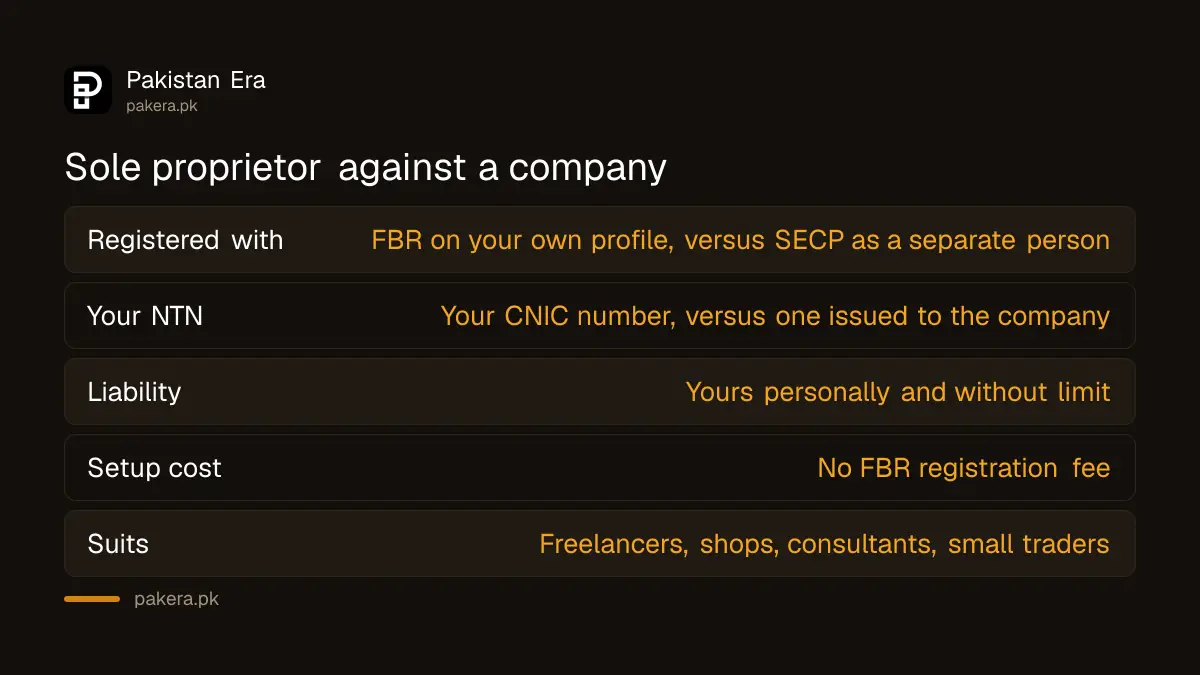
| Sole proprietor | Private limited company | |
|---|---|---|
| Registered with | FBR, on your own profile | SECP, as a separate legal person |
| Your NTN | Your CNIC number | Issued to the company |
| Liability | Yours, personally and without limit | Limited to the company |
| Setup cost | No registration fee at FBR | SECP fees and process |
| Suits | Freelancers, shops, consultants, small traders | Anything taking investment or carrying real risk |
The liability row is the one to think about rather than skim. As a sole proprietor there is no separation between you and the business, so a business debt is your debt and a business claim reaches your personal assets. If that matters for what you do, the route is registering a company with the SECP instead.
What to have ready before you open the portal
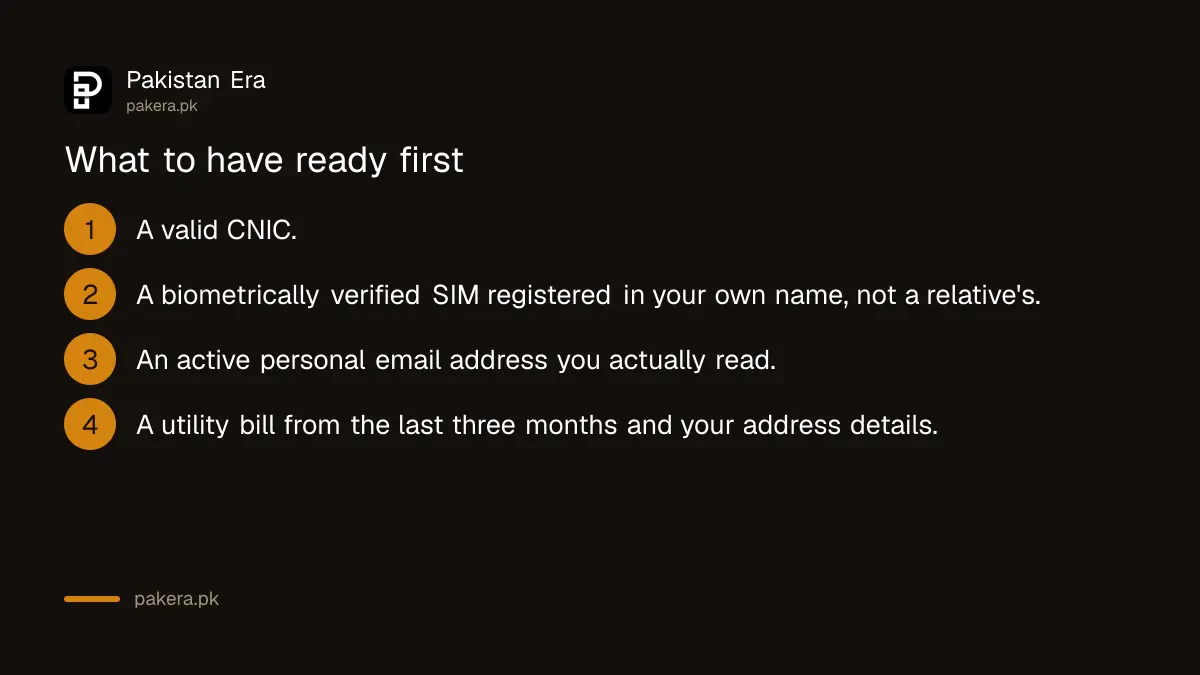
- A valid CNIC.
- A SIM registered under your own CNIC and biometrically verified. Not a family member's, not a business SIM in someone else's name. The verification codes go there.
- An active personal email address you actually read.
- A utility bill from the last three months for the address you are declaring.
- Your residential address details.
The SIM requirement is where most people stall. If your number is registered to your father or your former employer, fix that first, because the portal sends the confirmation code to the number tied to your CNIC and there is no way around it. Our guide to checking which SIMs are registered on your CNIC shows you how to see what is in your name.
The process on IRIS
Registration runs on FBR's IRIS portal at iris.fbr.gov.pk, which was live on 8 November 2026, running as IRIS 2.0. If you already have an account but cannot get in, our guide to IRIS password reset and e-enrolment covers every case.
The sequence is:
- On the login page, choose registration for an unregistered person, the option below the login fields, rather than trying to log in.
- Complete the registration form with your CNIC, mobile number, email and address, and verify with the codes sent to your phone and inbox.
- Log in to IRIS with the credentials you receive.
- Open the business tab and add a business using the plus control.
- Enter the exact business name, your shop or agency name as you intend to use it.
- Set the acquisition date, meaning the day you actually started the business.
- Select your principal activity, for example retail trade or software development.
- Submit.
It is free, the form itself takes about 10 to 15 minutes, and completion usually takes 2 to 5 working days.
Check the labels on screen as you go, because they may not match this list word for word.
Two details that cause problems later
The business name should be the name you will actually use. It goes on your invoices and it is what a client's accounts department will match against. Changing it later is possible but it means amending your registration and reissuing anything already out.
The acquisition date is the date you started trading, not the date you are filling the form. Backdating it to when you genuinely began matters, because it defines the period FBR expects returns for. Putting a date you cannot support is not a shortcut, and putting today's date when you have been trading for two years does not erase those two years.
What registration actually gets you
- A business bank account, which banks will not open on a personal account alone for business volumes.
- The ability to issue proper invoices that corporate clients can put through their own books.
- Eligibility for government tenders.
- Corporate clients at all, since larger companies increasingly will not pay an unregistered supplier because they cannot claim the expense cleanly.
- The route to filer status, which changes the withholding rates you pay on ordinary banking and vehicle transactions.
In Punjab, practising a trade or profession can also mean a yearly provincial professional tax, set out in our guide to Punjab professional tax rates.
The filer rate is the one with the clearest value. A company paying a supplier on the Active Taxpayers List deducts 5.5 per cent from an individual's goods invoice, against 11 per cent for a non-filer, under FBR's rate card for 2026-27. Our guide to tax deducted from supplier and contractor payments sets out every rate.
That last one is the part that pays for itself. Registration and filing are separate steps, and we cover them in the guide to becoming a tax filer and the return filing guide. Registering without filing leaves you on the register and off the active taxpayer list, which is the worst of both positions.
Sales tax is a separate registration
Registering a sole proprietorship gives you an income tax profile, not a sales tax number. Sales tax registration is a second step on IRIS, with its own documents and a NADRA biometric visit within 30 days.
You must take that step if you are an importer, a wholesaler or distributor, a manufacturer above the cottage industry limit, or a Tier-1 retailer, according to FBR's own list. A small shop or a consultant often does not need it. Our guides to the documents FBR asks for in sales tax registration and filing the monthly sales tax return cover what follows if you do.
If your business is software or IT work for foreign clients, look at PSEB registration and the 0.25 per cent export rate before you file your first return.
If you already have an NTN
Many people do without realising it, because an NTN is issued on the CNIC and a salaried person may already be registered.
In that case you are not registering again. You log in and add the business to the profile that exists. Creating a second registration is not possible and attempting it wastes an afternoon. If you are unsure what you already have, checking your filer status or verifying your NTN online with FBR is the fastest way to find out where you stand. A partnership or company is different: it needs its own NTN, covered in our guide to getting an NTN for an AOP or company.
Questions readers are asking
How do I register a sole proprietorship in Pakistan?
You register yourself with FBR on the IRIS portal at iris.fbr.gov.pk and add your business to your own tax profile. There is no separate incorporation and no SECP involvement.
What documents do I need?
A valid CNIC, a biometrically verified SIM registered in your own name, an active email address, a utility bill from the last three months, and your residential address details.
How much does it cost?
Registering with FBR is free. Costs arise later from your tax liability and from anything you choose to pay a practitioner to handle.
How long does it take?
The form takes about 10 to 15 minutes and completion usually 2 to 5 working days. Delays usually come from the SIM or the address documentation rather than from FBR.
Is my NTN the same as my CNIC?
For an individual, yes. The CNIC number functions as the NTN, which is why a sole proprietorship attaches to you rather than existing separately.
Do I need a business bank account?
You are not compelled to have one, but banks expect business volumes to run through a business account, and registration is what lets you open one.
Should I be a sole proprietor or register a company?
A sole proprietorship is faster and free but carries unlimited personal liability. A company separates the business from you. If the work carries real financial risk or takes outside investment, the company route is the one to look at.
How we verified this
What we checked and where we read it.
Last checked 8 November 2026. We opened FBR's IRIS portal on this date and it was live, titled IRIS 2.0. The list of persons who must register for sales tax comes from FBR's register for sales tax page, and the 5.5 and 11 per cent supplier rates from FBR's withholding tax rate card for tax year 2027. Nothing here is tax or legal advice.
About the author

Senior Writer, Public Services and Technology
Shahid joined us in 2024 as an author. He is a senior contributor to Pakistan's leading technology websites. He writes detailed articles, mostly covering his expertise in the latest tech, mobiles, apps, gadgets, and step-by-step guides. His ideology is to help people understand the latest trends and explain complex methods through very easy-to-understand guides.