Punjab Professional Tax: Who Owes It and How to Pay
A tax on trades and professions in Punjab, running under a 1977 law. Who it covers, how enrolment works, and where the real rate comes from.
Punjab charges a tax on practising a profession or running a trade. It is not income tax, it is not a licence fee, and a lot of people who owe it have never heard of it.
It runs under the Punjab Finance Act 1977 and the Punjab Professions and Trade Tax Rules 1977, and it is collected by the Excise and Taxation Department.
Who it applies to
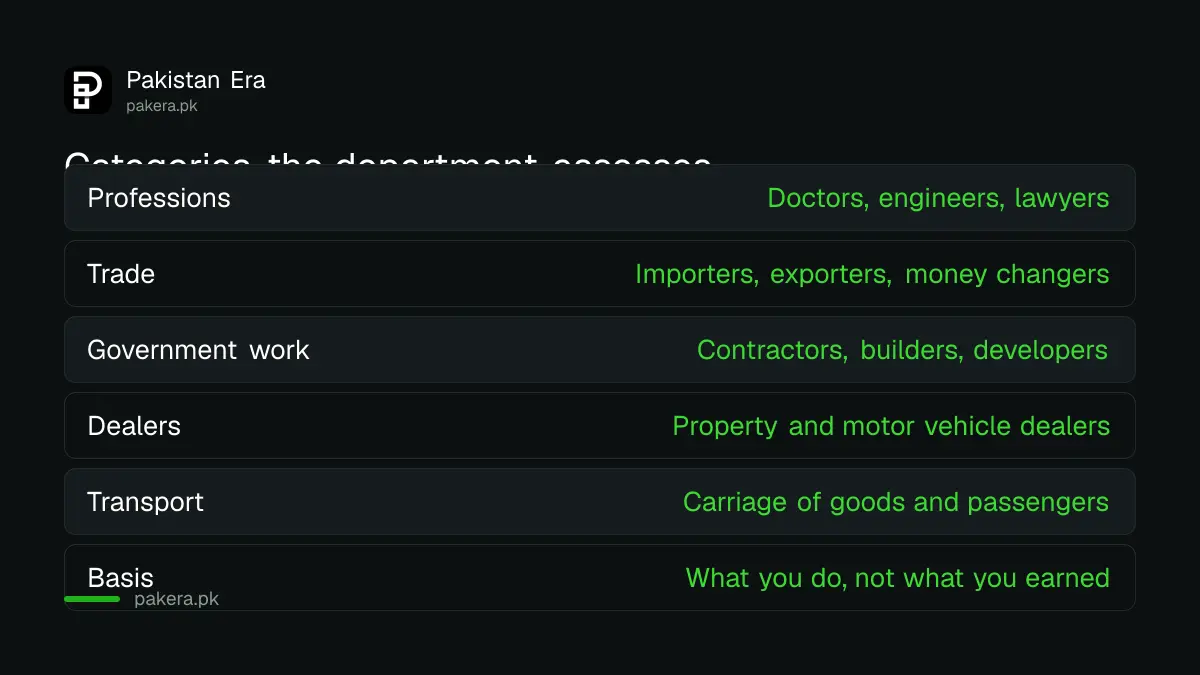
The law reaches persons engaged in a profession, trade, calling or employment in the Province of the Punjab. That is deliberately wide.
The department assesses it under separate heads, and these are the ones it names:
| Head | Covers |
|---|---|
| Professions | Doctors, engineers, lawyers |
| Trade | Importers and exporters, money changers |
| Government work | Contractors, builders, property developers |
| Dealers | Property dealers, motor vehicle dealers |
| Transport | Carriage of goods and passengers |
Two things stand out about that list.
It is occupational, not income based. The question is what you do, not what you earned. That is why it catches people who assume they have no provincial obligation because their federal income tax is settled, a separate matter covered in our income tax return guide.
Government contractors and builders are named separately from ordinary trade. If you hold government work in Punjab, the department has a head for you.
The year starts in July
The tax comes into force on and from the first day of July, under section 1(3) of the Punjab Finance Act 1977.
That matters for a simple practical reason. It runs on the financial year rather than the calendar year, so an obligation that began in July is already live by the time most people think about it, and enrolling late does not reset the clock.
It is also the same season as the province's other annual demands. Property tax carries a rebate deadline of 30 September, which we set out in the property tax guide, and motor vehicle token tax has its own rebate window covered in the token tax guide. If you owe one of these in Punjab you probably owe more than one.
Enrolment and payment
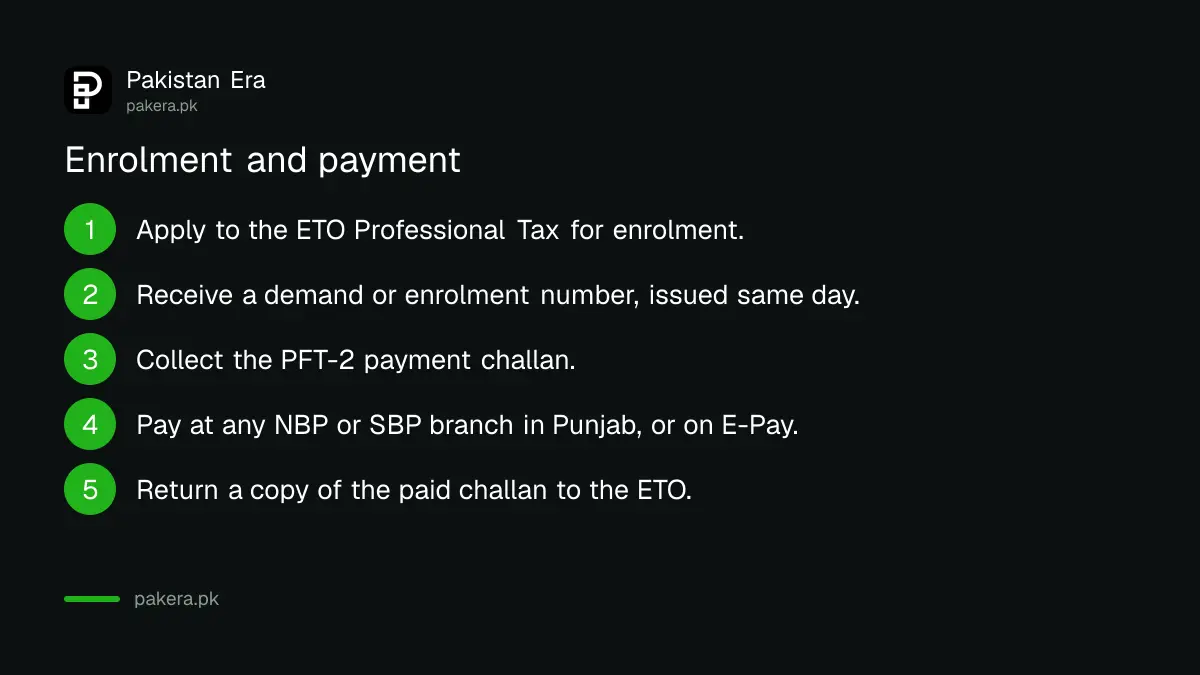
This is the department's stated sequence.
- Apply to the ETO Professional Tax for your district.
- Receive a demand or enrolment number. The department says this is issued to the applicant on the same day.
- Collect the payment challan, form PFT-2, issued on 32-A.
- Pay at any NBP or SBP branch in Punjab, or through the department's E-Pay route.
- Return a copy of the paid challan to the ETO Professional Tax.
Step five is the one that gets skipped, and it is the one that closes the loop. Paying at a bank does not by itself tell the office that you have paid. The copy of the challan is what does that.
There is also a computerised route, where the challan is printed from the system and paid on E-Pay or at a bank branch. Either way, the paid challan is the evidence.
Why we are not printing a rate
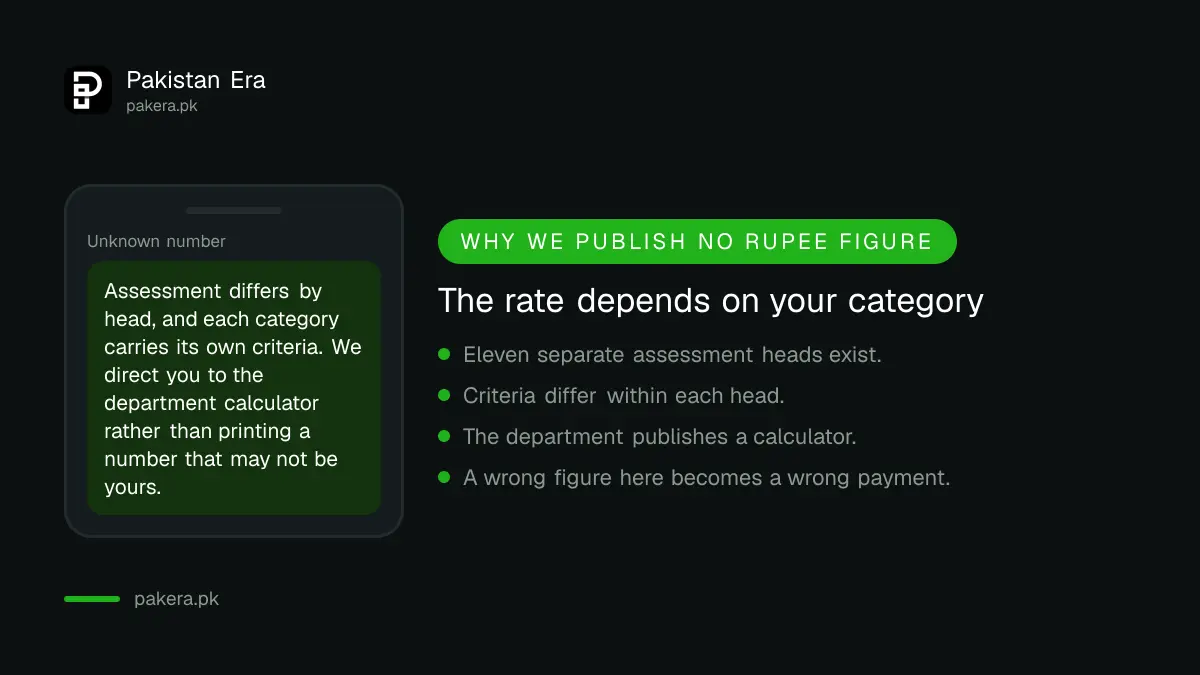
You will find pages that give a single rupee figure for professional tax in Punjab. We are not going to.
The department states that assessment criteria differ across every head, and there are eleven of them. A doctor, an importer and a passenger transport operator are not assessed the same way, and within a head the criteria vary again.
One number printed across all of that would be wrong for most people reading it. On a tax page, a wrong number is not a helpful approximation. It is a wrong payment, and then a shortfall.
Use the department's Professional Tax Calculator instead. It sits on the Excise Punjab portal alongside the property tax, luxury house tax and motor vehicle calculators, and it applies whatever criteria are current for your category.
The clearance certificate
The department issues a professional tax clearance certificate, and the requirement for it is proof of professional tax paid up to date.
This is worth knowing before you need it rather than after. Clearance certificates tend to be asked for at inconvenient moments, when a tender is being submitted, a contract renewed or a licence processed, and the department cannot issue one against arrears.
So the practical value of enrolling and paying on time is not only avoiding a demand. It is that the certificate is available on the day somebody asks for it.
The same pattern applies to property tax, where proof of payment up to date is likewise required for departmental applications.
What we did not verify
We read the department's professional tax page directly on 18 August 2026. The governing law, the assessment heads, the July commencement and the enrolment and payment sequence above all come from it.
We did not read every per category sub page, so we cannot tell you what your particular head is assessed on. That is the honest reason there is no rate table here.
We did not enrol or pay ourselves, so the steps are the department's published process rather than a walkthrough of our own transaction. We are not describing screens we have not seen.
We have not covered penalties for late enrolment or non payment, because we did not read them at source and a penalty quoted from memory is worse than none.
This is Punjab only. Sindh, Khyber Pakhtunkhwa and Balochistan levy their own professional taxes under their own laws, with different heads and different rates. Nothing here transfers.
Questions readers are asking
What is professional tax in Punjab?
A provincial tax on persons engaged in a profession, trade, calling or employment in Punjab, levied under the Punjab Finance Act 1977 and the Punjab Professions and Trade Tax Rules 1977.
Who has to pay it?
The department assesses eleven heads, including doctors, engineers, lawyers, importers and exporters, government contractors and builders, property and motor vehicle dealers, money changers, and carriage of goods and passengers.
How much is it?
It depends on your category, and the criteria differ across every head. Use the department's Professional Tax Calculator rather than any single figure quoted online, including a figure that would have been quoted here.
When does it become due?
It comes into force on and from the first day of July, under section 1(3) of the Punjab Finance Act 1977, so it runs on the financial year.
How do I pay it?
Get an enrolment number from the ETO Professional Tax, collect the PFT-2 challan, pay at any NBP or SBP branch in Punjab or through E-Pay, and return a copy of the paid challan to the office.
How long does enrolment take?
The department says the demand or enrolment number is issued to the applicant on the same day.
What do I need for a clearance certificate?
Proof that professional tax has been paid up to date. Arrears prevent it being issued, which is a problem if a tender or contract needs one at short notice.
About the author

Senior Writer, Public Services and Technology
Shahid joined us in 2024 as an author. He is a senior contributor to Pakistan's leading technology websites. He writes detailed articles, mostly covering his expertise in the latest tech, mobiles, apps, gadgets, and step-by-step guides. His ideology is to help people understand the latest trends and explain complex methods through very easy-to-understand guides.