Why Your Client Pays Less Than the Invoice in Pakistan
A business paying you for goods, services or a contract must deduct tax from the gross amount, advances included. How to keep the credit.

If a business pays you for goods, services or a contract, it is required to deduct tax before paying you, including on an advance. Suppliers and contractors discover this when the first payment lands short.
It is section 153 of the Income Tax Ordinance, 2001, which we read on 6 September 2026 in the consolidated text FBR publishes on its own download site.
What the section covers
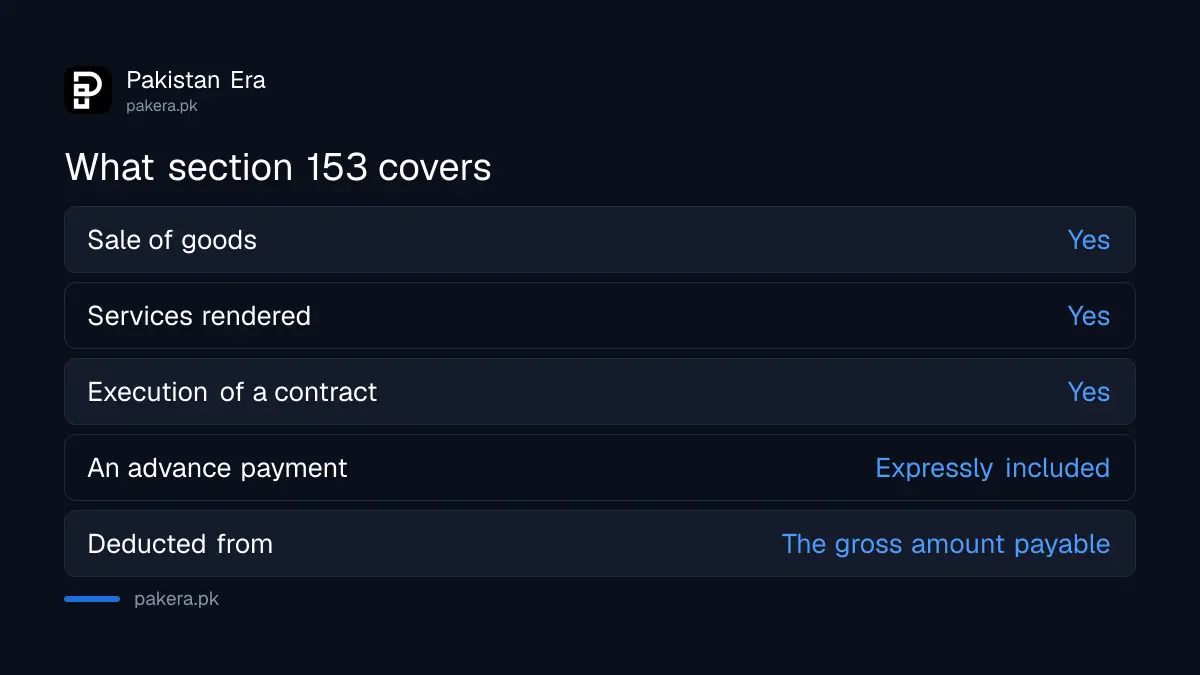
Every prescribed person making a payment in full or in part, including a payment by way of advance, to a resident person deducts tax at the time of making the payment.
| Type of payment | Inside section 153 |
|---|---|
| Sale of goods | Yes |
| Rendering or providing of services | Yes |
| Execution of a contract | Yes, other than goods or services contracts |
| An advance payment | Yes, expressly included |
| Deducted from | The gross amount payable |
Two words do most of the work. Advance means the deduction happens on the first instalment, not at the end when the job is finished. And gross means it comes off the whole invoice rather than a profit figure.
Why your first payment arrives short
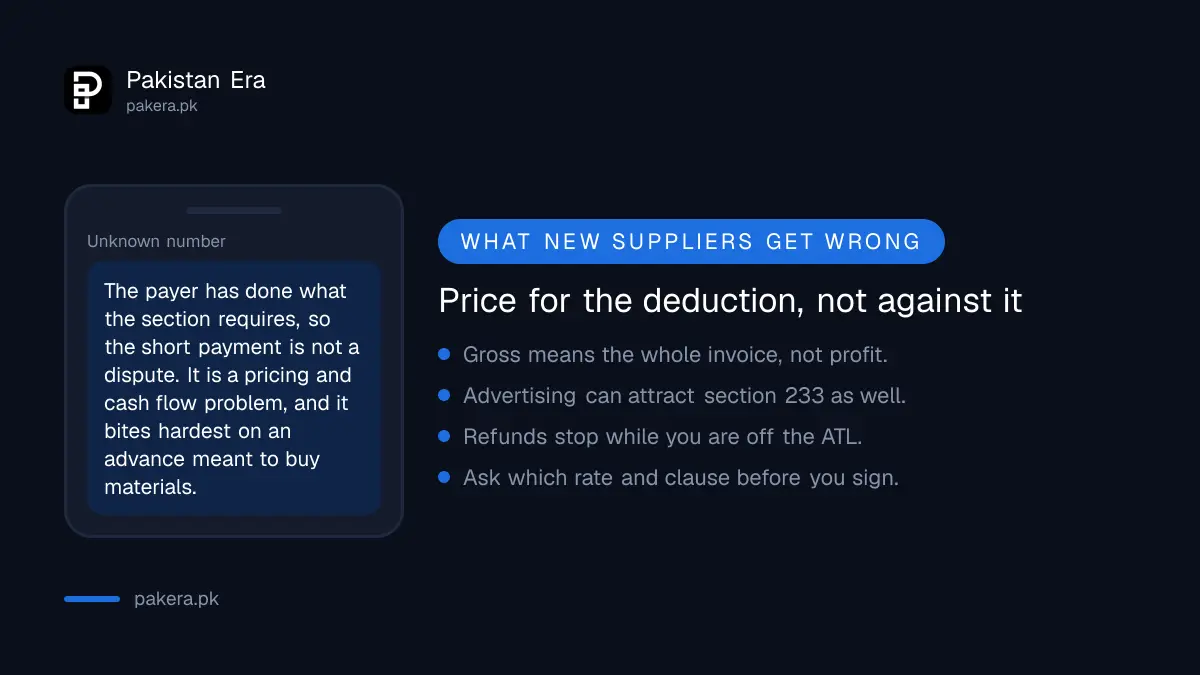
New suppliers quote a price, agree it, invoice it, and then receive less than the invoice. Nothing has gone wrong. The payer has done what the section requires.
The practical consequence is for your pricing rather than your dispute. If your margin is thin and your cash flow assumes the full invoice, a deduction on the gross amount at the moment of payment changes both.
It matters most on advances. A deposit that was meant to buy materials arrives already reduced.
Getting the credit
The deduction is not lost. It is tax paid on your behalf, and the certificate is what connects it to you.
- Ask every payer for a tax deduction certificate each year.
- Check your CNIC or NTN is on it and correct.
- Keep one from every client, not just the largest.
- Match the certificates against your own invoice records.
- Hand them all to whoever prepares your return.
This is the same failure that recurs across every withholding provision we have written about. If the deposit does not carry your identifier, the credit does not attach to you, and no client is going to chase it on your behalf.
If you also draw a salary, those certificates can reduce your monthly payroll deduction rather than waiting for a refund, as our guide to how salary tax is deducted explains.
Advertising has an overlap worth knowing
Advertising is the one area where two sections touch the same transaction.
Section 233, which covers brokerage and commission, requires a deduction on an advertising agent's commission that is expressly in addition to tax required under section 153 on advertising services, excluding the commission itself.
So an agency placing advertising can face both. Our guide to tax on commission and brokerage income sets out that side, including the formula the section applies.
Filing is what makes it recoverable
Tax deducted at source only helps somebody who files a return, and being off the Active Taxpayer List makes it worse, because no refund is issued while a person is off the list.
For a small supplier whose whole income arrives net of deduction, that is the difference between paying tax and overpaying it every year without reclaiming the excess. Our guide to the ATL surcharge and the 30 September deadline covers what returning to the list now costs.
Why no rate appears here
Section 153 sets out who deducts and on what. The rates sit in Division III of Part III of the First Schedule, and they differ by the type of payment, so goods, services and contracts are not treated alike.
We are not quoting a percentage. The consolidated Ordinance FBR publishes is amended up to 20 February 2026, before the Finance Act, 2026 took effect on 1 July 2026, so the table in the copy we can read is not current. Rates in this area also commonly differ by filer status.
Ask your client which rate they are applying and under which clause, and put it in the contract rather than discovering it on the first payment.
Where this sits among the other collections
A business can meet several of these in one year. Our guide to advance tax when you buy at an auction covers purchases at public auction and tender, and our guide to tax on buying and selling property covers transfers.
They are separate provisions with separate certificates. Collect each one, because the credit for each is claimed the same way and lost the same way.
Common questions
Why did my client pay less than the invoice?
Section 153 requires a prescribed person to deduct tax from the gross amount at the time of payment.
Does it apply to an advance?
Yes. The section expressly includes a payment by way of advance.
Is it deducted from profit or from the invoice?
From the gross amount payable.
What payments are covered?
Sale of goods, rendering or providing of services, and execution of a contract other than one for goods or services.
How do I get it back?
Through your return, using a deduction certificate from each payer with your CNIC or NTN on it.
What is the rate?
We do not quote one. Rates sit in the First Schedule, differ by payment type and filer status, and the published Ordinance predates the Finance Act, 2026.
How we verified this
What we checked, where we read it, and what we could not confirm.
Last checked 6 September 2026. We downloaded the consolidated Income Tax Ordinance, 2001 from FBR's own download site, the version amended up to 20 February 2026, and read section 153 in it. That every prescribed person making a payment in full or part, including a payment by way of advance, to a resident person shall at the time of making the payment deduct tax from the gross amount payable at the rate specified in Division III of Part III of the First Schedule, and that the payments covered are for the sale of goods, for the rendering of or providing of services, and on the execution of a contract other than a contract for the sale of goods or the rendering or providing of services, are taken from that text. The interaction with section 233 on an advertising agent's commission, which is stated there to be in addition to tax required under clause (b) of subsection (1) of section 153 on advertising services excluding commission, is taken from section 233. No rate is quoted here because rates sit in the First Schedule, differ by type of payment and commonly by filer status, and the published consolidated text predates the Finance Act, 2026. Whether a deduction is adjustable or final in your circumstances depends on provisions we did not set out here, so take advice. Nothing here is tax advice.
About the author

Tax, Bills and Technology Writer
Ali Akhtar is a young and curious voice here at Pakistan Era. He is currently pursuing his A-Levels and has a growing interest in Pakistan’s changing industrial landscape and educational trends. Ali likes to write in a way that helps him explain and explore the world around him. His writing reflects the perspective of the new generation navigating the evolving trends of Pakistan where technology, youth innovation, and shifting opportunities are reshaping the country’s future.