Advance Tax When You Buy at an Auction in Pakistan
Advance tax is collected from the buyer on the sale price, including confiscated goods, and again with every instalment you pay.
Buy anything at a public auction in Pakistan and advance tax is collected from you, the buyer, on the sale price. If you pay in instalments, it is collected with each one.
Update, 11 October 2026: State land auctions can be checked on the SLMS portal.
It also reaches things people do not think of as auctions at all, including the renewal of a licence and the award of a lease.
We read section 236A of the Income Tax Ordinance, 2001 on 4 September 2026, in the consolidated text FBR publishes on its own download site.
What the section reaches
The wording is deliberately wide, and the width is the point.
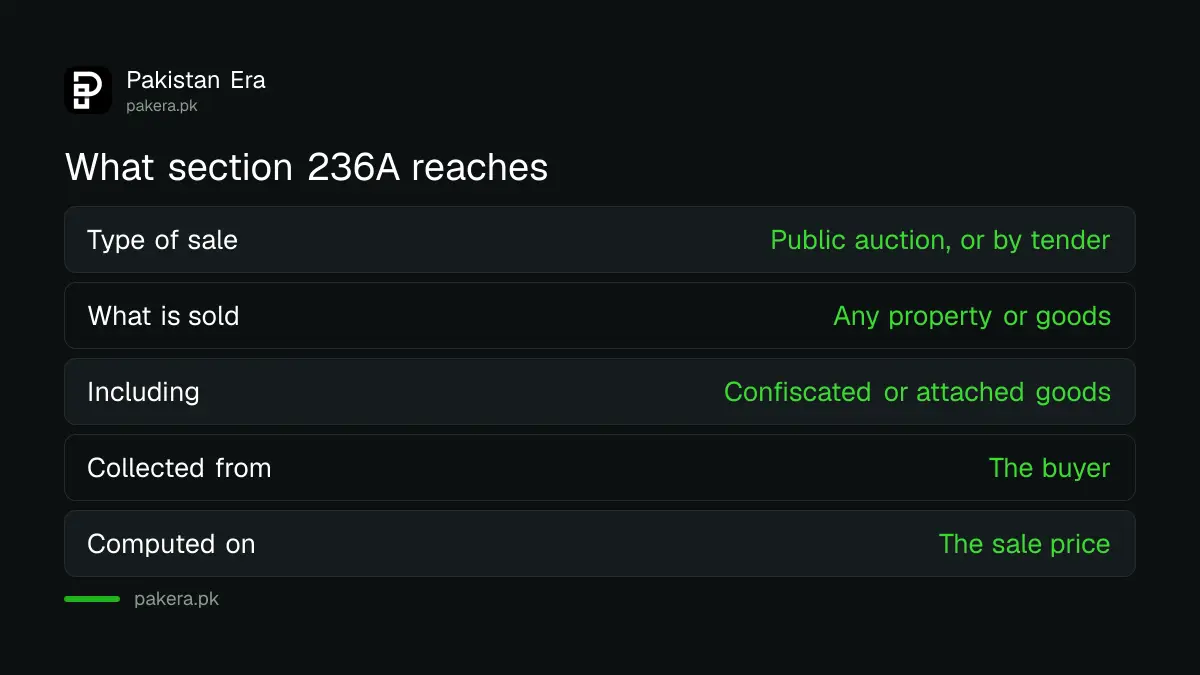
| Point | What the section states |
|---|---|
| Type of sale | Public auction, or auction by tender |
| What is sold | Any property or goods, including confiscated or attached |
| Whose property | Belonging to or not belonging to the seller listed |
| Collected from | The person the property or goods are sold to |
| Computed on | The sale price |
The sellers named include the Government, a local Government, any authority, a company, certain foreign associations and contractors, the Collector of Customs, the Commissioner of Inland Revenue, and any other authority.
Note the phrase "either belonging to or not belonging to" those bodies. An authority auctioning goods it is merely holding is still inside the section.
Confiscated and attached goods are covered
The section says property or goods "including property or goods confiscated or attached".
Customs auctions of seized consignments, and auctions of property attached in recovery proceedings, are exactly the kind of sale people treat as a bargain hunt. The tax applies there like anywhere else, and it is computed on the sale price you bid.
So build it into the number you bid, not into your surprise afterwards. A winning bid that ignored the tax is a worse deal than a slightly higher one that accounted for it.
Instalments mean repeated collection
An explanation added to the section removes any argument about timing. Where payment is received in instalments, advance tax is to be collected with each instalment.
That matters for larger purchases paid over time, because the cash flow is not what you would assume from a single collection at the fall of the hammer. Each payment carries its share.
Licence renewal counts as an auction sale

This is the part that surprises people who have never been near an auction hall.
The same explanation states that the expression "sale by public auction or auction by a tender" includes the renewal of a licence previously sold by public auction or auction by a tender.
So if a licence was originally won at auction or by tender, renewing it is treated as an auction sale for this section. Nobody re-bids, nobody attends an auction, and the tax still applies.
A further explanation states that sale of any property includes the awarding of a lease to any person, including a lease of the right to collect tolls, fees or other levies, by whatever name called. Contractors who take on toll or fee collection rights are squarely inside that.
The credit is yours
Subsection 2 is the reason to keep the paperwork.
Credit for the tax collected is given, subject to section 147, in computing the tax payable by the person purchasing the property in the relevant tax year. For taxpayers to whom section 98B or section 145 applies, it is given in the tax year in which the relevant date falls, or whichever is later.
- Get the receipt or challan for the tax collected at the auction.
- Check it carries your CNIC or NTN, not just a lot number.
- Collect one for every instalment, not only the first.
- Keep them with your records for that tax year.
- Enter them as tax already paid when the return is filed.
The failure here is the same one that recurs across every withholding provision. If the deposit does not carry your identifier, the credit does not attach to you, and no auction house will chase it on your behalf.
If you buy vehicles or property at auction
Auction purchases frequently involve assets that carry their own separate taxes, and this section is not the only one that applies.
A vehicle bought at auction still faces the registration position set out in our guide to advance tax when you buy or transfer a vehicle. Immovable property bought at auction carries the transfer collections covered in our guide to what tax you pay when you buy or sell property.
Read them together before bidding, because two or three separate collections can attach to a single purchase.
Why no rate appears here
The section sets out who collects, from whom, and on what basis. The rate sits in Division VIII of Part IV of the First Schedule, which changes with each Finance Act.
The consolidated Ordinance FBR publishes is amended up to 20 February 2026, before the Finance Act, 2026 took effect on 1 July 2026, so the table in the copy we can read is not current. Ask the auctioning authority what rate it will apply before you bid.
Common questions
Who pays advance tax at an auction?
The buyer. It is collected from the person to whom the property or goods are sold, computed on the sale price.
Does it apply to confiscated goods?
Yes. The section expressly includes property or goods confiscated or attached.
I am paying in instalments. Is it collected once?
No. An explanation states advance tax is to be collected with each instalment.
Does renewing a licence count?
Where the licence was previously sold by public auction or auction by tender, the section treats the renewal as an auction sale.
Is a lease covered?
Sale of property is stated to include the awarding of a lease, including a lease of the right to collect tolls, fees or other levies.
Can I claim it back?
Subsection 2 gives credit against the tax payable by the purchaser, subject to section 147, so keep the challan with your identifier on it.
How we verified this
What we checked, where we read it, and what we could not confirm.
Last checked 4 September 2026. We downloaded the consolidated Income Tax Ordinance, 2001 from FBR's own download site, the version amended up to 20 February 2026, and read section 236A in it. That any person making sale by public auction or auction by a tender of any property or goods, including property or goods confiscated or attached, either belonging to or not belonging to the Government, a local Government, any authority, a company, a foreign association declared to be a company, a foreign contractor, consultant or consortium, the Collector of Customs, the Commissioner of Inland Revenue or any other authority, shall collect advance tax computed on the basis of the sale price at the rate specified in Division VIII of Part IV of the First Schedule from the person to whom the property or goods are sold; that the expression sale by public auction or auction by a tender includes renewal of a licence previously sold in that way; that where payment is received in instalments advance tax is to be collected with each instalment; that credit for the tax collected is given, subject to section 147, in computing the tax payable by the purchaser in the relevant tax year, or for taxpayers to whom section 98B or 145 applies in the tax year in which the said date falls or whichever is later; and that sale of any property includes the awarding of any lease, including a lease of the right to collect tolls, fees or other levies by whatever name called, are all taken from that text. No rate is quoted here because it sits in the First Schedule and the published consolidated text predates the Finance Act, 2026. Nothing here is tax advice.
About the author

Tax, Bills and Technology Writer
Ali Akhtar is a young and curious voice here at Pakistan Era. He is currently pursuing his A-Levels and has a growing interest in Pakistan’s changing industrial landscape and educational trends. Ali likes to write in a way that helps him explain and explore the world around him. His writing reflects the perspective of the new generation navigating the evolving trends of Pakistan where technology, youth innovation, and shifting opportunities are reshaping the country’s future.