Advance Tax When You Buy or Transfer a Vehicle in Pakistan
No advance tax is collected on a transfer more than five years after first registration. And you should not pay it twice on a new car.
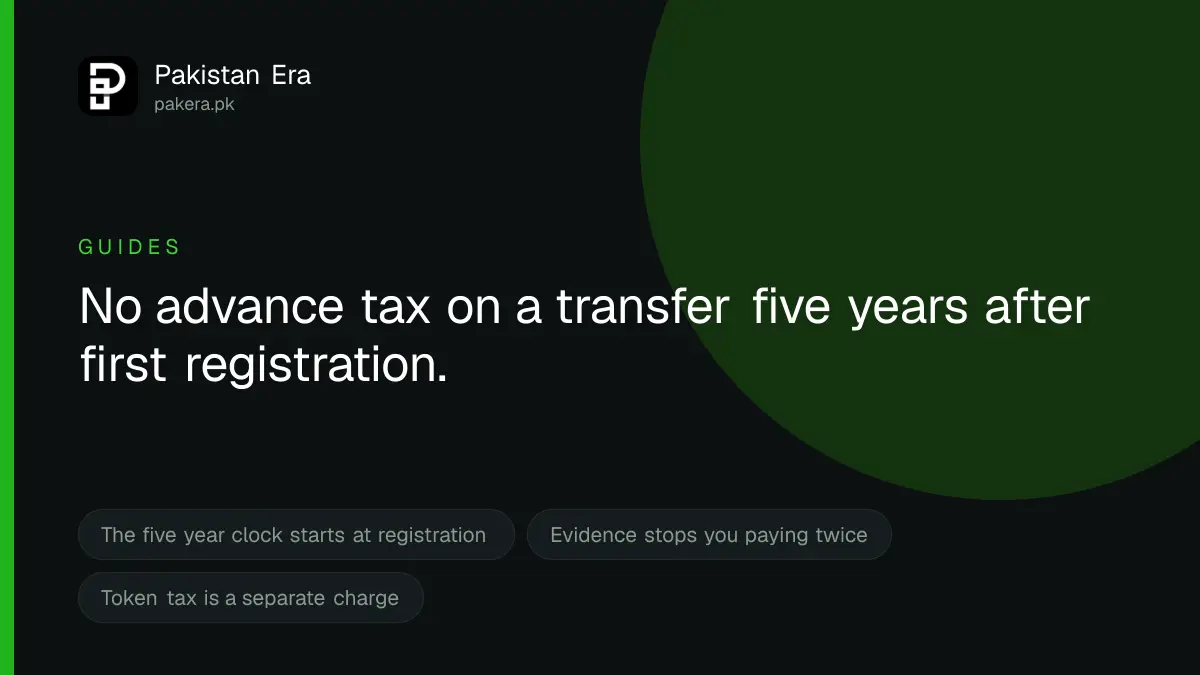
No advance tax is collected when a vehicle changes hands more than five years after it was first registered in Pakistan. That single proviso decides whether a used car costs you more at transfer or nothing at all.
And if the manufacturer already collected the tax when the car was sold new, you can produce evidence of that and avoid paying a second time.
We read section 231B of the Income Tax Ordinance, 2001 on 4 September 2026, in the consolidated text FBR publishes on its own download site.
Where the tax is collected
The section puts the duty on two different people at two different moments.
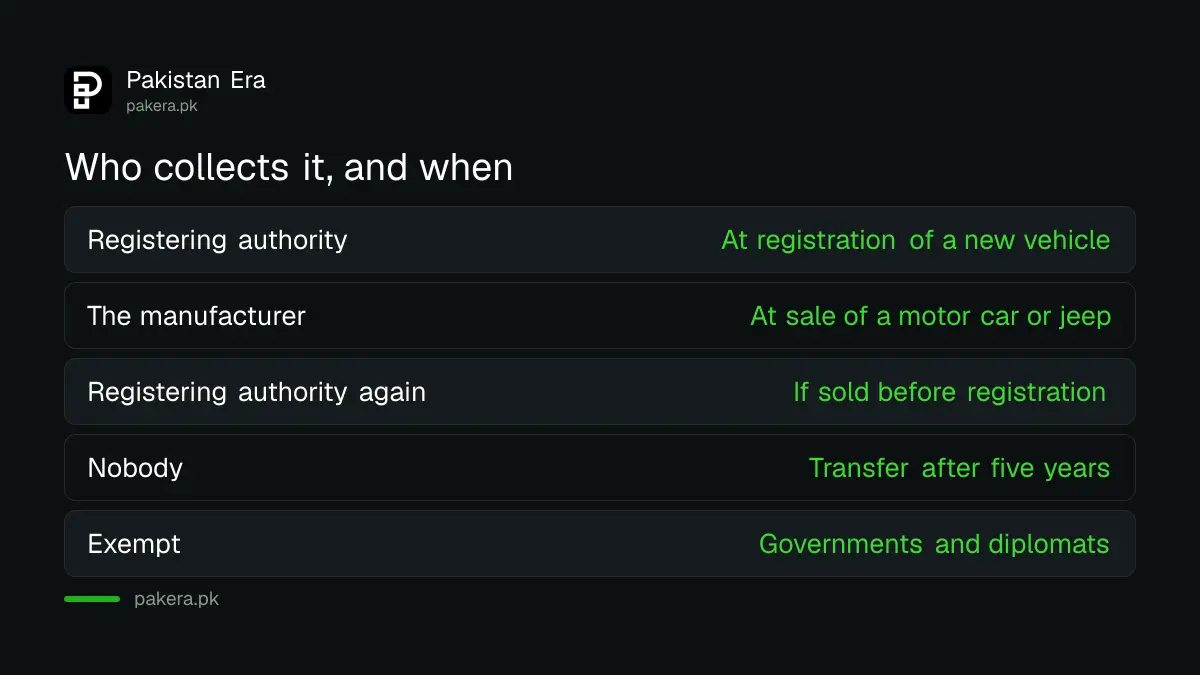
| Who collects | When |
|---|---|
| The motor vehicle registering authority of Excise and Taxation | At registration of a new locally manufactured vehicle |
| The manufacturer | At the time of sale of a motor car or jeep |
| The registering authority again | Where the vehicle was sold before registration by the original buyer |
| Nobody | On transfer more than five years after first registration |
Rates are set in Division VII of Part IV of the First Schedule, which is a separate part of the law.
The five year line
A proviso in the section states that no collection of advance tax shall be made on transfer of a vehicle after five years from the date of first registration in Pakistan.
So the date that matters is not the model year and not the date you buy it. It is the date the vehicle was first registered here. Check that on the registration book or smart card before you agree a price, because it changes what the transfer costs.
Our guide to transferring vehicle ownership covers the process itself, and our guide to verifying a vehicle across provinces covers checking the record before you pay anything.
You should not pay twice
Subsection 4 is the one to know if you bought a car new.
It says the collection at registration does not apply if a person produces evidence that tax was already collected from the same person, either by the manufacturer on a locally manufactured vehicle or under section 148 in the case of an imported vehicle.
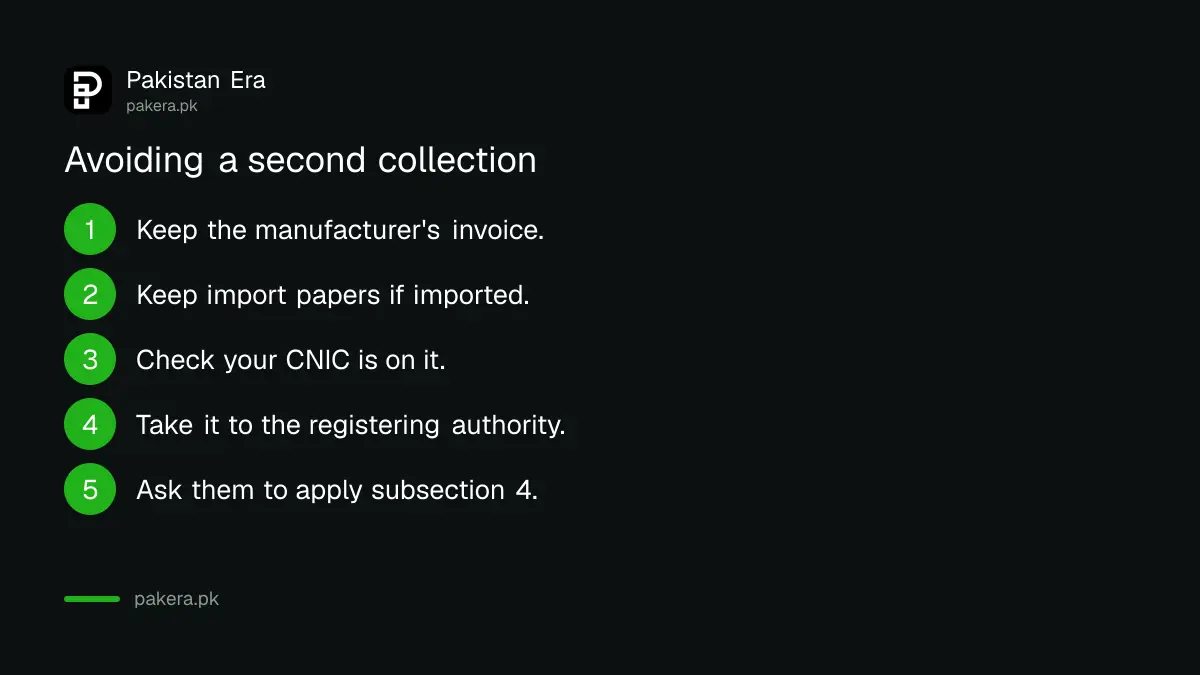
- Keep the invoice showing tax collected by the manufacturer.
- Keep the import documents if the vehicle was imported.
- Check your CNIC appears on whichever document you hold.
- Take it to the registering authority with the file.
- Ask them to apply subsection 4 rather than collecting again.
The evidence has to show the tax was collected from the same person. A document in the dealer's name does not help you, which is another reason the invoice should carry the name of whoever will own the vehicle.
Selling before registration is specifically covered
Subsection 2A deals with a practice the market knows well. Where a locally manufactured vehicle has been sold before registration by the person who originally bought it from the manufacturer, the registering authority collects tax at registration.
That is aimed squarely at buying a new vehicle on a booking and selling it on before it is ever registered. If you are buying a car in that situation, understand that the tax follows the registration regardless of how many hands the vehicle passed through first.
Who is outside the section
The proviso lists five categories the section does not apply to.
They are the Federal Government, a Provincial Government, a Local Government, a foreign diplomat, and a diplomatic mission in Pakistan. There is no general exemption for an ordinary buyer, whatever a dealer may suggest.
This is not your token tax
Two different charges get confused constantly, and mixing them up leads people to think they have been charged twice when they have not.
Advance tax under section 231B is a federal income tax collected around purchase and registration. Token tax is a provincial charge on the vehicle, paid annually or as a lifetime amount depending on the vehicle and the province.
Our guide to paying token tax online covers that side, and our guide to registering a motorcycle in Punjab covers what registration itself involves.
Why no rate appears here
The section sets out who collects and when. The amounts sit in Division VII of Part IV of the First Schedule, which changes with each Finance Act.
The consolidated Ordinance FBR publishes is amended up to 20 February 2026, before the Finance Act, 2026 took effect on 1 July 2026, so the table in the copy we can read is not current. Rates also commonly differ according to engine capacity and whether you are on the Active Taxpayer List, which is another reason to check your own position rather than a published figure.
Common questions
Is advance tax charged on a used car transfer?
Not where the transfer happens more than five years after the vehicle was first registered in Pakistan.
Which date does the five years run from?
The date of first registration in Pakistan, not the model year or your purchase date.
I already paid tax when I bought the car new. Do I pay again at registration?
Subsection 4 says the collection does not apply if you produce evidence that tax was collected from the same person by the manufacturer, or under section 148 for an imported vehicle.
Is anybody exempt?
The Federal, Provincial and Local Governments, a foreign diplomat and a diplomatic mission in Pakistan.
Is this the same as token tax?
No. This is federal income tax collected at purchase or registration. Token tax is a separate provincial charge.
What is the rate?
We do not quote one. It sits in the First Schedule and the published Ordinance predates the Finance Act, 2026.
How we verified this
What we checked, where we read it, and what we could not confirm.
Last checked 4 September 2026. We downloaded the consolidated Income Tax Ordinance, 2001 from FBR's own download site, the version amended up to 20 February 2026, and read section 231B in it. The collection by every motor vehicle registering authority of the Excise and Taxation Department at the time of registration of a new locally manufactured motor vehicle at rates specified in Division VII of Part IV of the First Schedule, the proviso excluding the Federal Government, a Provincial Government, a Local Government, a foreign diplomat and a diplomatic mission in Pakistan, the proviso that no collection shall be made on transfer of a vehicle after five years from the date of first registration in Pakistan, subsection 2A covering a locally manufactured vehicle sold before registration by the person who originally purchased it from the manufacturer, subsection 3 requiring every manufacturer to collect at the time of sale of a motor car or jeep, and subsection 4 disapplying the collection where evidence is produced that tax under subsection 3 or under section 148 for an imported vehicle was collected from the same person, are all taken from that text. No rate is quoted here because rates sit in the First Schedule, commonly vary by engine capacity and filer status, and the published consolidated text predates the Finance Act, 2026. Nothing here is tax advice.
About the author

Tax, Bills and Technology Writer
Ali Akhtar is a young and curious voice here at Pakistan Era. He is currently pursuing his A-Levels and has a growing interest in Pakistan’s changing industrial landscape and educational trends. Ali likes to write in a way that helps him explain and explore the world around him. His writing reflects the perspective of the new generation navigating the evolving trends of Pakistan where technology, youth innovation, and shifting opportunities are reshaping the country’s future.