How to Transfer Vehicle Ownership in Pakistan: Sindh, Punjab, KP and Islamabad
Transfer a car or bike through the excise department of the province it is registered in. Sindh, Punjab, KP and Islamabad portals tested.
To transfer vehicle ownership in Pakistan, go to the excise department of the province where the vehicle is registered: excise.punjab.gov.pk in Punjab, excise.gos.pk in Sindh, kpexcise.gov.pk in Khyber Pakhtunkhwa and islamabadexcise.gov.pk in Islamabad. Seller and buyer both sign the transfer forms and attend with original CNICs. There is no national vehicle transfer, so the province decides everything: which office, which forms, which fees.
So the first question is not how. It is where.
Which portal, and which one does not exist
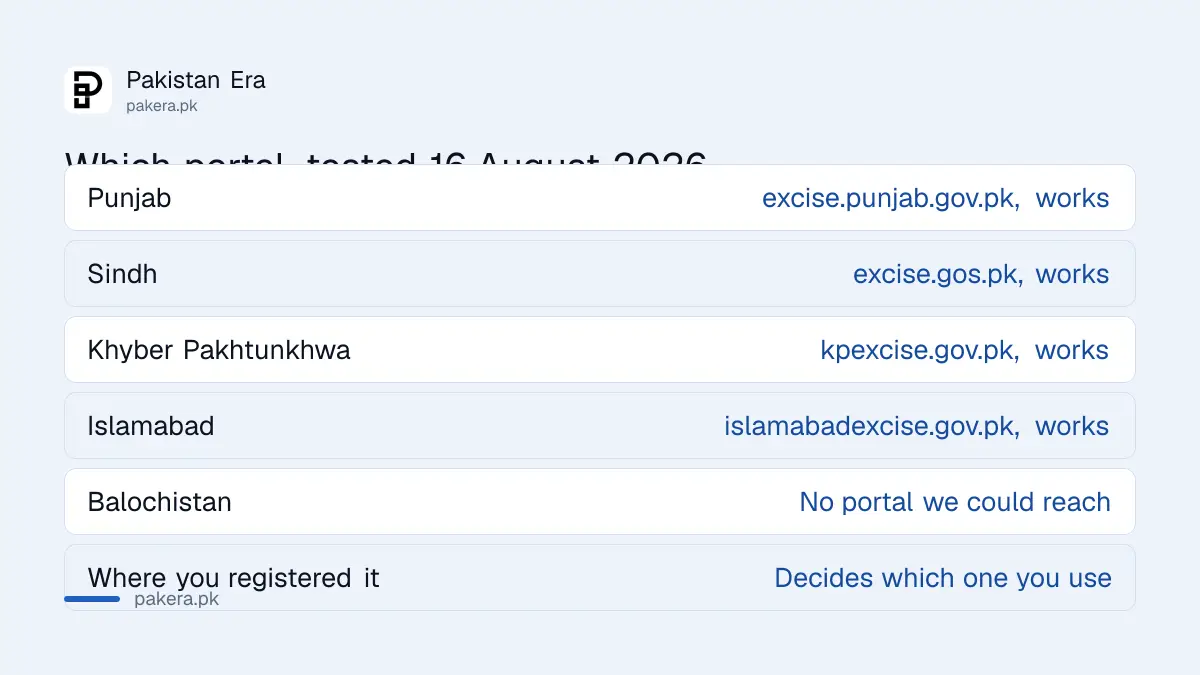
We tested each of these on 16 August 2026.
| Province | Portal | Result |
|---|---|---|
| Punjab | excise.punjab.gov.pk | Works |
| Sindh | excise.gos.pk | Works |
| Khyber Pakhtunkhwa | kpexcise.gov.pk | Works |
| Islamabad | islamabadexcise.gov.pk | Works |
| Balochistan | None we could reach | Go to the office |
Two of those need explaining.
Sindh is not where people look. The address commonly shared is excise.sindh.gov.pk, and it does not resolve. Neither does sindhexcise.gov.pk. The working site is excise.gos.pk, on the Government of Sindh domain, and it identifies itself as the Excise, Taxation and Narcotics Control Department.
Balochistan we could not find. We tried three plausible addresses and none resolved. We are not going to publish a link we could not open, so if the vehicle is registered in Balochistan, treat this as an in-person process and ask at the excise office.
The shape of a transfer
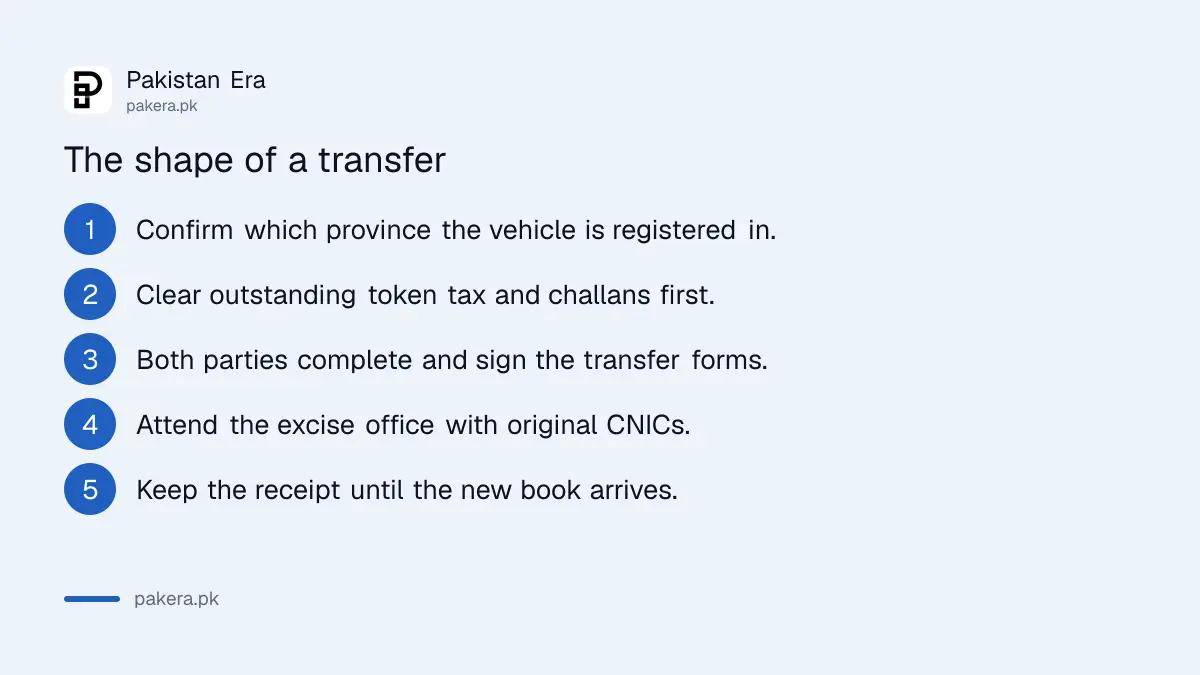
Details differ by province, but the sequence does not.
- Confirm where the vehicle is registered. Not where you live, and not where you are buying it. The registration book says.
- Clear what is outstanding first. Token tax and challans attach to the vehicle, and a transfer with arrears sitting on it stalls at the counter.
- Both parties complete and sign the transfer forms. Seller and buyer, with original CNICs.
- Attend the excise office. Several provinces now take biometrics, which means the parties attend rather than send someone.
- Keep the receipt until the updated registration book reaches you.
We are not listing forms by number here, because they differ between provinces and we did not read them at source. Ask for the transfer set at the counter and you will be given the right ones.
Until it is transferred, the vehicle is still theirs
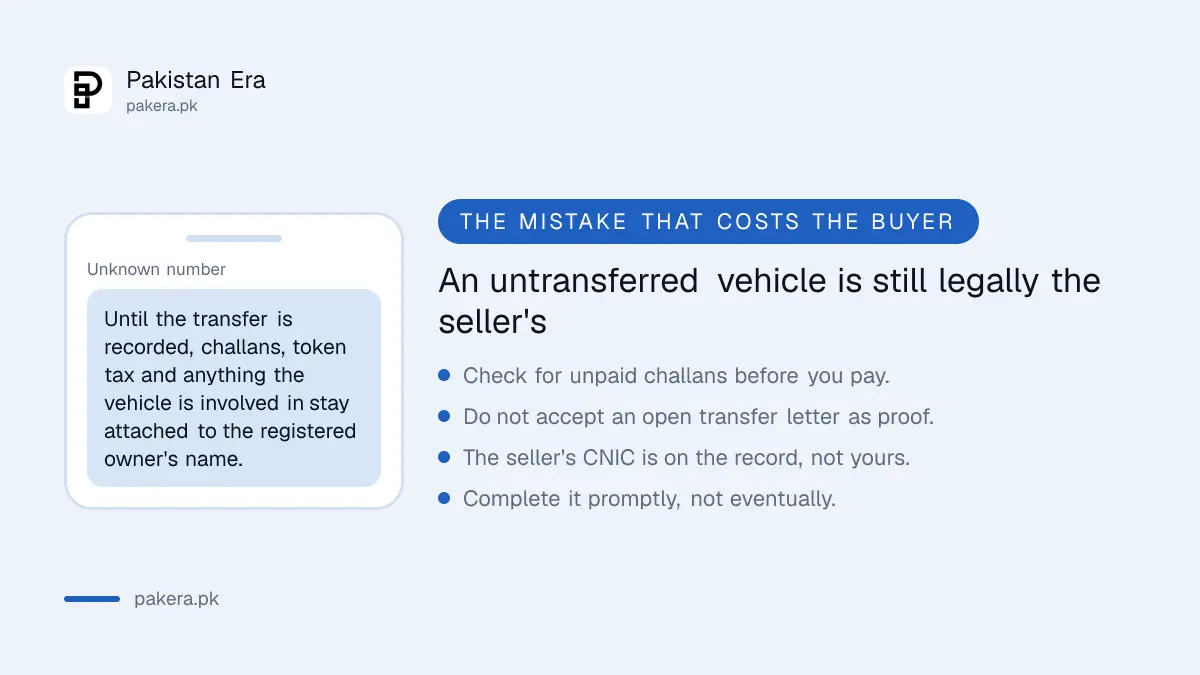
This is the part that catches buyers, and it is worth being blunt about.
A signed transfer letter is not a transfer. Until the change is recorded with the excise department, the registered owner is the seller. Their CNIC is on the record, not yours.
That has consequences in both directions. Challans issued to the vehicle go to them. Token tax arrears accrue against their name. And if the vehicle is involved in anything, the trail leads to the person on the record.
Sellers should care as much as buyers. An "open letter" sale, where the buyer never completes the transfer, leaves you legally attached to a car you have not owned for years.
So complete it promptly, and before money changes hands, check what is already outstanding. Unpaid challans follow the vehicle, and you can look them up yourself before you buy, which we cover in checking a Punjab e-challan.
If the vehicle is registered in another province
This comes up constantly, because people move and cars get sold across provincial lines.
A vehicle registered in Punjab and sold to a buyer in Karachi does not simply become a Sindh vehicle. The transfer is recorded where the vehicle is registered, so the paperwork goes through Punjab excise even though neither party may be there.
Moving the registration itself to another province is a separate transaction from transferring ownership, and the two are often confused. If you want both, expect two processes rather than one.
Ask specifically which you are being quoted for. A price for a transfer is not a price for a transfer plus a change of province, and discovering that at the counter wastes a day.
Check the vehicle before you check the paperwork
Two verifications are worth doing on any used vehicle, and both are free.
Confirm the registration itself against the provincial record, so you know the plate, engine and chassis match what you are being shown. The portal for every province is in vehicle verification.
Confirm the seller is the registered owner. It sounds obvious. It is also the single most common way a used vehicle sale goes wrong, because the person selling is often not the person on the book.
If either check disagrees with what you have been told, stop there rather than at the transfer counter.
What it costs
Fees are provincial, and we have only verified Punjab's at source, so those are the only ones we publish.
For Punjab, the transfer fee by engine category, the full document list and the rebate currently available are set out in our Punjab transfer guide.
For the other provinces, ask at the office or on the portal above before you go. We would rather send you to the counter than print a figure we have not read, because a wrong fee on a page like this is somebody budgeting badly for a purchase.
Once the vehicle is yours, the recurring obligation is token tax, covered in paying token tax online.
Questions readers are asking
Where do I transfer a vehicle in Pakistan?
At the excise department of the province where the vehicle is registered. There is no national transfer service.
What is the Sindh excise website?
excise.gos.pk. The commonly shared excise.sindh.gov.pk does not resolve.
Is there a Balochistan portal?
We could not reach one at any of the addresses we tried. Treat it as an in-person process.
Is a signed transfer letter enough?
No. Until the change is recorded, the seller remains the registered owner and challans and token tax attach to their name.
Do both parties have to attend?
Increasingly yes, because several provinces take biometric verification at transfer.
What does it cost?
Fees are provincial. We publish Punjab's, which we verified, in the Punjab transfer guide. For others, ask at the office.
What should I check before buying?
That the registration matches the vehicle, that the seller is the registered owner, and that there are no unpaid challans or token tax arrears.
About the author

Senior Writer, Public Services and Technology
Shahid joined us in 2024 as an author. He is a senior contributor to Pakistan's leading technology websites. He writes detailed articles, mostly covering his expertise in the latest tech, mobiles, apps, gadgets, and step-by-step guides. His ideology is to help people understand the latest trends and explain complex methods through very easy-to-understand guides.