How to Transfer Car Ownership in Punjab
Transfer is Rs 4,540 up to 1000cc and Rs 18,150 above 1800cc. The exact document list, the fees, and the token tax trap that stops it.
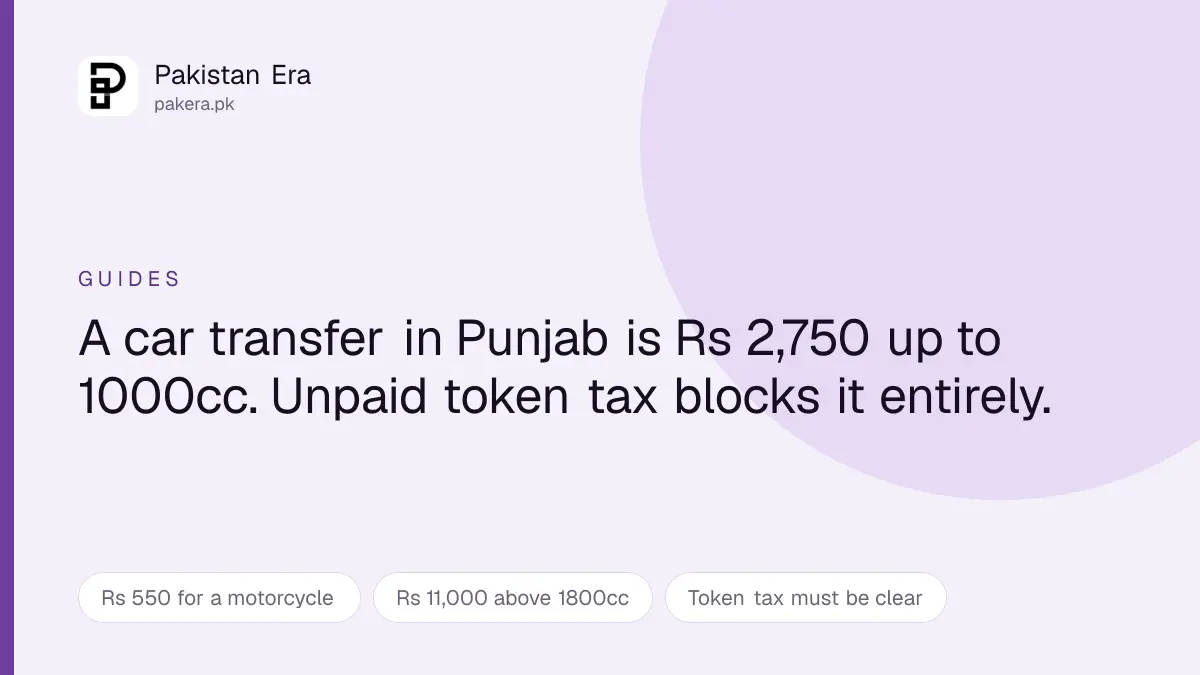
Transferring a car into your name in Punjab costs Rs 4,540 up to 1000cc, Rs 9,075 between 1000cc and 1800cc, and Rs 18,150 above 1800cc. A motorcycle is Rs 910.
Those are the Excise and Taxation Department's own published figures. The reason so many used car deals go wrong is not the fee, it is one line in the document list that buyers skip, so we are putting it where you cannot miss it.
The requirement that stops most transfers
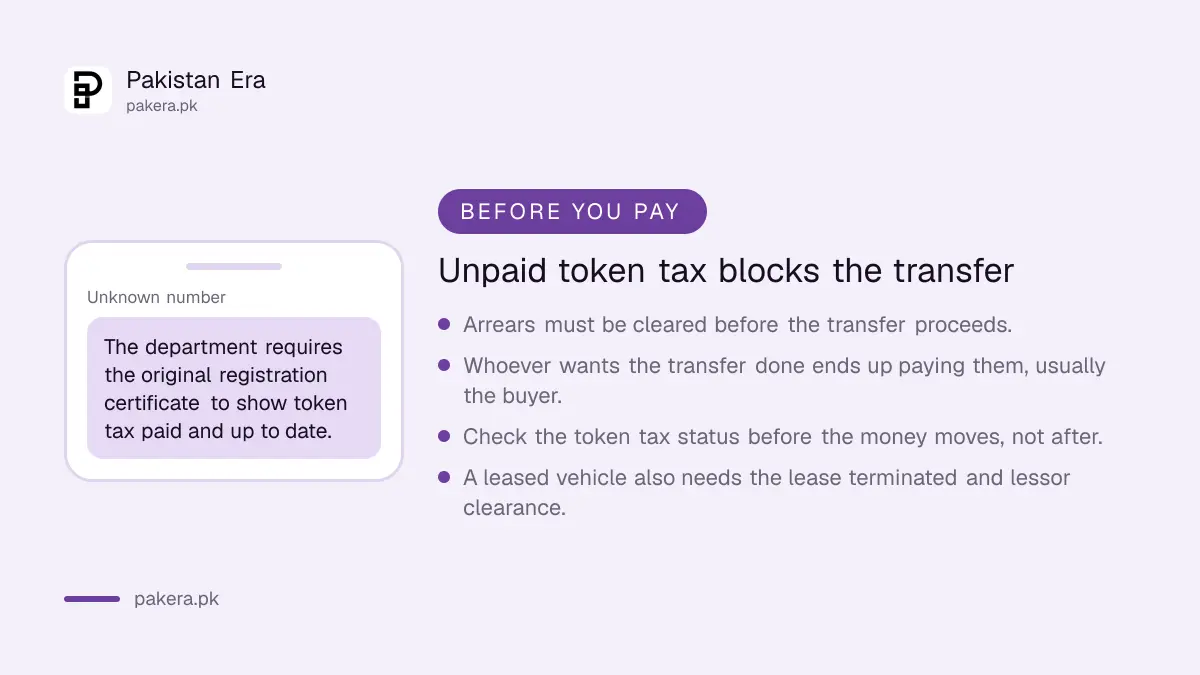
The department requires the original registration certificate containing updated payment of token tax.
Read that twice. The registration book has to show the token tax paid and up to date. If the seller owes two years of token tax, the transfer does not proceed until that is cleared, and the person who ends up paying is whoever wants the transfer to happen. That is usually you, after the money has changed hands.
Check the token tax status before you pay for the car, not after. Our guides to online vehicle verification and paying token tax online cover how to look that up in a couple of minutes, and doing it in the seller's presence is a normal, reasonable thing to ask.
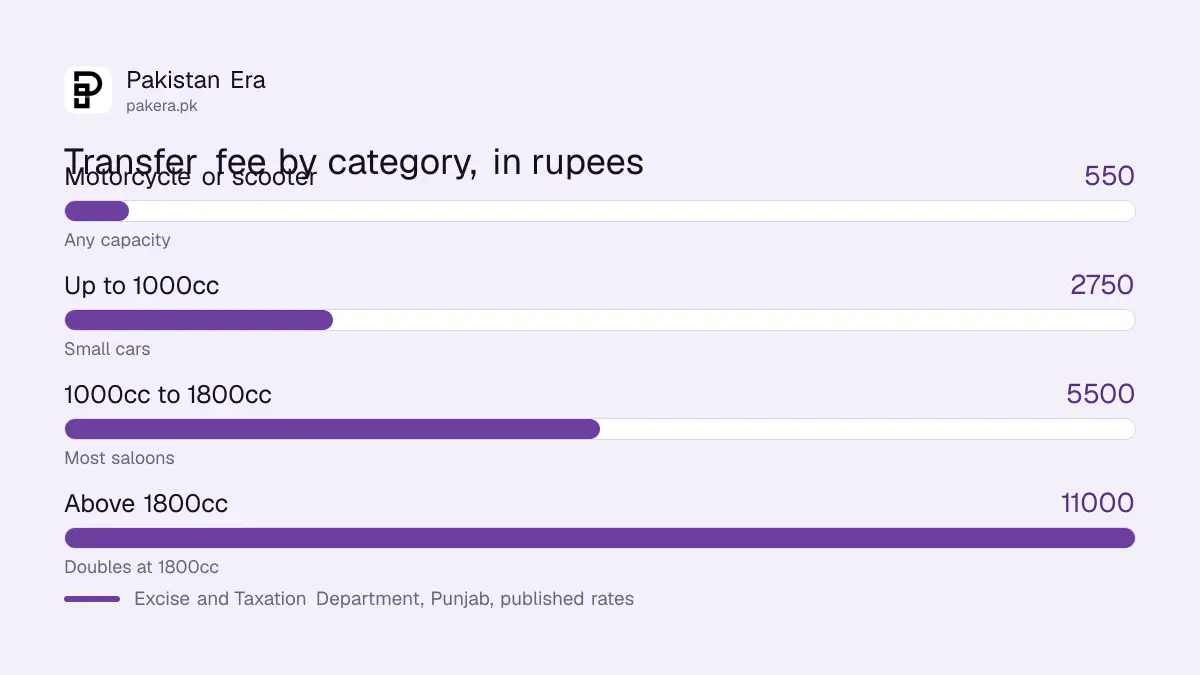
The transfer fee, by category
| Vehicle | Transfer fee |
|---|---|
| Motorcycle, scooter and similar | Rs 910 |
| Up to 1000cc | Rs 4,540 |
| Exceeding 1000cc but not exceeding 1800cc | Rs 9,075 |
| Exceeding 1800cc | Rs 18,150 |
| Heavy transport vehicle | Rs 9,075 |
Note that a 1000cc car and a 1300cc car are two different fee brackets, and 1800cc is the line where it doubles. If someone quotes you a single flat transfer charge regardless of the car, they are quoting their own price, not the department's.
Everything you need to bring
- Transfer Order (T.O.) Form, the prescribed one.
- Photocopy of the seller's CNIC.
- Photocopy of the purchaser's CNIC.
- Photocopies of the witnesses' identification.
- Original registration certificate showing token tax paid and current.
- Original registration file, for vehicles registered under the File Return Scheme.
- Duplicate registration certificate.
- Application in the prescribed form.
Witnesses are on that list and people forget them. Arrange who they are before the appointment rather than finding someone in the corridor.
Biometric verification is coming to transfers
Excise Punjab has announced that biometric verification for vehicle registration and transfer through the Pak Identity app is being introduced, and separately that re-registration of vehicles registered outside Punjab is being launched.
Both announcements are on the department's own site. We are flagging them rather than describing how they work, because the announcements give a rollout timing and not an operating procedure, and we could not confirm the current live status of either. Ask at the office whether biometric verification applies to your transaction before you plan the day around it.
If it is live for your case, it changes one thing materially: the seller has to be biometrically present. That is a protection for buyers, because the classic used car fraud is a transfer signed by someone who is not the recorded owner.
A rebate worth having right now
The department is currently advertising a 10 per cent rebate on motor vehicle token tax until 31 August 2026, and a 5 per cent rebate on property tax until 30 September 2026.
Since a transfer requires token tax to be current anyway, and since somebody is going to pay it, paying it before the end of August is straightforwardly cheaper than paying it in September. That is a dated, expiring saving rather than general advice.
Related transactions and what they cost
Three things that come up in the same conversation, with the department's published requirements.
Lost or stolen registration book. You need a police report, a photocopy of your CNIC, an updated token tax certificate for non-tie-up vehicles other than motorcycles, and the original registration file if the vehicle is under the File Return Scheme. If the book is damaged or torn rather than lost, the damaged book is enclosed with the application. A duplicate book is Rs 1,300.
Ending a lease or hire purchase. A termination of hire purchase agreement needs an application on plain paper from the lessee, an NOC or clearance certificate from the lessor, a photocopy of your CNIC, the original registration certificate with token tax current, and the registration file where applicable. Until that is done, the vehicle is not cleanly yours to sell.
Changing an engine. A receipt for the new engine, your CNIC photocopy, Form F carrying the vehicle particulars including the new engine number, the original registration certificate with token tax current, and the registration file. Doing this without recording it is how a car ends up with papers that do not match the metal, which surfaces at the next transfer.
Buying a used car, in the right order
- Verify the registration online against the number plate and chassis, before any money moves.
- Confirm token tax is clear. This is the one that costs money later.
- Check for a hire purchase entry. A leased vehicle cannot be cleanly transferred until the lease is terminated and the lessor has issued clearance.
- Match the engine and chassis numbers to the book, physically.
- Agree who pays the transfer fee in the price conversation, not at the counter.
- Complete the transfer immediately. A car in the seller's name is the seller's liability and your problem, and challans follow the registered owner.
That last point is the one people learn expensively. Until the transfer is recorded, every ticket, every tax notice and every legal consequence attaches to the name in the book. Our guide to checking a Punjab traffic challan is the other half of this problem.
Questions readers are asking
How much does it cost to transfer a car in Punjab?
Rs 4,540 up to 1000cc, Rs 9,075 for above 1000cc up to 1800cc, and Rs 18,150 above 1800cc. Motorcycles and scooters are Rs 910 and heavy transport vehicles are Rs 9,075.
What documents are needed to transfer vehicle ownership?
The Transfer Order form, photocopies of the seller's, purchaser's and witnesses' identification, the original registration certificate showing token tax paid, the duplicate registration certificate, an application in the prescribed form, and the original registration file for File Return Scheme vehicles.
Can I transfer a car if token tax is unpaid?
No. The department requires the original registration certificate to show updated payment of token tax, so any arrears have to be cleared first. Check this before buying.
What happens if I do not transfer the car into my name?
The vehicle remains registered to the seller, which means challans, tax notices and liability continue to attach to them and to the record rather than to you as the actual owner.
How much is a duplicate registration book?
Rs 1,300. A lost book also requires a police report.
Is there a rebate on token tax at the moment?
Excise Punjab is advertising a 10 per cent rebate on motor vehicle token tax until 31 August 2026, and a 5 per cent rebate on property tax until 30 September 2026.
Is biometric verification required for a transfer?
The department has announced biometric verification for vehicle registration and transfer through the Pak Identity app. Confirm whether it applies to your transaction at the office before you attend, since the announcement gives timing rather than procedure.
About the author

Tax, Bills and Technology Writer
Ali Akhtar is a young and curious voice here at Pakistan Era. He is currently pursuing his A-Levels and has a growing interest in Pakistan’s changing industrial landscape and educational trends. Ali likes to write in a way that helps him explain and explore the world around him. His writing reflects the perspective of the new generation navigating the evolving trends of Pakistan where technology, youth innovation, and shifting opportunities are reshaping the country’s future.