What a Car Loan in Pakistan Actually Costs
The cap counts every bank together, engine size sets your tenure, and a KIBOR linked rate can move your instalment. What to ask first.
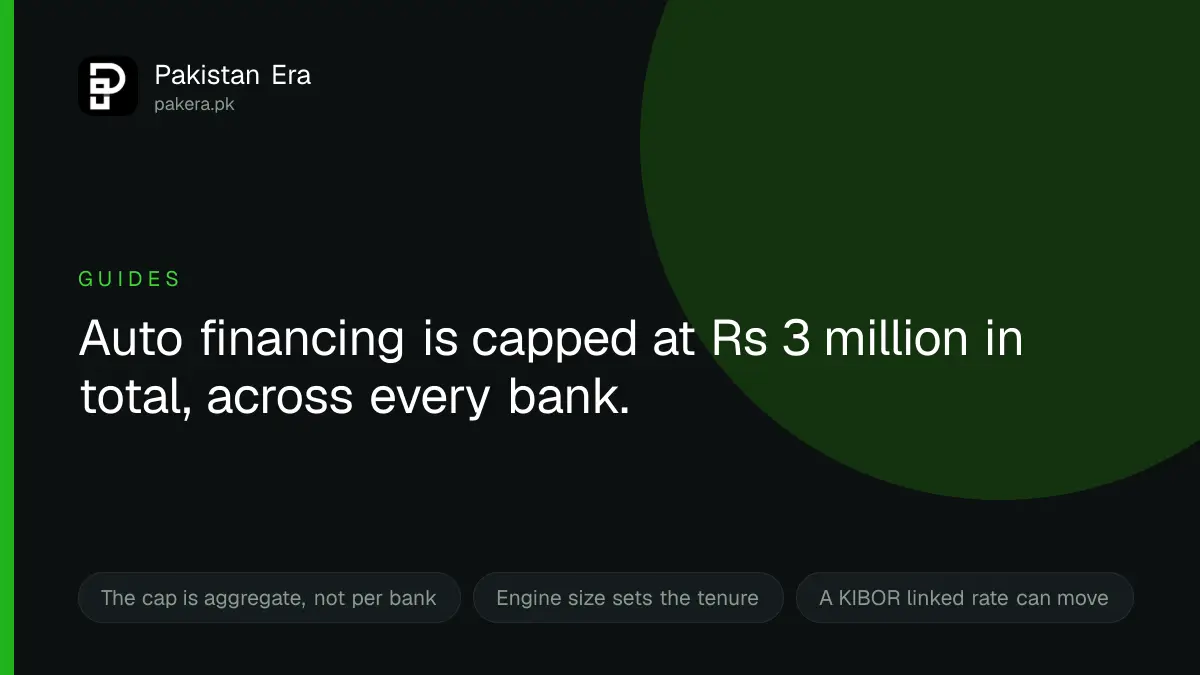
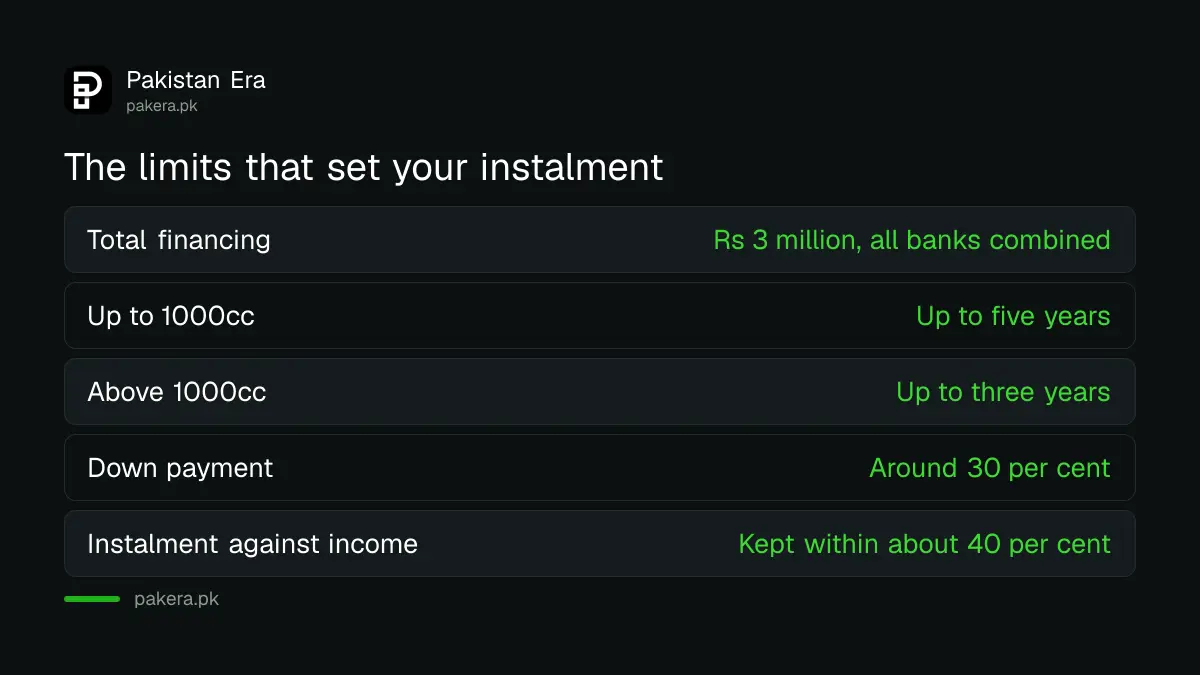
Auto financing in Pakistan is capped at Rs 3 million per person, and that cap counts every bank together rather than each one separately. Taking Rs 2 million from one bank does not leave you a fresh Rs 3 million at another. It leaves you Rs 1 million in total.
Two other limits shape the deal before any bank quotes you a rate: how long you can borrow for depends on the engine, and how much you must put down is fixed rather than negotiable.
The three limits that decide your instalment
| Limit | Reported position |
|---|---|
| Total financing | Rs 3 million per person, across all banks combined |
| Tenure, up to 1000cc | Up to five years |
| Tenure, above 1000cc | Up to three years |
| Down payment | Around 30 per cent, with financing capped near 70 per cent of value |
| Debt to income | Instalments generally kept within about 40 per cent of income |
The tenure rule is the one that changes the monthly figure most. The same borrowed amount spread over five years instead of three is a much smaller instalment, and the only way to get five years is to stay at or below 1000cc.
The rate is not fixed, and that is the real risk
Most car financing in Pakistan is priced as KIBOR plus a bank spread, commonly reported in the range of about 2.5 to 4 percentage points. KIBOR moves. So your instalment can move too, usually at a set review interval rather than every month.
Reported figures put one year KIBOR in the region of 12 per cent in August 2026, with bank markup ranging from roughly 13.8 per cent at the cheaper end to about 17 per cent at the more expensive. That spread between banks is worth real money over three to five years.
Before you sign, ask two questions and get the answers in writing. What is the spread over KIBOR, and how often is the rate reset. A borrower who budgets for today's instalment without asking those is planning around a number that is not fixed.
Work the total, not the monthly
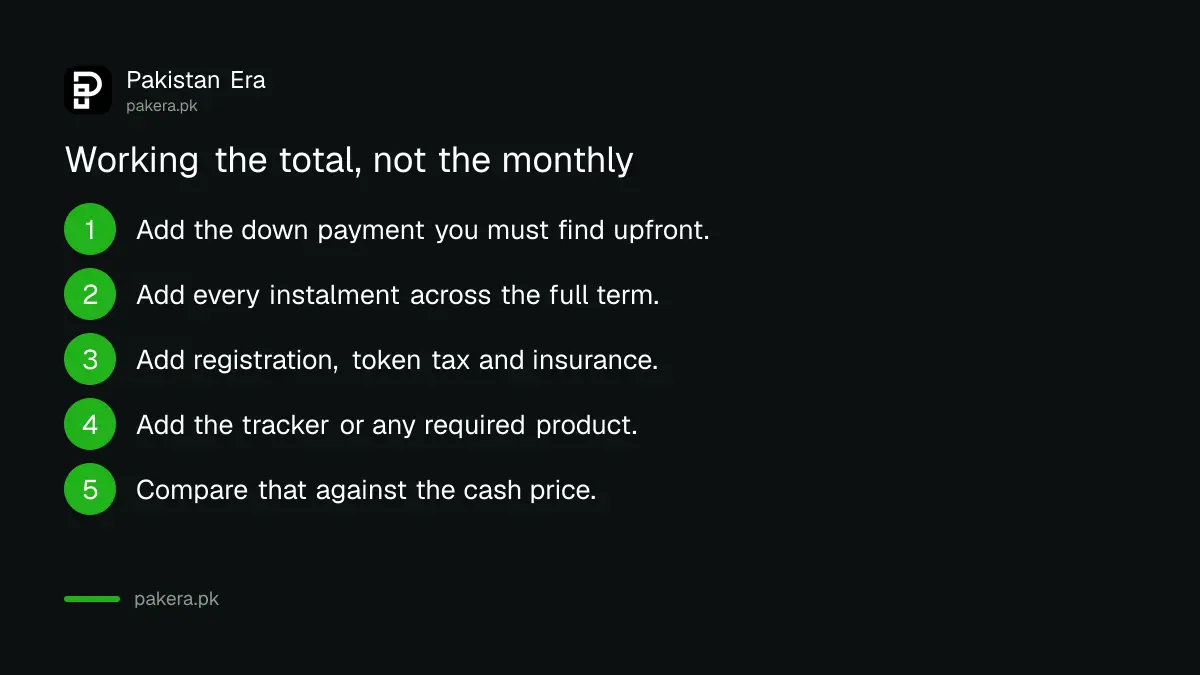
- Add the down payment you must find upfront.
- Add every instalment across the full term.
- Add registration, token tax and insurance for the period.
- Add the tracker or any product the bank requires.
- Compare that total against the cash price of the same car.
Dealers and banks both quote monthly figures because a monthly figure sounds small. The number that tells you what the car costs is the total, and on a three year term at these rates the difference from the cash price is substantial.
Insurance and the extras are part of the price
Financed cars normally carry comprehensive insurance for the term, at the bank's requirement rather than your choice, and that premium recurs every year. A tracker is commonly required too.
Ask whether you may arrange insurance yourself with an insurer the bank accepts, since the difference between a bank's panel rate and one you find can be meaningful across several years. Ask what happens to the premium if you claim.
Conventional and Islamic financing are priced differently
Islamic auto financing is usually structured as a lease or a diminishing partnership rather than a loan with interest. The paperwork, the ownership position during the term and what happens on early settlement all differ.
Compare them on total cost and on the early settlement terms rather than on the headline rate alone, because the structures do not map onto each other cleanly. If early settlement matters to you, ask about it before choosing, not afterwards.
Before you commit
Check the car itself as carefully as the finance. Our guide to verifying a vehicle across provinces covers the registration check, and for a used purchase the transfer is its own process, covered in transferring ownership in Punjab.
Budget for the running costs from day one. Token tax is annual and easy to forget, and paying it online takes minutes. Your income tax position also affects what a bank will lend against, and the current slabs are in our salary tax guide.
Try it on your own numbers: use our Car Finance Calculator to compare 11 banks on your own car, see the monthly instalment, and find which car your salary can finance.
Common questions about car financing in Pakistan
How much can I borrow for a car?
Reported at up to Rs 3 million in total, counted across every bank rather than per bank. Existing auto financing reduces what is left.
Why can I only get three years?
Reported tenure limits allow up to five years at or below 1000cc and up to three years above it. Engine size, not the price of the car, sets the ceiling.
Will my instalment change?
If your financing is KIBOR linked, it can. Ask what the spread is and how often the rate resets before signing.
How much down payment do I need?
Reported at around 30 per cent, with banks financing up to about 70 per cent of value. Confirm with the bank for your own case.
Is Islamic financing cheaper?
Not automatically. Compare total cost and early settlement terms rather than headline rates, since the structures differ.
How we verified this
What we checked, where we read it, and what we could not confirm.
Last checked 28 August 2026. We tried to read the State Bank's prudential regulations for consumer financing at source and the file returned a server error, so every limit here is reported rather than read: the Rs 3 million aggregate cap, the five year and three year tenure ceilings by engine displacement, the roughly 30 per cent down payment, and the debt to income guidance. What supports them is that the cap was still being publicly lobbied against by the auto parts industry in January 2026, and the State Bank was reported in May 2025 as having no plans to lift it, so it was in force at both points. KIBOR and bank markup figures are reported and move constantly, so treat them as indicative and get your own quote. This is general information and not financial advice.
Work out your own figure
Put your own car, down payment and tenure in, and see every bank's monthly instalment side by side.
Car Loan Calculator →About the author

Tax, Bills and Technology Writer
Ali Akhtar is a young and curious voice here at Pakistan Era. He is currently pursuing his A-Levels and has a growing interest in Pakistan’s changing industrial landscape and educational trends. Ali likes to write in a way that helps him explain and explore the world around him. His writing reflects the perspective of the new generation navigating the evolving trends of Pakistan where technology, youth innovation, and shifting opportunities are reshaping the country’s future.