Foreign Income and Assets Statement in Pakistan: Who Must File and the 2% Penalty
Section 116A requires a foreign income and assets statement at US$10,000 of foreign income or US$100,000 of assets. See what it lists and the 2% penalty.
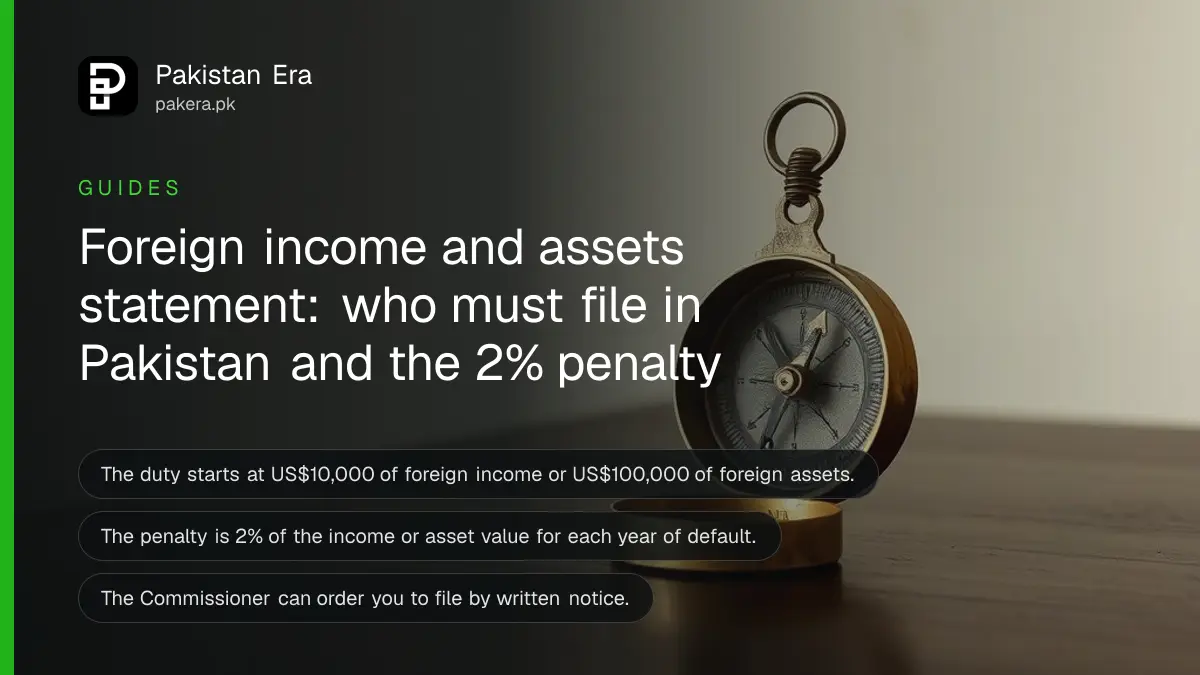
Short answer: If you live in Pakistan and have foreign income of at least US$10,000 or foreign assets worth at least US$100,000, section 116A requires a foreign income and assets statement. Failing to file it carries a penalty of 2% of the foreign income or asset value for each year of default.
Many Pakistani families hold a bank account, a flat or savings abroad. Some earn rent or profit from outside the country. The rule is easy to miss because it sits apart from the normal return and the wealth statement.
We read section 116A and the penalty table in section 182 on FBR's website on 13 October 2026. The figures below come from those two pages.
Two thresholds decide who must file
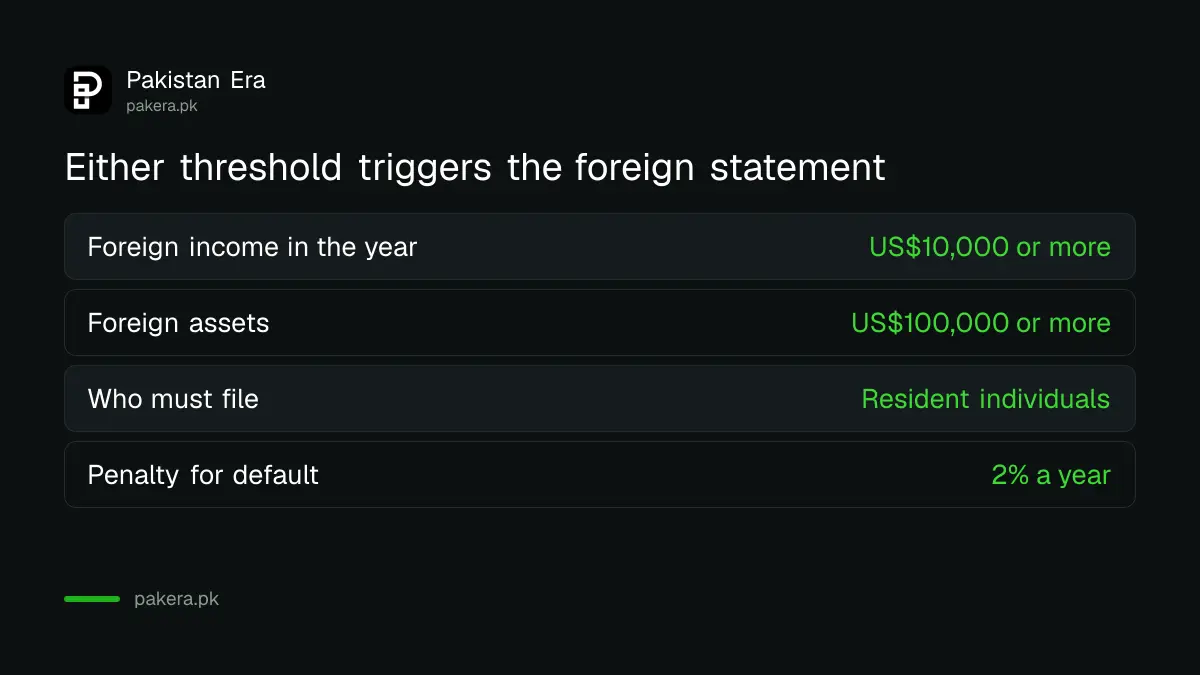
Section 116A applies to a resident individual. You must file if you have foreign income of not less than US$10,000, or foreign assets worth not less than US$100,000. Meeting either one is enough.
Both amounts are in United States dollars. Convert your income and your assets at the rate that applies to the tax year before you compare. The statement itself is on the prescribed form and must be verified in the prescribed way.
| Test | Threshold in section 116A |
|---|---|
| Foreign income in the tax year | Not less than US$10,000 |
| Foreign assets | Not less than US$100,000 |
| Who the rule covers | Resident individuals |
| Penalty for not filing | 2% of foreign income or asset value, per year |
The statement lists assets, transfers and income
Section 116A asks for three groups of facts. First, your total foreign assets and liabilities on the last day of the tax year. Second, any foreign asset you transferred to another person during the year, and what you received for it. Third, complete details of your foreign income, and the costs wholly and necessarily spent to earn it.
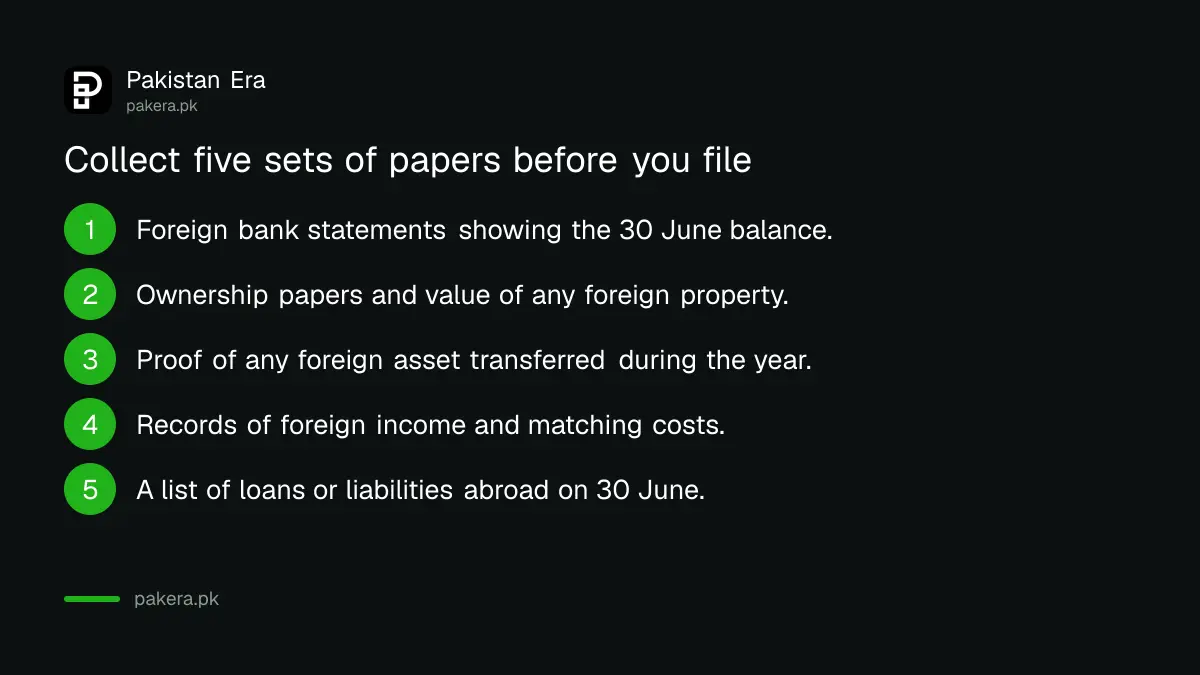
Before you start, collect these papers.
- Statements for every foreign bank account, showing the balance on 30 June.
- Title or ownership papers for any foreign property, with its value.
- Proof of any transfer or sale of a foreign asset during the year.
- Records of foreign income and the matching expenses.
- A list of loans or other liabilities abroad on 30 June.
The penalty is 2% for each year you fail to file
Item 1AAA of the section 182 table covers a person who fails to furnish a foreign assets and income statement by the due date. The penalty is 2% of the foreign income or the value of the foreign assets, for each year of default. It is linked to section 116A.
A short worked example, from our own arithmetic. If foreign assets are worth Rs 40 million, 2% is Rs 800,000 for one year. Two missed years would double that. The page does not say how the base is chosen if both income and assets exist, so ask an adviser if you are in that position.
Section 182(2) still applies. No penalty is payable unless a written order is passed after you are heard.
The Commissioner can ask for the statement by notice
Under section 116A(2), the Commissioner can send a written notice to an individual who, in the Commissioner's opinion, should have filed but did not. The reasons must be recorded in writing, and the notice sets a date to file.
If you receive one, do not ignore it. File by the date or explain in writing why you are not covered. Our guide to replying to a section 114(4) notice shows how to answer an FBR notice in a clean, dated way.
It sits beside your return and your wealth statement
This statement is separate from the wealth statement. Your wealth statement lists everything you own. Your foreign income and assets statement gives more detail about what is outside Pakistan. The figures must agree with each other.
The wealth statement has its own penalty on the same table, given as 0.1% of taxable income per week or Rs 100,000, whichever is higher. See the guide to filling the tax return and wealth statement. If you were abroad for part of the year, read how overseas Pakistanis file as well. Money sent home has its own rules, covered in the remittance tax limit guide.
Common questions
Who must file a foreign income and assets statement in Pakistan?
A resident individual with foreign income of US$10,000 or more, or foreign assets of US$100,000 or more, under section 116A.
What is the penalty for not filing it?
On FBR's penalty table it is 2% of the foreign income or the value of the foreign assets, for each year of default.
Is this the same as the wealth statement?
No. The wealth statement covers all your assets. This statement gives separate details of foreign income and assets. Both must match.
Does a small foreign bank balance count?
Only if you cross a threshold. A balance under US$100,000 with foreign income under US$10,000 does not trigger section 116A, but you should still show it in your wealth statement.
Can FBR force me to file it?
Yes. The Commissioner can issue a written notice with reasons and a date, if they believe you should have filed.
How we verified this
What we checked, where we read it, and what we could not confirm.
Last checked on 13 October 2026, Pakistan time. We read FBR's page for section 116A and its page for section 182. The section 182 copy was stamped 23 June 2026, so a change made by the Finance Act 2026 could be missing. We did not read the prescribed form or the due date for this statement, so check both in IRIS. This page is general information, not legal advice.
About the author

Public Services and Education Journalist
Fajr Riaz is a journalist and content writer at Pakistan Era, based in Lahore. She covers the questions people meet in everyday life in Pakistan: how a public service works, what a change in the rules means, and where to find a reliable answer.