Remittances and FBR Tax in Pakistan: Up to Rs 5 Million a Year Is Protected
Money sent from abroad through banks is shielded from FBR questions up to Rs 5 million a year. Check the section 111(4) rule, gift limits and records to keep.
Short answer: money sent to you from abroad through a bank, exchange company or money transfer service is protected from FBR's "unexplained income" rule up to Rs 5 million in each tax year. That is about $18,000 at Rs 277 to the dollar. Above that, or through hundi, you must be able to show where the money came from.
The rule is section 111(4) of the Income Tax Ordinance, 2001. We read it in FBR's own copy of the Ordinance, amended up to 30 June 2026. With the tax return deadline on 15 October 2026, this is the month families receiving remittances should check their numbers.
Up to Rs 5 million a year from abroad needs no explanation
Section 111(4) says FBR's unexplained income rule "does not apply" to foreign exchange sent from outside Pakistan through normal banking channels, up to Rs 5 million in a tax year. The money must be changed into rupees by a scheduled bank, and you must produce a certificate from that bank.
In plain words, if your son in Riyadh sends you Rs 3 million in a year through a bank, the tax office cannot treat that Rs 3 million as hidden income. You do not have to prove how he earned it.
The law also says exchange companies, money service bureaus and money transfer operators count as normal banking channels. So a transfer through a licensed exchange company or money transfer service is covered, as long as it reaches you through the formal system.
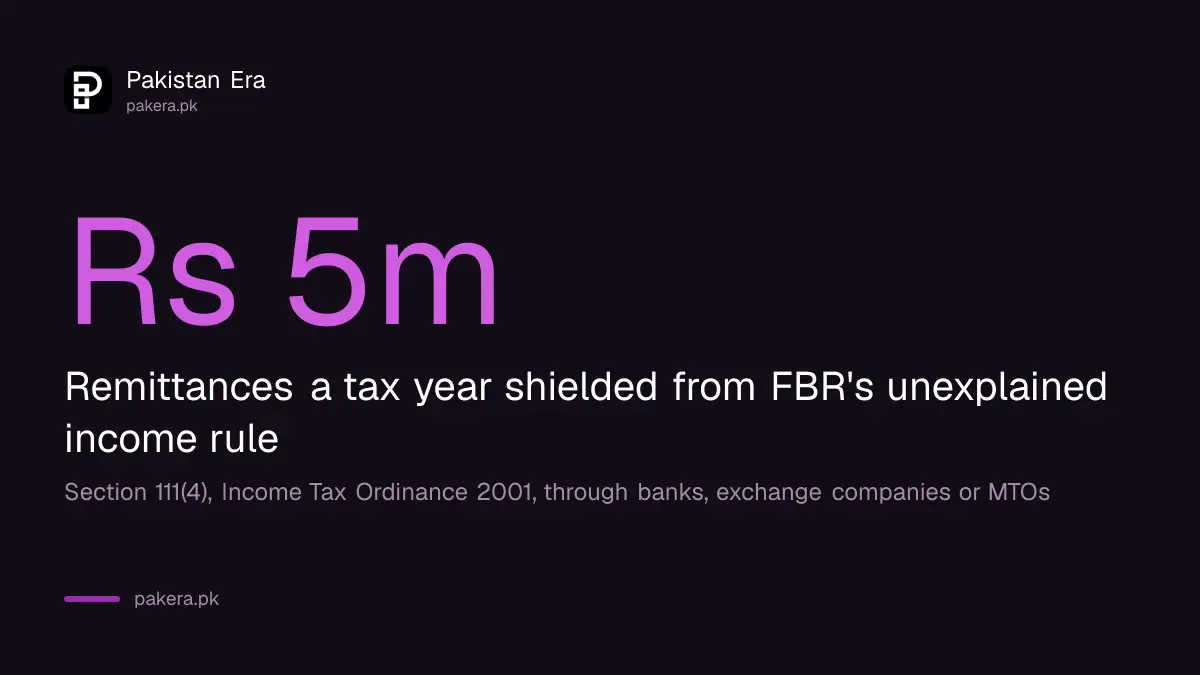
Section 111 is the rule the limit protects you from
Section 111(1) lets FBR add money to your taxable income when you cannot explain where it came from. It covers money credited to you, investments, valuables you own and money you spend.
If your explanation is not, in the Commissioner's opinion, satisfactory, the unexplained amount is added to your income under "Income from Other Sources". It is then taxed at your normal rates. That is the risk the Rs 5 million limit removes for honest remittances.
It matters more now that FBR runs tax audits online through its new National Faceless Centre. Large bank credits with no matching income on a return are the kind of gap an audit asks about.
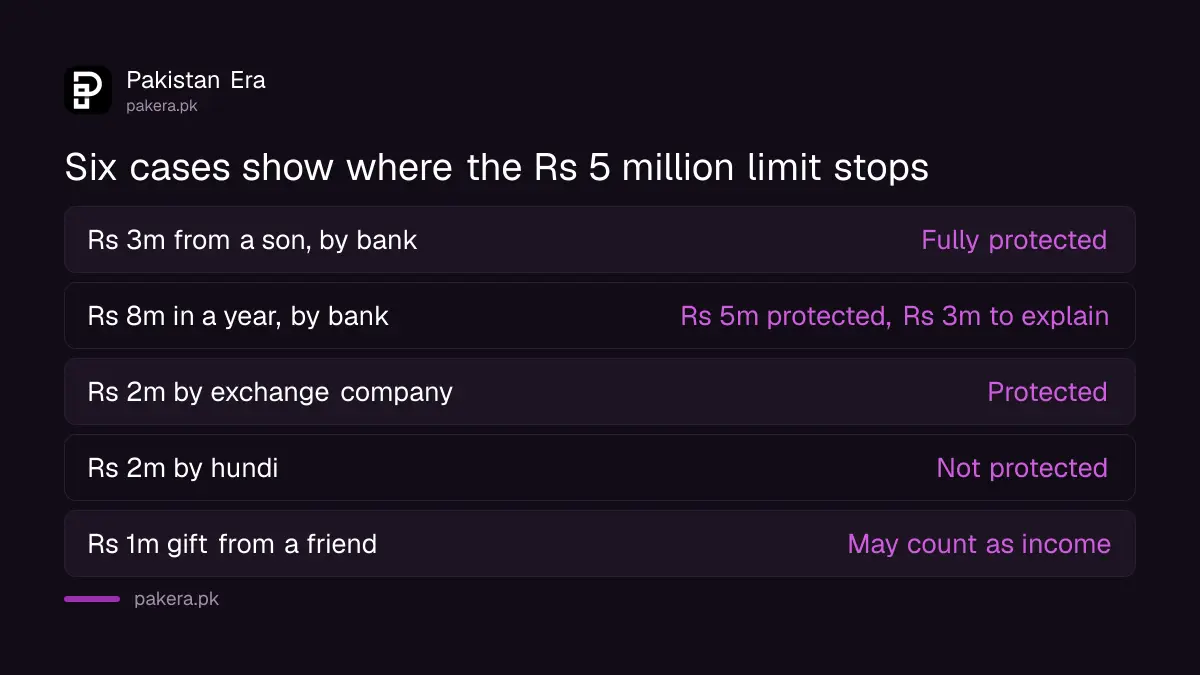
Six cases show where the limit helps and where it stops
The limit is per tax year, which in Pakistan runs from 1 July to 30 June. Tax year 2026 means 1 July 2025 to 30 June 2026.
| Situation | Protected by section 111(4)? | What you need |
|---|---|---|
| Rs 3 million from a son abroad, through a bank | Yes, in full | Bank certificate |
| Rs 8 million in one year, through a bank | First Rs 5 million only | Proof of source for Rs 3 million |
| Rs 2 million through an exchange company | Yes | Certificate from the paying bank |
| Rs 2 million through hundi or hawala | No | Full proof of source |
| Rs 1 million gift from a friend abroad | Source is covered, but the gift may be income | See the gift rule below |
| Cash carried in by a relative | No, not a banking channel | Full proof of source |
Going over Rs 5 million does not mean the extra is taxed. It means the extra loses the automatic shield. If you can show it came from a relative's salary or business abroad, the Commissioner can accept that.
Gifts from people who are not relatives can count as income
A separate rule, section 39(1)(la), treats a gift received without payment as income, unless it comes from a relative. Section 85(5) defines a relative widely: an ancestor, anyone descended from your grandparents or your spouse's grandparents, an adopted child, and the spouses of all of these.
So money from a brother, uncle, cousin, parent or child abroad is a gift from a relative. Money from a friend, an employer or a stranger is not. Section 111(4) answers the question "where did it come from?" It does not stop a gift from a non-relative being taxed as income.
If a non-relative abroad is paying you for work, that is not a gift at all. It is your income, and freelancers have their own rules for export of services.
Keep these five records before you file
The return deadline for tax year 2026 is 15 October 2026, after FBR extended it. Before you file, do this:
- Add up every remittance you received from 1 July 2025 to 30 June 2026. Your bank statement shows each credit.
- Ask your bank for a certificate of foreign remittances received in that year. Section 111(4) requires a certificate from the bank that changed the money into rupees.
- Note who sent each amount and their relationship to you. A copy of the sender's passport page or work visa helps.
- Show the total as money coming in when you reconcile your wealth statement. It explains how your savings or assets grew.
- If the total is above Rs 5 million, keep proof of the sender's income, such as salary slips or a business record from abroad.
The full IRIS steps for the return and the wealth statement are in filling your FBR tax return and wealth statement. If you are the one living abroad, filing as an overseas Pakistani works differently, because non-residents declare only Pakistan income.

Hundi money has no protection at all
The Rs 5 million shield applies only to money that came through the formal system and was changed into rupees by a bank. Hundi and hawala transfers leave no bank certificate, so they fall straight under section 111(1).
That is a second cost on top of the legal risk. Formal transfers of $200 or more are free under State Bank rules, as set out in receiving money from abroad in Pakistan. And only bank transfers count for the Pasban prize draw, which started on 1 October 2026.
Common questions
Is money received from abroad taxable in Pakistan?
A remittance is not income just because it came from abroad. Up to Rs 5 million a tax year through banking channels is also protected from FBR's unexplained income rule under section 111(4).
What happens if I receive more than Rs 5 million in a year?
The amount above Rs 5 million loses the automatic protection. FBR can ask you to explain its source. If you can show it came from a relative's earnings abroad, the Commissioner can accept that explanation.
Do exchange companies and money transfer services count as banking channels?
Yes. The Explanation to section 111(4) says money service bureaus, exchange companies and money transfer operators count as normal banking channels.
Is a gift from a cousin abroad taxable?
No, a cousin counts as a relative under section 85(5), because cousins are descendants of your grandparents. A gift from a friend is different and can be treated as income.
Which tax year does a remittance received in August 2026 fall into?
Tax year 2027, which runs from 1 July 2026 to 30 June 2027. You will declare it in the return filed in 2027.
How we verified this
What we checked, where we read it, and what we could not confirm.
Last checked on 9 October 2026. Sections 111(1), 111(4) and its Explanation, 39(1)(la) and 85(5) are quoted from FBR's Income Tax Ordinance, 2001, amended up to 30 June 2026, listed on FBR's Income Tax Ordinance page. The 15 October 2026 deadline is from FBR's extension of 30 September 2026. The dollar conversion uses an interbank rate of about Rs 277 and is our arithmetic. This page explains the law in plain words and is not personal tax advice.
About the author

Global Affairs & Political Economy Writer
Muhammad Hatim is a book lover who started writing because he enjoys it. At Pakistan Era he writes about international relations, geopolitics and the global economy, with a particular interest in South Asia and the forces behind current events.