How to Receive Money From Abroad in Pakistan, Free From USD 200
Banks must send money home to Pakistan free on USD 200 or more. See 4 ways your family can receive it, SBP credit deadlines and why hawala costs you later.
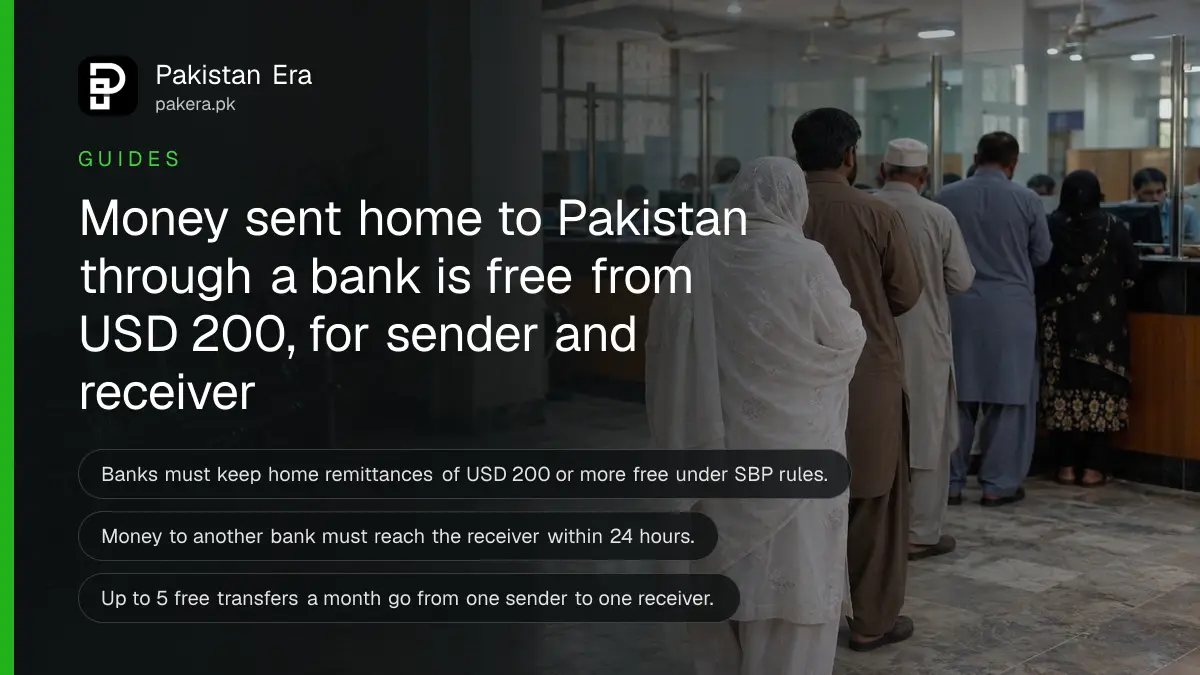
Money sent home to Pakistan through a bank's remittance channel is free for both sender and receiver when it is USD 200 or more. The State Bank of Pakistan told banks on 2 July 2026 to keep these transfers free. Your family can receive it in a bank account, a JazzCash or Easypaisa wallet, or as cash at a bank counter.
Update, 11 October 2026: If money has not arrived, trace it and complain.
We read SBP's circulars on remittance charges, chapter 10 of its Foreign Exchange Manual, the Foreign Exchange Regulation Act, 1947, and the Income Tax Ordinance on 7 October 2026. We also read the remittance pages of JazzCash and Easypaisa.
The question is rarely "can I send it". It is "how much reaches my mother in Gujranwala, and how fast". The rules below answer both.
Sending money home is free from USD 200
A home remittance of USD 200 or more through a formal channel carries no fee for the sender or the receiver. SBP stopped paying banks for this on 1 July 2026, but told them to keep the transfers free anyway.
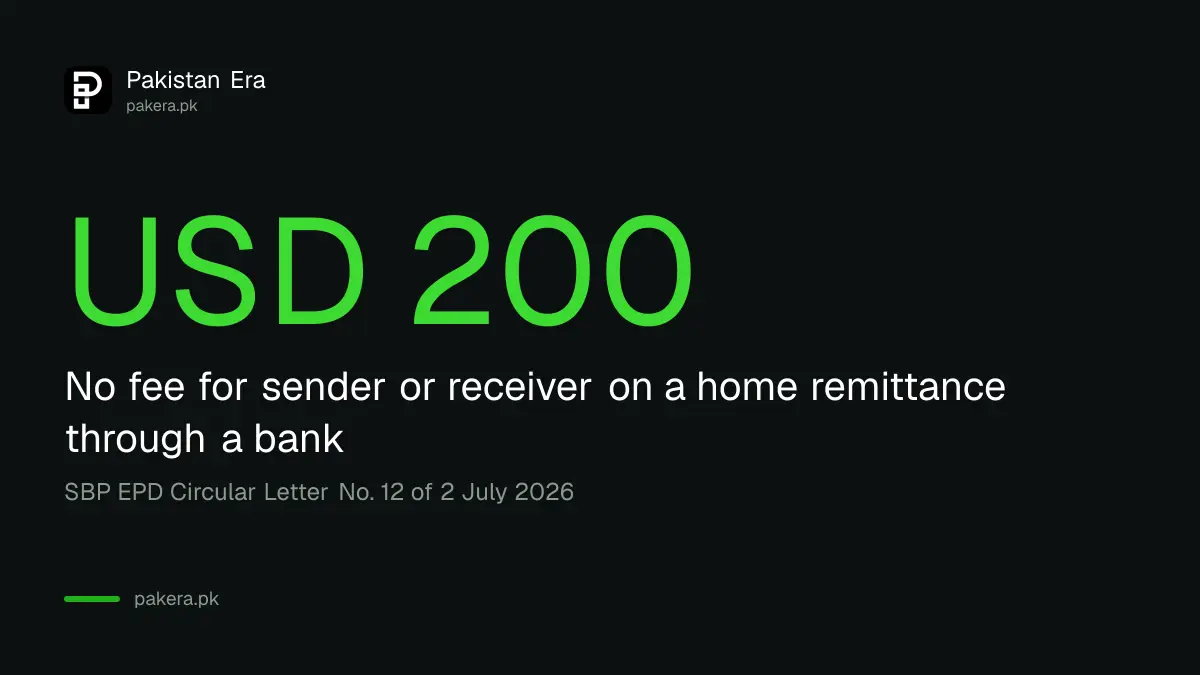
The old Telegraphic Transfer Charges Incentive Scheme paid banks a flat SAR 20 for each free transfer of USD 200 or more. EPD Circular Letter No. 12, dated 2 July 2026, ended that payment from 1 July 2026. The same letter says banks "shall ensure that home remittance transactions meeting the criteria" of the old scheme "remain free-of-cost for the senders and beneficiaries". Exchange companies and microfinance banks were part of the old scheme too, but the letter puts this duty on banks by name. If a wallet or exchange company quotes a fee on USD 200 or more, ask them why.
The criteria come from Appendix A of EPD Circular Letter No. 04 of 2025:
- The amount is at least USD 200, or the same in another currency.
- Several transfers from the same sender to the same receiver on one day count as one transfer.
- Only 5 free transfers a month are allowed from one sender to one receiver through the same overseas company.
- The names and identity of both sender and receiver must be accurate.
The rule covers fees. It does not set the exchange rate the sending company offers. So the cheapest service is the one that puts the most rupees in your account for the same amount sent, and the sender should compare that figure before paying.
Four ways your family can receive the money
Your family can receive money from abroad into a bank account using an IBAN, into a mobile wallet, as cash at a bank counter, or through a licensed exchange company. Bank accounts and wallets suit regular monthly support. Cash suits a family without an account.
| How it arrives | What the receiver needs | Good for |
|---|---|---|
| Bank account | Account in their own name and its 24 character IBAN | Monthly support, the Pasban prize draw |
| Mobile wallet | A JazzCash or Easypaisa account on their CNIC | Families far from a bank branch |
| Cash at a bank counter | Original CNIC and the transfer reference number | One-off transfers, families with no account |
| Exchange company or money transfer firm | CNIC and the reference number, or an account for credit | Senders who already use a firm abroad |
The bank account route is the most useful in the long run. Your mother can find her IBAN in her bank app or on a statement and send it to you. JazzCash says its Asaan Digital Remittance Account lets families receive international remittances straight into the wallet. Easypaisa lists "receive international remittance" among its payment services.
For a sender in Britain, Europe or the US, Wise transfers to Pakistan deliver rupees to a bank account only. The SBP rules still apply at the Pakistani end.
How fast the money must reach the receiver
SBP sets deadlines. Money to an account at the same bank must be credited at once. Money to another bank must arrive within 24 hours. Cash over the counter must be available at once. Late banks owe the receiver compensation.
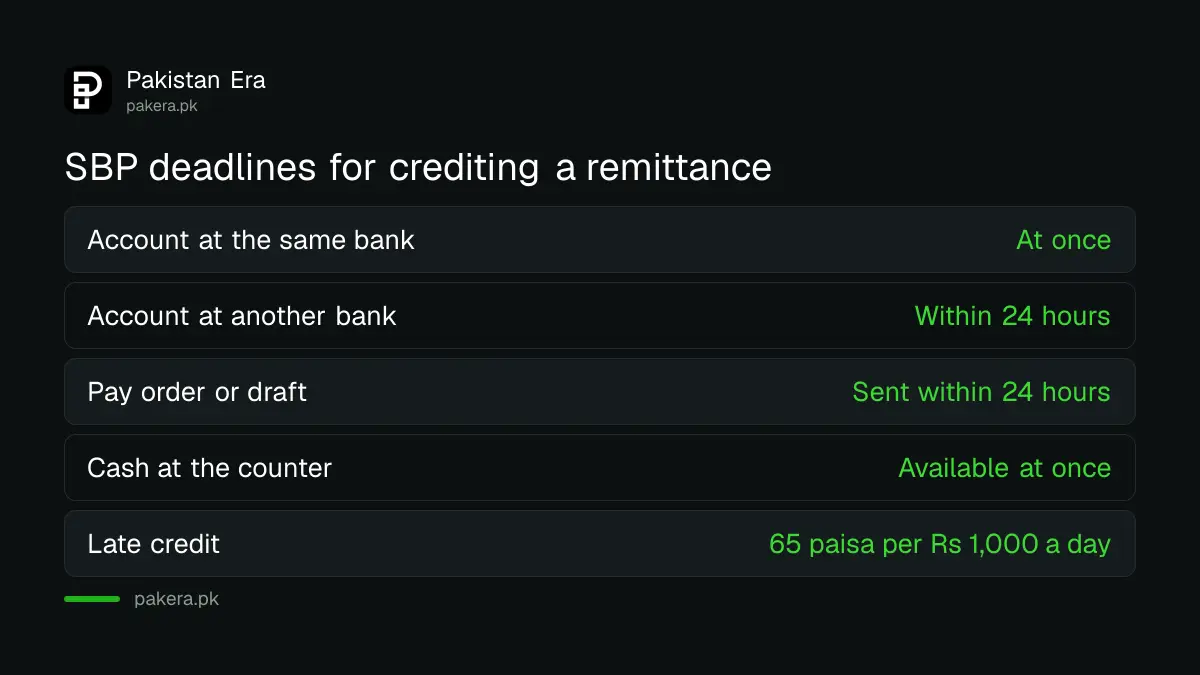
Chapter 10 of the Foreign Exchange Manual sets the compensation at 65 paisa per Rs 1,000 for each day of delay. On a Rs 100,000 remittance held up for 4 days, that is Rs 260. It is small, but it is owed, and a written complaint citing it gets attention.
If the bank does not fix it, call SBP's Pakistan Remittance Initiative helpline on 111-727-774, from 9:00 am to 5:30 pm, Monday to Friday.
Hundi and hawala are illegal, and cost you later
Hundi and hawala are informal ways of moving money through unlicensed dealers. Section 4 of the Foreign Exchange Regulation Act, 1947, bars anyone other than an authorised dealer from dealing in foreign exchange. Section 23 sets up to five years of rigorous imprisonment.
The hidden cost comes at tax time. Section 111(4) of the Income Tax Ordinance protects up to Rs 5 million a tax year of money sent from abroad through normal banking channels and converted to rupees by a bank. FBR cannot treat that money as unexplained income if you hold the bank's certificate. Exchange companies and money transfer operators count as banking channels too.
Hawala money has no certificate and no such protection. If your family later buys a plot or a car with it, they may have to explain where it came from.
- Ask the sender to use a bank, a licensed exchange company or a known money transfer firm.
- Make sure the receiver's name matches the CNIC exactly.
- Keep every transfer receipt and reference number.
- Ask your bank for a remittance certificate once a year, before you file a return.
- Never pay a dealer who offers a better rate for cash handed over in person.
Remittances into a bank account can win a Pasban prize
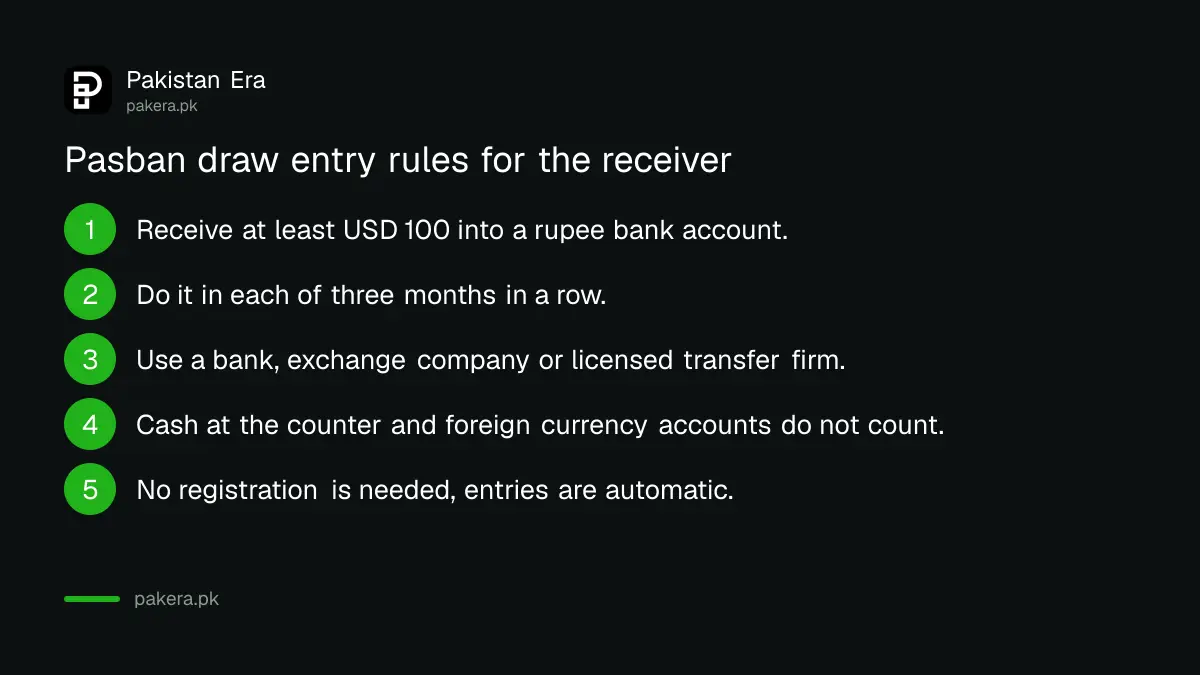
SBP's Pasban scheme gives a prize draw entry to bank accounts that receive at least USD 100 in each of three months in a row. Cash collected at a counter and money sent to a Roshan Digital or foreign currency account do not count.
Pasban replaced the Sohni Dharti points scheme, and points did not carry over. The first draw is on 15 January 2027, for money received from 1 October to 31 December 2026. The rules on qualifying for the Pasban remittance reward are strict, and the receiver does not need to register.
The formal route keeps growing. Pakistan received USD 3.66 billion in remittances in August 2026, up 16.5% on a year earlier.
Common questions
Is there any fee to receive money from abroad in Pakistan?
No, for a home remittance of USD 200 or more through a bank. SBP's 2 July 2026 circular keeps these free for sender and receiver.
What is the cheapest way to receive money from abroad in Pakistan?
A bank transfer of USD 200 or more, since fees are zero. Compare the rupee amount each sending service quotes, because exchange rates differ.
Can I receive international money in JazzCash or Easypaisa?
Yes. Both list international remittance as a service. JazzCash calls its version the Asaan Digital Remittance Account.
How long does a remittance take to reach my bank account?
At once at the same bank and within 24 hours at another bank, under SBP rules.
Will FBR ask where money from abroad came from?
Not for up to Rs 5 million a tax year sent through banking channels and converted by a bank, if you keep the bank's certificate.
How we verified this
What we checked, where we read it, and what we could not confirm.
Last checked on 7 October 2026. Free remittance rules come from the State Bank of Pakistan's EPD Circular Letter No. 12 of 2026 and EPD Circular Letter No. 04 of 2025 with its Appendix A. Credit deadlines and compensation come from chapter 10 of SBP's Foreign Exchange Manual. The helpline is from SBP's home remittance page. Penalties come from the Foreign Exchange Regulation Act, 1947, and the tax rule from section 111(4) of the Income Tax Ordinance, amended up to 30 June 2026. Wallet services come from the JazzCash and Easypaisa websites.
About the author

Public Services and Education Journalist
Fajr Riaz is a journalist and content writer at Pakistan Era, based in Lahore. She covers the questions people meet in everyday life in Pakistan: how a public service works, what a change in the rules means, and where to find a reliable answer.