Dividend Tax in Pakistan: 15% for Filers, 30% for Non-Filers on PSX Shares
Dividends from PSX shares are taxed at 15% for filers and 30% for others. See mutual fund, bonus share and capital gains rates, and how to stop Zakat. Read now.
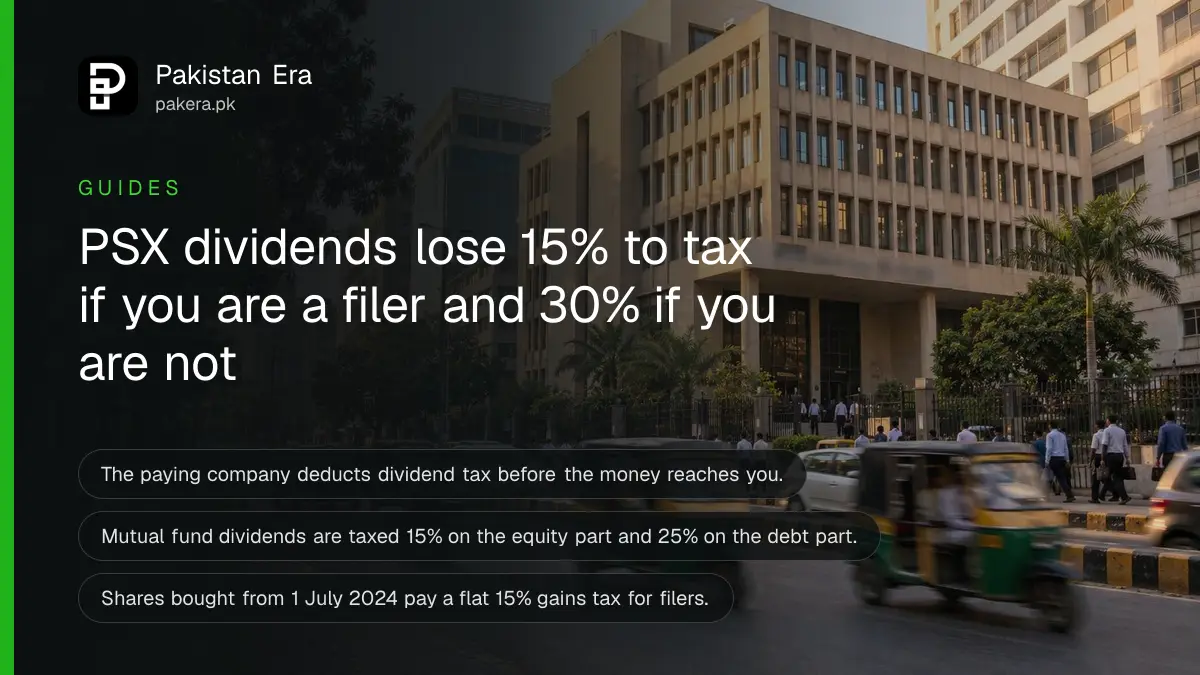
Dividends from PSX shares are taxed at 15% if you are on FBR's Active Taxpayers List and 30% if you are not. The company deducts the tax before the money reaches your bank account. Mutual fund dividends are taxed at 15% on the share part and 25% on the debt part, and bonus shares carry their own 10% tax.
We read the Income Tax Ordinance, 2001, as amended up to 30 June 2026, and FBR's withholding tax rate card for tax year 2027 on 7 October 2026. We also read the Zakat and Ushr Ordinance, 1980, for the Zakat cut on share dividends. Every rate below is from those texts.
Most new investors notice the tax only when the first dividend lands short. A Rs 10,000 dividend becomes Rs 8,500 for a filer and Rs 7,000 for a non-filer. That gap alone is a reason to file a return before you buy shares.
Dividend tax rates in Pakistan for tax year 2027
Section 150 makes the paying company deduct tax from every dividend. The usual rate is 15% for filers and 30% for non-filers. Power producers pay out at 7.5%, and companies that pay no tax because of losses or exemptions pay out at 25%.
| Dividend paid by | Filer | Non-filer |
|---|---|---|
| Most listed companies, and REITs | 15% | 30% |
| Independent power producers, where the dividend is a pass through cost | 7.5% | 15% |
| A company paying no tax because of exemption, carried forward losses or tax credits | 25% | 50% |
| Mutual fund, part earned from shares | 15% | 30% |
| Mutual fund, part earned from debt | 25% | 50% |
| A REIT's special purpose vehicle, paid to anyone other than the REIT | 35% | 70% |
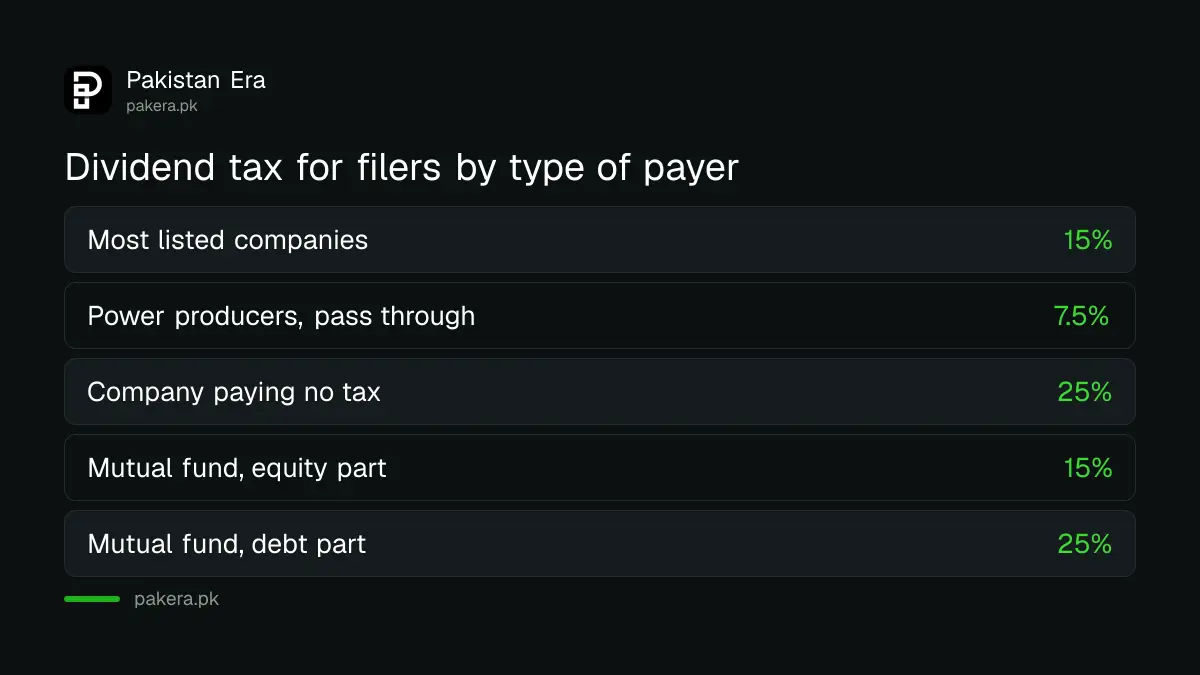
The rates are in Division I of Part III of the First Schedule. The Tenth Schedule doubles them for anyone not on the list, which is where the non-filer column comes from. The tax is worked out on the gross dividend, before any charges.
For most individuals, this deduction is the whole tax. Section 5 taxes dividends separately from salary or business income, at the same rate. You still show the dividend and the tax in your return.
Mutual fund dividends are split between shares and debt
Since the Finance Act, 2025, a mutual fund dividend is taxed in two parts. The share of income the fund earned from equities is taxed at 15%. The share it earned from debt, such as bonds and bank deposits, is taxed at 25%.
So a pure stock fund mostly attracts 15%, and a money market fund mostly attracts 25%. A balanced fund falls in between. Your fund manager works out the split from the fund's average investments over the year and deducts the tax before paying you.
That is worth knowing when you compare mutual funds in Pakistan by their headline return. Two funds with the same return can leave you with different amounts after tax.
Bonus shares are taxed at 10% of their value
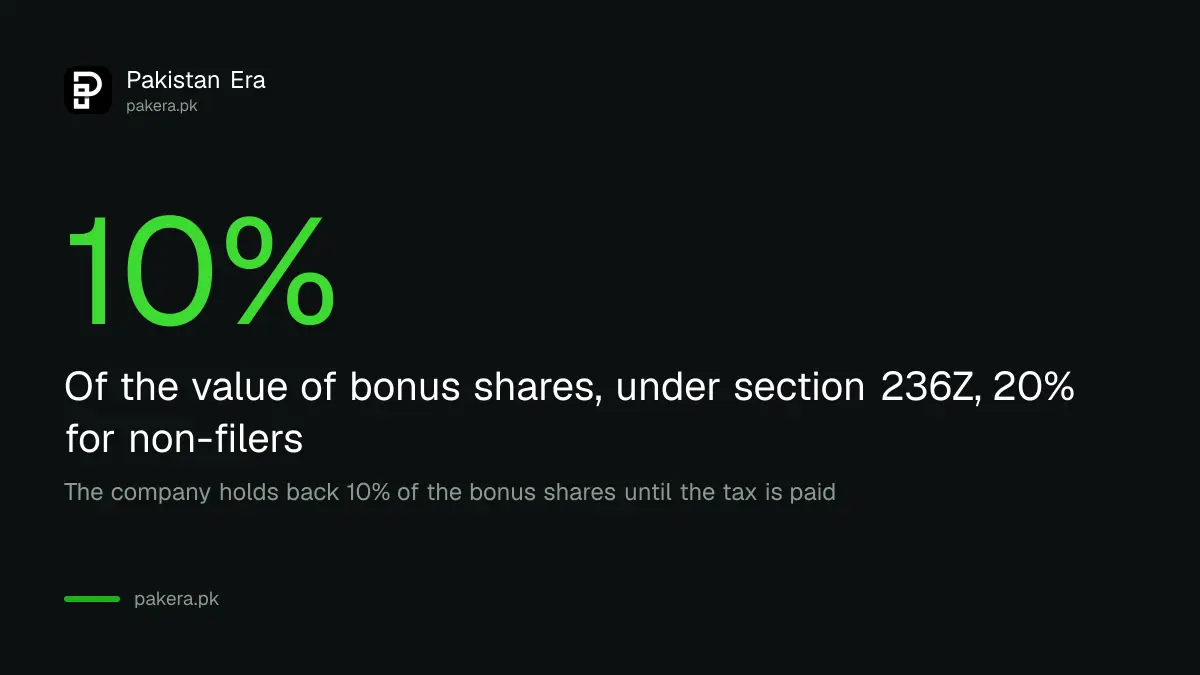
When a company issues bonus shares, section 236Z makes it hold back 10% of them. You get those shares only after paying tax equal to 10% of the value of all the bonus shares. FBR's rate card links the section to the Tenth Schedule, so a non-filer pays 20%.
The value is the closing price on the first day the company closes its books. The company deposits the tax within 15 days of book closure. If you neither pay nor collect your shares within 15 days of issue, the company may sell the withheld shares to recover the tax. The tax is final on that income.
Capital gains tax on PSX shares depends on when you bought
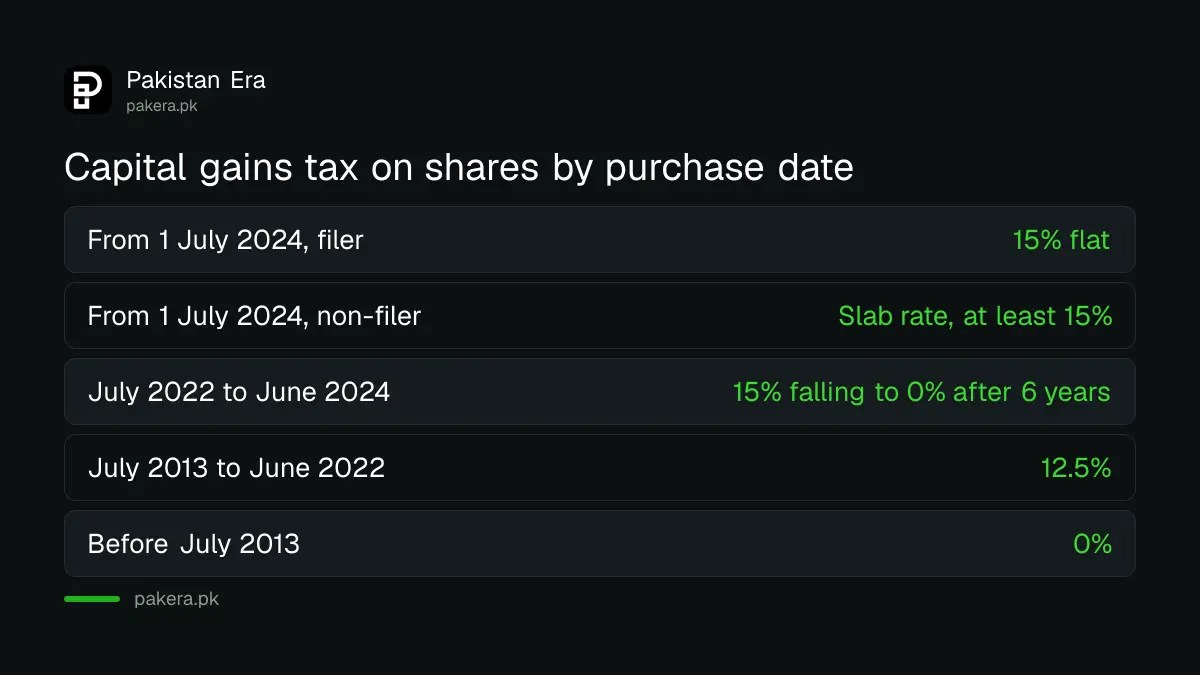
Selling shares at a profit is taxed under section 37A. Shares bought on or after 1 July 2024 are taxed at a flat 15% for filers, however long you hold them. Older shares still follow a holding period table that falls to 0% after six years.
| When you bought the shares | Tax on the gain |
|---|---|
| On or after 1 July 2024, filer on both buying and selling dates | 15%, whatever the holding period |
| On or after 1 July 2024, non-filer | Normal income tax slab rate, never below 15% |
| 1 July 2022 to 30 June 2024 | 15% within a year, then 12.5%, 10%, 7.5%, 5%, 2.5%, and 0% after six years |
| 1 July 2013 to 30 June 2022 | 12.5% |
| Before 1 July 2013 | 0% |
You do not pay this at a tax office. Section 100B and the Eighth Schedule make the National Clearing Company of Pakistan (NCCPL) work out and collect the tax on listed shares through your broker. A loss on shares can be set off only against gains on shares, and section 37A lets an unused loss carry forward to later years.
Mutual funds deduct capital gains tax themselves when you redeem units. For an individual it is 15% for stock funds and other funds alike. Nothing is deducted on units bought on or before 30 June 2024 and held for more than six years.
Zakat is cut from your first dividend of the Zakat year
For Muslim citizens, the company deducts Zakat of 2.5% when it pays the first dividend of the Zakat year. It is charged on the paid-up value of your shares or their market value on 1 Ramazan, whichever is lower. Form CZ-50 stops it.
Item 8 of the First Schedule of the Zakat and Ushr Ordinance sets this. Take 1,000 shares with a Rs 10 face value trading at Rs 150. Zakat is 2.5% of Rs 10,000, the lower figure, so Rs 250 comes off that year's first dividend.
The steps to stop it are the same as for a bank account. Swear a CZ-50 declaration to stop Zakat deduction and send it to the company, usually through its share registrar, at least 30 days before 1 Ramazan. For shares held in the Central Depository, ask your broker how it passes declarations on.
- Get stamp paper and fill in Form CZ-50 with your name, fiqh and the shares it covers.
- Swear it before an oath commissioner or notary with two witnesses.
- Send a copy to each company or its share registrar, or through your broker.
- Do it at least 30 days before 1 Ramazan, which means December 2026 for the coming Ramazan.
- Keep the acknowledgement. The declaration stays valid while the shares stay in the same place.
How to pay less dividend tax legally
The biggest saving is filing a return. It halves the tax on every dividend, bonus issue and share sale. Holding shares bought before July 2024 for longer also cuts the gains tax on them.
If you are new to the market, sort out becoming a tax filer before you open a brokerage account. The account and broker steps for investing in the PSX come after that.
Common questions
What is the dividend tax rate in Pakistan for filers?
15% for most listed companies. It is 7.5% for qualifying power producers and 25% where the paying company pays no tax.
How much dividend tax does a non-filer pay?
Double the filer rate, so 30% on most PSX dividends, under the Tenth Schedule of the Income Tax Ordinance.
Do I need to pay more tax on dividends when I file my return?
Usually not. The tax deducted at source is the tax on that dividend, but you must still declare it in your return.
Is there tax on bonus shares in Pakistan?
Yes. Section 236Z charges 10% of the value of the bonus shares, and 20% for non-filers on FBR's rate card.
Can I stop Zakat on my PSX dividends?
Yes. File a sworn CZ-50 declaration with the company or its share registrar at least 30 days before 1 Ramazan.
How we verified this
What we checked, where we read it, and what we could not confirm.
Last checked on 7 October 2026. Dividend, bonus share and capital gains rates come from the Income Tax Ordinance, 2001, amended up to 30 June 2026, sections 5, 37A, 100B, 150 and 236Z and the First Schedule, and FBR's withholding tax rate card updated to 30 June 2026. The Zakat rule comes from the Zakat and Ushr Ordinance, 1980, First Schedule, item 8. Tax law changes with each Finance Act, so check the rates again after the June 2027 budget.
About the author

Tax, Bills and Technology Writer
Ali Akhtar is a young and curious voice here at Pakistan Era. He is currently pursuing his A-Levels and has a growing interest in Pakistan’s changing industrial landscape and educational trends. Ali likes to write in a way that helps him explain and explore the world around him. His writing reflects the perspective of the new generation navigating the evolving trends of Pakistan where technology, youth innovation, and shifting opportunities are reshaping the country’s future.