How to Become an Organ Donor in Pakistan: Pledge Online, Witnesses and the CNIC Mark
Pledge your organs and eyes in Pakistan from age 18: the free PHOTA online form in Punjab, HOTA's Form 6 in Islamabad, the witnesses, and the CNIC donor mark.
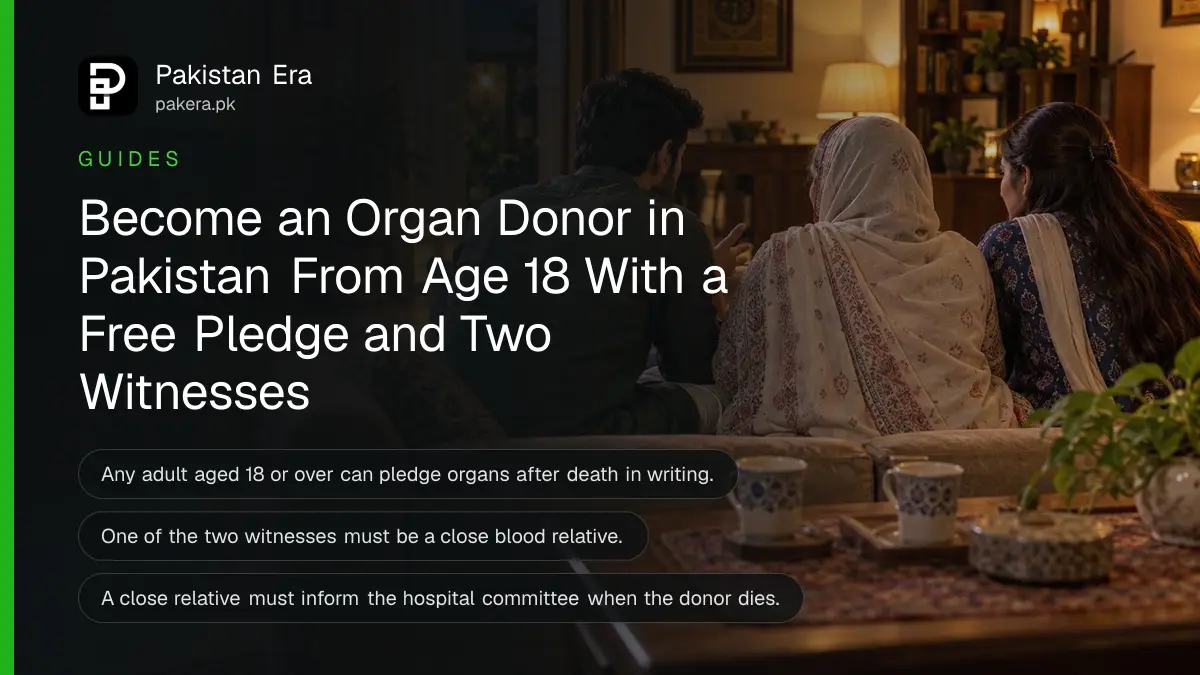
To become an organ donor in Pakistan you must be at least 18 and sign a written pledge with two witnesses, one of them a close blood relative. In Punjab you can fill the pledge online on the Punjab Human Organ Transplant Authority's portal. In Islamabad, HOTA's Form 6 does the same job. Then tell your family, because they must report your death for the pledge to work.
Many people think the donor mark on the identity card is the registration. It is not. The card mark comes after you register with a transplant authority, and the law that makes donation possible puts the last step in your family's hands.
We opened the Punjab authority's donation portal and read both pledge forms on 7 October 2026. We also read the Transplantation of Human Organs and Tissues Act 2010 on the Pakistan Code and the Punjab Code, and Khyber Pakhtunkhwa's own 2014 Act. Here is what each one asks of you.
The law lets any adult pledge organs after death
Under the Transplantation of Human Organs and Tissues Act 2010, anyone aged 18 or over can donate organs or tissue after death. The pledge must be in writing, signed, and verified by an Evaluation Committee. You can cancel it at any time in front of two witnesses.
Section 4 of the Act sets out three rules that matter to a donor:
- You must be at least 18 when you sign.
- You can name a hospital recognised by the transplant authority to carry out the removal.
- When you die, "any close relative" must inform the Evaluation Committee. Without that call, nothing happens.
An Evaluation Committee is a hospital panel of specialists and two local notables. It confirms death and approves each transplant. Death here includes brain stem death, which the Act defines as the "irreversible loss of brain and brain stem functions".
Which authority to register with
Health is a provincial subject, so the authority depends on where you live. Punjab has PHOTA with an online portal. Islamabad falls under the federal Human Organ Transplant Authority, HOTA. Khyber Pakhtunkhwa has its own Medical Transplantation Regulatory Authority under a 2014 Act.
| Area | Authority | How to pledge |
|---|---|---|
| Punjab | Punjab Human Organ Transplant Authority (PHOTA) | Online cadaveric donation form; head office (042) 99206046-47 |
| Islamabad | Human Organ Transplant Authority (HOTA) | Form 6 from HOTA's downloads; 051-9255662, info@hota.gov.pk |
| Khyber Pakhtunkhwa | KP Medical Transplantation Regulatory Authority | Pledge through a hospital it recognises; no online form found |
| Sindh and Balochistan | Provincial health authorities | Ask a recognised transplant hospital; no online form found |
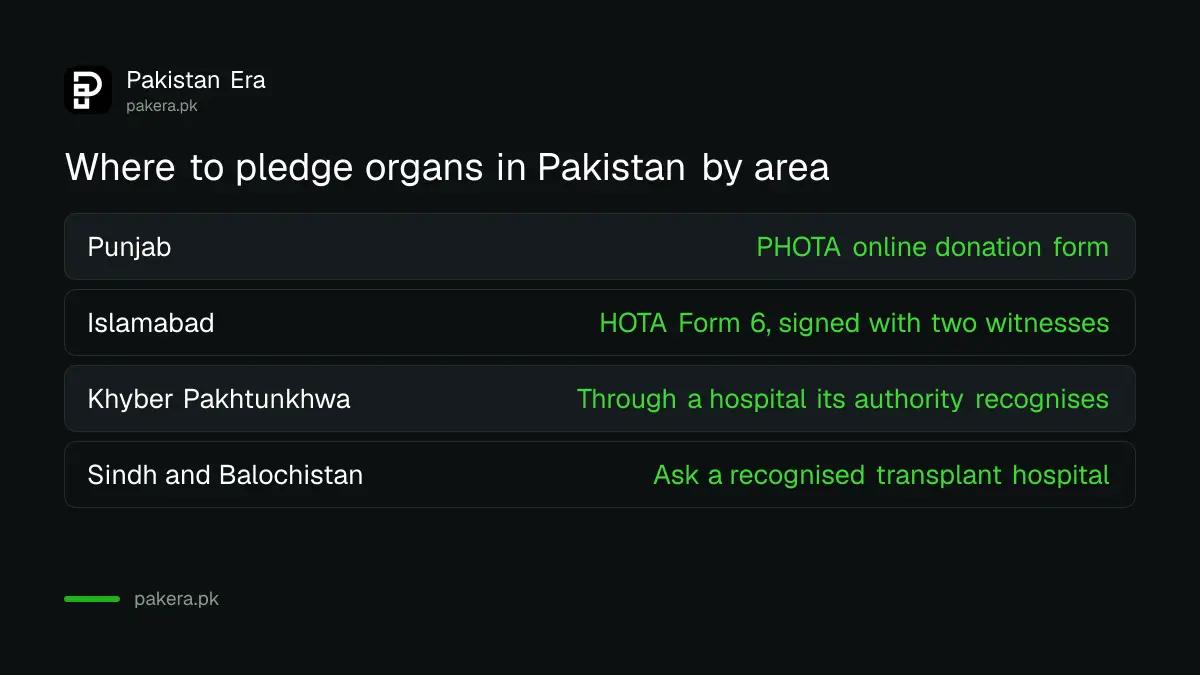
Balochistan adopted the federal Act with amendments in 2012, as the Balochistan Code lists. We did not find a separate donor portal for Sindh or Balochistan. In those provinces, ask the transplant unit of a large teaching hospital for the written pledge form.
How to pledge your organs online in Punjab
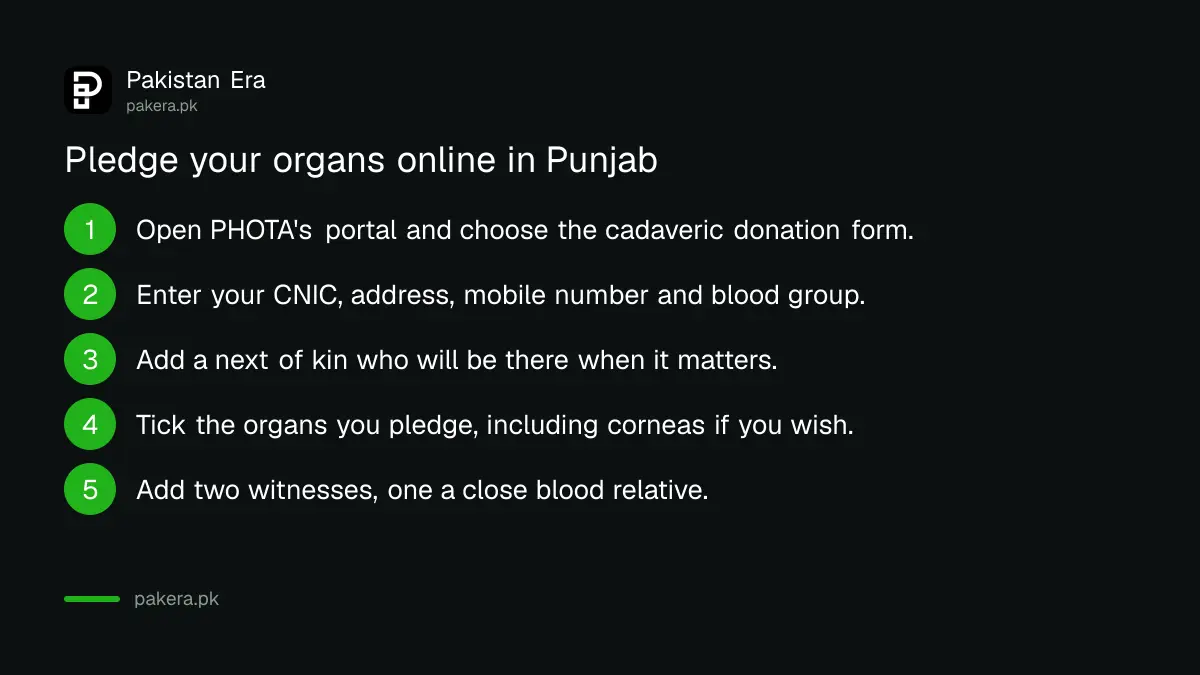
Go to PHOTA's donation portal, choose the cadaveric form, which means donation after death, and fill in your details, next of kin and two witnesses. The form is free. It ends with an affidavit you confirm on oath. We read every field of it on 7 October 2026.
- Open the portal at ms-phota.punjab.gov.pk/organ_donation and pick "Cadaveric Organ Donation Form (Retrieval after death)".
- Enter your details: name, father's or husband's name, CNIC, date of birth, address, mobile number and blood group. Upload a photo.
- Add your next of kin with their CNIC and relationship. Pick someone who will actually be there.
- Answer the medical questions on blood pressure, diabetes, hepatitis B, cancer, alcohol and recent psychiatric illness.
- Tick the organs you pledge: whole body, kidneys, liver, heart, lungs, pancreas or corneas.
- Add two witnesses. One must be a close blood relative. The second can be a friend or other relative.
Read the affidavit before you confirm. It says the donation involves no money, that your legal heirs will not object or go to court, and that the pledge stays valid until you revoke it. It also lets PHOTA publish your picture and details as a donor on its website and social media. Some people will not want that, so decide first.
Eye donation uses the same pledge
Corneas, the clear front layer of the eye, count as tissue under the 2010 Act. So you pledge them the same way as other organs. On PHOTA's form, corneas are one tick box. On HOTA's Form 6, you write "corneas" in the list of organs.
The family still has to contact the hospital quickly after death. Tell them now, not in a will they will read a week later.
The CNIC donor mark comes after you register
The Prime Minister announced on 16 September 2024 that registered organ donors would get a special logo on their identity cards. NADRA's card rules reportedly provide a card with a donor logo and lifetime validity. We could not open NADRA's rules document, so treat those details as reported.
The order matters. Register with PHOTA or HOTA first, then ask for the mark when you renew or reprint your card. NADRA's own documents were blocked for us on 7 October 2026, so ask the counter what proof of registration it accepts. You can book a NADRA appointment online to avoid the queue.
This is a separate mark from the special CNIC for people with disabilities, which has its own process for a disability certificate and special CNIC.
Selling an organ can bring up to 10 years in prison
The Act bans buying, selling, brokering or advertising organs. The penalty is up to 10 years in prison and a fine up to Rs 1 million under the federal and Punjab Act. Khyber Pakhtunkhwa's 2014 Act raises it to up to 14 years and a fine of Rs 5 million to Rs 10 million.
| Situation | What the law says |
|---|---|
| Living donor to a close relative | Allowed from 18: parent, child, brother, sister or spouse |
| Living donor who is not a close relative | Only with Evaluation Committee approval |
| Pakistani donor to a foreign citizen | Not allowed |
| Paying for an organ or advertising one | Up to 10 years and Rs 1 million fine (14 years in KP) |
| Removing an organ without authority | Up to 10 years; a doctor is reported to the medical council |
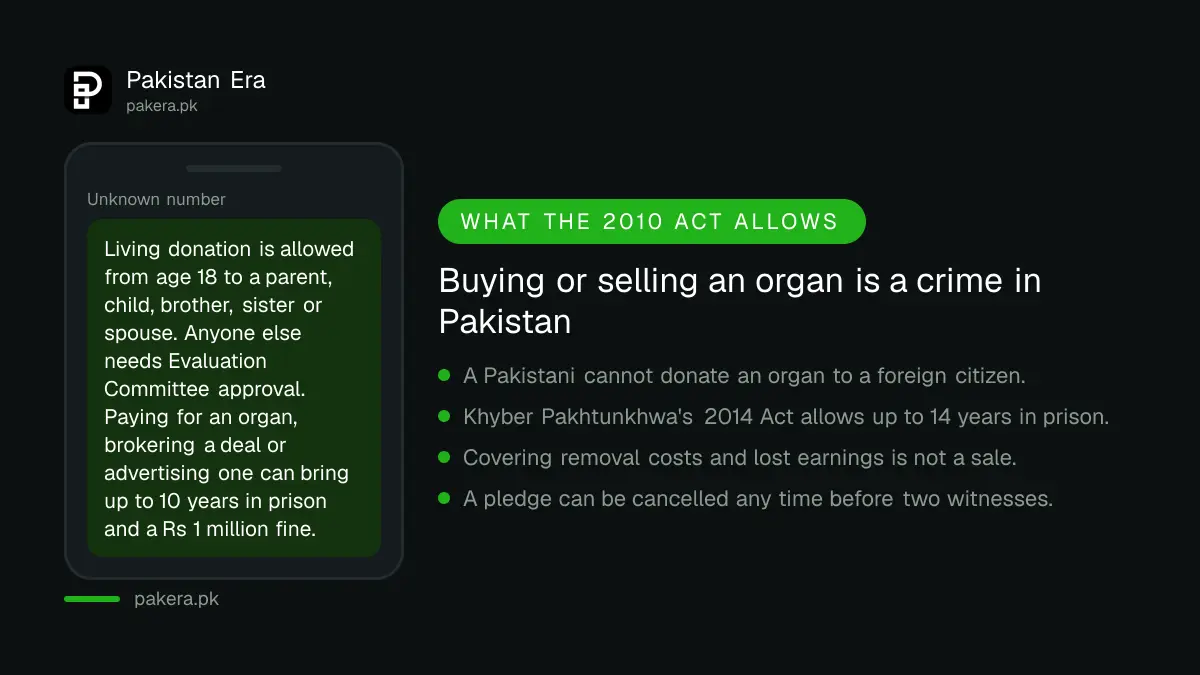
One detail protects donors' families. The Act's definition of "payment" excludes the cost of removing and transporting the organ, and any expenses or lost earnings caused by donating. Getting those costs back is not a sale. For people waiting on a kidney, treatment options while on the list include free dialysis in Pakistan.
Common questions
Who can become an organ donor in Pakistan?
Anyone aged 18 or over. The pledge must be in writing, signed and witnessed, and verified through an Evaluation Committee.
Is there a fee to register as an organ donor?
No. PHOTA's online form asks for no payment, and HOTA's Form 6 is a free download.
Can I cancel my organ donor pledge?
Yes, at any time while you are alive. The Act says you revoke it in the presence of two witnesses.
Can my family stop the donation after I die?
The law needs a close relative to inform the Evaluation Committee. If your family does not make that call, the donation will not happen in practice.
Can I donate a kidney to a friend?
Only with approval from the Evaluation Committee, which must be satisfied that the donation is voluntary. Close relatives do not need that extra approval.
Does the organ donor mark go on my CNIC automatically?
No. You register with a transplant authority first, then ask NADRA when you renew or reprint the card.
How we verified this
What we checked, where we read it, and what we could not confirm.
Last checked on 7 October 2026. We read the Transplantation of Human Organs and Tissues Act 2010 on the Pakistan Code and its Punjab version on the Punjab Code, the Khyber Pakhtunkhwa Medical Transplantation Regulatory Authority Act 2014 on the KP Code, and HOTA's Rules 2012 and forms on hota.gov.pk. We opened PHOTA's donation portal and read both forms. NADRA's rules document returned "Access Denied" for us, so the card details are reported, not confirmed at source.
About the author
Public Services and Education Journalist
Fajr Riaz is a journalist and content writer at Pakistan Era, based in Lahore. She covers the questions people meet in everyday life in Pakistan: how a public service works, what a change in the rules means, and where to find a reliable answer.