How to Invest in Mutual Funds in Pakistan With a CNIC
Invest in mutual funds in Pakistan: check the AMC on MUFAP, open an account with your CNIC, understand front-end load, 2026-27 dividend tax and the RDA route.
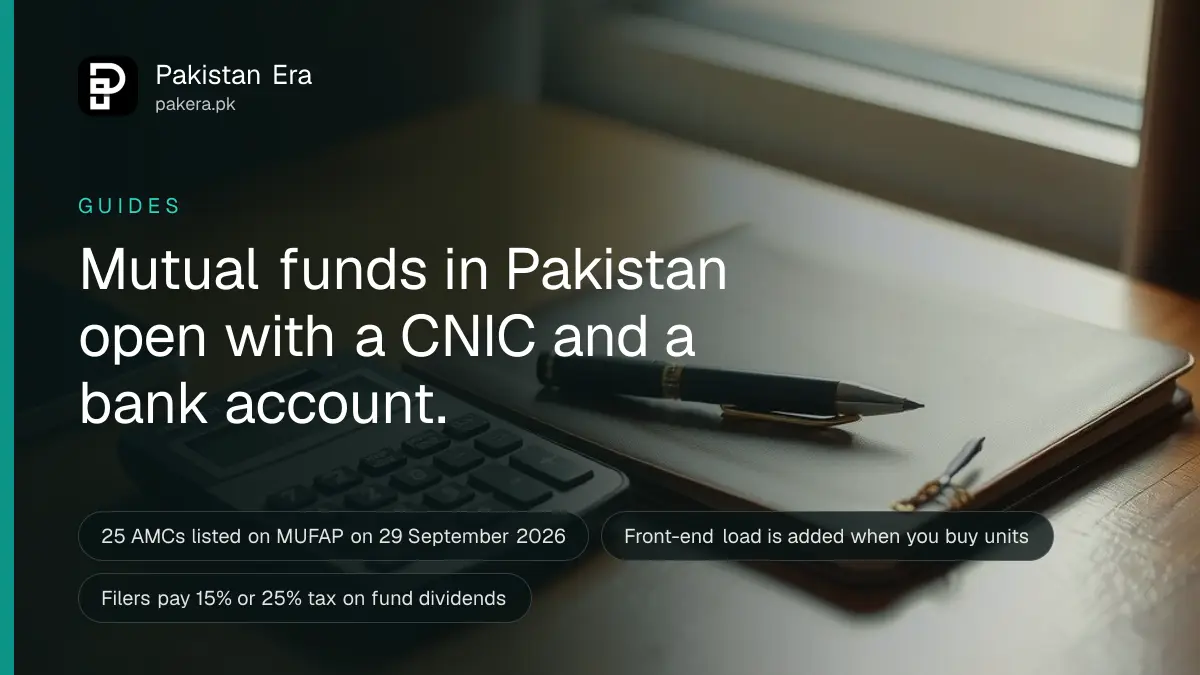
You can start investing in mutual funds in Pakistan with a CNIC, a bank account and an online form from any asset management company (AMC) that is a member of MUFAP. Check the fund on MUFAP's members directory first, read its risk profile and sales load, and never pay cash to an agent.
Mutual funds are regulated by the Securities and Exchange Commission of Pakistan (SECP). MUFAP, the Mutual Funds Association of Pakistan, is the industry body that publishes every fund's daily price, fees and risk label. On 29 September 2026 its members directory listed 25 asset management companies.
We read MUFAP's investor FAQ, its members directory and its daily NAV table, the State Bank of Pakistan's Roshan Digital Account pages, and FBR's withholding tax rate card for 2026-27. We did not open a fund account ourselves.
How a mutual fund works in Pakistan
A mutual fund pools money from many investors and a professional AMC invests it in shares, bonds, government securities or bank deposits. You get units, and each unit's price moves with the fund's investments. SECP regulates every fund, and MUFAP publishes their prices daily.
The unit price is called NAV, or net asset value. MUFAP's FAQ gives the formula in plain terms: the market value of everything the fund owns, minus what it owes, divided by the number of units issued. If the fund's bonds or shares gain value, your units gain value too.
Most funds you will see are open-end funds. That means you can buy new units or sell (redeem) your units on any working day at that day's price, by contacting the AMC.
SECP groups open-end funds into categories so investors can compare like with like. MUFAP lists them as money market, income, equity, capital protected, fixed rate or return, fund of funds, aggressive fixed income, balanced, asset allocation, index tracker, commodities and Shariah compliant schemes.
| Fund type | What it mostly holds | Risk label you will often see |
|---|---|---|
| Money market | Treasury bills, short bank deposits | Low |
| Income | Bonds, sukuk, longer deposits | Medium |
| Fixed rate or return | Instruments held to a set date | Very Low |
| Equity | Shares on the Pakistan Stock Exchange | Stated in the fund documents |
| Shariah compliant | Screened Islamic assets only | Depends on the fund |
The risk labels in the first three rows are the ones MUFAP's table showed against those categories on the day we checked. Equity funds carry more risk because share prices can fall sharply. Check the label on the fund's own fact sheet.
Check a fund on MUFAP before you invest
Before you send any money, confirm the AMC is on MUFAP's members directory and the fund appears in MUFAP's daily tables. Note its category, risk profile, NAV, offer price and expense ratio. A company that is not on the list is not a place for your savings.
The members directory shows each AMC's chief executive, number of funds, management quality rating, auditor and phone number. For example, on 29 September 2026 it listed Al Meezan Investment Management with 46 funds, ABL Asset Management with 37 and Alfalah Asset Management with 65, each rated AM1 by a credit rating agency. We name these only as examples from MUFAP's list, not as advice.
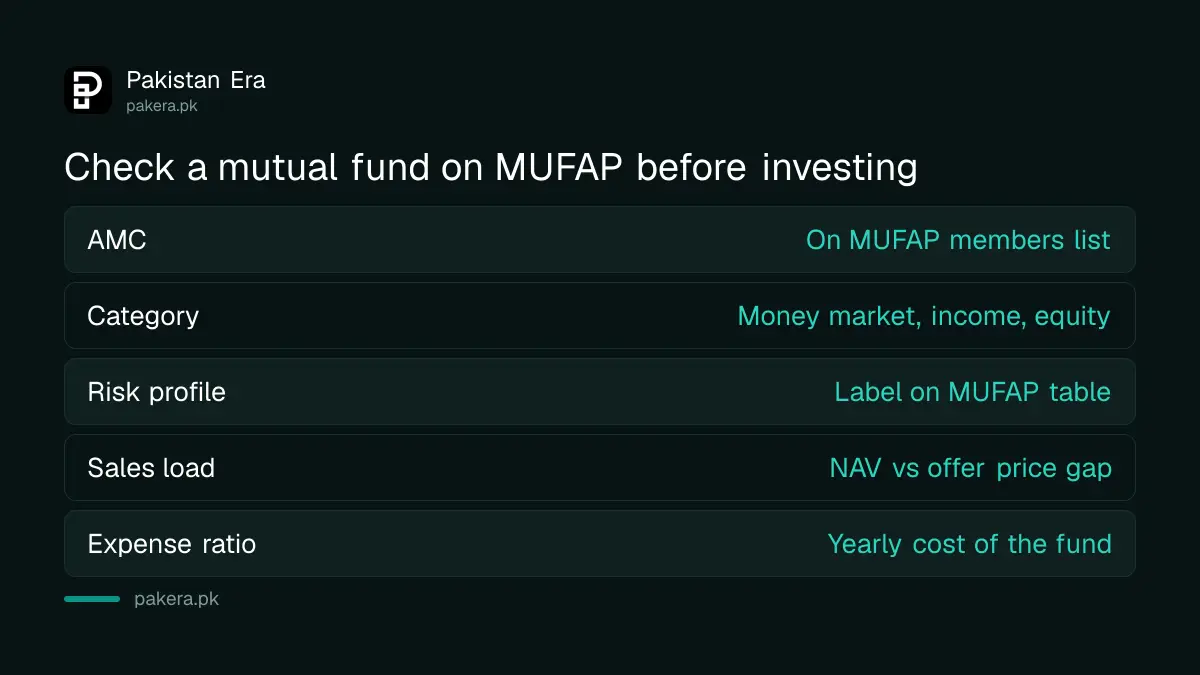
MUFAP's "NAVs and Sale Loads" page is the most useful one for a beginner. It shows each fund's NAV next to its offer price, which is what you actually pay per unit. The gap between the two is the sales load.
Also look at the expense ratio, which is the yearly cost of running the fund taken from the fund itself. You never see it as a bill, but it lowers your return every year.
Open a mutual fund account with your CNIC
Most AMCs let you open an account online. You fill in the account opening form, upload your CNIC, answer a risk profiling questionnaire and link a bank account. Money moves only from your own bank account to the fund's account, never in cash to a person.
MUFAP's FAQ lists the documents that go with the account opening form. Not all apply to every investor:
- Copy of CNIC, and Form B for a child's account
- Copy of NTN, if you have one
- Proof of business or employment
- Zakat declaration, where it applies
- FATCA and CRS forms, which are tax residence declarations
- KYC details and a risk profiling questionnaire
The Zakat declaration matters for Muslim investors. Without it, Zakat can be deducted on redemption, the same way it is from a bank account. The steps are the same as when you stop Zakat deduction from a bank account.
- Pick an AMC from MUFAP's members directory and open its website yourself.
- Choose a fund that matches your time frame and risk comfort.
- Fill the online form, upload your CNIC and finish the risk questionnaire.
- Transfer money from your own bank account to the fund's account shown in the form.
- Keep the unit confirmation or account statement the AMC sends you.

Front-end load and other fees cut your return
A front-end load is a sales fee added when you buy units. A back-end load is charged when you sell, usually only in funds with a lock-in period. MUFAP says both must be disclosed before you pay, so ask for them in writing.
Here is how the load shows up in practice. On 29 September 2026, one money market fund on MUFAP's table had a NAV of Rs 10.53 and an offer price of Rs 10.63. That gap is about 1 per cent. Put in Rs 100,000 and roughly Rs 950 goes on the load before any profit is earned.
That is why short holding periods rarely make sense in a fund with a load. Some funds show an offer price of zero on MUFAP's table, which usually means they are not selling new units at the moment. Always check the load in the fund's own offering document rather than trusting a sales call.
Tax on mutual fund dividends and gains
Dividends from mutual funds are taxed at source. FBR's 2026-27 rate card sets 15 per cent on the equity part and 25 per cent on the debt part for people on the Active Taxpayers List, and double for those who are not. Tax on gains is deducted when you redeem.
| Income | Filer (ATL) | Non-filer |
|---|---|---|
| Dividend, share of income from equities | 15% | 30% |
| Dividend, share of income from debt | 25% | 50% |
| Dividend from a fund earning 50% or more from profit on debt | 25% | 50% |
| Overseas Pakistani through Roshan Digital Account | 15% final | 15% final |
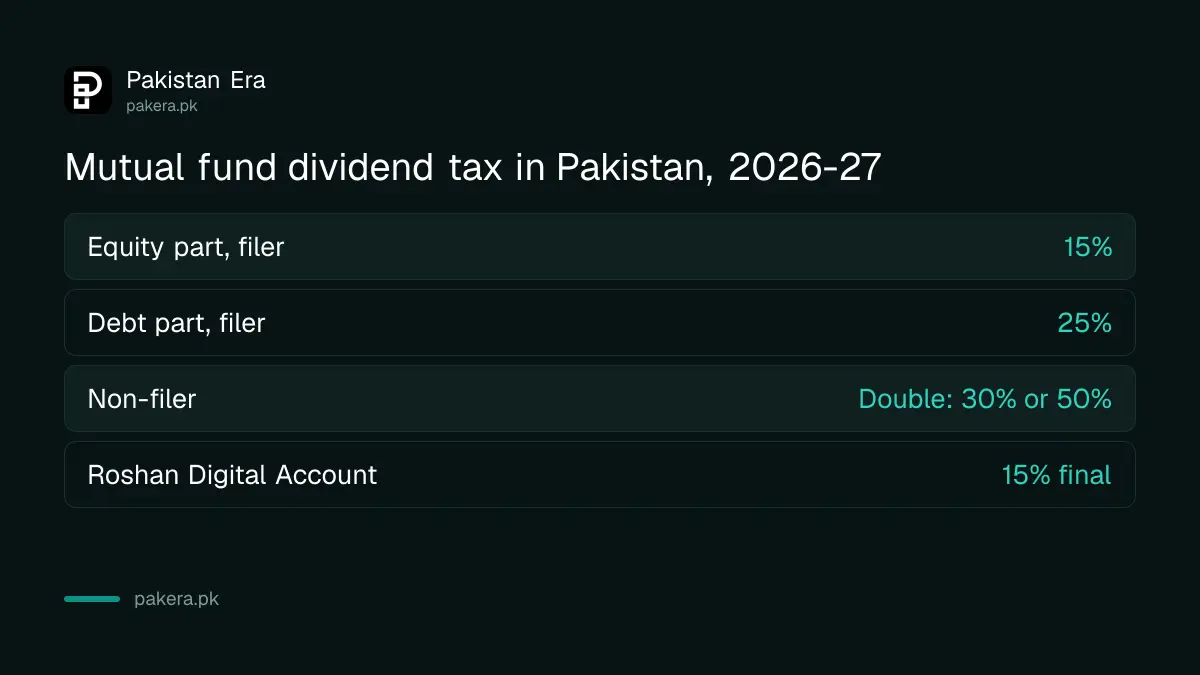
The non-filer rates are the main reason to check your filer status before you invest. Capital gains tax on redeemed units is worked out under section 37A of the Income Tax Ordinance and deducted by the AMC. The rate depends on when you bought and on the fund type. We could not read a current table of those rates on FBR's site, so read the deduction on your redemption statement.
The Roshan Digital route for overseas Pakistanis
Overseas Pakistanis can buy mutual funds through a Roshan Digital Account. SBP lists "Roshan Equity Investment" among the account's investment options. Gains and dividends then carry a final 15 per cent tax, with no return to file and no doubling for being off the Active Taxpayers List.
SBP's page says this tax regime covers investments made through the account in government securities, the stock market, mutual funds and property. Money can also be sent back abroad without separate approval. If you do not have an account yet, opening a Roshan Digital Account is the first step, and the bank then links you to the AMCs it works with.
Risks to understand before you invest
A mutual fund is not a bank deposit. No fund's return is promised unless it is a fixed return scheme, and even those depend on the fund holding its assets to the set date. Equity funds can lose money for months or years.
- Past returns on MUFAP's tables do not promise future returns.
- Income funds can fall when interest rates rise, because bond prices drop.
- Loads and expense ratios eat into small or short investments.
- An agent who asks for cash, or for money in a personal account, is a warning sign.
If you want share market exposure and are comfortable choosing companies yourself, investing directly in the PSX is the other route. For a fixed return with no market risk, compare the National Savings profit rates before you decide.
Common questions
What is the minimum amount to invest in a mutual fund in Pakistan?
Each AMC sets its own minimum in the fund's offering document. We did not find one industry minimum on MUFAP, so check the fund's page on the AMC's own website.
How do I check if a mutual fund company is genuine?
Look for the company on MUFAP's members directory, which lists every member AMC with its phone number and rating. Then find the fund in MUFAP's daily NAV table.
Can I withdraw my money from a mutual fund at any time?
From an open-end fund, yes, at that day's price on working days. A back-end load may apply if the fund has a lock-in period.
Is Zakat deducted from mutual fund investments?
It can be, on redemption, unless you submit a Zakat declaration with your account opening form. MUFAP lists it as one of the documents.
How much tax do non-filers pay on mutual fund dividends?
Double the filer rate: 30 per cent on the equity part and 50 per cent on the debt part, according to FBR's 2026-27 withholding tax rate card.
Can overseas Pakistanis invest in mutual funds?
Yes, through a Roshan Digital Account. SBP says gains and dividends are then taxed at a final 15 per cent, with no tax return needed.
How we verified this
What we checked, where we read it, and what we could not confirm.
Last checked on 29 September 2026. SECP's role, how funds work, the NAV formula, the definitions of front-end and back-end loads, the SECP fund categories and the account opening documents are read in MUFAP's investor FAQ. The count of 25 member AMCs, their fund numbers and ratings are read on MUFAP's members directory, and the Rs 10.53 NAV and Rs 10.63 offer price on MUFAP's open-end fund table, all on 29 September 2026. Dividend tax rates are read in FBR's Withholding Tax Rate Card updated to 30 June 2026 under the Finance Act 2026. The Roshan Equity Investment option and the 15 per cent final tax for Roshan Digital Account holders are read on the State Bank of Pakistan's Roshan Digital Account pages. SECP's own website blocked our automated check with a security page, so SECP rules are cited as MUFAP states them. We could not confirm the current capital gains tax rates on fund units at source.
About the author

Tax, Bills and Technology Writer
Ali Akhtar is a young and curious voice here at Pakistan Era. He is currently pursuing his A-Levels and has a growing interest in Pakistan’s changing industrial landscape and educational trends. Ali likes to write in a way that helps him explain and explore the world around him. His writing reflects the perspective of the new generation navigating the evolving trends of Pakistan where technology, youth innovation, and shifting opportunities are reshaping the country’s future.