How to Check an Earthquake in Pakistan: Magnitude and Epicentre From PMD
Felt a tremor? PMD's Recent Earthquakes table gives magnitude, depth and epicentre in UTC. How to read it, convert the time, and what NDMA says to do next.

To check an earthquake in Pakistan, open the Pakistan Meteorological Department's Recent Earthquakes table at weather.gov.pk/seismic/events. It lists the date, time, place, magnitude and depth of each event. Add five hours to its time, because the table runs on UTC, not Pakistan time.
The glass on the shelf rattles, the fan swings, and within a minute every family group chat is asking the same thing: was that an earthquake, how strong, and where? PMD's National Seismic Monitoring Centre in Islamabad answers all three for free, and for the quakes we checked it posted them the same day.
We read the table on 29 September 2026. It held 14,418 entries on one long page. The newest was dated 28 September 2026 at 19:45:01 UTC, a magnitude 5.0 event in eastern Honshu, Japan. The newest one inside Pakistan was a magnitude 4.1, 74 km west of Sost in Gilgit-Baltistan, at 07:27:03 UTC the same day.
PMD's Recent Earthquakes table is the official record
The Pakistan Meteorological Department (PMD) is responsible for seismic monitoring and tsunami warnings in Pakistan. Its National Seismic Monitoring Centre publishes every event it records in one table, newest first, with the place named in plain words.
The easiest way in is from the seismic home page at weather.gov.pk/seismic. It shows the latest events as cards, and the "Recent Earthquakes" menu item opens the full table. The old pmd.gov.pk address now only points you to weather.gov.pk, and the separate seismic.pmd.gov.pk address returned a server error when we tried it.
Each row of the table has nine columns:
| Column | What it tells you | Example from 28 September 2026 |
|---|---|---|
| Date | Day of the event | 28 Sep 2026 |
| Origin Time (UTC) | When the rupture began, in world time | 07:27:03, so 12:27 in Pakistan |
| Region | The epicentre, the point on the surface above the quake | 74 Km West of Sost, GB |
| Magnitude | The size of the earthquake | 4.1 |
| Depth (km) | How far underground it started | 35 |
| Latitude and Longitude | Exact position | 36.61 N, 74.05 E |
| Map Image | A "Show Map" button with the location | Opens a map |
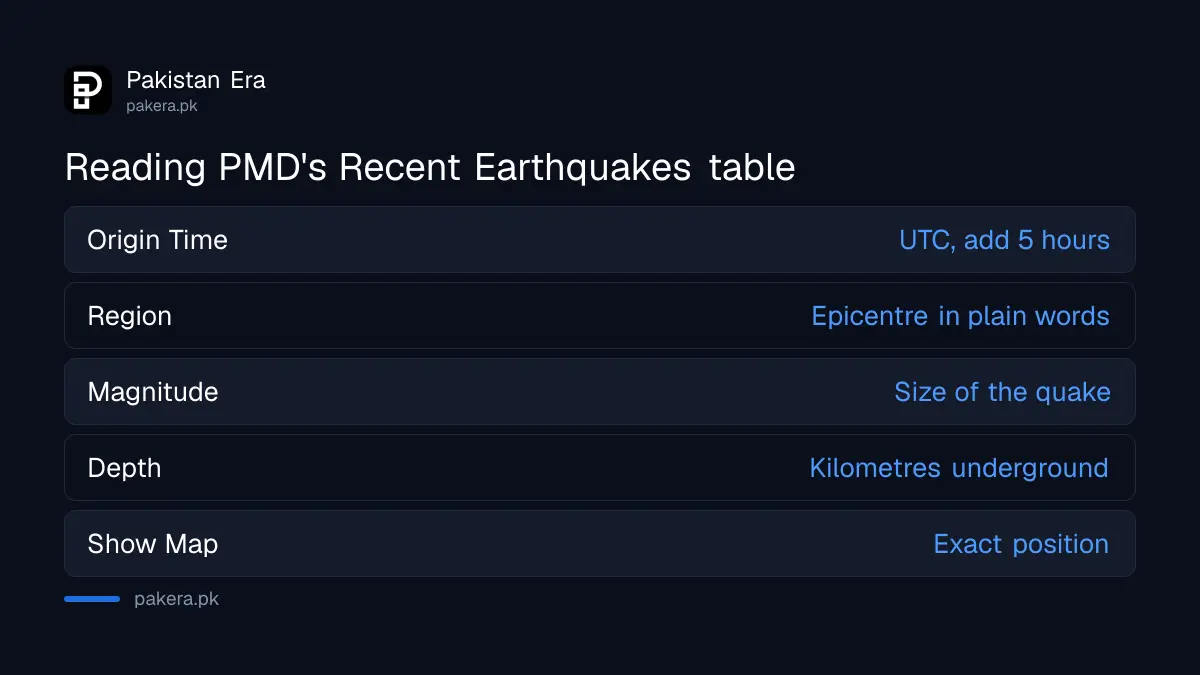
The table is not only about Pakistan. Of the 169 events it listed for September 2026 up to the 28th, most were in Afghanistan, Tajikistan, Japan and the Pacific. So read the Region column before you worry.
How to check an earthquake you just felt
Open the table, look at the top five rows, and match the time. Convert UTC to Pakistan time by adding five hours. If the Region names a place near you, that is your earthquake, with its magnitude and depth beside it.
- Note the time you felt the shaking, in Pakistan time.
- Open weather.gov.pk/seismic/events on your phone.
- Subtract five hours from your time to get UTC, and find that row.
- Read the Region for the epicentre and the Magnitude for the size.
- Open "Press Releases" on the same site for PMD's statement in Pakistan time.
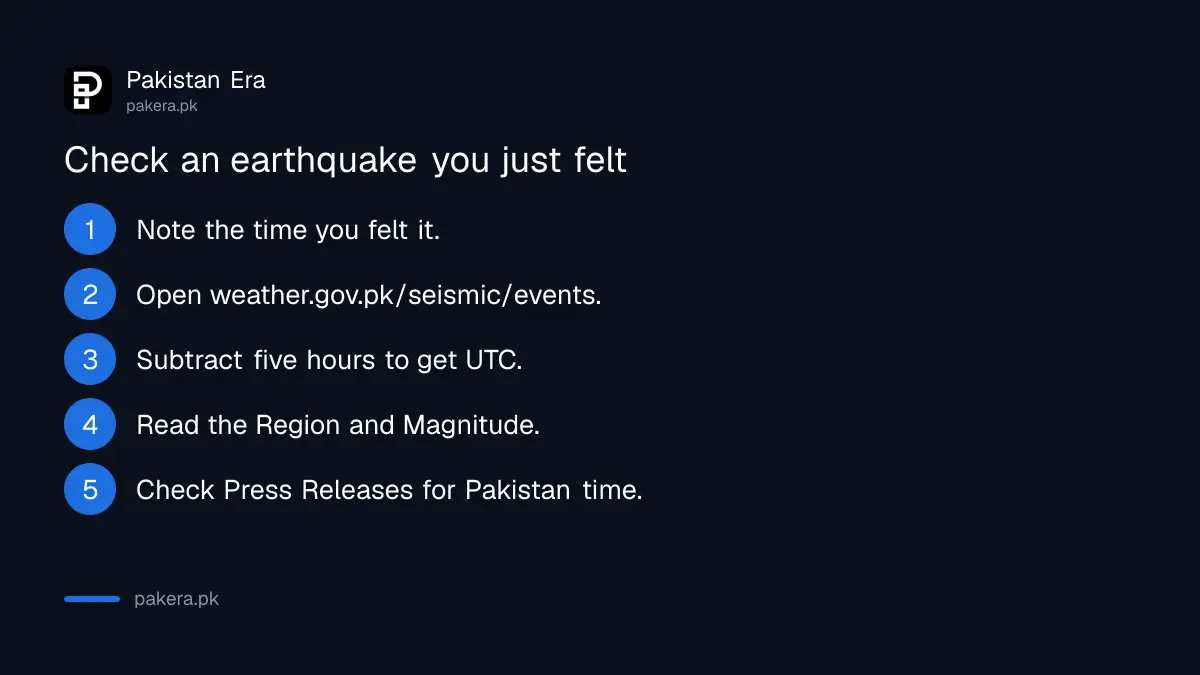
Give it a little time. A small quake may take a while to appear, and early numbers can be revised. If nothing shows yet, the shaking may have come from a distant, deep quake in the Hindu Kush, which PMD often lists with depths above 100 km. Those are felt across Khyber Pakhtunkhwa and Islamabad even though the epicentre is in Afghanistan.
PMD press releases give the Pakistan time
For events it treats as significant, PMD posts a short press release at weather.gov.pk/seismic/press-releases. It gives magnitude, depth, epicentre and the time in Pakistan Standard Time, with a PDF attached. It is the quickest official line to share.
The release for 28 September 2026 read, in full: an earthquake originated at 12:27 PST, magnitude 4.1, depth 35 km, latitude 36.61 N, longitude 74.05 E, epicentre 74 km west of Sost, GB. That matches the 07:27 UTC row in the table exactly, which is how you know the five-hour rule holds.
The list is busy. We counted releases dated 18, 20, 21, 22, 23, 25, 27 and 28 September 2026, with three on 22 September alone. So a press release does not mean damage. It means PMD recorded an event worth reporting.
Weather warnings sit elsewhere on the same site. The PMD weather forecast and warnings run from the main weather.gov.pk pages, not the seismic section.
Magnitude and depth tell you how serious it is
Magnitude measures the size of the quake. NDMA's Earthquake Guidelines 2026 call magnitude 4 small, 5 and 6 strong to major and able to damage communities, and 7 large. A shallow quake is usually felt more strongly than a deep one of the same size.
| Magnitude | NDMA's description |
|---|---|
| 0 to 3 | Microearthquakes |
| 4 | Small earthquakes |
| 5 and 6 | Strong to major, can damage communities |
| 7 | Large, can cause extensive damage |
| 8 and 9 | Great earthquakes, widespread damage |
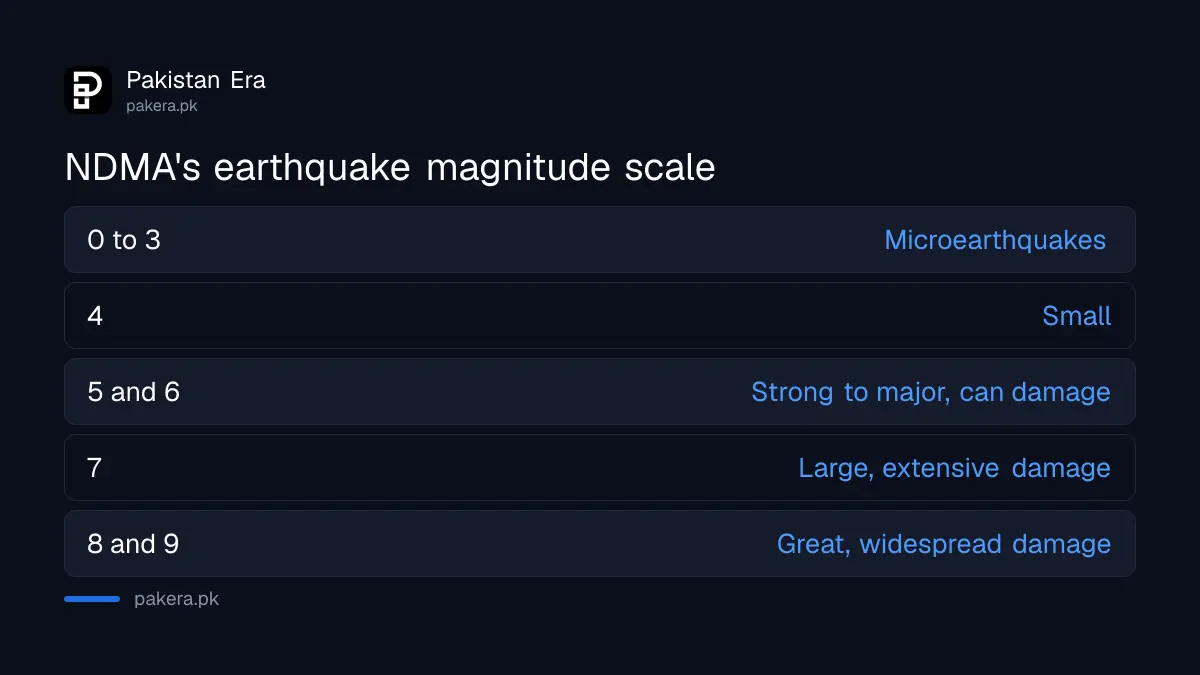
Pakistan's history shows why the numbers matter. NDMA's guidelines list the 1935 Quetta earthquake at 7.5 with more than 30,000 deaths, and the 2005 Balakot and Azad Kashmir earthquake at 7.6 with more than 80,000. Most rows in PMD's table are far smaller. The largest 2026 event we found placed inside Pakistan was a 5.5 in Gilgit-Baltistan on 26 March.
Depth changes the feel. The 28 September Sost quake started 35 km down. A Hindu Kush quake 190 km down can be the same magnitude and feel gentler, but it spreads over a much wider area.
What NDMA says to do during and after an earthquake
NDMA's advice is "Drop, Cover and Hold On". Get under a sturdy table or desk, cover your head and neck, and hold on until the shaking stops. Stay away from windows and heavy objects. Do not use lifts, and do not run for a doorway.
The National Disaster Management Authority published its Earthquake Guidelines 2026 on 23 January 2026. Here is what it tells the public, in short:
- Indoors: drop, cover and hold on. If there is no table, crouch in an inside corner and cover your head with your arms. Stay inside until the shaking stops.
- In bed: stay there and protect your head with a pillow, unless a heavy light fitting hangs above you.
- Outdoors: move to open ground, away from buildings, trees, streetlights and wires.
- Driving: stop when it is safe, pull over and stay in the car. Avoid bridges, flyovers and wires.
- Trapped under debris: do not light a match, cover your mouth with cloth, and tap on a pipe or wall. Shout only as a last resort.
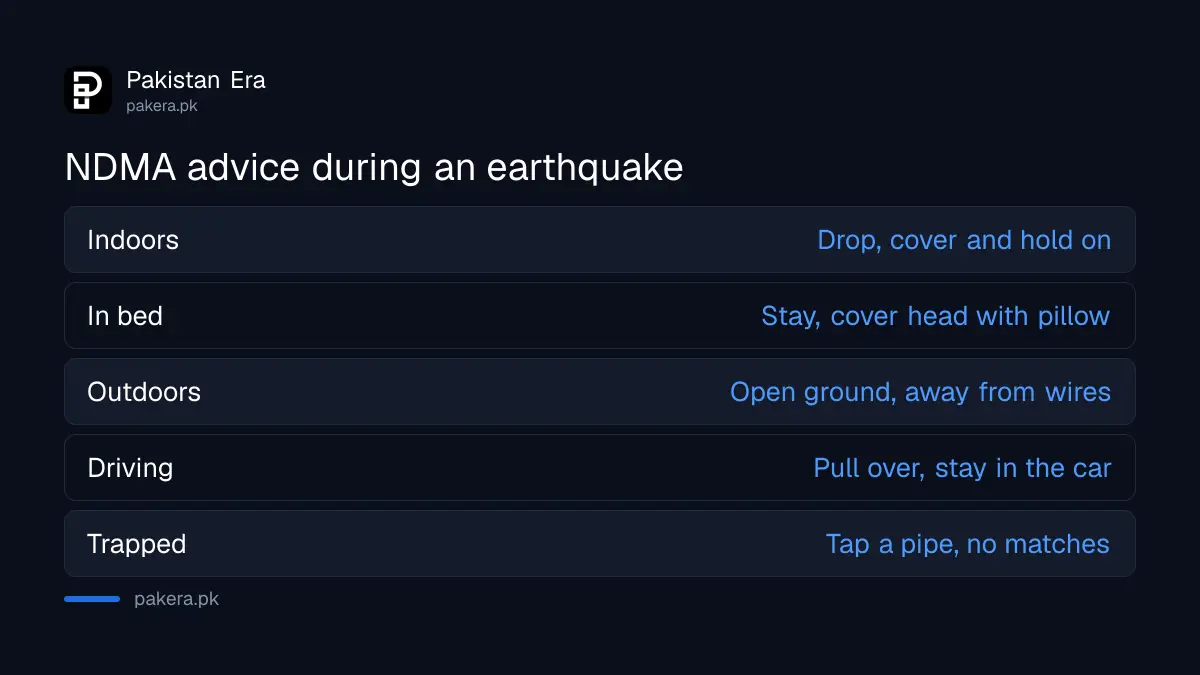
After the shaking, NDMA says check yourself for injuries, expect aftershocks, look for fire and gas leaks, and do not enter a partly damaged building. It also asks people not to tie up phone lines with casual calls, because others need them to reach help. The doorway myth is old advice, and NDMA says so directly: a modern doorway is no stronger than the rest of the house.
For help, NDMA's UAN is 051-111-157-157 and its WhatsApp line is 0300-0881641. Rescue services and other lines are on our list of emergency helpline numbers in Pakistan, and Rescue 1122 handles rubble and road rescue in the provinces where it runs.
NDMA alerts come through its app, not a live feed
NDMA runs the Global Disaster Early Warning Application on the Google Play Store. It sends alerts for earthquakes, floods, cyclones and heatwaves. For the facts of a quake that already happened, PMD's table is still the primary record.
The app page asks you to allow notifications and, if you like, location access for local warnings. NDMA's own disclaimer says to also follow local authorities and emergency services. Its advisories page is useful for guidance, but it has run days behind events before, as we found when testing flood warning websites. So do not wait for NDMA to confirm a quake you just felt. Check PMD first.
Common questions
Where can I check the latest earthquake in Pakistan?
On PMD's Recent Earthquakes table at weather.gov.pk/seismic/events. It lists date, UTC time, region, magnitude, depth and coordinates for every event its National Seismic Monitoring Centre records, newest at the top.
Why does PMD's earthquake time not match mine?
The table shows Origin Time in UTC. Pakistan is five hours ahead, so add five hours. PMD's press releases give the time in Pakistan Standard Time instead.
Is a magnitude 4 earthquake dangerous?
NDMA's guidelines describe magnitude 4 as small. It is often felt, but damage is not expected. Magnitudes 5 and 6 are described as strong to major and able to damage communities.
Can anyone predict an earthquake in Pakistan?
No. NDMA's guidelines list claims about animals, "earthquake weather" and dawn quakes as myths with no scientific basis. PMD records earthquakes after they happen. Be wary of messages that claim to predict one.
Should I stand in a doorway during an earthquake?
No. NDMA calls this outdated advice. Get under a sturdy table or desk, cover your head and neck, and hold on until the shaking stops.
How we verified this
What we checked, where we read it, and what we could not confirm.
We read PMD's Recent Earthquakes table, seismic home page and press releases on weather.gov.pk on 29 September 2026, including the release for 28 September 2026, and NDMA's Earthquake Guidelines 2026 PDF and Global Disaster Early Warning Application page on ndma.gov.pk the same day. Counts of events are from the table as it stood on 29 September 2026, and PMD may add or revise entries.
About the author

Senior Writer, Public Services and Technology
Shahid joined us in 2024 as an author. He is a senior contributor to Pakistan's leading technology websites. He writes detailed articles, mostly covering his expertise in the latest tech, mobiles, apps, gadgets, and step-by-step guides. His ideology is to help people understand the latest trends and explain complex methods through very easy-to-understand guides.