FBR Sets Up National Faceless Centre to Run Tax Audits Online
FBR set up a National Faceless Centre on 25 September 2026. Audit cases will be picked by computer and handled online by officers you never meet. Details.
FBR set up a National Faceless Centre in Islamabad on 25 September 2026. Tax audits and assessments will now be handled by officers the taxpayer never meets, on cases picked by a computer, with every notice, reply and hearing done online through IRIS.
The decision was taken by the Board in Council at its meeting that day, according to FBR's press release. It lands five days before the 30 September 2026 deadline for individual income tax returns, which makes it directly relevant to anyone filing this week.
We read the press release and the part of the Income Tax Ordinance, 2001 that the new centre rests on, on 26 September 2026.
What changes for a taxpayer picked for audit
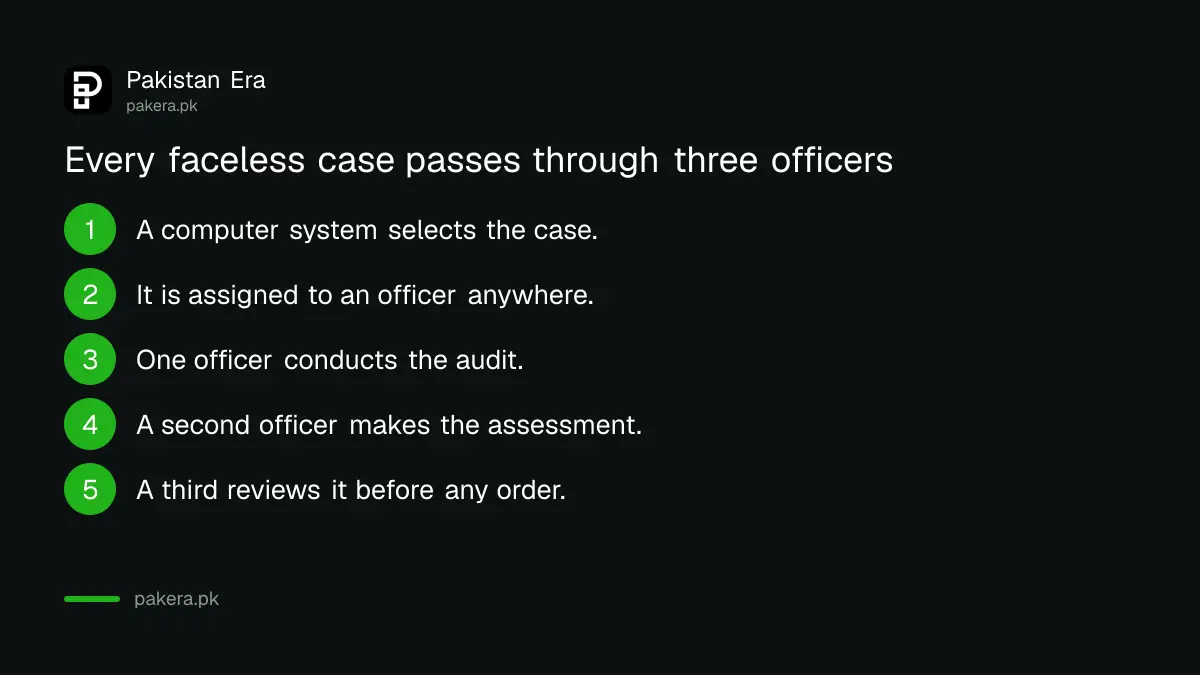
Until now, a return picked for audit went to one officer in one tax office, often with meetings in person. Under the new centre, a computer picks the case, a system assigns it to an officer anywhere in Pakistan, and the taxpayer is never told who that officer is.
FBR says the officer will also have no say in which case reaches them. That matters in both directions. The taxpayer cannot seek out a friendly officer, and an officer cannot choose a taxpayer to pursue.
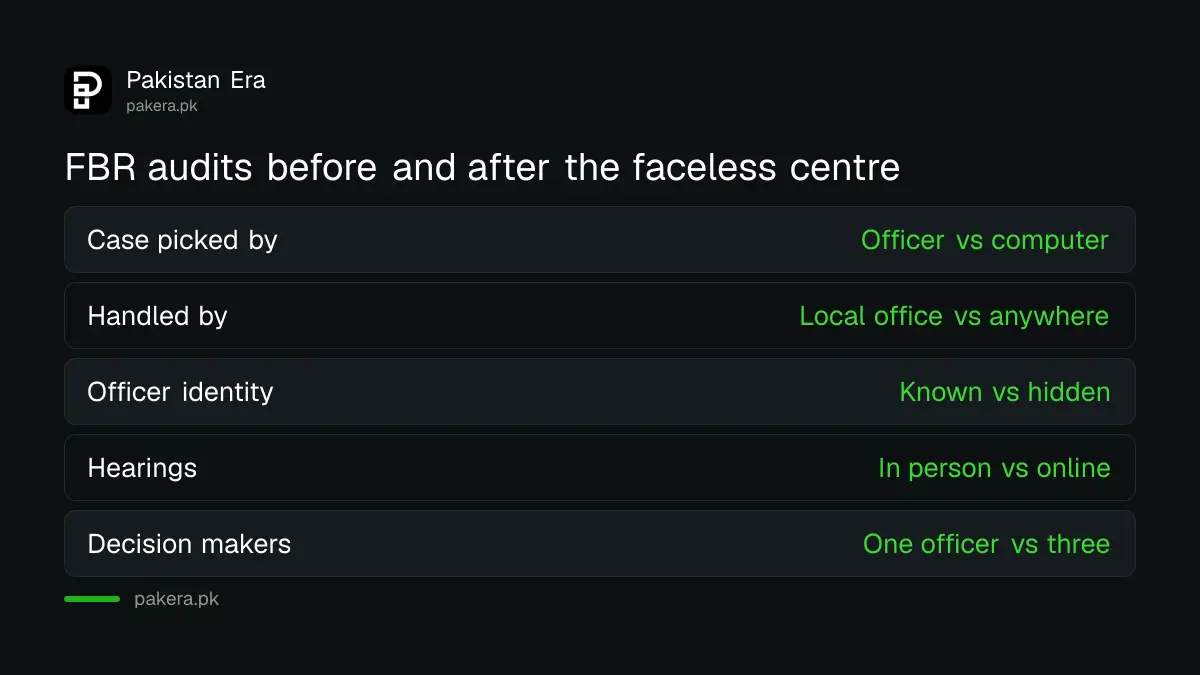
| Step | Before | Under the National Faceless Centre |
|---|---|---|
| Who picks the case | Officers in the field office | A computerised, risk based system |
| Who handles it | One officer in your local office | Assigned automatically, anywhere in Pakistan |
| Who you deal with | A named officer, often in person | An officer whose identity is kept from you |
| Notices and hearings | Paper, visits and meetings | Electronic, through IRIS |
| Who decides | The same officer from start to end | Three officers, one for each stage |
Physical work does not disappear entirely. Where the law requires a physical verification or recovery of tax, FBR says a separate field team will carry it out.
Three officers will handle every case
Each case passes through three separate officers. One conducts the audit, a second makes the assessment, and a third reviews the work for quality before any order is issued. FBR says no single officer will control a taxpayer's case from start to finish.
The centre will be headed by a Chief Commissioner Inland Revenue. It has separate wings for faceless audit, faceless assessment, quality control and field operations. FBR says a Programme Management Unit has already been set up to run the rollout.
FBR's stated aim is the same rules for every taxpayer, decisions based on data rather than personal judgement, and an end to face to face contact, which it describes as a long-standing source of complaints.
The law behind it is section 122E, added by the Finance Act 2026
The centre draws its power from the Finance Act 2026, which added section 122E to the Income Tax Ordinance. It allows audits, unexplained income orders, assessments and rectifications to be made "in a faceless manner", for persons or cases the Board specifies.
We read section 122E in FBR's consolidated copy of the Ordinance, amended up to 30 June 2026. It covers four kinds of proceedings:
- Audits under section 177 and section 214C, which is how returns are selected and examined.
- Orders under section 111, which adds unexplained income or assets to a person's income.
- Assessments under Part II of Chapter X of the Ordinance.
- Rectification of mistakes under section 221.
Where a taxpayer must be heard, or a statement taken on oath, section 122E says it will be done by e-hearing under section 227E. It adds that the identity of the officer running the e-hearing, "including facial and voice identity", shall be kept confidential. Section 227E also says a recording of an e-hearing is admissible as evidence before any forum or court.
The section 111 point is the one most filers should notice. Unexplained assets are exactly what a wealth statement that does not reconcile, or an asset left out of it, can lead to.
What is announced and what is not yet in force
The centre exists and the law allows faceless audits. What FBR has not yet published is the detail: which taxpayers or cases go through the centre, the procedure it will follow, and the date the first cases move to it.
Section 122E says faceless proceedings apply to "such persons or class of persons, or incomes or class of incomes, or cases or class of cases, as may be specified by the Board", in a manner "as may be prescribed by the Board". As of 26 September 2026, we found no notification on FBR's site specifying either. So it is not yet clear whether every audit will go through the centre, or only some.
FBR expects the centre to make tax proceedings faster, fairer and more transparent. That is FBR's expectation, not something that can be measured yet.
What it means for your return this week
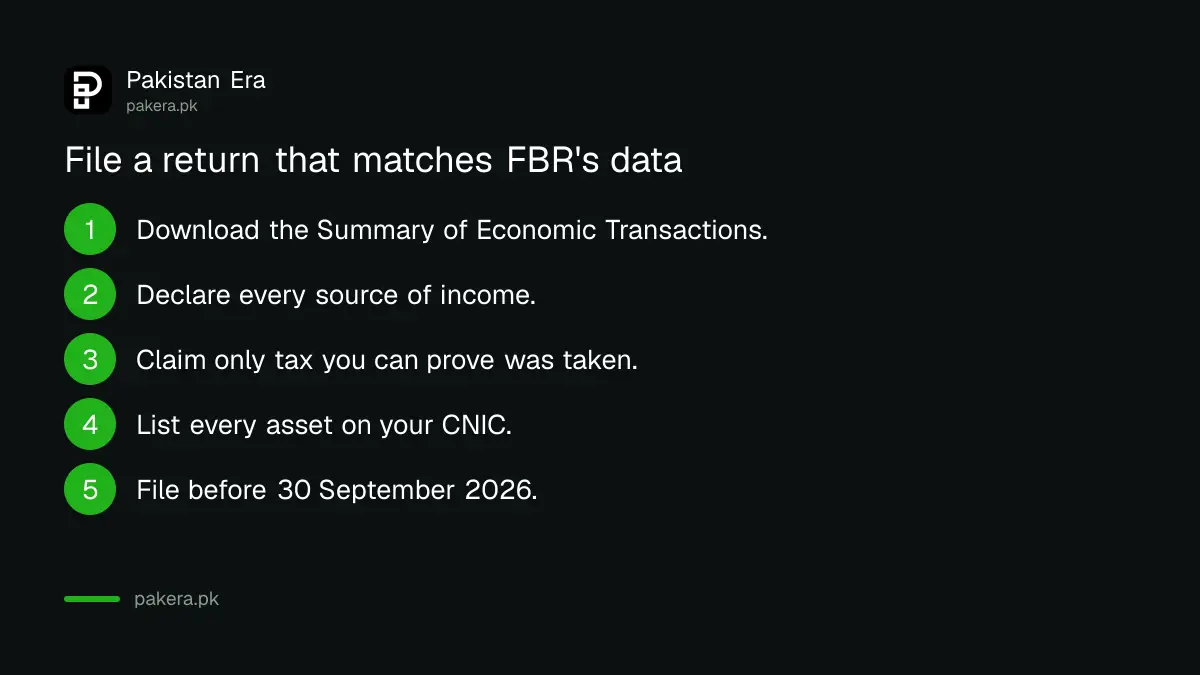
If audit cases are chosen by a computer that compares your return with FBR's own data, the safest return is one that matches that data. Check the tax already recorded against your CNIC before filing, and make sure your wealth statement explains every asset.
The tax year 2026 return already shows most filers a Summary of Economic Transactions, listing the tax withheld from them during the year. The practical steps on filling the tax return and wealth statement start from that screen, and cover which taxes you can claim back and the entries most likely to be flagged.
The deadline has not moved. As of 26 September 2026 we found no FBR notification extending it, and FBR told its tax offices to keep normal working hours on Saturday 26 September. Missing the 30 September deadline means a late penalty and a Rs 25,000 surcharge to get back on the Active Taxpayers List. If you have never filed, start by becoming a tax filer, and check your filer status afterwards.
Common questions
Will I ever meet the officer auditing my return?
No, under the new system. FBR says all notices, replies and hearings will be electronic, and the law keeps the officer's identity, including face and voice, confidential.
Does the National Faceless Centre start today?
It was set up on 25 September 2026, but FBR has not yet published which cases it covers or when the first cases move to it.
How will cases be selected for audit?
By a computerised, risk based system rather than by an officer, according to FBR's press release.
Can I still go to the tax office?
For audit and assessment cases handled by the centre, FBR says face to face contact ends. Field teams will still carry out physical verification or recovery where the law requires it.
Has the 30 September deadline been extended?
No. As of 26 September 2026 we found no FBR notification extending the deadline for tax year 2026 returns.
Is a faceless hearing recorded?
Section 227E of the Ordinance says a recording of an e-hearing is admissible as evidence before any forum or court of law.
How we verified this
What we checked, where we read it, and what we could not confirm.
Last checked on 26 September 2026. The setting up of the National Faceless Centre on 25 September 2026 by the Board in Council, the computerised risk based case selection, automatic assignment to officers anywhere in Pakistan, the three stage audit, assessment and quality review, electronic notices and hearings through IRIS, the separate field team, the Chief Commissioner Inland Revenue as head, its four wings and the Programme Management Unit are all from FBR's press release of 25 September 2026, which FBR's press release list shows dated 2 October 2026 although its text is dated 25 September. Section 122E and its scope, the reference to e-hearing under section 227E and the confidentiality of the officer's facial and voice identity are read in the Income Tax Ordinance, 2001, in FBR's consolidated copy amended up to 30 June 2026, where a footnote records that section 122E was inserted by the Finance Act, 2026. The admissibility of e-hearing recordings is from section 227E(2). Normal working hours for tax offices on Saturday 26 September 2026 are from FBR's letter F.No.6(1)S(IR-Operations)/2024 dated 23 September 2026. The absence of an extension or of a notification specifying faceless cases reflects what we found on FBR's site on 26 September 2026.
About the author

Tax, Bills and Technology Writer
Ali Akhtar is a young and curious voice here at Pakistan Era. He is currently pursuing his A-Levels and has a growing interest in Pakistan’s changing industrial landscape and educational trends. Ali likes to write in a way that helps him explain and explore the world around him. His writing reflects the perspective of the new generation navigating the evolving trends of Pakistan where technology, youth innovation, and shifting opportunities are reshaping the country’s future.