File Your FBR Tax Return by 30 September to Avoid a Rs 25,000 Surcharge
Miss 30 September and you pay Rs 1,000 a day plus Rs 25,000 to rejoin the ATL. A non-filer pays 10.5% buying a plot, a filer 1.25%.
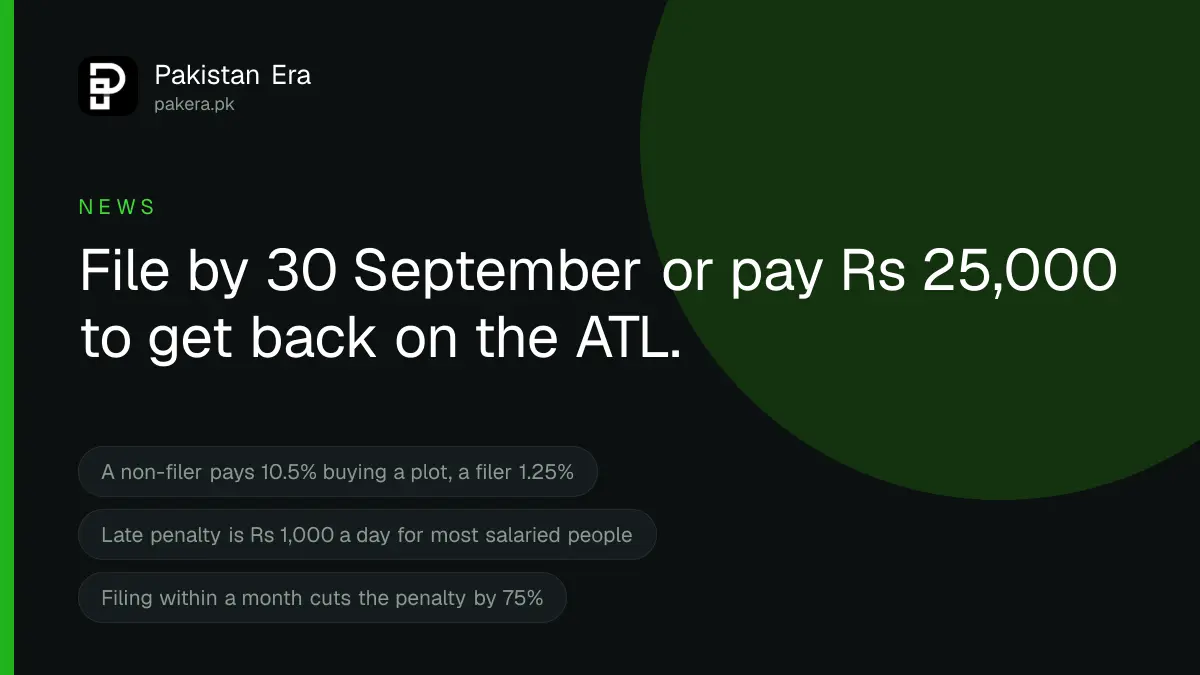
The last date to file your income tax return for tax year 2026 is 30 September 2026. Miss it and you are dropped from the Active Taxpayers List, you pay a late filing penalty that starts at Rs 1,000 a day, and you pay a further Rs 25,000 to get back on the list. Stay off it, and you pay more than eight times the tax a filer pays when you buy a property, and three times as much when you register a new car.
Latest, 30 September 2026: FBR has extended the deadline to 15 October 2026 by Circular No. 3 of 2026-27. The penalties below now apply from 16 October. Details of the extension.
Tax year 2026 covers income from 1 July 2025 to 30 June 2026. The deadline applies to salaried people, business owners, freelancers and associations of persons. Companies with a June year end have until 31 December.
We read the deadline, the penalty, the surcharge and every rate below in the Income Tax Ordinance 2001 itself, in FBR's consolidated copy amended up to 30 June 2026, on 21 September 2026. We found no FBR notification extending the deadline as of that date. Last year FBR refused to extend the tax year 2025 deadline, so do not plan on an extension this year.
What missing 30 September costs you
A late return costs you in two separate ways, and you pay both.
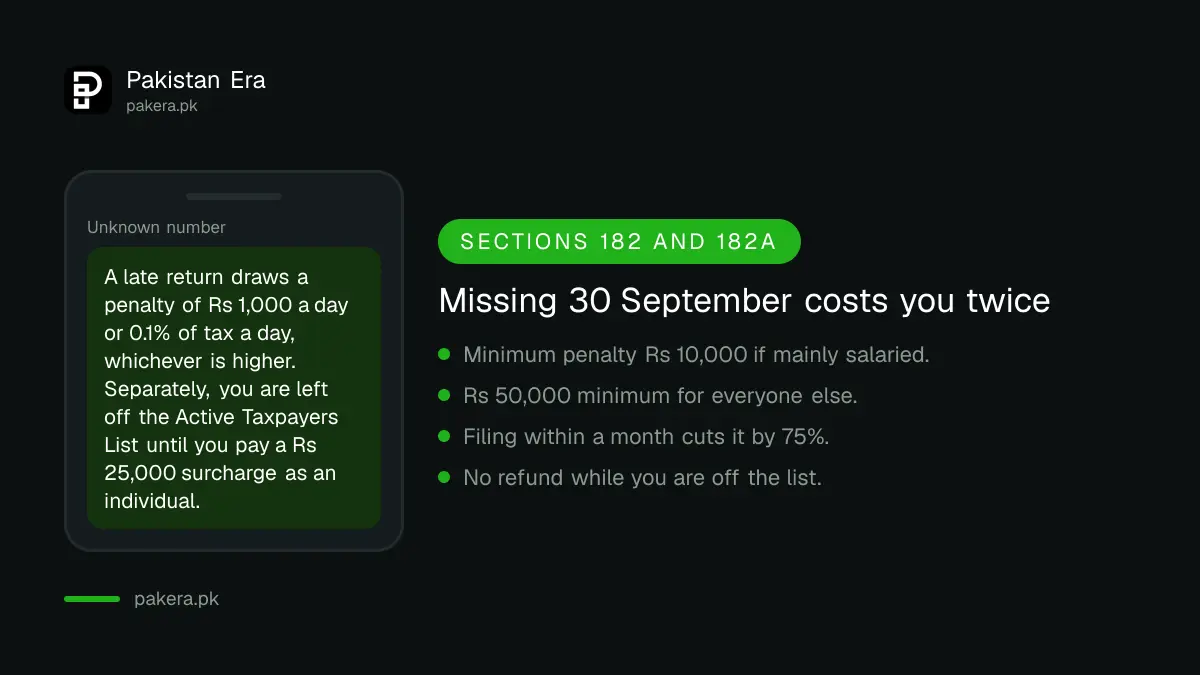
First, a penalty under section 182. It is the higher of Rs 1,000 for each day late, or 0.1% of your tax payable for each day late. The minimum is Rs 10,000 if at least three quarters of your income is salary, and Rs 50,000 for everyone else. The maximum is twice the tax payable for the year.
For most salaried people the Rs 1,000 a day figure is the one that applies. The 0.1% figure only becomes higher once your tax for the year passes Rs 1 million.
The law also rewards filing late rather than never. The penalty is cut by 75% if you file within one month of the deadline, by 50% within two months, and by 25% within three months.
Second, you lose your filer status. Under section 182A, a return filed after the due date does not put you on the Active Taxpayers List for that year. To get on it, you must pay a surcharge of Rs 25,000 as an individual, Rs 50,000 as an association of persons, or Rs 100,000 as a company. The Finance Act 2026 raised these from Rs 1,000, Rs 10,000 and Rs 20,000.
While you are off the list, section 182A also says you get no tax refund and cannot carry forward a business loss for that year.
Here is how it adds up for a salaried person whose tax is under Rs 1 million and who files 45 days late:
- Penalty at Rs 1,000 a day for 45 days: Rs 45,000.
- Filed within two months, so the penalty is cut by 50%: Rs 22,500.
- Surcharge to get back on the Active Taxpayers List: Rs 25,000.
- Total: Rs 47,500, for a return that would have cost nothing to file on time.
What filing on time saves you
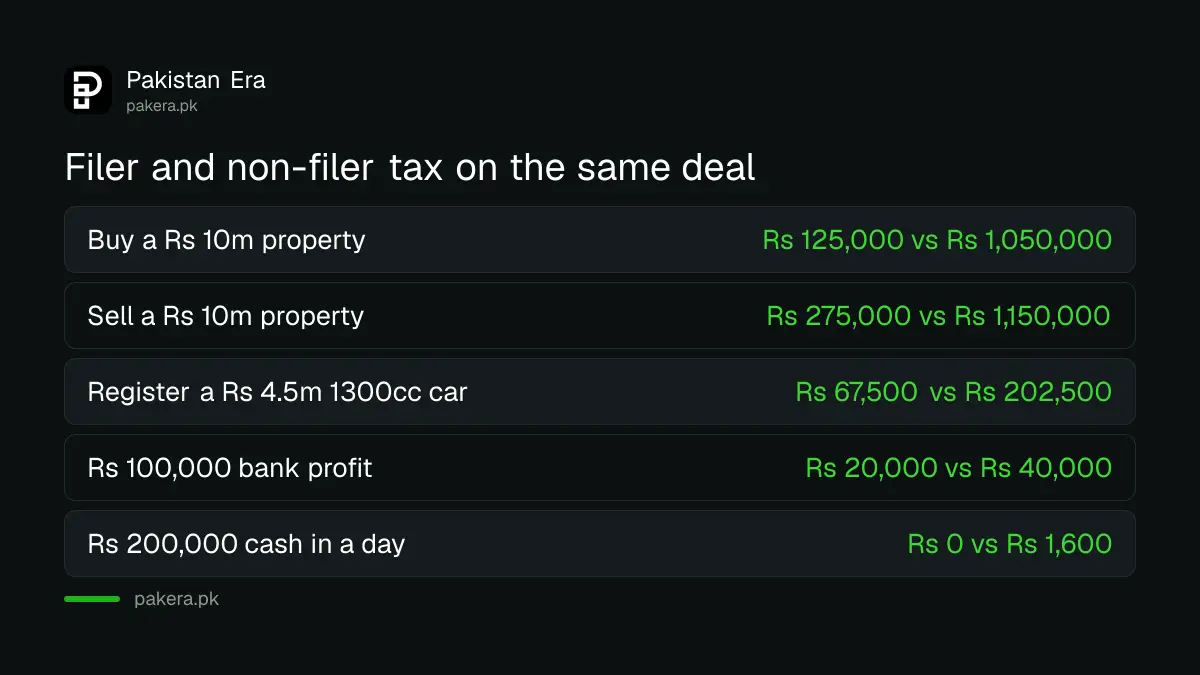
The bigger cost of missing the deadline is not the penalty. It is paying non-filer rates on everything you do until you are back on the list.
The Ordinance charges people not on the Active Taxpayers List double the normal rate on most transactions, three times the rate on vehicle registration, and special higher rates on property. These are the rates in force from 1 July 2026:
| Transaction | Filer rate | Non-filer rate | Filer pays | Non-filer pays |
|---|---|---|---|---|
| Buy a property worth Rs 10 million | 1.25% | 10.5% | Rs 125,000 | Rs 1,050,000 |
| Sell a property for Rs 10 million | 2.75% | 11.5% | Rs 275,000 | Rs 1,150,000 |
| Register a new 1,300cc car valued at Rs 4.5 million | 1.5% | 4.5% | Rs 67,500 | Rs 202,500 |
| Earn Rs 100,000 profit on a bank deposit | 20% | 40% | Rs 20,000 | Rs 40,000 |
| Withdraw Rs 200,000 cash in one day | Nil | 0.8% | Rs 0 | Rs 1,600 |
The property purchase rate for non-filers rises further with value: 14.5% on property worth Rs 50 million to Rs 100 million, and 18.5% above Rs 100 million. The filer rate stays at 1.25% at every value.
On a single Rs 10 million plot, a non-filer pays Rs 925,000 more than a filer. That is 37 times the Rs 25,000 surcharge.
If you cannot file by 30 September
There is no general extension, but section 119 of the Ordinance lets you ask for your own. The rule that catches people is the timing: you must apply before the deadline, not after it.
Apply in writing to your Commissioner Inland Revenue on or before 30 September. The Commissioner can grant up to 15 more days if you cannot file because you are away from Pakistan, because of illness or another misfortune, or for any other reasonable cause. If the Commissioner refuses, the Chief Commissioner can grant up to 15 days on a further application. Longer extensions are allowed only in exceptional circumstances.
An extension granted under section 119 counts as your due date, so filing within it keeps you on the Active Taxpayers List with no surcharge.
How to file before the deadline
You file online on FBR's IRIS portal or through the Tax Asaan mobile app. FBR formally notified the tax year 2026 return forms on 2 September 2026, by SRO 1495(I)/2026.
- Register on IRIS with your CNIC if you have never filed before.
- Gather your salary certificate, bank profit certificates and the tax deducted on your bills and transactions.
- Fill in the return for tax year 2026, and the wealth statement where it applies to you, then submit.
- Pay any tax due and keep the acknowledgement.
You can file your income tax return on IRIS in a browser, or file on the Tax Asaan app from a phone. IRIS login errors are worth sorting out now rather than on 30 September. If you are salaried, a salary tax calculator gives a rough figure for what you owe before you start.
Common questions
What is the last date to file an income tax return in 2026?
30 September 2026 for individuals, salaried people and associations of persons, for tax year 2026. Companies with a June year end have until 31 December 2026.
Has FBR extended the tax return deadline for 2026?
We found no FBR notification extending it as of 21 September 2026. You can apply for your own extension of up to 15 days under section 119, but only before 30 September.
What is the penalty for filing a tax return late?
The higher of Rs 1,000 a day or 0.1% of tax payable a day, with a minimum of Rs 10,000 for mainly salaried individuals and Rs 50,000 for others. It is cut by 75%, 50% or 25% if you file within one, two or three months.
How much is the ATL surcharge for a late filer?
Rs 25,000 for an individual, Rs 50,000 for an association of persons and Rs 100,000 for a company, from 1 July 2026.
How much more tax does a non-filer pay on property?
Buying, 10.5% to 18.5% of the value against 1.25% for a filer. Selling, 11.5% against 2.75%.
Is it worth filing if my income is below the taxable limit?
If you do not file, you are not on the Active Taxpayers List and pay the non-filer rates above. On one property deal or car registration, the saving from filing can be far larger than the effort.
How we verified this
What we checked, where we read it, and what we could not confirm.
Last checked 21 September 2026. The 30 September due date for salaried individuals and every person other than a company, and 31 December for companies, are read from section 118 of the Income Tax Ordinance 2001, in FBR's consolidated copy amended up to 30 June 2026. The individual extension of up to 15 days, the grounds for it, the requirement to apply by the due date, and the further extension by the Chief Commissioner are read from section 119. The late filing penalty, being the higher of 0.1% of tax payable or Rs 1,000 for each day of default, with minimums of Rs 10,000 for an individual with seventy five per cent or more income from salary and Rs 50,000 in other cases, a maximum of two hundred per cent of tax payable, and reductions of 75%, 50% and 25% for filing within one, two and three months, is read from entry 1 of the table in section 182. The exclusion from the Active Taxpayers List, the surcharge of Rs 25,000, Rs 50,000 and Rs 100,000 as substituted by the Finance Act 2026, and the bar on refunds and on carrying forward losses are read from section 182A. The filer rates of 1.25% under section 236K and 2.75% under section 236C are read from Divisions XVIII and X of Part IV of the First Schedule, and the non-filer rates of 10.5%, 14.5% and 18.5% under section 236K and 11.5% under section 236C, the doubling of other rates and the tripling of the section 231B rate are read from rule 1 of the Tenth Schedule. The vehicle and bank profit rates are read from FBR's Withholding Income Tax Rate Card updated up to 30 June 2026 as per the Finance Act 2026, and agree with the Ordinance; the card states that the Ordinance prevails over it. The worked examples are our own arithmetic on those rates. SRO 1495(I)/2026 dated 2 September 2026, which notifies the tax year 2026 return forms, is read on FBR's site. FBR's refusal to extend the tax year 2025 deadline is from its press release of 29 September 2025. Nothing here is tax advice for your own circumstances.
About the author

Tax, Bills and Technology Writer
Ali Akhtar is a young and curious voice here at Pakistan Era. He is currently pursuing his A-Levels and has a growing interest in Pakistan’s changing industrial landscape and educational trends. Ali likes to write in a way that helps him explain and explore the world around him. His writing reflects the perspective of the new generation navigating the evolving trends of Pakistan where technology, youth innovation, and shifting opportunities are reshaping the country’s future.