Salary Tax Calculator Pakistan 2026-27: Rs 50,000 to Rs 500,000 a Month
Monthly tax on every salary from Rs 50,000 to Rs 500,000 under the Finance Act 2026 slabs, read in the Gazette, plus how to check your payslip.
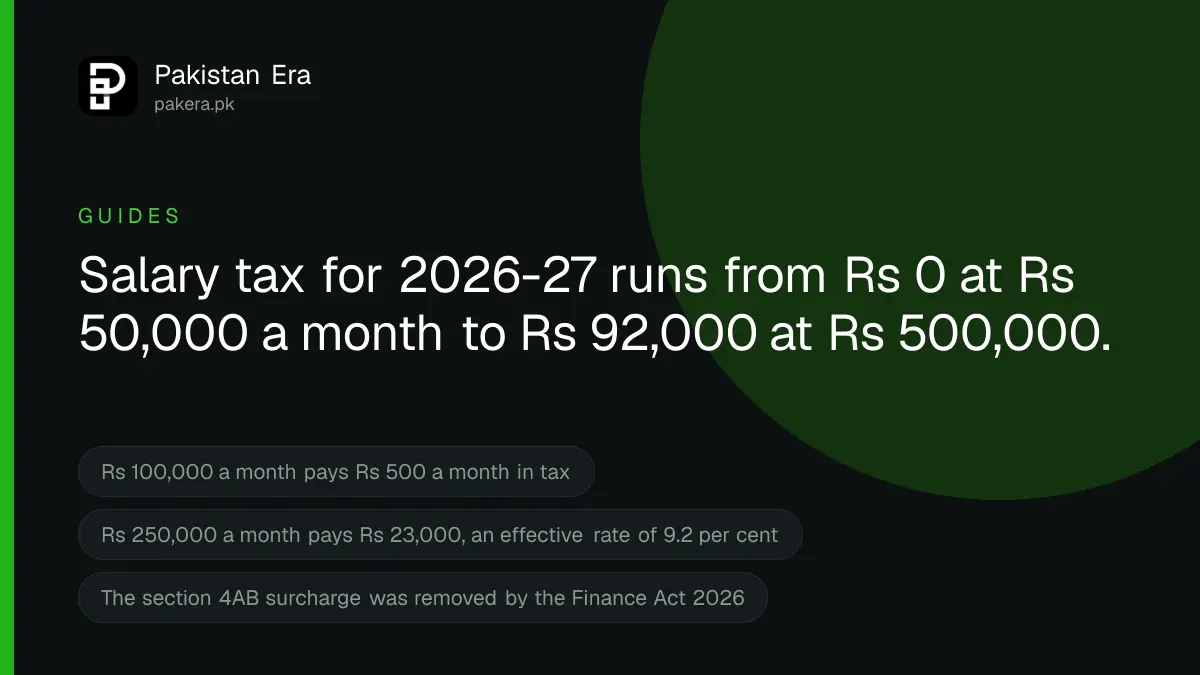
A salary of Rs 100,000 a month pays Rs 500 a month in income tax for 2026-27. Rs 200,000 pays Rs 13,000. Rs 500,000 pays Rs 92,000. Those figures come from the eight salary bands in the Finance Act 2026, which we read in the Gazette of Pakistan of 26 June 2026, and the full table from Rs 50,000 to Rs 500,000 is below, with the arithmetic shown once so you can check your own payslip.
Payroll departments get this wrong more often than people expect, especially in July and August after the slabs change. A salary tax calculator for Pakistan only helps if it uses the bands that are actually in force, so before building the table we went to the Act itself rather than to another website's copy of it.
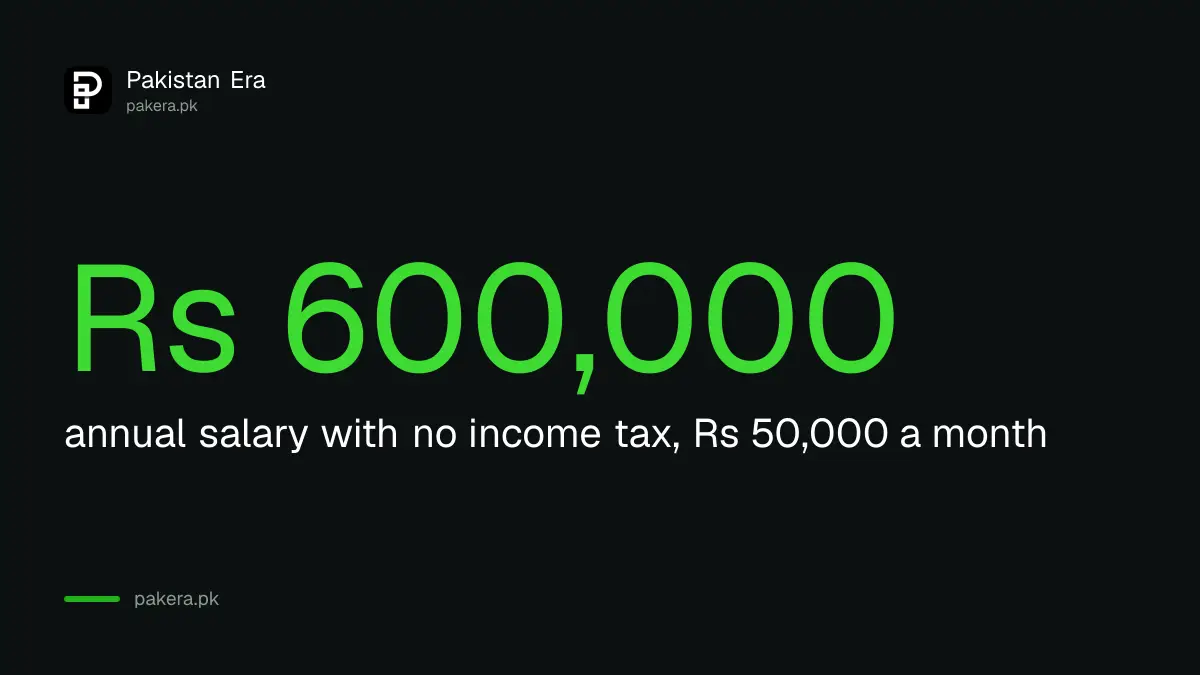
The Act is clear on one thing that matters to a lot of people: nothing is taxed on the first Rs 600,000 a year. That is Rs 50,000 a month, and it has not moved. The National Assembly Secretariat published the Finance Act, 2026 in the Gazette on 26 June 2026, and section 1 of the Act says it came into force on 1 July 2026.
What are the salary tax slabs for 2026-27?
Eight bands, starting at nil and ending at 35 per cent above Rs 7 million a year. Each band charges a fixed amount plus a percentage of only the income above the band's lower line. Clause (44) of the Finance Act 2026 substitutes this table into Division I of Part I of the First Schedule to the Income Tax Ordinance, 2001.
| Annual taxable salary | Tax for 2026-27 |
|---|---|
| Up to Rs 600,000 | Nil |
| Rs 600,001 to Rs 1,200,000 | 1% of the amount over Rs 600,000 |
| Rs 1,200,001 to Rs 2,200,000 | Rs 6,000 plus 11% of the amount over Rs 1,200,000 |
| Rs 2,200,001 to Rs 3,200,000 | Rs 116,000 plus 20% of the amount over Rs 2,200,000 |
| Rs 3,200,001 to Rs 4,100,000 | Rs 316,000 plus 25% of the amount over Rs 3,200,000 |
| Rs 4,100,001 to Rs 5,600,000 | Rs 541,000 plus 29% of the amount over Rs 4,100,000 |
| Rs 5,600,001 to Rs 7,000,000 | Rs 976,000 plus 32% of the amount over Rs 5,600,000 |
| Above Rs 7,000,000 | Rs 1,424,000 plus 35% of the amount over Rs 7,000,000 |
These are the same bands set out in the salary tax slabs for 2026-27, which explains what changed from last year and why a raise never leaves you worse off. The difference here is that we have now read them in the Gazette text rather than in reporting, and the figures match exactly.
One condition applies. The salaried table is for people whose salary is more than 75 per cent of their taxable income. A person with a large rental or business income alongside a salary falls under the other individual table, which is not covered here.
How much tax do you pay each month on your salary?
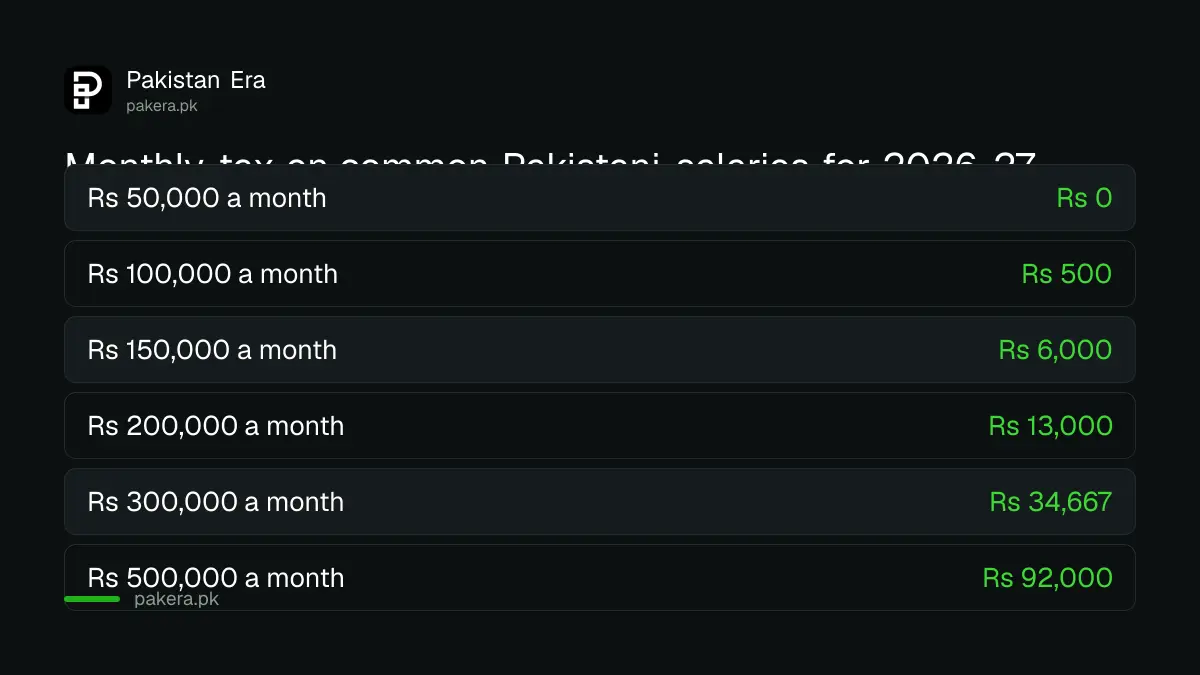
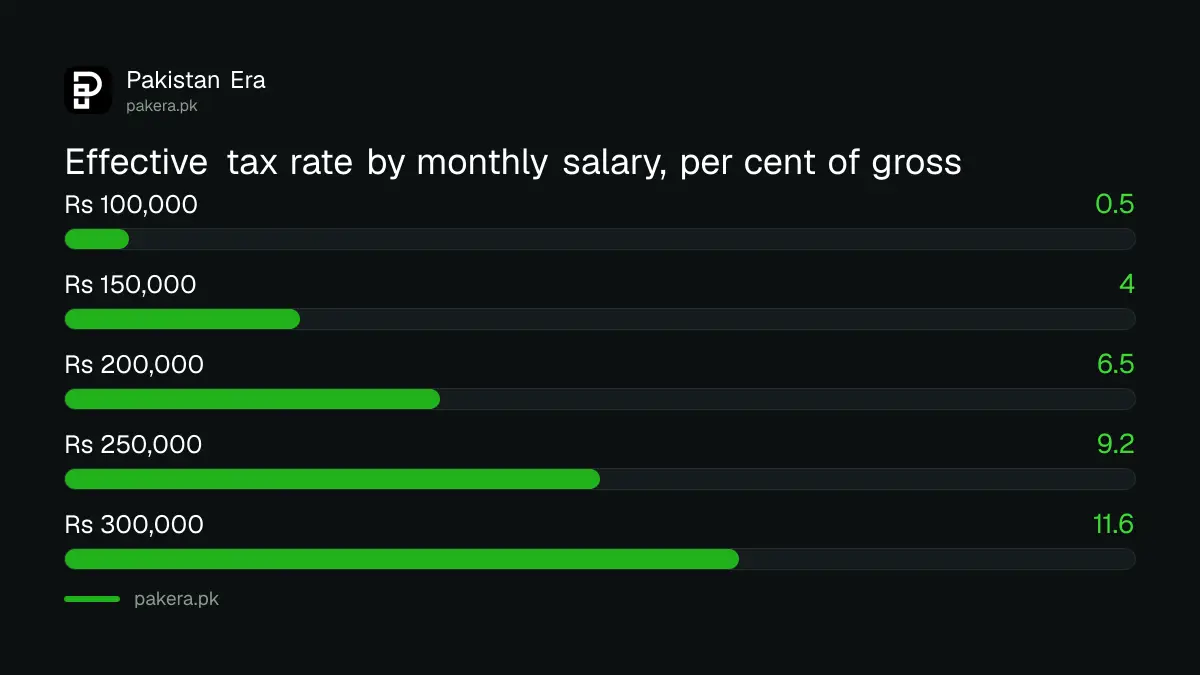
Here is the table most people actually want. Gross monthly salary on the left, the annual tax on that salary in the middle, and the monthly deduction on the right, which is the annual figure divided by 12. The last column is the effective rate, meaning tax as a share of the whole salary.
| Monthly gross | Annual salary | Annual tax | Monthly tax | Effective rate | Monthly take home |
|---|---|---|---|---|---|
| Rs 50,000 | Rs 600,000 | Rs 0 | Rs 0 | 0% | Rs 50,000 |
| Rs 75,000 | Rs 900,000 | Rs 3,000 | Rs 250 | 0.3% | Rs 74,750 |
| Rs 100,000 | Rs 1,200,000 | Rs 6,000 | Rs 500 | 0.5% | Rs 99,500 |
| Rs 125,000 | Rs 1,500,000 | Rs 39,000 | Rs 3,250 | 2.6% | Rs 121,750 |
| Rs 150,000 | Rs 1,800,000 | Rs 72,000 | Rs 6,000 | 4.0% | Rs 144,000 |
| Rs 175,000 | Rs 2,100,000 | Rs 105,000 | Rs 8,750 | 5.0% | Rs 166,250 |
| Rs 200,000 | Rs 2,400,000 | Rs 156,000 | Rs 13,000 | 6.5% | Rs 187,000 |
| Rs 250,000 | Rs 3,000,000 | Rs 276,000 | Rs 23,000 | 9.2% | Rs 227,000 |
| Rs 300,000 | Rs 3,600,000 | Rs 416,000 | Rs 34,667 | 11.6% | Rs 265,333 |
| Rs 350,000 | Rs 4,200,000 | Rs 570,000 | Rs 47,500 | 13.6% | Rs 302,500 |
| Rs 400,000 | Rs 4,800,000 | Rs 744,000 | Rs 62,000 | 15.5% | Rs 338,000 |
| Rs 450,000 | Rs 5,400,000 | Rs 918,000 | Rs 76,500 | 17.0% | Rs 373,500 |
| Rs 500,000 | Rs 6,000,000 | Rs 1,104,000 | Rs 92,000 | 18.4% | Rs 408,000 |
Take home here means gross minus income tax only. Provident fund, EOBI and any loan recovery come off separately and are set by your employer, not by the Act.
The jump between Rs 100,000 and Rs 125,000 a month looks harsh, from Rs 500 to Rs 3,250. That is the 11 per cent band starting at Rs 1.2 million a year. The rate is still only charged on the slice above the line, so the extra Rs 25,000 of salary costs Rs 2,750 of tax and leaves Rs 22,250 in your pocket. More salary is always more money.
For a salary not in the table, the salary tax calculator on this site runs the same bands and shows the monthly deduction, the effective rate and the take home figure for any amount you type in.
How is the monthly tax worked out?
Multiply the monthly salary by 12, find the band, add the fixed amount to the rate on the excess, then divide by 12. That is the whole method, and it is what section 149 of the Ordinance tells your employer to do on your estimated annual salary. Here it is once, for Rs 250,000 a month.
- Annual salary: Rs 250,000 multiplied by 12 is Rs 3,000,000.
- Band: Rs 3,000,000 sits in the fourth band, Rs 2,200,001 to Rs 3,200,000.
- Excess over the band's lower line: Rs 3,000,000 minus Rs 2,200,000 is Rs 800,000.
- Tax on the excess: 20 per cent of Rs 800,000 is Rs 160,000.
- Add the fixed amount: Rs 116,000 plus Rs 160,000 is Rs 276,000 for the year.
- Monthly deduction: Rs 276,000 divided by 12 is Rs 23,000.
Notice what the fixed amount is. Rs 116,000 is exactly the tax on the three bands below, added up: nothing on the first Rs 600,000, Rs 6,000 on the next Rs 600,000 at 1 per cent, and Rs 110,000 on the next Rs 1,000,000 at 11 per cent. Every fixed figure in the table reconciles this way, which is a quick test that a slab table you find elsewhere has not been mistyped.
Two things change the answer in real payrolls. A bonus or a mid-year raise lifts the estimated annual salary, so the deduction on later months rises to catch up. And an employee who joins in, say, January has a shorter tax year with the same bands, so the annual estimate is what is actually expected between the joining date and 30 June. The mechanics of that estimate, and the tax credits an employer must adjust for, are set out in the piece on how salary tax is deducted under section 149.
Does the 10 per cent surcharge still apply to salaries?
No. The Finance Act 2026 removed it. Section 4AB of the Ordinance had carried a surcharge on higher incomes, and going into this budget it stood at 9 per cent of the income tax where income exceeded Rs 10 million in a year. Clause (2) of the 2026 Act replaces the words setting that nine per cent surcharge with the words "no surcharge shall be payable". Older payroll notes still call it the 10 per cent surcharge, which was its original rate.
FBR's own Withholding Income Tax Rate Card, updated to 30 June 2026 for the Finance Act 2026, agrees. Its section 149 salary rows list the eight bands above and no surcharge line. We did notice that the card's pension row still prints "surcharge @ 10.00%" against section 4AB, which reads like an old line that survived the update. The card itself says it cannot be produced as a legal document, and on this point the Act is the authority. For a salary, there is no surcharge in 2026-27.
That matters for anyone on Rs 850,000 a month or more, which is where Rs 10 million a year begins. On Rs 12 million a year, the slab tax is Rs 3,174,000. Last year another 9 per cent of that, Rs 285,660, would have gone on top. This year it does not.
How do you check the tax on your payslip?
Find the line marked income tax, tax under section 149, or WHT on salary, and compare it with the table above for your gross. If they match, your payroll is using the right bands. If they do not, work out why before you complain, because a mismatch is not always an error.
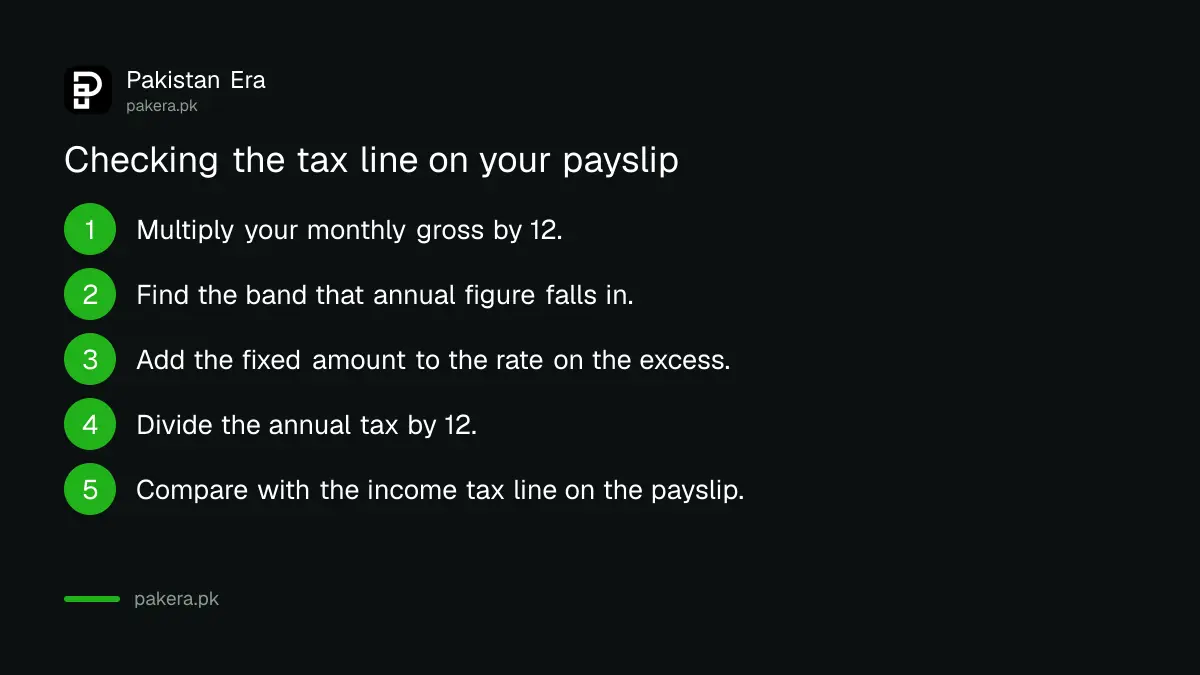
Four reasons a payslip can differ from the table, all legitimate:
- Taxable salary is not the same as gross. Some allowances are exempt, and the employer's own contribution to a recognised provident fund is treated separately. Ask which figure the tax was computed on.
- A bonus, arrears or a raise earlier in the year lifted the annual estimate, so the remaining months carry a higher deduction to true up.
- Tax already withheld from you elsewhere, such as on a car registration or a mobile bill, can be adjusted against the salary deduction under section 149 if you gave payroll the evidence.
- The July and August deductions were run on last year's bands and the difference is being recovered or refunded over the following months.
Two reasons that are errors: a flat percentage applied to every month regardless of the annual figure, and the old 2025-26 bands still loaded in the payroll software in September. Both show up as a monthly figure that does not match any row above and does not match the tool either. Take the working to payroll with the number, and ask for the tax deduction certificate at the end of the year, which the employer must issue.
Whether or not the deduction is right, the return is a separate duty. Salary tax is withheld whether you file or not, but staying on the Active Taxpayer List is what keeps you off the higher non-filer rates on bank transactions and property, and the cost of getting back on the ATL after the deadline is now Rs 25,000 for an individual. The return for tax year 2026 is due on 30 September 2026, and the process is in the notes on filing an income tax return in Pakistan.
Which tax year do these figures belong to?
Tax year 2027 in FBR's numbering, which is the year ending 30 June 2027, and which everybody outside FBR calls 2026-27. The bands apply to salary paid from 1 July 2026. The return you file by 30 September 2026 is for the year that ended on 30 June 2026, and that one uses the older bands, with the 35 per cent rate starting at Rs 4.1 million and the surcharge still in place.
So if you are checking a payslip from June 2026, use last year's table. If you are checking one from August 2026, use this one. Mixing the two is the most common reason a reader writes in to say the calculator is wrong.
Common questions about salary tax in Pakistan
How much salary is tax free in Pakistan in 2026-27?
Rs 600,000 a year, or Rs 50,000 a month. The Finance Act 2026 left the threshold unchanged.
What is the tax on a Rs 100,000 monthly salary?
Rs 500 a month, or Rs 6,000 a year. The annual salary of Rs 1,200,000 sits at the top of the 1 per cent band.
What is the tax on a Rs 200,000 monthly salary?
Rs 13,000 a month. The annual figure of Rs 2,400,000 is Rs 116,000 plus 20 per cent of Rs 200,000, which is Rs 156,000 a year.
Is there still a surcharge on high salaries?
No. The Finance Act 2026 replaced the nine per cent surcharge wording in section 4AB with "no surcharge shall be payable". FBR's 2026 rate card shows no surcharge on salary.
Does a raise into a higher slab reduce my take home pay?
No. Only the amount above the band line is taxed at the higher rate. Every row in the table above has a higher take home than the row before it.
Do these slabs apply to freelancers or business income?
No. They apply where salary is more than 75 per cent of taxable income. Other individuals and associations of persons have a separate table with different rates.
How we verified this
What we checked, where we read it, and what we could not confirm.
Last checked 17 September 2026. We read the Finance Act, 2026 as published in the Gazette of Pakistan, Extraordinary, Part I, dated 26 June 2026, downloaded from FBR's document server through the Finance Act 2026 link on the FBR homepage. Section 1 of the Act gives commencement on the first day of July 2026. Clause (44)(a)(i) substitutes the Table in clause (2) of Division I of Part I of the First Schedule, and the eight bands and fixed amounts in the slab table above are copied from that text. Clause (2) of the Act amends section 4AB by substituting the proviso's words on a nine per cent surcharge where income exceeds ten million rupees with the words "no surcharge shall be payable". We also read FBR's Withholding Income Tax Rate Card, marked updated up to 30 June 2026 as per Finance Act 2026, whose section 149 rows repeat the same eight bands without a surcharge and whose pension row still carries a 10 per cent surcharge reference that we treat as a leftover in the card. FBR's income tax rates web page returned a page not found message on 17 September 2026. Every monthly figure, effective rate and take home amount in the tables is our own arithmetic from the Gazette bands, run in a script and checked by hand for the Rs 250,000 example shown. The 75 per cent salary condition is from clause (2) of Division I. The Rs 25,000 ATL surcharge and the 30 September return date were read in earlier checks on FBR pages and are covered in the linked pieces. Nothing here is tax advice, and your payroll department, a tax adviser or FBR are the authorities for your own figures.
About the author

Tax, Bills and Technology Writer
Ali Akhtar is a young and curious voice here at Pakistan Era. He is currently pursuing his A-Levels and has a growing interest in Pakistan’s changing industrial landscape and educational trends. Ali likes to write in a way that helps him explain and explore the world around him. His writing reflects the perspective of the new generation navigating the evolving trends of Pakistan where technology, youth innovation, and shifting opportunities are reshaping the country’s future.